Austin Heat Wave Records 2026's Hottest Day as Energy Usage Debate Intensifies
Austin hit its 2026 temperature peak on July 22, sparking a massive debate over air conditioning efficiency and Texas grid conservation.
Editorial disclaimer: Opinions and analysis on Keep TX Red are editorial content — not statements of fact. See our editorial standards.
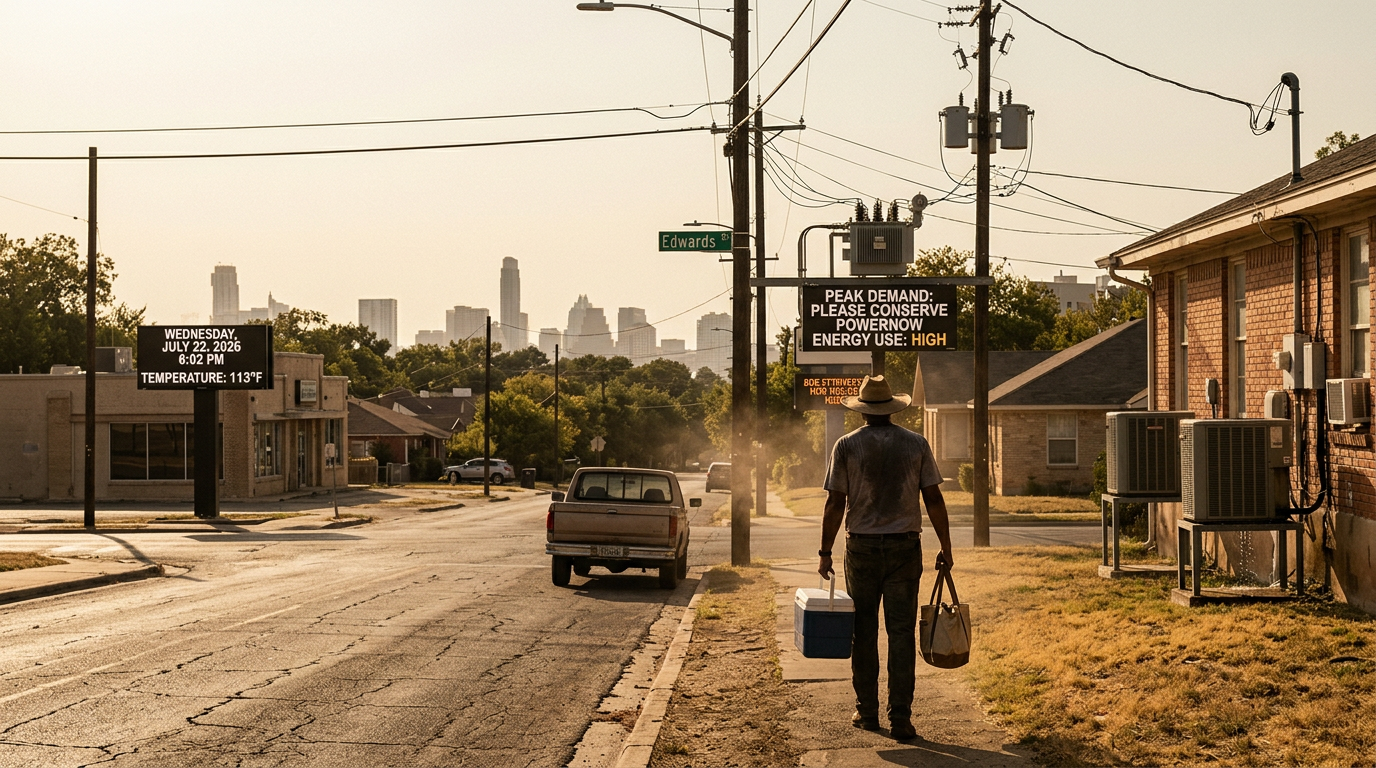
On July 22, 2026, the city of Austin endured its most extreme temperature reading of the calendar year. This heat event pushed the local climate into a grueling territory that tested both individual household systems and the city’s broader infrastructure. Historically, the month of July in Central Texas is defined by a relentless stretch of triple-digit highs, but this particular day set a new benchmark for the current season. The transition into these peak summer temperatures typically triggers a shift in public behavior, as residents move from outdoor activities to indoor survival strategies. For years, the Lone Star State has grappled with the reality of an increasingly taxed electrical grid, and this July peak represents a critical moment where consumer habits directly intersect with utility stability. The surge in temperature has rekindled a perennial Texas debate: how to balance the need for personal comfort with the mechanical limitations of modern cooling technology. As the mercury climbed, the digital landscape across Austin became a forum for troubleshooting, with thousands sharing their strategies for keeping homes livable while the sun beat down on the Edwards Plateau. This event follows a decade-long trend of intensifying summer peaks that have forced a re-evaluation of building insulation standards and energy consumption patterns across the state.
Texas relevance
As the state capital and one of its fastest-growing hubs, Austin acts as a primary stress test for the Texas energy market. The decisions made by Austin residents regarding their thermostats have ripple effects that reach the Electric Reliability Council of Texas (ERCOT). During the peak of a Texas summer, the sheer volume of cooling demand in a metro area like Austin can determine whether the state avoids emergency conservation alerts. This local weather event highlight the ongoing tension between urban expansion and the finite capacity of the Texas power grid, making it a matter of statewide interest for every taxpayer and ratepayer from Amarillo to Brownsville.
The Mechanical Realities of the 20-Degree Rule
In the humid and harsh environment of Central Texas, the HVAC system is the most critical piece of equipment in a home. However, the recent record-breaking heat has brought the '20-degree rule' back into the spotlight. Most air conditioning systems are engineered to provide a maximum temperature drop of approximately 20 to 25 degrees from the outside ambient air. When Austin sees temperatures soar into the triple digits, a thermostat set to 75 degrees requires the system to perform well beyond its primary design specifications.
The physics of heat exchange mean that once the outside temperature crosses 100 degrees, an AC unit must run almost continuously to combat the heat infiltrating through walls, windows, and attics. This continuous operation doesn't just result in higher bills; it leads to shortened equipment lifespans. Residents are finding that their systems are constantly 'on,' yet the indoor temperature continues to creep upward during the late afternoon, illustrating a ceiling in current residential technology.
Local HVAC contractors in Travis County reported a surge in service calls during this peak period. Frequent issues included frozen evaporator coils and failed capacitors, often caused by the strain of trying to maintain deeply cool interiors against the record-breaking exterior heat. This mechanical barrier is forcing a conversation about whether the traditional goal of 72 degrees is still a realistic benchmark for Texas summers.
Community Adaptations and Survival Strategies
As the temperature hit its 2026 high, the Austin community responded with a mix of resignation and innovation. Social platforms were flooded with residents comparing notes on their 'stat' settings, ranging from those who religiously follow ERCOT recommendations of 78 degrees to those who refuse to budge from a chilly 70. This peer-to-peer exchange has become a vital part of the Texas summer experience, where collective knowledge helps newcomers navigate their first record-breaking season.
Passive cooling occupies a central role in these discussions. Many Austinites are reverting to 'pioneer' methods to assist their modern appliances. The use of heavy blackout curtains, originally designed for theaters or night-shifters, has become a standard residential feature to block the intense solar gain from west-facing windows. Additionally, the strategic use of ceiling fans—which cool people, not rooms—is being emphasized to allow for higher thermostat settings without a loss in perceived comfort.
There is also a growing trend of 'pre-cooling' homes. Smart homeowners are increasingly lowering their temperatures in the early morning hours when the grid is less stressed and the air is cooler, then allowing the temperature to rise gradually throughout the afternoon. This tactic aims to use the home’s thermal mass to resist the peak heat of 4:00 PM, reducing the load on the compressor when electricity demand is at its absolute highest.
Energy Grid Stability and Urban Growth
The impact of the hottest day of the year extends far beyond the four walls of an individual home. In Austin, the rapid influx of new residents over the last several years has placed an unprecedented load on the municipal energy infrastructure. Every new apartment complex and suburban development adds thousands of tons of cooling demand to a system that was largely designed for a smaller, less densely populated city.
Austin Energy, the city’s utility provider, must manage the delicate balance of supply and demand during these peak events. When the 'hottest day' arrives, the risk of localized transformer failures increases as cooling equipment pulls maximum current for hours on end. These localized outages can be just as disruptive as statewide blackouts, leaving entire neighborhoods without power during the most dangerous heat of the day.
Infrastructure planners are looking at these 2026 records as data points for future expansion. The resilience of the grid depends on diversifying power sources and incentivizing 'demand response' programs, where residents are paid or credited for allowing their thermostats to be remotely adjusted during critical peaks. The success of such programs in Austin is often seen as a blueprint for other major Texas metros like Dallas and Houston.
The Financial Burden of the July Peak
The economic toll of the hottest day of 2026 will manifest in the 'sticker shock' of August utility bills. For many Central Texas households, cooling costs can account for more than 50% of their total energy expenditure during the summer months. As the gap between outdoor and indoor temperatures widens to 40 degrees, the amount of energy required to move heat out of the home increases exponentially, not linearly.
This financial pressure is particularly acute for residents living in older housing stock with poor insulation or single-pane windows. In these cases, the air conditioner is essentially 'cooling the neighborhood' as cold air escapes and heat pours in. The record heat highlights the socioeconomic divide in climate resilience, where those with the financial means can invest in high-efficiency upgrades, while others are left to face soaring bills and dwindling comfort.
Furthermore, the peak temperature day acts as a catalyst for the local repair economy. The cost of emergency HVAC repair during a heat wave often carries a premium, and the parts supply chain can become strained. For a typical Austin family, a failed compressor in late July isn't just a comfort issue; it's a multi-thousand-dollar financial emergency that can disrupt household stability for months.
Looking Ahead: The Future of Texas Living
The record-breaking heat of July 22, 2026, is likely not an anomaly but a preview of the 'new normal' for the region. As Austin continues to experience these intense heat spikes, the focus is shifting toward long-term urban planning. This includes the 'Cool Cities' initiatives aimed at increasing the tree canopy and reducing the heat island effect caused by vast stretches of asphalt and concrete in the urban core.
Future building codes in Texas may soon require even higher levels of thermal resistance. The conversation is moving toward 'passive survivability'—the ability of a building to maintain life-sustaining temperatures even if the power grid fails. This involves advanced materials like radiant barriers in attics and high-performance windows that were once considered luxury upgrades but are now becoming necessities.
Ultimately, the way Austin handles its hottest days will influence the state's approach to energy and environment for years to come. Whether through better technology, more robust infrastructure, or shared community conservation, the goal remains the same: ensuring that the heart of Texas remains a viable place to live and work, even when the thermometer suggests otherwise. The thermostat debate is just the beginning of a larger adaptation to the Texas sun.
Analysis
The heat wave of 2026 serves as a stark reminder that technology has limits. The widespread frustration expressed by residents trying to cool their homes suggests a growing gap between homeowner expectations and HVAC engineering. While many Texans view air conditioning as a non-negotiable right, the reality of a 110-degree day versus a 70-degree interior setting is an engineering feat that most standard residential units were never built to handle. We are seeing a shift where 'grid consciousness' is becoming part of the Texas identity, not necessarily out of environmental concern, but out of a pragmatic desire to prevent equipment failure and catastrophic utility bills. This event may further incentivize a market shift toward high-performance heat pumps and superior building envelopes, as the 'standard' Texas home of the previous generation struggles to keep pace with the modern July peak.
Source attribution
This story was reported using a public release from the r/austin. Keep TX Red rewrote the coverage independently and links to the official statement for verification.
Frequently Asked Questions
- What was the significance of July 22, 2026, in Austin?
- It was recorded as the hottest day of the year for the city, marking the peak of the 2026 summer heat wave and resulting in the highest energy demand of the season.
- Why do HVAC systems struggle when it's over 100 degrees outside?
- Most residential systems are designed to lower temperatures by about 20-25 degrees. When it is 110 degrees outside, asking a system to reach 70 degrees requires it to work double its intended capacity, often leading to mechanical failure.
- What is the recommended thermostat setting for a Texas summer?
- ERCOT and local utilities typically recommend setting thermostats to 78 degrees when at home to balance personal comfort with grid reliability and cost savings.
- How can I cool my Austin home without lowering the AC?
- Residents are encouraged to use blackout curtains, run ceiling fans (only when people are in the room), and avoid using heat-generating appliances like ovens or clothes dryers during the afternoon peak.
Official Sources
Take the next step
Browse the Newsroom →Read more about Keep Texas Red → Our full guide to what Keep Texas Red means and why Texans support it.
Related Articles

Get Texas updates delivered weekly.
Independent Texas reporting on politics, policy, and daily life. One email a week. Unsubscribe anytime.
Keep TX Red Newsroom
The Keep Texas Red Editorial Staff produces nonpartisan explainers, policy breakdowns, and educational resources to help Texans understand how their government works. All content is reviewed for accuracy and updated regularly.
About Keep TX Red →