Unpacking the High-Pressure World of Texas One-Day Lakefront Land Sales
Texas residents are increasingly reporting mailers offering cheap lakefront lots. Here is what potential DFW area buyers need to know before attending.
Editorial disclaimer: Opinions and analysis on Keep TX Red are editorial content — not statements of fact. See our editorial standards.
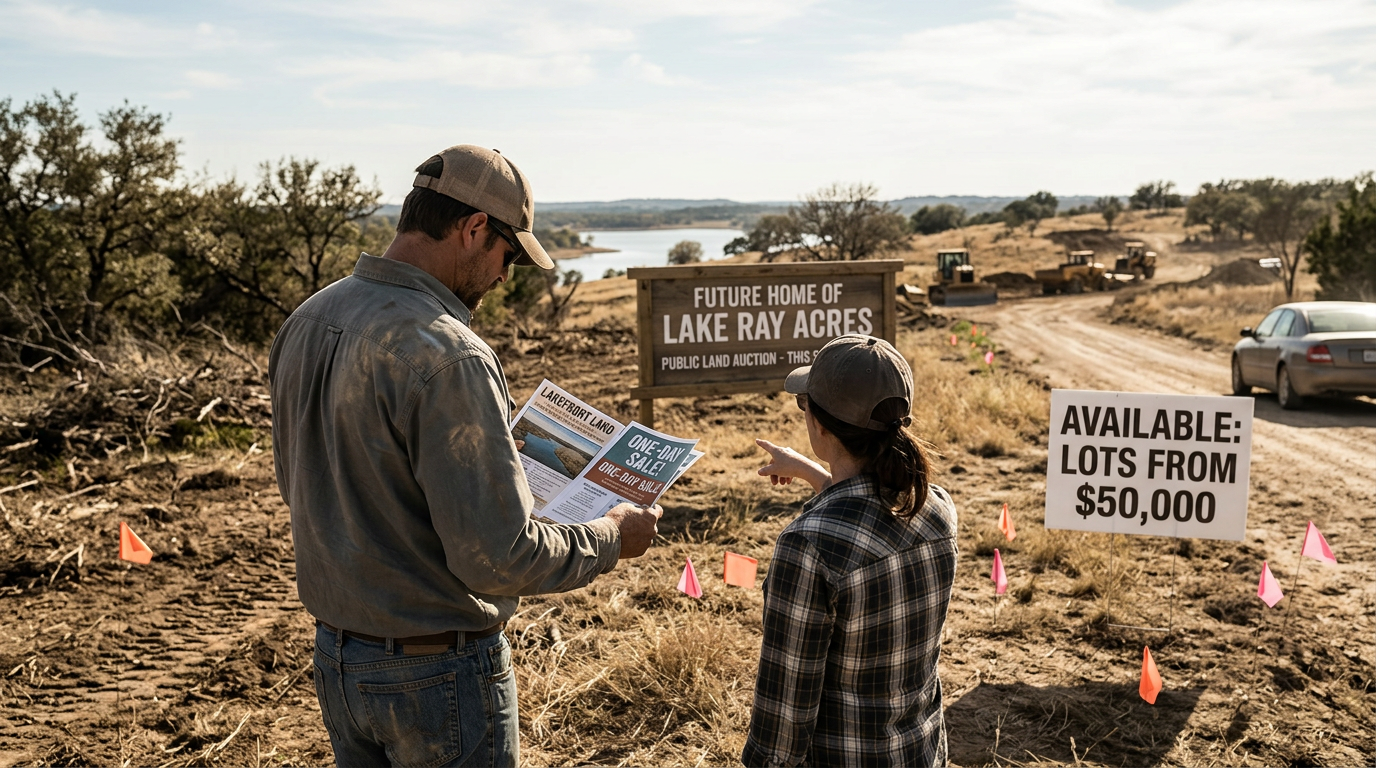
Residents across the Dallas-Fort Worth metroplex have reported a surge in aggressive direct-mail marketing campaigns advertising undeveloped lakefront property at seemingly impossible prices. These flyers often feature glossy imagery of pristine water and rustic cabins, offering residential lots for as low as $50,000 or finished small-scale homes for under $200,000. Historically, Texas has a storied relationship with land speculation, dating back to the railroad expansions and the later mid-century booms that saw the creation of man-made reservoirs. The current trend focuses on 'one-day liquidation events' where buyers are pressured to make immediate decisions on lots that may lack basic infrastructure. While not always outright illegal, these sales tactics rely on a business model designed to create a sense of scarcity and urgency. For decades, developers in the Texas Hill Country and the Piney Woods have used similar high-pressure tactics to offload remote parcels. The resurgence of these mailers in North Texas suggests a renewed interest in rural getaways following the post-pandemic migration patterns. However, the gap between the marketing materials and the physical reality of the land often leads to substantial legal and financial complications for unsuspecting buyers who fail to investigate the underlying details of the offer.
Texas relevance
This issue is specifically localized to North Texas and the DFW area, where the demand for recreational property near regional water bodies like Lake Ray Hubbard, Lake Lewisville, and Lake Texoma remains at an all-time high. Texas law regarding land sales is generally 'buyer beware,' meaning the responsibility for verifying access to utilities, road maintenance, and clear title falls squarely on the individual purchaser rather than the developer. Because Texas is a non-disclosure state, determining the actual market value of neighboring properties can be difficult, making these 'unbelievable' flyer prices hard to verify against local comps without professional assistance.
The Anatomy of the One-Day Liquidation Event
The typical marketing cycle begins with a direct mailer sent to middle-to-high income zip codes across North Texas. These documents often use official-sounding language, referencing 'grand openings' or 'liquidation deadlines' to suggest that the buyer is getting in on the ground floor of an exclusive opportunity. The pricing is calibrated to be just low enough to seem like a bargain, yet high enough to appear credible to those unfamiliar with the costs of rural land development in the Lone Star State.
Upon arriving at these events, potential buyers are often grouped with sales representatives who provide guided tours of a larger tract of land that has been subdivided into smaller parcels. The environment is curated to minimize distractions and maximize the emotional appeal of 'owning a piece of Texas.' By limiting the sale to a single day, the developers effectively remove the buyer's ability to consult with outside contractors, surveyors, or real estate attorneys before signing a binding contract.
In many cases, the most desirable lots—the ones actually touching the water—are either already 'sold' or priced significantly higher than the flyer suggested. The teaser prices of $50,000 often apply to 'lake access' or 'lake view' lots, which may be located a significant distance from the shoreline or separated by other private holdings. This 'bait and switch' tactic is a hallmark of high-volume land sales firms operating in the expansive rural corridors surrounding major Texas metropolitan hubs.
The Infrastructure and Utility Gap
One of the most significant risks associated with these discounted Texas land offers is the lack of existing infrastructure. While the flyer may show a beautiful cabin, the reality of the lot often includes no connection to the electrical grid, no access to municipal water, and no sewage system. In rural Texas, the cost of drilling a water well can range from $10,000 to over $30,000 depending on the depth of the aquifer, and installing a septic system can add another five-figure sum to the project's bottom line.
Furthermore, many of these subdivisions are located in unincorporated areas where the developer is not required to provide paved roads. During the rainy seasons common to North and East Texas, these dirt or gravel paths can become impassable for standard vehicles, requiring property owners to invest in 4WD equipment or lobby the county for improvements that may never come. Buyers frequently overlook the 'utility easement' sections of their contracts, only to find later that the local electric cooperative charges by the foot to run power lines to remote sites.
Prospective owners must also investigate the status of the 'lake front' itself. In many Texas reservoirs, the land surrounding the water is managed by the U.S. Army Corps of Engineers or local river authorities. A 'lakefront' lot might actually end at a government survey line, meaning the property owner does not own the beach or the water access and must apply for specific, revocable permits just to clear brush or build a floating dock.
Hidden Fees and Property Owner Associations
Even if the land is purchased outright for cash, the ongoing costs of ownership can be substantial. Many of these newly subdivided tracts are subject to a Property Owners Association (POA) or Homeowners Association (HOA) created by the developer. These entities often have the power to levy annual assessments and special fees for road maintenance, common area upkeep, and security. In some cases, the developer retains control of the POA board until a high percentage of lots are sold, allowing them to dictate terms and fees without resident input.
Texas law provides some protections for buyers in these scenarios, but the fine print in the closing documents often includes 'architectural control committee' clauses. These clauses can restrict the type of structure you are allowed to build, often requiring a minimum square footage or specific materials that far exceed the 'cheap cabin' aesthetic promoted in the flyers. A buyer might find that their $50,000 lot requires a $400,000 home build to comply with the developer's standards.
Additionally, the tax implications of these purchases can be a shock to DFW residents. While the land might be currently taxed at an 'ag-use' or 'timber' valuation, the moment it is subdivided and sold for residential use, the local central appraisal district will likely revalue the property at its 'highest and best use.' This results in a massive spike in property taxes that the buyer must account for in their annual budget, often without the benefit of a homestead exemption if the property is a secondary residence.
The Legal Reality of Texas Land Contracts
Contracts for deed, also known as 'executory contracts,' have a troubled history in Texas. While the state legislature has passed reforms to protect consumers, some developers still use creative financing models that do not grant the buyer a deed until the property is paid in full. This puts the buyer at risk; if they miss a single payment, they could lose all equity and be evicted. It is vital for North Texas buyers to ensure they are receiving a Warranty Deed at the time of closing and that the transaction is recorded with the county clerk.
Title insurance is another non-negotiable component that is often skipped in 'one-day' high-pressure sales. Without a title search, a buyer might unknowingly inherit liens, back taxes, or unresolved heirship issues from previous owners. In the rural counties surrounding the DFW area, property lines are sometimes based on century-old surveys that are notoriously inaccurate. A new, independent survey is the only way to verify that the 'lakefront' you think you are buying isn't actually situated on a neighbor's parcel or a protected floodway.
Before attending any of these sales events at local DFW hotels or on-site tents, residents should research the development company's history with the Better Business Bureau and the Texas Real Estate Commission. Many of these companies operate under various LLCs to shield themselves from liability, but a pattern of consumer complaints usually follows the primary organizers across different projects in different counties.
Long-Term Investment Outlook
While the emotional draw of owning a piece of the Texas landscape is powerful, the investment potential of these subdivided lots is often overstated. Because the developers are selling hundreds of similar lots at once, the 'market' becomes saturated. If a buyer needs to sell their lot a year later, they find themselves competing with the developer's remaining inventory and other disillusioned buyers, often leading to a situation where the property cannot be resold for the original purchase price.
A truly valuable lakefront property in Texas is one with established utility access, proven buildability, and clear riparian rights. These properties are rarely sold via mass-mailed flyers with 'one-day only' stickers. Real estate experts in the Dallas area suggest that if a deal seems too good to be true in the current hyper-competitive Texas market, it likely carries a level of risk or hidden cost that negates the initial savings. The best approach for a DFW resident is to work with a local buyer's agent who specializes in rural land to find a vetted property through traditional channels.
Analysis
From a market perspective, these operations are less of a 'scam' in the criminal sense and more of a highly aggressive marketing funnel. The 'one-day sale' is a classic psychological trigger used to bypass the standard due diligence period that a sensible real estate transaction requires. In Texas, where property rights are fiercely protected, the freedom of a developer to sell land is broad, but so is the freedom of a buyer to walk into a bad deal. Investors should view these events through a lens of skepticism; if a property is priced significantly below the market rate for the DFW region, there is almost always a hidden cost related to topographic challenges, lack of utility easements, or restrictive covenants that make building far more expensive than the initial land purchase suggests.
Source attribution
This story was reported using a public release from the r/texas. Keep TX Red rewrote the coverage independently and links to the official statement for verification.
Frequently Asked Questions
- Are the $50,000 lakefront flyers in DFW a scam?
- They are typically not 'scams' in the sense of stealing money without providing land, but they are often misleading. The $50,000 price usually applies to the least desirable lots without direct water access, and the high-pressure sales environment is designed to prevent you from discovering hidden infrastructure costs or restrictive building codes.
- Can I build whatever I want on these rural Texas lots?
- Rarely. Most of these subdivided tracts come with 'Deed Restrictions' or are governed by an HOA/POA. These rules often dictate the minimum size of the home, the types of building materials allowed, and even where on the lot you can build. Always review the 'Covenants, Conditions, and Restrictions' (CC&Rs) before buying.
- What is the most important thing to check during a one-day land sale?
- Check for utility availability. Many rural North Texas lots have no access to city water or sewer. You must verify if the land can support a septic system (via a perk test) and how much it will cost to bring electricity to the specific site. Without these, the land is essentially unbuildable.
- Do I actually own the water at a lakefront property in Texas?
- In Texas, most lake water is state-owned, and the land under and around it is often controlled by a river authority or the Army Corps of Engineers. You may have 'riparian rights' to use the water, but you often need a permit for a dock, and you may not actually own the land all the way to the water's edge.
Official Sources
Take the next step
Browse the Newsroom →Read more about Keep Texas Red → Our full guide to what Keep Texas Red means and why Texans support it.
Related Articles


Get Texas updates delivered weekly.
Independent Texas reporting on politics, policy, and daily life. One email a week. Unsubscribe anytime.
Keep TX Red Newsroom
The Keep Texas Red Editorial Staff produces nonpartisan explainers, policy breakdowns, and educational resources to help Texans understand how their government works. All content is reviewed for accuracy and updated regularly.
About Keep TX Red →