Uncovering the Legacy of the Treue der Union Monument in Comfort Texas
Discover the history of the only monument to the Union on former Confederate soil, where a 36-star flag flies perpetually at half-staff in Hill Country.
Editorial disclaimer: Opinions and analysis on Keep TX Red are editorial content — not statements of fact. See our editorial standards.
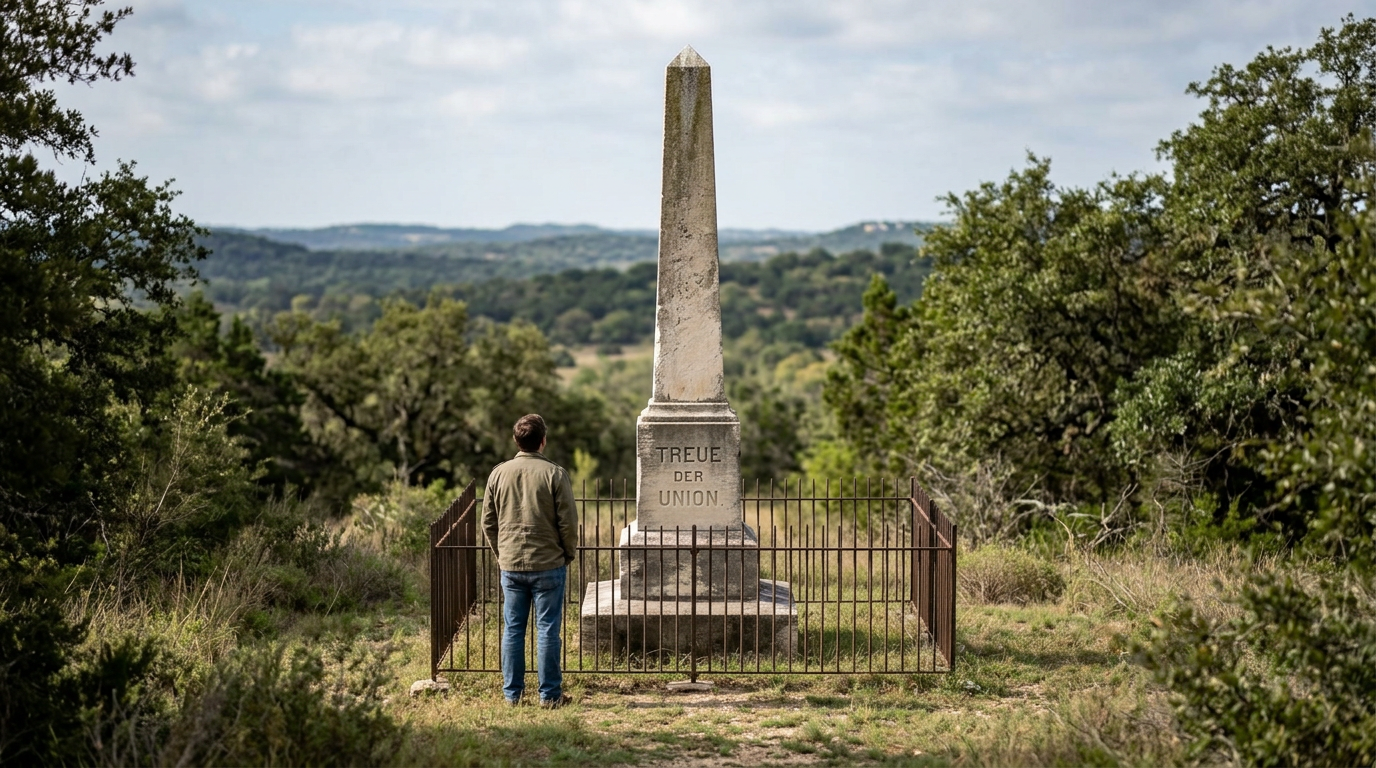
In the quiet Hill Country town of Comfort, Texas, stands a limestone obelisk that serves as a permanent testament to a tragic and often overlooked chapter of the American Civil War. The Treue der Union monument, which translates to 'Loyalty to the Union,' marks the final resting place of German-Texan settlers who were killed by Confederate forces in 1862. This site is unique in the American landscape as it represents one of the few locations in the South where a monument was erected to honor those who remained loyal to the United States government during the secessionist conflict. Even more striking is the American flag that waves above the site; it features only 36 stars, representing the Union as it existed at the time of the monument’s dedication, and it is flown at half-staff 365 days a year to honor the fallen. The story of Comfort is one of deep ideological conviction, immigrant resilience, and the brutal internal divisions that defined the Texas frontier during the 1860s. Historically, the Hill Country was a bastion of 'Freethinker' culture, populated by German immigrants who had fled political upheaval in Europe. These settlers brought with them strong anti-slavery sentiments and a firm belief in constitutional democracy. When Texas voted to secede from the Union in 1861, the residents of Comfort and surrounding areas found themselves at odds with their neighbors and the state government in Austin. While many Texans embraced the Confederate cause, the German intellectuals of Kendall County largely refused to take an oath of allegiance to the Confederacy. This refusal led to increased tensions, eventually culminating in a state-sanctioned crackdown on dissenters. The resulting violence, known as the Battle of the Nueces, remains one of the darkest stains on the history of the Lone Star State, and the monument in Comfort serves as the physical memory of that bloodshed.
Texas relevance
The story of the Treue der Union monument is fundamentally a Texas story, localized in Kendall County within the heart of the Texas Hill Country. It challenges the monolithic view of Texas history during the Civil War era by highlighting the diverse political and social landscapes that existed within the state. For modern Texans, Comfort represents a site of historical preservation that honors a specific subset of the state's heritage—the German 'Forty-Eighters' who contributed to the intellectual and economic development of the region. The permanency of the 36-star flag at half-staff is a legal and cultural distinction recognized within the state as a unique historical exception, making Comfort a significant destination for those studying the complexities of Texas’s role in the 19th-century United States.
The German Immigrant Experience in the Hill Country
In the mid-19th century, Texas saw a massive influx of German immigrants, many of whom were highly educated professionals, artists, and academics. These individuals, often referred to as 'Forty-Eighters' because they left Europe following the failed revolutions of 1848, sought a life defined by personal liberty and rationalism. When they settled in the Texas Hill Country, they established towns like Comfort, New Braunfels, and Fredericksburg, where they maintained their language and customs while attempting to integrate into the American frontier.
Unlike many of their Anglo-Texan neighbors, these German settlers were largely opposed to the institution of slavery. Their opposition was rooted both in moral philosophy and their own experiences with European tyranny. As the clouds of the Civil War gathered, these communities became centers of pro-Union sentiment. This cultural and political divide created an invisible border within Texas, setting the stage for a violent confrontation once the state officially joined the Confederacy.
The Tragedy of the Nueces Massacre
The conflict reached a breaking point in August 1862. Concerned about the newly implemented Confederate conscription laws and growing harassment by local militias, a group of approximately 60 German Unionists from the Comfort area decided to flee to Mexico. Their plan was to eventually travel to New Orleans and join the Union Army. However, they were pursued by a much larger force of Confederate cavalry, which caught up to them near the Nueces River.
On the morning of August 10, the Confederate forces launched a surprise attack on the sleeping settlers. The result was a massacre; many of the Germans were killed in the initial skirmish, and several others who surrendered or were wounded were executed shortly thereafter. A second group of fleeing Unionists was intercepted and killed near the Rio Grande weeks later. The bodies of the fallen were left unburied on the battlefield for three years, as the residents of Comfort were prohibited by Confederate authorities from retrieving their kin.
Dedication of the Treue der Union Monument
Following the end of the Civil War in 1865, the survivors and families of the victims returned to the Nueces site to collect the remains of those who had been killed. The bones were brought back to Comfort and interred in a mass grave. In 1866, the community dedicated the Treue der Union monument over the burial site. It was a bold statement of identity, standing as the only monument to the Union ever built by residents of an ex-Confederate state on their own land during the 19th century.
The monument itself is modest but evocative. Built from local limestone, it lists the names of the men who died during the Nueces Massacre and those who were executed at the Rio Grande. It serves not only as a tombstone for those men but as a landmark for the values they died for. For the people of Comfort, the monument was a way to reclaim their place in the Union after years of being treated as traitors by the state they lived in.
The Symbolism of the 36-Star Flag
A defining feature of the site is the flag that flies nearby. Visitors will notice that the flag looks slightly different from the modern American flag because it only contains 36 stars. This specific design commemorates the number of states in the Union at the time the monument was dedicated and when Nevada was admitted to the Union during the war. It serves as a historical snapshot, preserving the visual identity of the nation as it was when the fallen men to whom the monument is dedicated were alive.
The flag is also notable for its permanent half-staff position. In U.S. flag code, half-staffing is typically reserved for periods of mourning following the death of government officials or national tragedies. However, a special exception exists for the Comfort monument, allowing the town to fly the colors at half-staff every single day. This perpetual state of mourning signifies that for this community, the loss of life and the rupture of the Civil War are events that deserve eternal remembrance.
Preserving the Freethinker Legacy
The Treue der Union site is more than just a Civil War memorial; it is a gateway to the 'Freethinker' (Freidenker) heritage of Texas. Many of the men buried there were part of a movement that prioritized reason over dogma and secularism over religious tradition. This intellectual tradition helped shape the early development of Kendall County, influencing everything from the local education system to the way residents viewed the role of government.
Today, the monument is a designated Texas State Historic Site and is listed on the National Register of Historic Places. Local historical societies and descendants of the original settlers work tirelessly to maintain the grounds. As urbanization expands further into the Hill Country, the preservation of sites like Comfort becomes increasingly important to ensure that the diverse, and often difficult, history of the Texas frontier is not forgotten in favor of a simplified narrative.
Impact on the Local Community Today
Comfort remains a small, vibrant town that takes immense pride in its history. The monument is located in the center of the community and serves as a point of reflection for residents and tourists alike. Unlike many Civil War sites that focus on tactical movements or the heroism of generals, the Treue der Union monument focuses on the common man and the heavy cost of political dissent. It highlights a community that refused to follow the crowd, even when the pressure to do so was backed by military force.
Educational programs and local tours often bring middle and high school students to the site to learn about the complexities of Texas history. It provides a tangible lesson on the Bill of Rights, the importance of minority viewpoints, and the consequences of civil unrest. The presence of the monument ensures that while the events of 1862 were a tragedy, the loyalty and bravery of those German-Texans continue to be a source of local inspiration.
Analysis
The Treue der Union monument serves as a powerful reminder that political loyalty in Texas has rarely been a simple binary. The decision to fly the flag at half-staff indefinitely suggests a wound that hasn't fully healed in the collective memory of the Hill Country. By maintaining this site, the community of Comfort ensures that the 'Unionist' perspective of the Civil War is not erased by the broader Southern narrative. It also highlights the extreme risks taken by immigrant populations to uphold their values in the face of local hostility. In a modern context, the monument encourages a more nuanced understanding of Texas identity, one that accounts for dissent, cultural diversity, and the heavy price of principled opposition.
Source attribution
This story was reported using a public release from the r/texas. Keep TX Red rewrote the coverage independently and links to the official statement for verification.
Frequently Asked Questions
- Why is the flag in Comfort only 36 stars?
- The flag features 36 stars to represent the number of U.S. states at the time the monument was dedicated in 1866. This specific version of the flag is used to maintain the historical accuracy of the era when the German-Texan settlers were fighting to keep the Union together.
- What was the Battle of the Nueces?
- The Battle of the Nueces was a violent skirmish on August 10, 1862, where Confederate cavalry attacked a group of German-Texan Unionists who were attempting to flee to Mexico. Many of the Germans were killed or later executed, and their bodies were left unburied until after the war.
- Why is the flag allowed to fly at half-staff every day?
- While the U.S. flag is typically only lowered for specific periods of national mourning, the Treue der Union site holds a special historical status that allows for the perpetual half-staff display. This serves as an ongoing tribute to the men buried beneath the monument.
- Can the public visit the monument?
- Yes, the Treue der Union monument is located in a public area in Comfort, Texas, near the intersection of High Street and Fourth Street. It is a historical landmark that is accessible to the public year-round and is a frequent stop for those exploring Texas Hill Country history.
Official Sources
Take the next step
Browse the Newsroom →Read more about Keep Texas Red → Our full guide to what Keep Texas Red means and why Texans support it.
Related Articles



Get Texas updates delivered weekly.
Independent Texas reporting on politics, policy, and daily life. One email a week. Unsubscribe anytime.
Keep TX Red Newsroom
The Keep Texas Red Editorial Staff produces nonpartisan explainers, policy breakdowns, and educational resources to help Texans understand how their government works. All content is reviewed for accuracy and updated regularly.
About Keep TX Red →