TxDOT Partners with New Braunfels Buc-ee's to Combat Speeding
The Texas Department of Transportation brought its latest road safety campaign to a popular Central Texas travel hub to engage drivers directly.
Editorial disclaimer: Opinions and analysis on Keep TX Red are editorial content — not statements of fact. See our editorial standards.
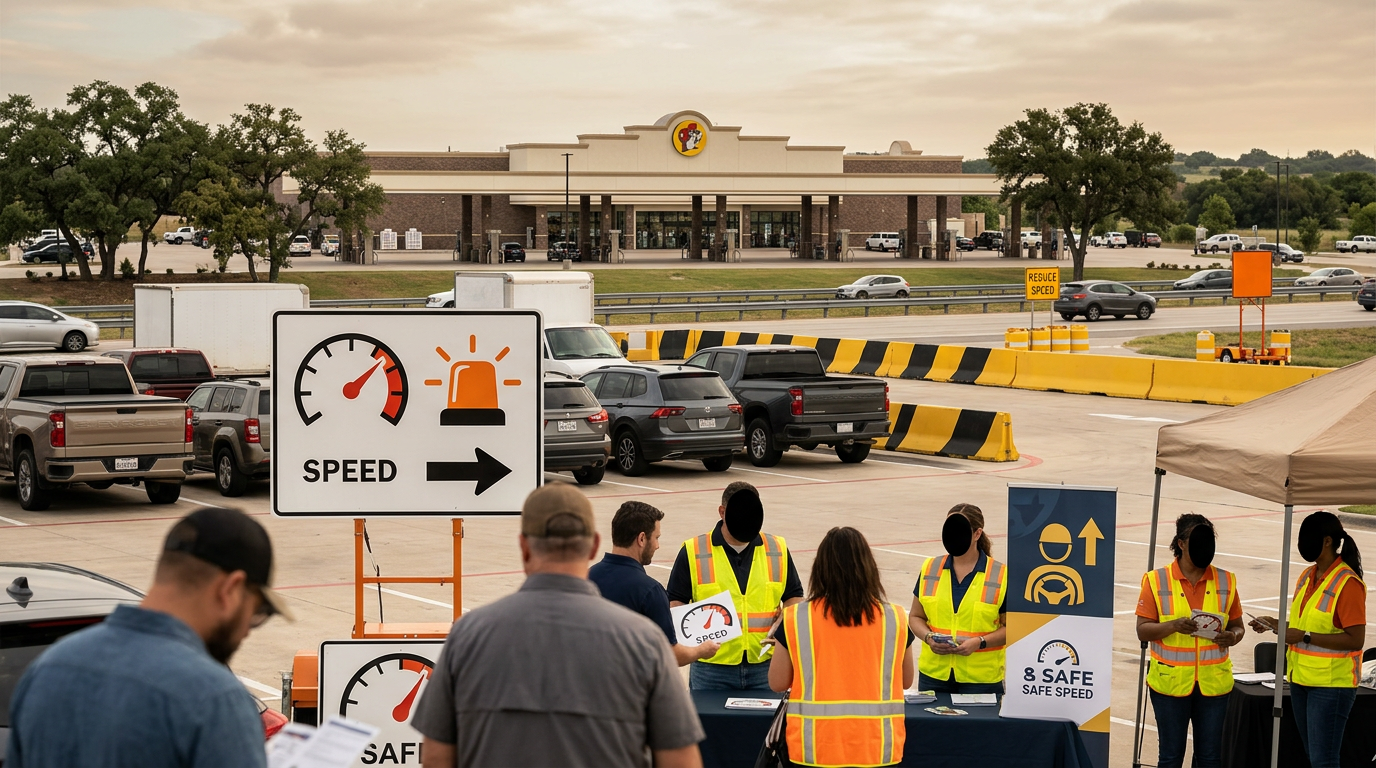
The Texas Department of Transportation (TxDOT) organized a high-visibility speeding awareness event at the Buc-ee's travel center in New Braunfels on July 20, 2026. This initiative is the latest installment in the department's "Be Safe. Drive Smart." campaign, which seeks to curb the rising trend of speed-related fatalities across the state. By utilizing the foot traffic at one of the world's most famous travel stops, state officials were able to distribute safety materials and engage in one-on-one conversations with hundreds of motorists navigating the busy Interstate 35 corridor. Historically, TxDOT has prioritized community-based outreach to supplement traditional law enforcement. In previous years, safety initiatives have focused on holiday travel windows where congestion typically surges. The partnership with a private entity like Buc-ee's follows a long-standing state precedent of meeting Texans where they are most likely to congregate during long-distance travels. This approach aims to transform a routine pit stop into a pedagogical moment that could potentially save lives further down the highway. This specific New Braunfels activation underscores a broader tactical shift toward preventative education. Rather than relying solely on the deterrent of a traffic citation, the state is investing in demonstrating the physical realities of high-speed collisions. By doing so, they hope to foster a culture of voluntary compliance with speed limits, particularly in areas where rapid population growth has placed an unprecedented strain on existing road infrastructure.
Texas relevance
Texas roads are currently facing a critical safety juncture as the state's population nears 30 million residents. For New Braunfels and the surrounding Comal County, this growth is visible every day on the Interstate 35 corridor, which serves as the primary artery connecting San Antonio and Austin. This stretch of road is not only vital for local commuters but also acts as a corridor for international trade and interstate tourism. Local residents have long expressed concerns regarding the increasing velocity and volume of traffic as the region transforms from a collection of small towns into a continuous metropolitan sprawl. Because Texas frequently leads the nation in total highway miles and, unfortunately, total annual road fatalities, these local awareness events are a centerpiece of the state’s transportation strategy. The New Braunfels Buc-ee's serves as a strategic “choke point” where drivers from all over the Lone Star State pause for fuel and food. By reaching a driver from Houston or North Texas while they are stopped in Central Texas, TxDOT creates a ripple effect of safety awareness that extends far beyond the Comal County line, impacting safety across the entire state highway system.
Strategic Selection of Travel Hubs
The New Braunfels Buc-ee's is widely regarded as one of the busiest retail locations in the state, making it an ideal venue for large-scale public messaging. TxDOT officials selected this location specifically because of its geographic significance on the I-35 corridor. On any given day, thousands of vehicles pass through this area, representing a diverse cross-section of Texas drivers, from commercial truckers to families on summer vacation.
By setting up interactive displays near the entrance of the store, the agency ensures that the 'Slow Down' message is seen by people who might otherwise ignore roadside billboards. The goal is to maximize the 'impressions' of the safety message in a setting where drivers are relaxed and receptive. This location also allows the department to collect qualitative data from residents about their specific concerns regarding local road conditions and traffic flow patterns.
The Escalating Crisis of Speeding
Data provided by transportation authorities indicates that speeding is a contributing factor in nearly one-third of all motor vehicle fatalities in Texas. As vehicle technology improves and cars become quieter and more stable at high speeds, many drivers lose their sense of relative velocity. TxDOT's recent campaign aims to remind motorists that the laws of physics do not change, regardless of how safe their vehicle feels at 85 miles per hour.
In the Central Texas region, the problem is exacerbated by the mix of high-speed passenger travel and heavy freight movement. Sudden changes in traffic density, often caused by the convergence of local and interstate travelers, lead to frequent rear-end collisions. Awareness events like the one in New Braunfels are designed to reduce these incidents by encouraging drivers to maintain safe following distances and adhere to posted speed limits even when the flow of traffic seems to dictate otherwise.
Educational Tools and Physical Demonstrations
During the New Braunfels event, participants were given access to information regarding the 'total stopping distance' required for vehicles traveling at various speeds. Most drivers are unaware that at 70 miles per hour, a vehicle travels nearly 100 feet in a single second. This means that by the time a driver reacts to a hazard, they have already traveled a significant distance before the brakes are even applied.
The educational materials also highlighted how speeding reduces the effective field of vision for a driver. As velocity increases, the human eye focuses further down the road, making it harder to spot hazards in the periphery, such as vehicles entering the highway from on-ramps. By explaining the biological and physical limitations of driving at high speeds, TxDOT hopes to give drivers a rational basis for slowing down beyond the fear of a ticket.
Impact on Local Law Enforcement
While TxDOT handles the education aspect, local agencies like the New Braunfels Police Department and the Comal County Sheriff’s Office benefit indirectly from these campaigns. Educational visibility often leads to a temporary 'halo effect' where drivers in the immediate area become more conscious of their speed. This can lead to a measurable reduction in local accidents during the weeks following the event.
Coordination between state and local entities is vital for a comprehensive safety strategy. When the public sees state agencies and local landmarks working together, it reinforces the community-wide importance of road safety. This multi-agency approach helps ensure that the safety message is consistent across different jurisdictions, providing a unified front against the dangers of reckless driving.
Economic Consequences of Highway Speeding
Beyond the human cost, speeding has a significant economic impact on the Texas economy. Major accidents on the I-35 corridor can result in multi-hour closures, stalling millions of dollars worth of freight and causing thousands of lost work hours for commuters. By reducing the frequency of these high-impact incidents, TxDOT is also working to protect the state’s economic vitality and the efficiency of the supply chain.
Infrastructure damage resulting from high-speed crashes—such as destroyed guardrails, signage, and pavement damage—also costs Texas taxpayers millions of dollars in annual repairs. The 'Slow Down' campaign is, in many ways, an effort to reduce these avoidable maintenance costs. Education is a low-cost investment compared to the massive expenditures required to clear accident scenes and perform emergency road repairs.
Long-Term Goals and Future Events
The event in New Braunfels is just one piece of a state-wide puzzle. TxDOT intends to continue these types of activations at major events and high-traffic locations throughout the year. As the state moves toward its target of halving road fatalities by 2035, behavioral change among the driving population is considered the most critical factor for success. No amount of engineering can fully compensate for a driver traveling at unsafe speeds.
Future events may include virtual reality simulations or more advanced interactive tools to help younger drivers understand the risks of speeding. For now, the focus remains on personal engagement and the distribution of clear, actionable information. As New Braunfels continues to grow, its residents can expect to see a continued and heightened presence of safety advocates working to keep the Hill Country roads safe for everyone.
Analysis
The decision to leverage the Buc-ee's brand for public safety messaging highlights a savvy intersection between public policy and Texas culture. In a state as massive as Texas, traditional media campaigns can often fail to reach the target demographic of long-haul drivers. By placing the message literally in the path of the traveler, TxDOT bypasses the 'digital noise' and engages the public in a physical environment. This strategy acknowledges that speeding is often a behavioral habit born of impatience or the vastness of Texas landscapes, and it attempts to break that cycle through human interaction. From a policy perspective, this also signals that the state recognizes that engineering and enforcement are only two-thirds of the safety equation. While billions are spent on expanding lanes and building overpasses, the 'human factor' remains the most volatile variable in traffic safety. The presence of state officials at a retail location serves as a soft-power approach to governance—one that prioritizes community cooperation over punitive measures, which may resonate more effectively with the Texas motoring public.
Source attribution
This story was reported using a public release from the Buc-ee's (Google News). Keep TX Red rewrote the coverage independently and links to the official statement for verification.
Frequently Asked Questions
- Why was the Buc-ee's in New Braunfels chosen specifically?
- The New Braunfels location is one of the highest-traffic travel hubs in the world. Its location on I-35 between San Antonio and Austin makes it a critical point for reaching thousands of drivers from multiple Texas regions in a single day.
- How does speeding affect accident statistics in Texas?
- Speeding is a contributing factor in roughly one out of every three road deaths in the state. High-speed collisions are far more likely to result in fatalities because the energy of the impact increases exponentially with the vehicle's speed.
- What kind of information was provided at the event?
- Drivers were provided with facts regarding stopping distances, the impact of speed on field of vision, and the relationship between speed and the severity of injuries in a crash. The event also encouraged drivers to use the 'two-second rule' for following distance.
- Will there be more events like this in other Texas cities?
- Yes, TxDOT regularly brings these awareness campaigns to high-traffic areas across the state, including major sporting events, festivals, and other large travel centers, as part of their ongoing 'Be Safe. Drive Smart.' initiative.
Official Sources
Take the next step
Browse the Newsroom →Read more about Keep Texas Red → Our full guide to what Keep Texas Red means and why Texans support it.
Related Articles

Get Texas updates delivered weekly.
Independent Texas reporting on politics, policy, and daily life. One email a week. Unsubscribe anytime.
Keep TX Red Newsroom
The Keep Texas Red Editorial Staff produces nonpartisan explainers, policy breakdowns, and educational resources to help Texans understand how their government works. All content is reviewed for accuracy and updated regularly.
About Keep TX Red →