Texas Law Enforcement Officer Rescues Driver from Burning Car in Daring Roadside Save
Body camera footage captures the intense moment a Texas officer pulled a driver from a vehicle seconds before it was fully engulfed in flames.
Editorial disclaimer: Opinions and analysis on Keep TX Red are editorial content — not statements of fact. See our editorial standards.
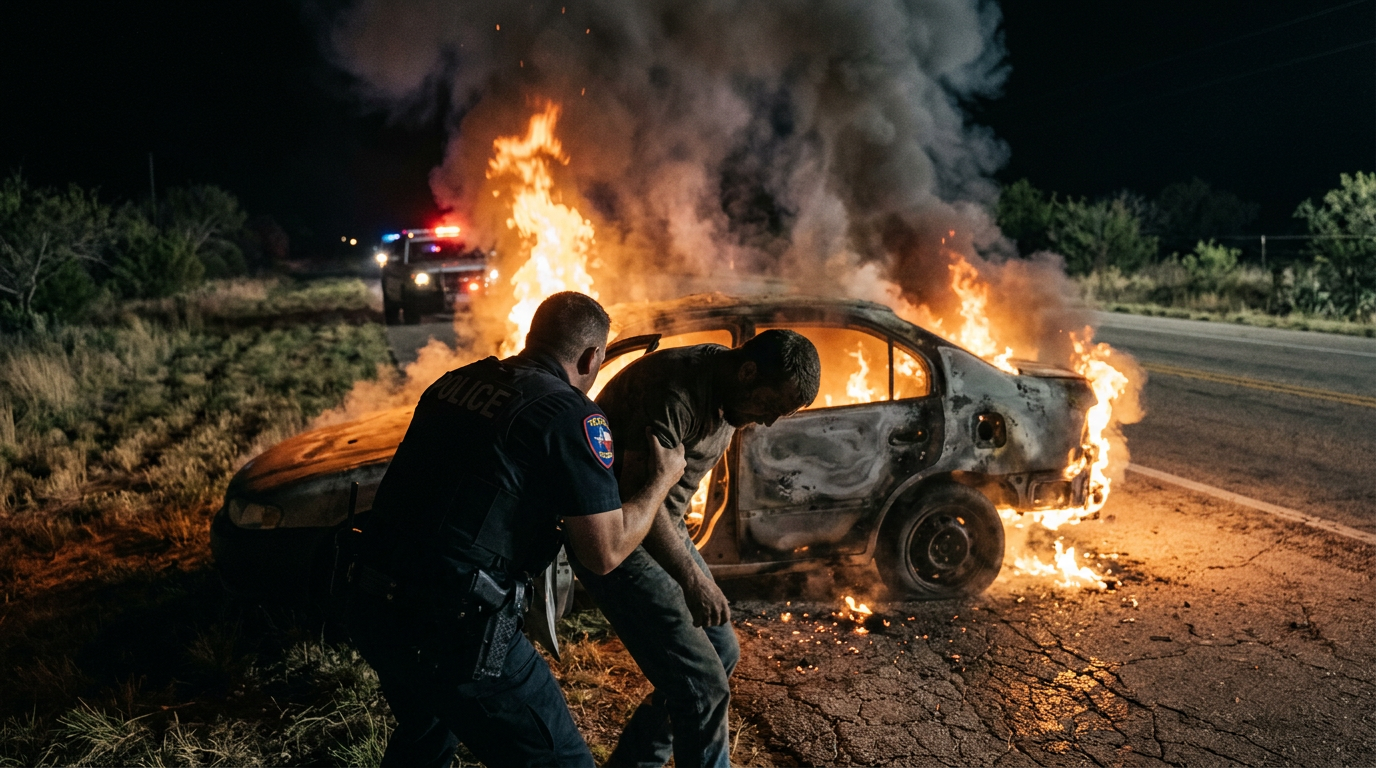
In an intense display of courage and quick thinking, a Texas law enforcement officer successfully extricated a driver from a vehicle that had caught fire and was rapidly becoming an inferno. The incident, captured on official body camera footage released on July 20, 2026, shows the officer arriving at the scene where smoke and visible flames were already emanating from the engine compartment. With little time to spare before the fire reached the passenger cabin, the officer took immediate action to ensure the occupant did not perish in the blaze. Historically, Texas law enforcement training has placed a heavy emphasis on rapid response to vehicular accidents, which often involve fire risks on high-speed frontage roads and highways. This event serves as a stark reminder of the unpredictable nature of emergency calls. The officer's ability to remain calm while directing the driver to exit the vehicle was crucial, as the driver appeared momentarily disoriented by the smoke. The rescue took place in a matter of seconds, highlighting the narrow margin between life and death during such catastrophic mechanical failures. The officer's decisive movements underscored the rigors of the Texas academy curriculum, which prepares recruits for high-stress scenarios that occur far from immediate backup or the presence of fire departments. Technically, vehicles today are built with many combustible materials that, once ignited, accelerate the spread of a fire within minutes. This particular incident occurred on a stretch of road where help was miles away, placing the entire burden of the rescue on the first responding officer. As the officer parked his patrol unit, the heat of the fire was already sufficient to distort the air around the vehicle, indicating that the cabin temperature was rising to lethal levels. This proximity to danger requires a specific type of mental fortitude that is a trademark of those who wear the badge in the state of Texas.
Texas relevance
This incident occurred on a Texas roadway and highlights the ongoing public safety challenges faced by law enforcement agencies across the Lone Star State. Texas has a massive network of highways where high-speed collisions and mechanical fires are a frequent occurrence, often requiring officers to act as firefighters and medical personnel until specialized teams arrive. For Texans, this story underscores the critical role that local police play in rural and urban transit safety, frequently acting as the first line of defense during life-threatening automotive disasters. Historically, Texas has seen similar incidents on major arteries like I-35 and I-10, where traffic volumes and speed increase the likelihood of heat-related vehicle failures and complex rescue operations.
The Evolution of Texas Roadside Response
In the vast geography of Texas, the role of a patrol officer often shifts from traffic enforcement to life-saver in an instant. This specific rescue demonstrates the reality of modern patrolling where officers must possess basic knowledge of fire dynamics and emergency medical triage. Since the majority of Texas roads are managed by counties or the Department of Public Safety, the first individual on the scene is rarely a firefighter. This puts a heightened responsibility on the initial officer to make an immediate 'go/no-go' decision regarding entering a burning structure or vehicle.
Over the last decade, Texas agencies have increasingly integrated these types of scenarios into their simulation training. Officers are taught to assess the stability of a burning vehicle, identify the potential for fuel line ruptures, and determine the fastest way to extract a victim who may be unconscious or physically pinned. In this case, the speed at which the officer breached the vehicle's space saved the driver from inhaling superheated gases that would have caused permanent respiratory damage or death within seconds.
Body Cam Highlights Urgent Rescue Dynamics
The released footage provides a harrowing first-person perspective of the officer's sprint toward the burning car. Through the crackle of the flames, the officer can be heard repeatedly commanding the driver to exit. This verbal communication is a standard protocol intended to break through the shock or panic a victim might be experiencing during a high-stress event. Auditory exclusion is common in car accidents, and the officer’s authoritative tone was designed to cut through the driver’s disorientation.
When the driver did not immediately respond by opening the door, the officer reached through the window frame to physically assist. The physical exertion required to pull a grown adult through a narrow aperture while avoiding the heat of the fire is a testament to the officer's physical readiness. Seconds after the driver was dragged to a safe distance, the interior of the car was completely overtaken by black smoke and orange flames, proving that even a five-second delay would have resulted in a tragedy.
The Science of Vehicle Infernos
Vehicle fires present unique hazards to Texas first responders because of the materials used in modern automotive manufacturing. Synthetic plastics, foams, and battery components can release toxic fumes and reach temperatures exceeding 1,500 degrees Fahrenheit. The officer in this case had no protective firefighting gear, relying only on a standard-issue uniform and the urgency of the moment. Without the specialized Nomex suits worn by fire crews, the officer was essentially risking second-degree burns just by nearing the door handle.
Furthermore, the risk of magnesium explosions—common in modern engine blocks—or fuel tank ruptures is a constant threat in these scenarios. Officers are generally trained to keep a safe perimeter, but the presence of a trapped civilian overrides standard distance protocols, necessitating a direct and dangerous intervention. The success of this rescue is being cited by peers as an example of departmental excellence in training and the innate bravery required to face fire without the proper equipment.
Community Response and Departmental Pride
Following the rescue, the driver was evaluated for smoke inhalation and shock, but thanks to the officer's intervention, no life-threatening burns were sustained. The footage has since circulated widely across social media and local news, serving as a demonstration of the dangerous and selfless work performed by Texas police officers every day. It offers a rare, unvarnished look at the split-second decisions that define public service careers in the Lone Star State.
Local residents have expressed their gratitude for the officer's bravery, noting that without this intervention, the outcome for the driver would have almost certainly been fatal. The department is expected to review the footage as part of their ongoing safety training modules to teach other new recruits how to handle similar high-temperature rescue operations. Such stories build a bridge between law enforcement and the communities they serve, showcasing the protective nature of the badge.
Future Implications for Texas Drivers
This incident highlights the importance of vehicle maintenance and the reality of road hazards in a state as large as Texas. As temperatures rise during the summer months, the strain on cooling systems and electrical components increases, leading to a higher frequency of vehicle fires. This case serves as a warning to drivers to pull over immediately if they see smoke and to never attempt to stay with the vehicle once a fire has moved into the engine bay.
Moving forward, there may be calls for standardizing fire suppression tools in patrol vehicles across all Texas jurisdictions. While most carry small extinguishers, those are often insufficient for a fully involved engine fire. Ensuring that officers have the tools to buy themselves just a few more seconds during an extraction could be the focus of upcoming local government safety budget discussions, particularly in high-traffic corridors where these events are most frequent.
Transparency Through Technology
In recent years, the Texas Legislature has consistently prioritized funding for first responder training and equipment, including state-of-the-art body cameras. Stories like this one reinforce the necessity of these investments. While the officer's actions were instinctive and heroic, they were also supported by a culture of readiness that is a hallmark of Texas public safety agencies. The camera does more than just hold officers accountable; it captures the reality of their service.
Documenting these events also provide transparency and allows the public to see the reality of the hazards faced on the road. As vehicle technology changes, including the rise of electric vehicles with different fire profiles that can last for hours, the lessons learned from this heroic save will help shape future response strategies for all Texas law enforcement agencies from the Panhandle to the Gulf Coast.
Analysis
This incident serves as a powerful rebuttal to those who suggest that law enforcement roles should be strictly limited to criminal investigations. In reality, Texas officers are the state's primary all-hazard responders. The visual evidence from the body camera not only validates the officer's bravery but also serves as a critical training tool for departments nationwide. It exemplifies the 'Texas way' of policing: proactive, courageous, and focused on the preservation of life above all else. This rescue highlights why public investment in police training and equipment, such as reliable body cameras and mobile thermal units, remains a non-negotiable priority for the safety of our traveling public.
Source attribution
This story was reported using a public release from the Texas Police / Public Safety Video (Google News). Keep TX Red rewrote the coverage independently and links to the official statement for verification.
Frequently Asked Questions
- Where did the vehicle fire take place?
- The incident occurred on a roadside in Texas where a vehicle had stopped due to a fire in the engine compartment that quickly spread to the passenger cabin.
- Was the driver injured in the incident?
- The driver was rescued before the fire reached the passenger interior. While they were checked for smoke inhalation and shock, the officer's quick actions successfully prevented any major burn injuries.
- Why was the officer's body camera footage released?
- The footage was released by the law enforcement agency to highlight the officer's bravery and to provide a public record of the life-saving actions taken during the emergency, serving as both a tribute and a training example.
- What should Texas drivers do if their car catches fire?
- Safety experts recommend pulling over as far from traffic as possible, exiting the vehicle immediately, and moving at least 100 feet away before calling for emergency services. Smoke inhalation can occur much faster than many realize.
Official Sources
Take the next step
Browse the Newsroom →Read more about Keep Texas Red → Our full guide to what Keep Texas Red means and why Texans support it.
Related Articles

Get Texas updates delivered weekly.
Independent Texas reporting on politics, policy, and daily life. One email a week. Unsubscribe anytime.
Keep TX Red Newsroom
The Keep Texas Red Editorial Staff produces nonpartisan explainers, policy breakdowns, and educational resources to help Texans understand how their government works. All content is reviewed for accuracy and updated regularly.
About Keep TX Red →