Texas Issues Travel Warnings for Middle East Regions Citing Rising Airspace Risks
Texas joins other major states in advising residents against travel to Israel, Saudi Arabia, Bahrain, and Qatar amid escalating regional tensions.
Editorial disclaimer: Opinions and analysis on Keep TX Red are editorial content — not statements of fact. See our editorial standards.
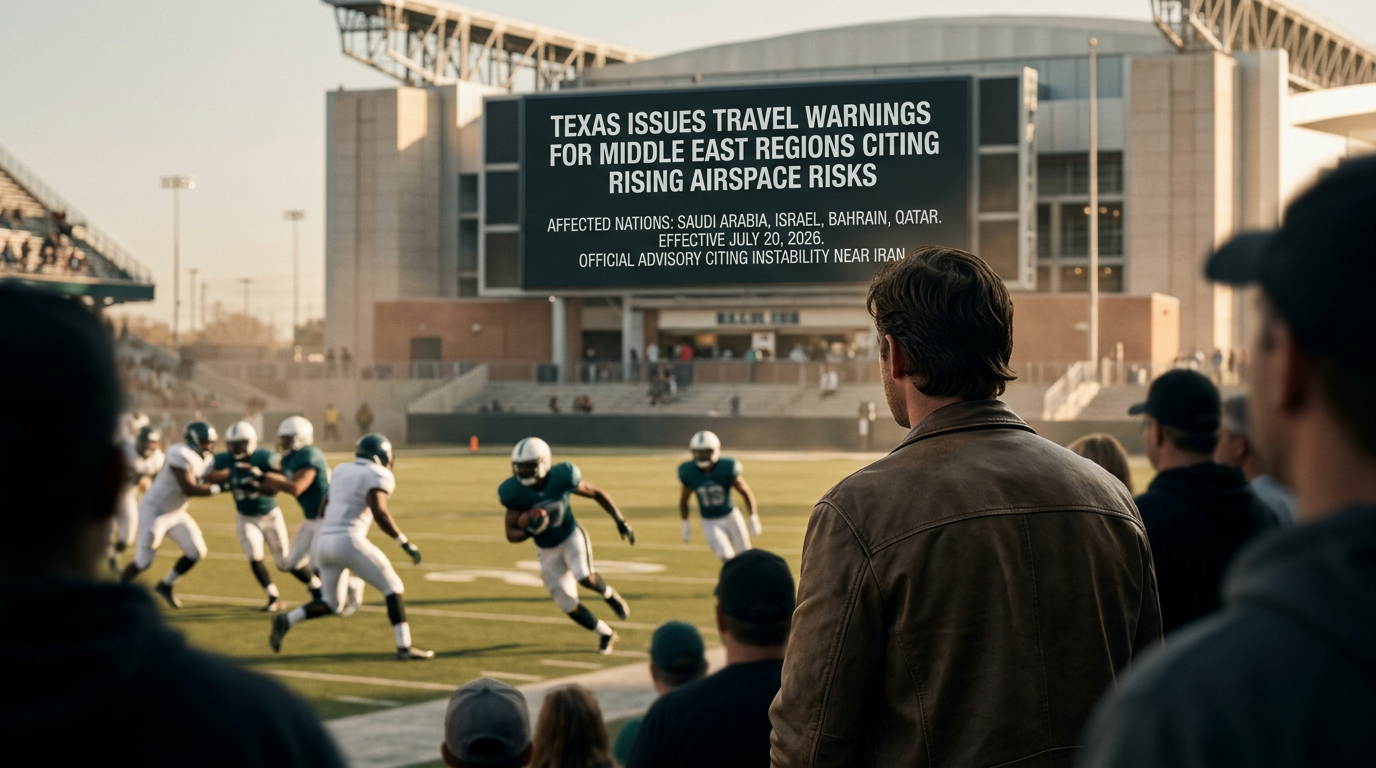
Texas authorities have joined a growing coalition of U.S. states, including New York, Florida, and California, in advising residents to avoid travel to several Middle Eastern nations as of July 20, 2026. The specific warnings target travel to Saudi Arabia, Israel, Bahrain, and Qatar, citing significant threats to civilian safety and the integrity of regional airspace. This advisory comes as the conflict involving Iran continues to destabilize localized transit corridors, creating unpredictable conditions for commercial aviation and foreign visitors alike. The coordination between major U.S. states highlights a unified domestic concern regarding the safety of American citizens abroad during this period of heightened geopolitical friction. Texas has a long history of monitoring international safety protocols, particularly given its status as a major global transit hub. DFW International Airport and Houston’s Bush Intercontinental serve as vital gateways for energy sector professionals and tourists moving between the Southern United States and the Middle East. Historically, the state has updated its travel guidance in alignment with federal State Department alerts when regional conflicts threaten to overlap with commercial flight paths or domestic safety within foreign jurisdictions. This current stance reflects a prioritized effort to prevent Texas residents from becoming stranded or endangered by rapidly shifting military activities in the targeted regions.
Texas relevance
The state of Texas is directly impacted by these travel warnings due to its massive presence in the international energy and technology sectors. Many Texas-based corporations maintain regional headquarters or critical operations in Saudi Arabia and Qatar, meaning the travel de-encouragement could lead to significant operational delays for local businesses. Furthermore, the warning serves as a direct notice to the millions of Texans who utilize the state’s international airports for transcontinental flights, necessitating a review of travel insurance and itinerary viability for those with planned departures.
Specific Geographic Risks and Airspace Limitations
The primary driver behind the latest Texas travel warning is the vulnerability of regional airspace. As conflict involving Iran intensifies, the risk of misidentification or collateral damage to civilian aircraft has climbed to levels deemed unacceptable by state safety monitors. The corridors over the Persian Gulf and the Levant are currently under intense scrutiny, as electronic warfare and missile defense systems are increasingly active.
Travelers are being warned that even if a destination like Qatar or Bahrain remains relatively stable on the ground, the flight paths required to reach them may cross high-risk zones. This makes scheduling and emergency landings difficult, as many nearby alternative airports may be closed to civilian traffic on short notice. Texas officials are urging residents to consider whether their travel is essential before booking passage through these specific transit points.
Regional instability has historically led to the temporary shuttering of civilian air traffic controllers in the Middle East. During previous spikes in hostility, airlines have been forced to reroute flights around entire countries, leading to fuel shortages and mechanical strain. By de-encouraging travel now, Texas authorities hope to minimize the number of residents caught in the logistical chaos that follows such widespread airspace closures.
Impact on Texas Energy and Defense Sectors
The economic relationship between Texas and the Middle East is foundational to the state's global trade profile. Companies based in Houston and Dallas frequently rotate staff through Saudi Arabian oil fields and Qatari natural gas facilities. These new travel warnings create a complex layer of liability and safety planning for these firms, which must now balance contract obligations with the safety of their Texas-based workforce.
Beyond the energy sector, Texas maintains a robust defense manufacturing presence that frequently coordinates with partners in Israel and Bahrain. The discouragement of travel could lead to a temporary transition toward remote consultation or the relocation of vital projects to secondary sites. State officials are monitoring how these restrictions will affect the flow of technical expertise and specialized labor that typically moves between Texas and the mentioned nations.
Local business leaders are currently evaluating the long-term implications of sustained travel friction. If the warnings remain in place for an extended period, it could lead to a reshuffling of international corporate strategies, with Texas firms potentially looking for more stable regional partners or delaying planned expansions in the targeted Middle Eastern markets until the conflict with Iran subsides.
Coordination with Federal and State Partners
The alignment of Texas with other major economic powerhouses like California and New York indicates a rare moment of cross-state consensus on international safety protocols. While each state maintains its own tourism and commerce departments, the uniform nature of these warnings suggests a shared intelligence baseline regarding the severity of the Iranian conflict’s impact on American citizens.
This state-level coordination often serves to amplify federal warnings from the U.S. State Department, ensuring that the message reaches residents through local news and state-run portals. By reinforcing the message at the state level, Texas authorities can provide more localized resources, such as specific contact points for Texans currently in the Middle East who may need assistance with travel arrangements.
The collaborative approach also allows for a more comprehensive data-sharing network between state governments regarding the number of citizens currently abroad. This data is critical for emergency management teams in Austin who must prepare for potential domestic impacts, such as an influx of returning travelers or the need for increased security at Texas international arrival terminals.
The Role of Iran in Regional Instability
The ongoing conflict involving Iran is cited as the central catalyst for the current travel restrictions. The geopolitical tension has moved beyond diplomatic disputes and into the realm of kinetic military action and technological disruption. For Texas travelers, this means that even stay-at-home digital services or financial transactions could be impacted while visiting the region due to ongoing cyber hostilities.
Iran’s influence over various maritime and aerial corridors in the region creates a bottleneck for global transit. Because Texas depends heavily on the free flow of goods and people for its economic health, the state government views the disruption of these corridors as a direct threat to the interests of its citizens. The warnings are designed to prevent unsuspecting travelers from entering a zone where regional actors may target Western interests.
Security analysts noted in the briefings provided to state officials that the situation is fluid. Unlike traditional wars with clear front lines, the current friction involving Iran features asymmetrical threats that can emerge in perceived safe zones like Bahrain or Saudi Arabia without significant warning. This unpredictability is what prompted the 'de-encouragement' of travel rather than a simple caution.
Guidance for Texans Currently Abroad
For Texas residents who are already in Israel, Saudi Arabia, Bahrain, or Qatar, the state is recommending heightened situational awareness. Travelers are encouraged to monitor local news constantly and keep their travel documents in a secure, accessible location. The advisory suggests that those currently in these countries should consider departing while commercial options remain available and reliable.
State agencies are also advising travelers to register with the Smart Traveler Enrollment Program (STEP) to receive the latest security updates. While the Texas government does not have the authority to order an evacuation from a foreign country, it is working to ensure that all residents have the information necessary to make informed decisions about their own safety and the safety of their families.
Communication is key during these periods of unrest. Texans abroad are urged to maintain contact with family members at home and to establish check-in schedules. The potential for internet outages or communication jams in conflict zones makes early planning essential for those who have not yet concluded their stay in the Middle East.
Analysis
Opinion: While travel advisories are typically the purview of the federal government, the vocal participation of Texas and other large states suggests a shift toward more proactive state-level communication regarding global risks. By explicitly naming countries like Bahrain and Qatar alongside more traditional conflict zones, Texas officials are signaling that the risks are no longer contained to active combat lines but have expanded into general logistics hubs. This move likely aims to reduce the burden on state resources that occurs when residents require emergency evacuation or assistance while abroad in volatile zones.
Source attribution
This story was reported using a public release from the Texas Travel Stories (Google News). Keep TX Red rewrote the coverage independently and links to the official statement for verification.
Frequently Asked Questions
- Is travel to the Middle East currently banned for Texans?
- No, there is no legal ban on travel to these nations. However, the state of Texas and several other large U.S. states are strongly 'de-encouraging' travel, meaning they are warning citizens of severe risks to their safety and the reliability of transportation.
- Why are Bahrain and Qatar included in the warning?
- While these countries may not be the primary site of conflict, their proximity to Iran and their role as regional aviation hubs put their airspace at high risk. The potential for missile activity or airspace closures makes them unsafe for standard commercial travel at this time.
- What should I do if I have a business trip scheduled to Saudi Arabia?
- State officials recommend re-evaluating the necessity of the trip. If you must go, ensure you have comprehensive travel insurance that covers conflict-related delays and register your presence with the U.S. State Department's enrollment programs.
- Does this warning affect flights departing from DFW or Houston?
- Yes, many direct and indirect flights to the Middle East originate from Texas hubs. Travelers should expect potential cancellations, rerouting, or increased security screenings for all flights heading toward the Persian Gulf and surrounding regions.
Official Sources
Take the next step
Browse the Newsroom →Read more about Keep Texas Red → Our full guide to what Keep Texas Red means and why Texans support it.
Related Articles


Get Texas updates delivered weekly.
Independent Texas reporting on politics, policy, and daily life. One email a week. Unsubscribe anytime.
Keep TX Red Newsroom
The Keep Texas Red Editorial Staff produces nonpartisan explainers, policy breakdowns, and educational resources to help Texans understand how their government works. All content is reviewed for accuracy and updated regularly.
About Keep TX Red →