Texas DOT Targets Speeding With Safety Campaign at New Braunfels Buc-ee’s
TxDOT officials visited the New Braunfels Buc-ee's to educate travelers on the dangers of speeding during a high-profile public safety event.
Editorial disclaimer: Opinions and analysis on Keep TX Red are editorial content — not statements of fact. See our editorial standards.
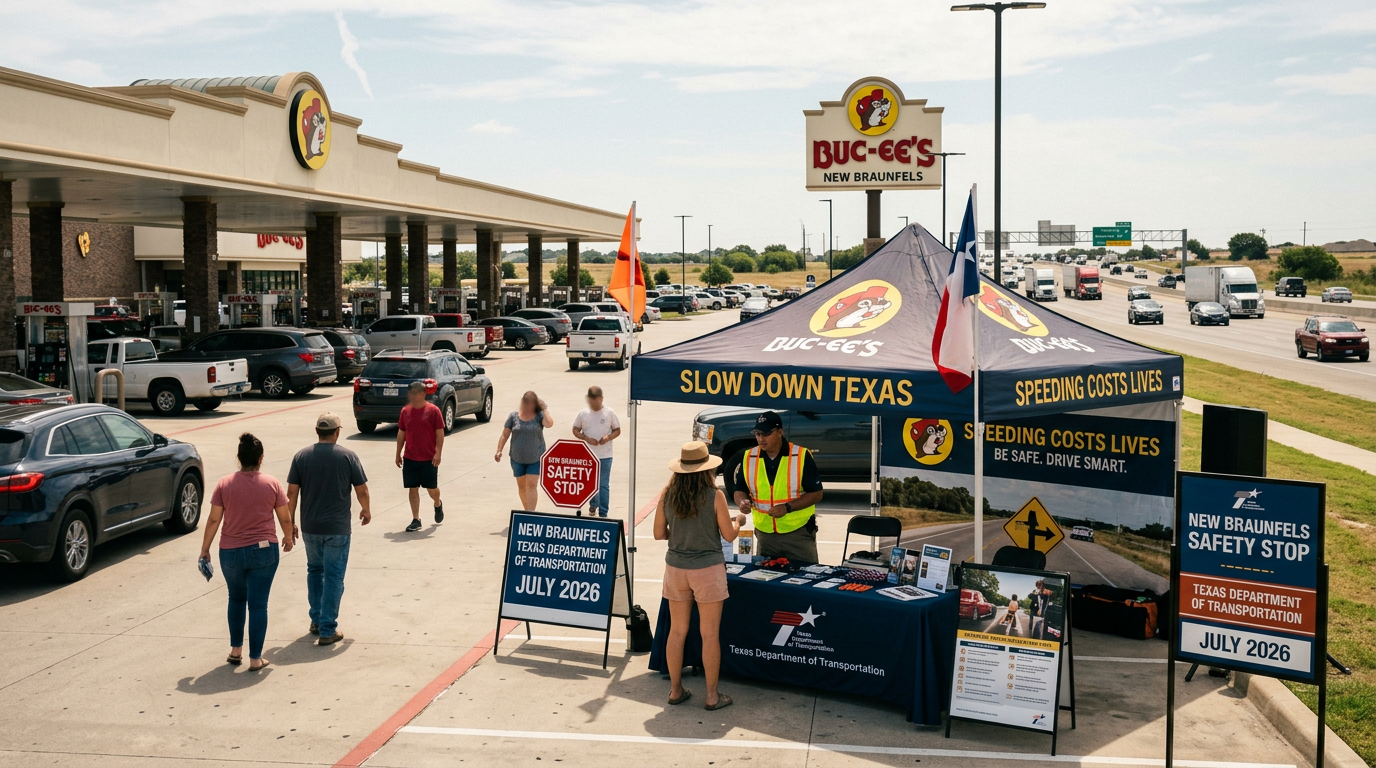
The Texas Department of Transportation brought its statewide messaging regarding road safety directly to travelers on July 20, 2026. Choosing one of the state's most iconic and high-traffic landmarks, officials gathered at the Buc-ee's location in New Braunfels to facilitate a speeding awareness event. This initiative is part of an ongoing effort to reduce the frequency of traffic-related incidents on major Texas corridors. By meeting motorists where they stop to rest and refuel, the agency aims to deliver a sobering reminder that excessive speed remains a leading factor in highway fatalities across the Lone Star State. Texas has a storied history of creative public safety campaigns, but this move represents a shift toward immersive, face-to-face interaction rather than simple roadside signage. Historically, the state has grappled with the logistical challenge of policing thousands of miles of open road, leading to a strategy that prioritizes driver education and the psychology of road safety over purely punitive measures. This specific event in New Braunfels serves as a cornerstone of the summer safety push, targeting the 'Texas Triangle' of San Antonio, Austin, and Houston. The department recognizes that the vastness of the state often encourages drivers to seek shorter arrival times, frequently at the expense of safety. By establishing a presence at a cultural hub like Buc-ee’s, the state is attempting to disrupt the monotony of long-distance driving with a message that resonates locally. The background of these initiatives stems from years of analyzing crash data, which suggests that high-traffic zones during holiday and vacation peaks are the most volatile. This awareness event is not just a one-off display but part of a broader, data-driven calendar meant to save lives through the power of suggestion and education at the very moment drivers are preparing to re-enter the flow of high-speed traffic.
Texas relevance
This event directly impacts the IH-35 corridor, which serves as a central artery for residents in New Braunfels, San Antonio, and Austin. Historically, Texas has leaned on public-private visibility to manage its expansive highway network, which covers more miles than any other state in the nation. Utilizing a major commercial hub like Buc-ee's ensures that the safety message reaches a diverse cross-section of Texas drivers, ranging from local commuters to long-haul vacationers, specifically within the fast-growing Comal County region. The focus on this area is no accident; IH-35 is one of the most heavily trafficked roads in North America, and the stretch between Austin and San Antonio is notorious for congestion and rapid speed transitions. For Texans, the safety of this road is a high-priority quality-of-life issue that affects everything from daily commutes to the state's logistical supply chains.
Strategic Outreach at a Texas Landmark
The New Braunfels Buc-ee’s, known for its massive scale and high volume of visitors, served as more than just a convenience stop on July 20. TxDOT utilized the location to set up educational displays and engage directly with the public. This specific location is one of the busiest gas stations in the world, making it a prime real estate for any agency hoping to capture the attention of thousands of drivers in a single afternoon. Because the site attracts travelers from across the entire state, the outreach effort here has a much wider geographical reach than an event held in a standard municipal park or town hall.
Personnel from the Department of Transportation provided information regarding the physical risks of speeding. The core mission of the day was to illustrate how even a slight increase in speed can significantly alter the outcome of a collision. By providing tangible data and conversation, the agency hoped to encourage a culture of caution among those heading out on long trips across the state. This interactive model allows travelers to see the real-world implications of kinetic energy and braking distances, concepts that are often forgotten once a driver settles into the left lane of a Texas interstate.
The choice of Buc-ee's specifically highlights the intersection of Texas commerce and public health. As a private partner, the business provides the infrastructure necessary to host such a large-scale public event without disrupting the flow of normal daily activities. This cooperation between the public sector and a dominant private enterprise demonstrates a unified front in addressing the state's road safety concerns, which is essential for a state where individual mobility is a deeply ingrained part of the social and economic fabric.
Addressing High-Speed Risks on IH-35
New Braunfels sits at a critical junction of the Texas highway system, where local traffic merges with heavy commercial logistics and tourist travel. Speeding in this area is not just a violation of the law but a serious threat to the flow of commerce and the safety of families. TxDOT’s presence served as a proactive measure to mitigate these risks through education rather than just enforcement. The agency highlighted the fact that IH-35 is a major corridor for international trade, meaning that car drivers must frequently share the lane with massive 18-wheelers that require much longer stopping distances.
The agency highlighted how reaction times are factored into road design. When drivers exceed the posted limits, they override the safety margins built into the infrastructure. This event allowed officials to explain the 'why' behind speed limits, helping travelers understand that these numbers are based on engineered curves, merging lanes, and pavement conditions specific to the New Braunfels stretch of IH-35. Many drivers do not realize that speed limits are often calculated to account for the 'worst-case' scenario of traffic density and weather transitions found in Central Texas.
Educational brochures and digital demonstrations underscored the reality that 'speeding' isn't just about going far over the limit. It is also about driving too fast for current conditions, such as during the sudden heavy rainstorms common in the Hill Country. By focusing on site-specific risks, TxDOT was able to offer advice that was immediately applicable to the drivers as they pulled out of the parking lot and back onto the main thoroughfares.
Stakeholders and the Drive for Safer Roads
The stakeholders in this event go beyond just the state agency and the retail chain. They include local emergency responders, insurance providers, and the families of Comal County who use these roads daily. For local paramedics and police in New Braunfels, every successful safety campaign means one fewer traumatic scene to manage on the highway. Their advocacy for these events is rooted in the frontline reality of what happens when a vehicle loses control at high speeds.
Insurance groups also have a vested interest in these initiatives, as Texas frequently ranks among the most expensive states for auto insurance due to high accident rates. By lowering the statewide accident frequency, there is a long-term potential for stabilizing premiums for the average Texan. This economic angle is rarely the focal point of a safety display, but it remains a powerful underlying motivator for the state's push toward a safer driving culture.
Furthermore, municipal leaders in the Austin-San Antonio corridor view road safety as a critical component of regional growth. As more businesses move to the area, the reliability and safety of the transportation network become key selling points for further investment. A road system that is perceived as dangerous or chaotic can stifle economic expansion, making TxDOT's efforts an essential part of the state's broader economic development strategy.
Public Interaction and Driver Feedback
During the event, travelers had the opportunity to ask questions about road projects and safety statistics. This two-way communication is a hallmark of TxDOT’s modern outreach strategy. By listening to the concerns of the motoring public, the agency can better tailor its future messaging to address common misconceptions about highway safety. For instance, drivers often express frustration with seemingly arbitrary speed limit changes in construction zones, and officials used this time to explain the worker safety requirements that dictate those shifts.
Many attendees expressed appreciation for the direct contact. Motorists often view traffic safety through the lens of law enforcement, but the Buc-ee’s event focused on the science of safety. This distinction helps build a cooperative relationship between the state and its citizens, emphasizing that the primary goal of these campaigns is the preservation of life. When people understand the physics involved in a crash, they are statistically more likely to self-correct their driving behavior without the immediate threat of a citation.
The feedback gathered during these sessions also provides TxDOT with localized intelligence. Drivers often point out specific merge points or sections of road where they feel the signage is unclear or where they witness frequent near-misses. This grassroots data collection is invaluable for engineers who may be planning future improvements for the IH-35 corridor. By turning the public into a collaborative partner in safety, the agency fosters a more engaged and responsible driving population.
The Evolution of Texas Road Safety Campaigns
Texas has a long history of innovative traffic safety programs, from the iconic 'Don’t Mess with Texas' anti-litter campaign to the 'Talk. Text. Crash.' distracted driving initiatives. This speeding awareness event is the latest evolution in that lineage. By moving away from static media and toward interactive pop-up events, TxDOT is attempting to break through the 'highway hypnosis' that often causes drivers to ignore standard signage. The modern driver is inundated with information, requiring more creative ways to capture their attention.
The choice of Buc-ee’s is indicative of this evolution. As a private entity that has become synonymous with Texas travel, the brand provides a friendly environment for a serious message. This synergy allows the state to leverage the positive associations people have with the venue to ensure the safety message is received more effectively than a standard public service announcement. It creates a 'community' feel to a state-mandated safety message, making it feel less like a lecture and more like a shared responsibility.
Historically, Texas was one of the first states to use massive digital signage to display fatality counts, a tactic meant to shock drivers into awareness. While effective, the state has realized that shock must be followed by education. The New Braunfels event represents the educational follow-through, giving drivers the tools and knowledge they need to actually change their habits once they leave the 'safety zone' of the rest stop.
Looking Ahead: Future Safety Initiatives
With the conclusion of the New Braunfels event, TxDOT is expected to continue these types of high-visibility appearances in other major Texas cities. The data gathered from public interactions at Buc-ee's will likely inform the next phase of the agency's safety push. As Texas continues to experience a population boom, the demand for safer roads and better driver education only grows. The agency recognizes that with millions of new residents moving to the state, many travelers are unfamiliar with the unique challenges of Texas's high-speed rural and suburban highways.
State officials remain committed to the 'Vision Zero' concept, which aims to eventually eliminate traffic fatalities entirely. While that goal is ambitious, events like the one held in New Braunfels are considered the building blocks of a safer future. These initiatives are being paired with hardware upgrades across the state, including better lighting, rumble strips, and improved barrier designs. However, technology alone cannot solve the problem; the human element remains the most significant variable in the safety equation.
The agency plans to monitor traffic data in the Comal County area following the event to see if the increased awareness corresponds with a reduction in local speeding incidents. If successful, this model could be replicated at other major travel hubs, such as airports or large-scale sporting venues. The ultimate goal is to create a culture where 'slowing down' is not just a reaction to a police cruiser on the shoulder, but a conscious decision made by every driver to ensure they reach their destination safely.
Analysis
The strategic partnership between a state regulatory body like TxDOT and a cultural staple like Buc-ee's represents a shift toward 'engagement-first' public safety. Rather than relying solely on billboards or digital signs, the presence of officials on the ground allows for a more personal interaction with the driving public. This approach likely reflects a desire to humanize traffic enforcement and education efforts during peak summer travel periods when road congestion and speed-related risks are at their highest. By aligning the state's safety goals with a beloved Texas brand, the agency is leveraging 'soft power' to influence behavior. It moves the conversation from the courtroom to the community, suggesting that safe driving is a shared Texas value rather than just a legal requirement.
Source attribution
This story was reported using a public release from the Buc-ee's (Google News). Keep TX Red rewrote the coverage independently and links to the official statement for verification.
Frequently Asked Questions
- Why was the New Braunfels Buc-ee's chosen for this event?
- The New Braunfels Buc-ee's is one of the highest-traffic locations in the state, located on the critical IH-35 corridor. This allows TxDOT to reach thousands of motorists from various regions in a single day, making it an efficient spot for public safety outreach. Its status as a cultural icon also helps the message resonate more effectively with native Texans and visitors alike.
- Was this a law enforcement sting or an educational event?
- This was an educational event focused on awareness. While TxDOT works alongside law enforcement, the primary goal at Buc-ee's was to provide information, answer questions, and encourage safer driving habits through direct public engagement. There were no tickets issued as part of the informational display; the focus was entirely on prevention and conversation.
- How does speeding affect Texas highway safety statistics?
- Speeding is consistently cited by TxDOT as a leading factor in fatal crashes across Texas. Higher speeds reduce a driver’s reaction time and increase the force of impact, significantly decreasing the chances of survival during a collision. In a state as large as Texas, these physics are amplified by long stretches of road where drivers may be tempted to push their vehicles beyond safe limits.
- What is the 'Vision Zero' goal mentioned by state officials?
- Vision Zero is a strategy intended to eliminate all traffic fatalities and severe injuries while increasing safe, healthy, and equitable mobility for all. TxDOT uses this as a guiding principle in their long-term planning, focusing on road design, public education, and policy changes to make the state's transportation network as safe as possible for all users.
Official Sources
Take the next step
Browse the Newsroom →Read more about Keep Texas Red → Our full guide to what Keep Texas Red means and why Texans support it.
Related Articles
Get Texas updates delivered weekly.
Independent Texas reporting on politics, policy, and daily life. One email a week. Unsubscribe anytime.
Keep TX Red Newsroom
The Keep Texas Red Editorial Staff produces nonpartisan explainers, policy breakdowns, and educational resources to help Texans understand how their government works. All content is reviewed for accuracy and updated regularly.
About Keep TX Red →