Quick-Thinking Texas Officer Saves Motorist from Engulfed Vehicle
A Texas police officer's rapid response saved a man's life after his car caught fire following a crash on July 20, 2026.
Editorial disclaimer: Opinions and analysis on Keep TX Red are editorial content — not statements of fact. See our editorial standards.
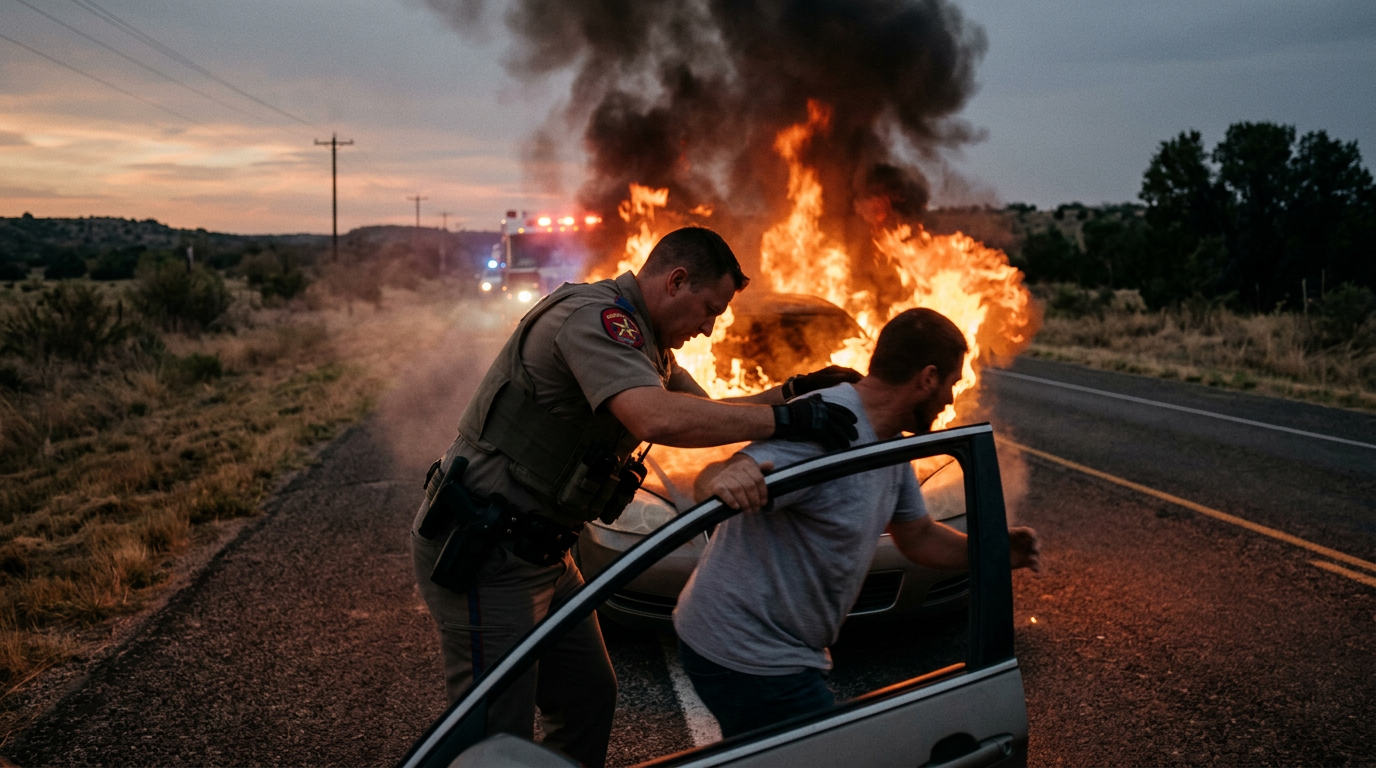
On July 20, 2026, a Texas police officer intervened in a life-threatening situation by pulling a man from a vehicle fully engulfed in flames. The incident occurred shortly after the vehicle was involved in a serious collision that triggered a rapid fire in the engine compartment. Emergency responders reached the scene as the blaze began to spread into the passenger cabin, leaving the driver trapped inside the smoking wreckage. Recognizing the imminent danger of an explosion or smoke inhalation, the responding officer bypassed waiting for specialized fire equipment to manually extract the individual from the driver's side of the car. Historically, Texas highway incidents often occur in remote or high-traffic areas where every second of response time dictates survival. Similar to prior departmental bravery awards given across the Lone Star State, this event underscores the multi-disciplinary requirements of modern policing. By acting as both a law enforcement officer and a makeshift firefighter, the responder prevented a tragic outcome that seemed inevitable given the intensity of the blaze and the delay inherent in traditional multi-agency dispatching.
Texas relevance
This event took place within the state of Texas and underscores the critical training and bravery exhibited by the state's municipal and state police forces. In Texas, where sprawling highway systems and high-speed transit contribute to significant traffic incidents annually, the role of local law enforcement as immediate medical and rescue personnel is a vital component of public safety infrastructure. This specific rescue highlights the ongoing challenges faced by Texas first responders who often arrive at the scene of accidents before fire or EMS crews can be deployed. Because Texas maintains thousands of miles of rural and urban highways, the proficiency of local police in vehicle extraction is a cornerstone of the state's public safety strategy, ensuring that citizens in even the most congested or remote corridors have a chance at survival during mechanical or accidental catastrophes.
The Moments Following the Collision
The sequence of events began when a vehicle lost control and collided with an obstacle, leading to mechanical failure and a subsequent fire. In such high-impact scenarios, fuel lines are often compromised, allowing flammable liquids to come into contact with the heat of the engine block. In this instance, the fire spread with unusual speed, trapping the occupant within the frame of the car as smoke filled the interior.
Local police arriving on the scene were met with a chaotic environment. The visibility was significantly reduced by thick black smoke, and the heat radiating from the vehicle made approaching the door difficult. Despite these hazards, the responding officer determined that the driver was unable to escape on his own and initiated a rescue attempt without delay. The initial impact had already left the driver disoriented, making self-extraction nearly impossible as the cabin temperatures soared.
The speed at which modern vehicles can ignite following a high-speed impact is a major concern for Texas traffic safety officials. Plastics and synthetic materials used in modern upholstery can release toxic fumes almost immediately when exposed to flame. This reality made the officer's decision to enter the smoke plume without fire-retardant gear a calculated risk of the highest order.
Execution of the Emergency Rescue
Technical details of the rescue indicate that the officer had to navigate around the growing flames to reach the door handle. With the fire intensifying, every second was critical to ensuring the driver's survival. The officer utilized their training to safely unbuckle or cut the driver free from the seat constraints before dragging him to a safe distance from the burning chassis.
The physical exertion required for such a rescue is substantial, especially when dealing with a victim who may be unconscious or in shock. The officer had to manage the weight of the victim while maintaining awareness of environmental threats, such as potential tire explosions or the collapse of the vehicle's structural components under extreme heat. Footage from the scene confirms that the vehicle became a total loss within minutes of the extraction.
The officer’s positioning was also crucial; by approaching from the upwind side when possible, they were able to maintain enough sight to locate the victim's limbs and torso. However, the heat levels described by witnesses suggest that the officer likely suffered from singed hair or minor thermal exposure during the brief but intense period they were physically attached to the vehicle frame.
First Responder Training and Protocols
Texas law enforcement agencies undergo rigorous training to handle multi-hazard environments, which include fire safety and victim extraction. While police are primarily responsible for scene security and traffic control, their status as first arrivals often requires them to transition into rescue roles. This incident serves as a practical application of those life-saving modules taught at police academies across the state.
The equipment carried by officers, including fire extinguishers and tactical gear, is designed to provide a small window of protection during these interventions. However, the sheer intensity of a vehicle fire often renders standard police equipment insufficient, forcing officers to rely on raw speed and courage to complete the extraction before the fire department arrives with high-pressure hoses.
These protocols are continuously updated as vehicle technology changes. For example, the rise of electric vehicles and high-pressure fuel systems in Texas requires officers to be aware of different types of thermal runaways. In this specific case, the traditional internal combustion engine failure provided a familiar, though no less deadly, challenge for the responding unit.
Condition of the Survivor and Post-Incident Care
Once the driver was successfully moved away from the fire, he was treated by medical professionals who arrived shortly after the rescue. The immediate removal from the smoke-filled environment likely prevented severe secondary injuries such as respiratory damage from toxic fumes. After the individual was stabilized, he was transported to a local medical facility for further evaluation of injuries sustained during the initial crash.
The focus of the department remained on the survival of the individual, treating the incident as a successful preservation of life in a situation that could have easily resulted in a fatality. Post-incident updates suggest that while the vehicle is irreparable, the driver is expected to recover, thanks largely to the absence of severe burns that would have occurred had he remained in the car for even sixty seconds longer.
Medical staff at the receiving hospital noted that early extraction is the number one factor in surviving vehicle fires. By the time the fire department had the blaze under control, the driver’s side of the cabin had been completely gutted by fire. The officer's intervention did not just save a life—it prevented permanent, life-altering disfigurement from third-degree burns.
Broader Implications for Police Staffing in Texas
This rescue shines a light on the ongoing debate regarding police staffing and response times throughout the state. In many Texas districts, the ability of an officer to arrive at an accident scene within minutes is the product of strategic patrolling and high staffing levels. When departments are underfunded or understaffed, the 'golden hour' of emergency response is often missed.
Communities that support their local law enforcement see the direct dividends of that support during events like this. The availability of a patrol car near the site of the collision was not a matter of luck, but a reflection of a well-organized public safety apparatus. Texans generally prioritize these rapid-response capabilities as a fundamental service of local government.
Furthermore, the psychological toll on officers who perform these rescues is now being better addressed by Texas legislation and departmental policies. Being the first on a scene and pulling a person from a burning wreckage is a traumatic event. Texas is increasingly leading the way in providing mental health support for first responders who engage in such heroic, yet taxing, physical rescues.
Community Impact and Public Safety Awareness
Events like this often resonate deeply within Texas communities, serving as a reminder of the dangers inherent in law enforcement work. The documentation of the rescue provides a clear view of the split-second decisions officers must make. Public safety officials often use these instances to remind the public of the importance of cautious driving and the necessity of clearing the way for emergency vehicles when they are responding to such calls.
This rescue will likely be reviewed by the local department for commendation and training purposes. Analyzing the video and the officer’s actions allows other members of the force to learn the best practices for similar high-stress scenarios. It also reaffirms the bond between the community and those sworn to protect them, showcasing the dedication present in Texas's public safety sectors.
Ultimately, the story of this July 20th rescue contributes to the narrative of Texas as a state that values its first responders and the rule of law. It highlights the individual agency of a single officer who chose to act in the face of extreme danger, embodying the spirit of service that defines the Texas law enforcement community.
Analysis
This incident serves as a poignant reminder of the multifaceted nature of law enforcement in the modern era. Critics often focus on the enforcement aspects of policing, but 'Keep TX Red' highlights that the primary mission of our men and women in blue is the preservation of life. The officer's willingness to put their own physical safety at risk to pull a stranger from a burning wreck demonstrates the silent courage required for the job. From a policy perspective, this further justifies the continued funding of comprehensive training programs and the outfitting of patrol units with necessary emergency tools. In a state as large as Texas, the officer on the beat is frequently the only thing standing between a citizen and a fatal accident, proving that public safety is about more than just crime prevention—it is about community resilience and readiness.
Source attribution
This story was reported using a public release from the Texas Police / Public Safety Video (Google News). Keep TX Red rewrote the coverage independently and links to the official statement for verification.
Frequently Asked Questions
- Where did this vehicle fire and rescue take place?
- The incident occurred in Texas. Local law enforcement responded to a vehicle collision that resulted in a fast-moving fire, leaving the driver trapped as flames consumed the engine and began entering the passenger compartment.
- Was the driver injured in the crash or the fire?
- The driver was rescued before the fire could cause fatal burns. He was transported to a regional medical facility to be treated for impact-related injuries from the collision and potential smoke inhalation from the fire's early stages.
- What training did the officer use to perform the rescue?
- Texas police officers receive comprehensive training in emergency vehicle extraction and trauma response. This includes learning how to safely approach burning structures and the best methods for moving victims who may be immobilized or unconscious.
- Will the officer be recognized for their actions?
- While official commendations are usually announced following internal reviews, incidents of this nature typically lead to departmental awards for bravery and life-saving actions, reflecting the officer's adherence to the highest standards of Texas law enforcement.
Official Sources
Take the next step
Browse the Newsroom →Read more about Keep Texas Red → Our full guide to what Keep Texas Red means and why Texans support it.
Related Articles


Get Texas updates delivered weekly.
Independent Texas reporting on politics, policy, and daily life. One email a week. Unsubscribe anytime.
Keep TX Red Newsroom
The Keep Texas Red Editorial Staff produces nonpartisan explainers, policy breakdowns, and educational resources to help Texans understand how their government works. All content is reviewed for accuracy and updated regularly.
About Keep TX Red →