Heroic Texas Officer Pulls Occupant from Flaming Vehicle Seconds Before Disaster
A Texas police officer is being hailed for bravery after a dramatic rescue of a trapped driver from a burning car was captured on video.
Editorial disclaimer: Opinions and analysis on Keep TX Red are editorial content — not statements of fact. See our editorial standards.
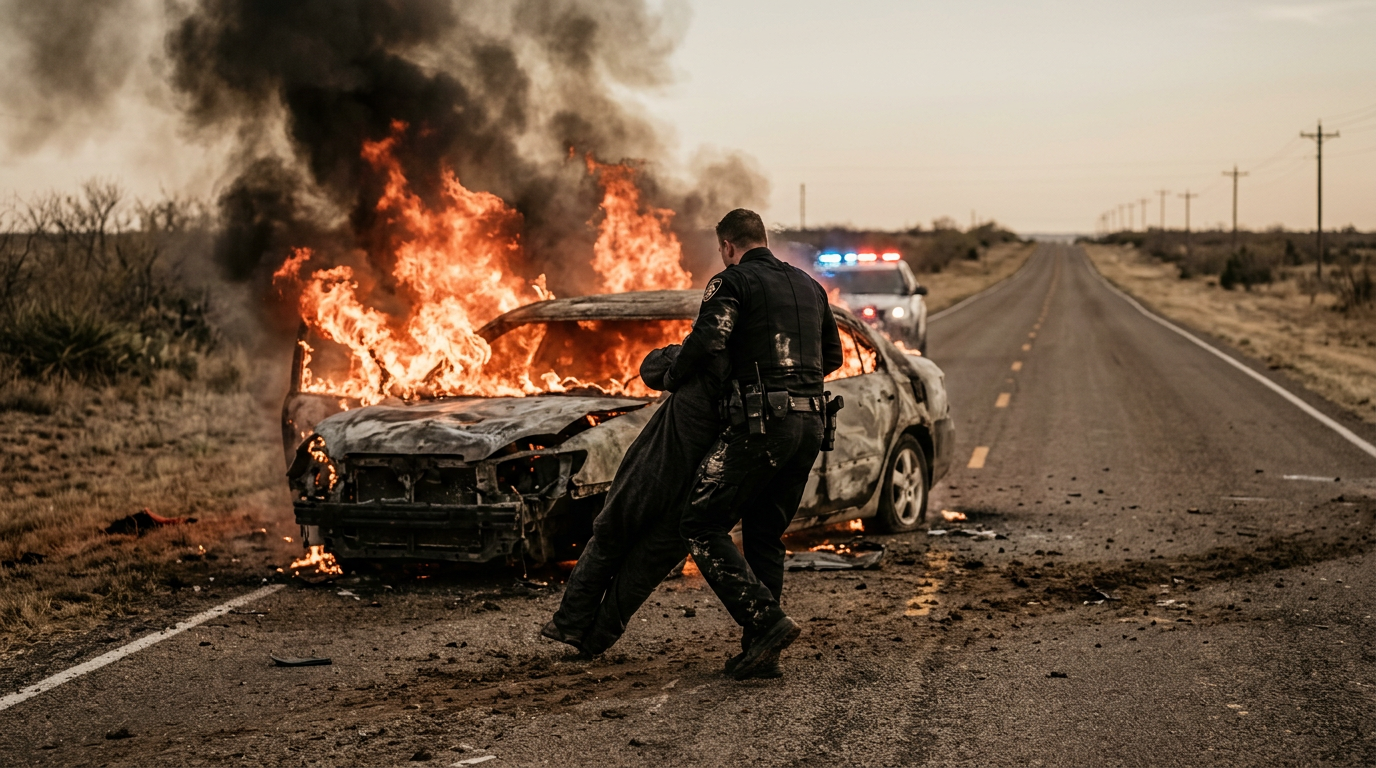
A Texas police officer acted decisively on July 20, 2026, to save the life of a driver trapped within a vehicle that had caught fire following a collision. Upon arriving at the scene, the officer observed a vehicle fully engulfed in flames with the occupant still inside, unable to escape the intensifying heat and smoke. Without waiting for fire suppression teams to arrive, the officer approached the burning wreckage and manually extracted the individual from the cabin. Historically, Texas law enforcement has operated under a multidisciplinary mandate where the vastness of the state’s geography often places patrol officers at the scene of accidents long before specialized fire crews can arrive. This life-saving intervention occurs as Texas communities continue to rely heavily on the dual-role of law enforcement as both peace officers and immediate medical first responders in high-stakes highway accidents. The officer’s ability to transition from a routine patrol to an emergency extraction specialist in a matter of seconds reflects the rigorous standards set by state training commissions.
Texas relevance
This incident occurred on a Texas roadway and highlights the immediate dangers faced by both the Texas motoring public and the law enforcement officers who patrol the state's vast highway system. In Texas, where long distances between rural outposts or congested urban corridors can lead to delayed fire department response times, patrolling officers are often the only line of defense between a crash victim and a fatal outcome. This specific event in July underscores a broader trend in Texas public safety policy, which has increasingly emphasized 'tactical' medical training and rescue proficiency for all sworn personnel. The bravery displayed in this instance serves as a case study for the rigorous emergency training mandated for officers across the Lone Star State to handle thermal and traumatic emergencies, ensuring that the safety of the 30 million residents who utilize Texas thoroughfares is prioritized regardless of the specific agency responding.
Details of the Fiery Crash Scene
The incident began when reports of a single-vehicle accident reached local dispatchers in Texas. Early responding units found a vehicle that had sustained significant structural damage, which likely hindered the driver's ability to open the doors or clear the wreckage independently. Within moments of the impact, the engine compartment ignited, sending thick black smoke into the air and creating a life-threatening environment for anyone remaining inside. The rapid escalation of the fire suggests a ruptured fuel line or a high-intensity engine fire, which can reach temperatures exceeding 1,000 degrees Fahrenheit in a very short window of time.
The responding Texas officer arrived while the fire was still localized to the front of the vehicle but spreading rapidly toward the passenger compartment. Dashcam and body-worn camera footage indicates that the heat was already intense enough to cause visible distortion in the air. The officer utilized their tactical training to assess the situation in seconds, recognizing that the driver's window of survival was closing as the flames began to enter the interior cabin. The psychological pressure of such a scene cannot be overstated, as the threat of an explosion or heat-related injury to the rescuer is a constant presence.
The Life-Saving Extraction
As the officer reached the burning car, they encountered a driver who was reportedly disoriented and unable to unbuckle or move toward an exit. The driver’s state of shock, combined with the structural deformity of the car frame, created a tomb-like environment. The officer had to use physical force to clear debris and reach the individual while the smoke began to fill the lungs of both the rescuer and the rescued. Throughout the rescue, the sound of small secondary explosions—likely tires or pressurized canisters within the vehicle—can be heard, emphasizing the volatility of the scene.
The officer successfully grabbed the driver and pulled them several yards away from the vehicle just as the fire intensified significantly. In his later recollections of the event, the officer noted that the primary focus was on the immediate necessity of movement, disregarding personal safety in favor of the victim's survival. This action prevented what likely would have been a fatal outcome, as the vehicle was completely consumed by fire shortly after the extraction was completed. The timing of the rescue was so precise that if the officer had arrived even sixty seconds later, the outcome would have shifted from a rescue to a recovery operation.
Training and Protocol for Vehicle Fires
Texas law enforcement agencies undergo specific training regarding vehicle fires, which are among the most dangerous scenes for officers due to the risk of magnesium flares, fuel leaks, and toxic fumes. Officers are taught to use fire extinguishers to suppress flames temporarily if a rescue is required, but in this specific instance, the size of the fire necessitated a direct physical rescue rather than a suppression attempt. The decision to forgo the extinguisher in favor of a manual pull is a judgment call that saved the driver’s life, as the delay involved in aiming a nozzle might have cost the driver their final breath.
The success of this rescue highlights the importance of the 'Golden Hour' in trauma medicine, where the first sixty minutes following a traumatic injury are the most critical. By being on-site within minutes of the crash, the Texas officer ensured that the driver received life-saving intervention before the thermal injuries became unsurvivable. This incident underscores why many Texas departments are increasing the amount of medical and rescue equipment carried in standard patrol units, including heavy-duty glass breakers, seatbelt cutters, and fire-resistant gloves.
The Officer's Personal Account
Following the adrenaline-filled rescue, the officer provided a statement reflecting on the split-second decisions made at the roadside. The officer described the heat as 'overwhelming' and mentioned that the priority was simply to 'get them out' before the smoke became too thick to navigate. Public safety officials often describe these moments as the 'silent' part of the job that rarely gets documented, though video evidence in this case has brought the story to a wider audience. The officer emphasized that he felt he was simply doing what any other member of the force would have done in the same predicament.
While the officer has remained humble regarding the intervention, the video serves as a reminder of the physical risks taken by Texas police every day. The driver involved was reportedly taken to a nearby medical facility for evaluation of smoke inhalation and injuries related to the initial crash, but they are expected to survive thanks entirely to the officer's presence of mind. The psychological impact on first responders who engage in such life-and-death struggles is also a point of focus for the department, which provides peer support for officers who experience traumatic events like high-intensity rescues.
Community Impact and Public Safety Awareness
Events like this often spark conversations throughout Texas regarding roadside safety and the 'Move Over' laws designed to protect first responders. When officers are operating on the shoulder of a highway to perform rescues, they are at extreme risk from passing traffic. This rescue took place in an environment where the officer had to manage both the fire and the potential for secondary collisions from distracted drivers observing the blaze. Texas lawmakers have historically supported strict penalties for those who fail to yield to emergency lights for this very reason.
The release of the rescue video by the department serves a dual purpose: it honors the bravery of the officer and acts as a sobering reminder to the public about the dangers of high-speed travel and the volatility of modern vehicles. Texas officials frequently use such footage to demonstrate the reality of police work, which extends far beyond traffic tickets or criminal investigations into the realm of emergency rescue and community protection. This incident will likely be used as a training video for future cadets in Texas academies to illustrate the speed at which a scene can transform into a life-threatening crisis.
Stakeholder Perspectives and Future Implications
The local community and Texas leadership have praised the officer’s actions as exemplary of the 'Lone Star' spirit of service. Stakeholders in the law enforcement community, including union representatives and police chiefs, have noted that this incident highlights the need for continued investment in body-worn camera technology, which provides a transparent view of these heroic acts. Without the video footage, the sheer intensity of the fire and the proximity of the danger would be difficult for the public to fully grasp through a written report alone.
Moving forward, this incident may influence how Texas departments integrate fire-safety training into their recurring professional development. Some agencies are already looking into providing officers with more advanced flame-retardant gear or specialized tools for vehicle entry. As vehicle technology changes, including the rise of electric vehicles with unique battery fire profiles, the lessons learned from this traditional internal combustion engine fire will remain a cornerstone of basic first responder protocols across the state.
Analysis
This rescue serves as a poignant reminder of the inherent risks associated with law enforcement in the modern era, where officers must be prepared to risk their lives in scenarios that have nothing to do with traditional crime fighting. From a policy perspective, the viral nature of the body-cam footage provides a rare moment of public unity, showcasing the 'protector' aspect of the police badge. Critics of police funding often overlook the fact that local departments serve as the primary rapid-response force for all life-safety issues, including thermal rescues and medical trauma. This event likely reinforces the case for maintaining robust budgets for local Texas departments, as the specialized equipment and training required to perform such a rescue are only possible through consistent investment in public safety infrastructure.
Source attribution
This story was reported using a public release from the Texas Police / Public Safety Video (Google News). Keep TX Red rewrote the coverage independently and links to the official statement for verification.
Frequently Asked Questions
- Where in Texas did the car fire rescue take place?
- The incident occurred on a Texas roadway following a vehicle accident where the car caught fire. Specific municipal details are typically released after the local department concludes its preliminary investigation of the crash dynamics.
- Was the police officer injured during the rescue?
- The officer has given public statements following the event and did not report any major injuries, despite having to approach high-intensity flames to pull the driver to safety. He was evaluated by medical personnel on-site as a precaution.
- How does Texas law enforcement train for these types of emergencies?
- Texas officers receive training in basic fire suppression and emergency medical response as part of their academy curriculum overseen by TCOLE. This allows them to act as first responders at accident scenes before EMS or Fire services arrive, which is essential in a state as geographically diverse as Texas.
- What happened to the driver after the rescue?
- The driver was transported to a local hospital for treatment resulting from the initial collision and smoke inhalation from the fire. Reports indicate they were in stable condition thanks to the rapid intervention of the officer.
Official Sources
Take the next step
Browse the Newsroom →Read more about Keep Texas Red → Our full guide to what Keep Texas Red means and why Texans support it.
Related Articles

Get Texas updates delivered weekly.
Independent Texas reporting on politics, policy, and daily life. One email a week. Unsubscribe anytime.
Keep TX Red Newsroom
The Keep Texas Red Editorial Staff produces nonpartisan explainers, policy breakdowns, and educational resources to help Texans understand how their government works. All content is reviewed for accuracy and updated regularly.
About Keep TX Red →