Texas Floods: Governor Abbott Mobilizes Massive State Response Efforts
Governor Abbott deploys 2,350 responders and 1,400 vehicles as Texas faces life-threatening flood conditions across several regions.
Editorial disclaimer: Opinions and analysis on Keep TX Red are editorial content — not statements of fact. See our editorial standards.
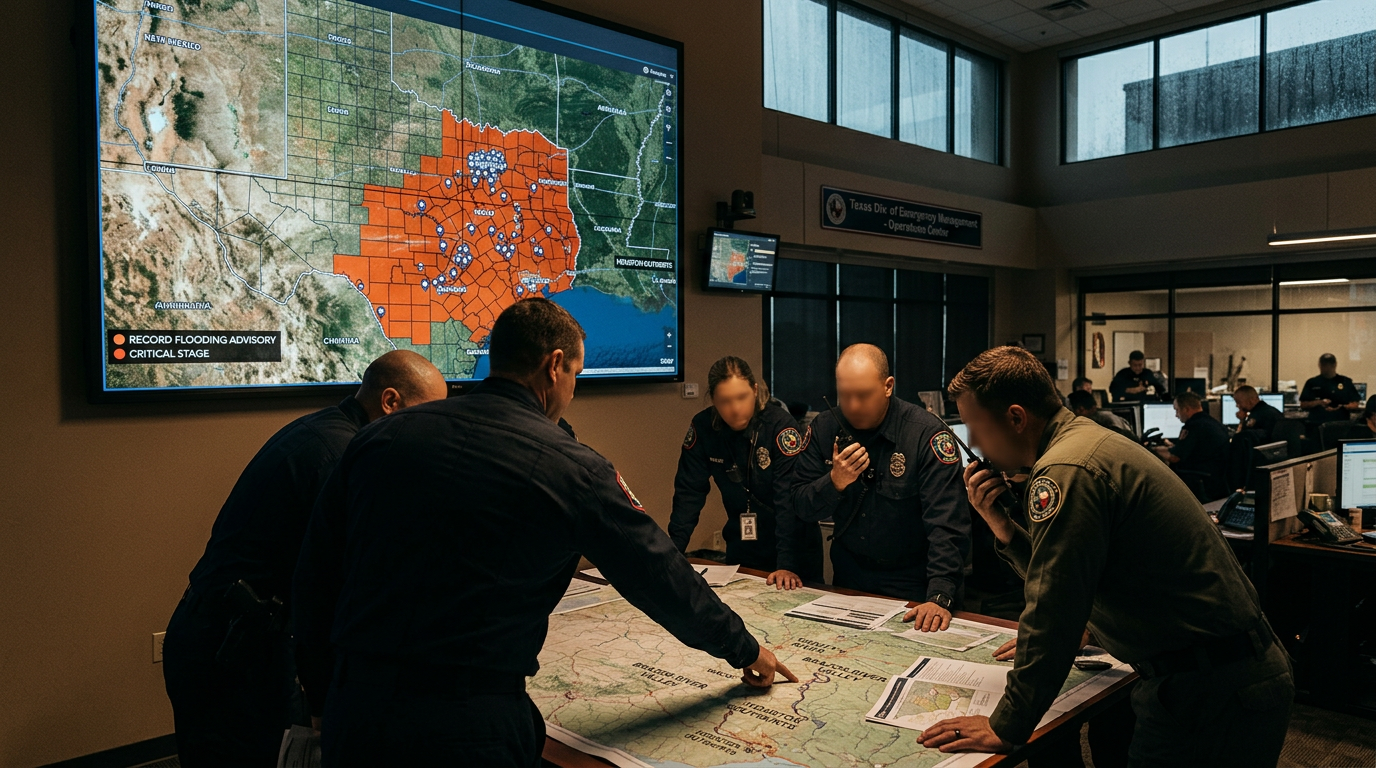
Governor Greg Abbott convened a critical briefing at the State Operations Center in Austin to address the escalating flood crisis currently impacting vast portions of the state. Central to the meeting was the coordination of thousands of state personnel as record-breaking rainfall continues to overwhelm local drainage systems and riverbeds. The Governor emphasized that the preservation of human life is the administration's primary focus as emergency crews work around the clock to mitigate the effects of the deluge. Historical data suggests that Texas is increasingly susceptible to late-season flash flooding, which often follows prolonged periods of drought, creating soil conditions that lead to rapid runoff rather than absorption. This specific weather event follows several weeks of atmospheric volatility, positioning the current crisis as one of the most significant state emergencies in the current fiscal year.
Texas relevance
The flooding crisis directly impacts residents from Central Texas to the Gulf Coast, necessitating a unified response from state agencies based in Austin. In previous years, major flooding in the Texas Hill Country and coastal plains has resulted in billions of dollars in infrastructure damage and significant loss of property. By coordinating the response at the state level, the Office of the Governor ensures that resources move across county lines, which is essential given that many local municipalities lack the heavy equipment needed for high-water rescues. This state presence is a vital component of the Texas emergency management framework, providing a safety net for communities overwhelmed by the sheer volume of precipitation.
Logistical Scale of the State Deployment
The state has committed a massive force of over 2,350 emergency responders to the affected areas. This personnel cohort includes members of the Texas Department of Public Safety, the Texas Parks and Wildlife Department's water rescue teams, and the Texas National Guard. These individuals are trained specifically for the unpredictable nature of flash flood environments, where water levels can rise several feet in a matter of minutes, trapping motorists and residents in low-lying areas.
Supporting these personnel is a fleet of more than 1,400 specialized vehicles. This fleet includes high-profile trucks capable of navigating streets that are impassable for standard civilian cars, as well as airboats and traditional watercraft for search and rescue operations. The logistical challenge of positioning these assets involves constant communication between the State Operations Center in Austin and local emergency management coordinators who identify the highest-priority targets for intervention.
The deployment is not limited to active rescue teams but also encompasses logistical support staff who manage the supply chains for fuel, food, and medical supplies. Maintaining this massive mechanical and human presence requires a sophisticated hub-and-spoke distribution model, ensuring that as water moves downstream, state resources can be repositioned southward ahead of the cresting rivers.
Record-Breaking Rainfall and Infrastructure Stress
Meteorological reports provided during the briefing indicated that many parts of the state are experiencing rainfall totals that exceed historical records for this time of year. These 'rain bombs' place immense pressure on the state's aging dam and levee systems. In rural Texas, where infrastructure may not have been upgraded to handle the volume of modern extreme weather events, the risk of breach or overspill is a constant concern for state engineers monitoring the situation.
Urban centers face a different set of challenges, as Concrete-heavy environments prevent natural drainage. The Governor’s briefing highlighted the necessity of keeping the state's drainage channels clear of debris, which can exacerbate flooding by creating makeshift dams. State utility workers are also working alongside emergency responders to stabilize power grids and water treatment plants that are frequently the first critical infrastructure components to fail during submerged conditions.
The financial impact on Texas infrastructure is estimated to be significant. Roadways in the path of the floodwaters are prone to 'scouring,' where the force of the water removes the underlying support material, leading to collapses or long-term structural instability. The Texas Department of Transportation is currently surveying these roads as water recedes to issue closure notices and plan for long-term reconstruction projects once the weather clears.
Public Safety Protocols and 'Turn Around, Don't Drown'
A recurring theme in the Governor's address was the importance of individual responsibility and adherence to established safety protocols. High-water crossings remain the most lethal environment during these storms, as even a few inches of moving water can exert enough force to sweep a heavy vehicle off the road. The 'Turn Around, Don't Drown' campaign has been the cornerstone of Texas flood safety for years, and its principles were reiterated as the primary defense against preventable fatalities.
Many residents often underestimate the depth of water on familiar roads, leading to dangerous situations where first responders must risk their lives to perform rescues. The Governor urged all Texans to monitor local news and official social media channels for real-time updates on road closures. In many instances, state officials have noted that digital maps and GPS services do not update fast enough to reflect the sudden appearance of floodwaters on rural highways.
Beyond immediate road safety, the state is advising residents in flood-prone zones to prepare 'go-bags' and have evacuation plans ready. State officials stressed that when a mandatory evacuation order is issued by local authorities, it is based on predictive modeling that suggests a high probability of life-threatening conditions. Delaying an evacuation can lead to situations where residents are stranded on rooftops, necessitating high-risk helicopter extractions.
The Role of the State Operations Center (SOC)
The State Operations Center serves as the brain of the Texas disaster response mechanism. Operating out of Austin, the SOC brings together representatives from dozens of state agencies, including the Texas Division of Emergency Management (TDEM). This centralization allows for the immediate cross-referencing of weather data with available resources, making the deployment process much faster than a fragmented local-only response.
During the current flooding event, the SOC is operating at an elevated readiness level. This means that staffing has been increased to ensure 24/7 monitoring of the storm systems moving across the state's diverse geography. Technical experts at the center use advanced mapping software to predict which river basins will reach flood stage next, allowing the Governor to preemptively declare disasters in specific counties to unlock state and federal funding.
The collaboration within the SOC also includes non-governmental organizations like the Red Cross and the Salvation Army. By integrating these groups into the state's official response plan, the Governor ensures that once the immediate rescue phase is over, the transition to sheltering and long-term recovery is seamless for the affected citizens.
Environmental and Agricultural Long-Term Impact
While the immediate focus is on human safety, the state is also looking at the long-term consequences for the Texas environment and its massive agricultural sector. Flooding at this scale can wash out thousands of acres of crops and drown livestock, leading to severe economic losses for rural families. The Texas Department of Agriculture is currently assessing the potential for crop insurance claims and emergency assistance for farmers located in the flood zones.
Environmentally, massive flooding events can lead to the contamination of water sources. Runoff from industrial sites and urban areas often carries pollutants into the river systems, which then terminate in the Gulf of Mexico. State environmental agencies are preparing to conduct water quality tests once the flooding subsides to ensure that municipal water supplies remain safe for consumption and that the state's fisheries are not compromised.
There is also the concern of soil erosion on a massive scale. The loss of topsoil during heavy rain events can have lasting effects on land productivity. State conservationists are expected to play a major role in the aftermath, helping landowners implement best practices for soil stabilization and debris removal to prevent future erosion during the remainder of the hurricane and storm season.
The Future of Flood Mitigation in Texas
This current crisis has renewed discussions about the long-term investment required for flood mitigation across the state. In past legislative sessions, Texas voters have approved billions of dollars in funding for the Texas Water Development Board to finance drainage projects. However, the speed of rural and urban development often outpaces the construction of these mitigation systems, creating new vulnerabilities.
The Governor’s update serves as a reminder that disaster response is only one half of the equation; the other half is forward-thinking engineering. Future projects are expected to focus on 'nature-based' solutions, such as preserving wetlands that act as natural sponges, alongside traditional concrete infrastructure like reservoirs and underground bypass tunnels.
As the state continues to grow in population, the pressure on its natural and man-made systems will only increase. Today's response at the State Operations Center is a testament to the current administration's ability to handle immediate threats, but it also highlights the ongoing need for a comprehensive, statewide strategy to manage the 'new normal' of extreme weather patterns in the Lone Star State.
Analysis
The scale of the state's mobilization suggests that internal meteorologists and risk assessment teams anticipate the conditions to worsen before they stabilize. By deploying over 2,000 responders before the full impact of the storm peaks, the Governor is leaning into a proactive management style designed to reduce the need for reactive, high-risk rescues. This strategy also serves as a communication tool, signaling to the public and potential private insurers that the state is treating the situation with the highest level of gravity. Politically and logistically, the efficacy of the State Operations Center during these windows of crisis defines the public's perception of state government competence, making these early-stage deployments critical for maintaining public trust.
Source attribution
This story was reported using a public release from the Office of the Governor. Keep TX Red rewrote the coverage independently and links to the official statement for verification.
Frequently Asked Questions
- How many state personnel are currently involved in the flood response?
- Over 2,350 state emergency responders have been deployed, including teams from the Texas Department of Public Safety and the Texas National Guard.
- What should I do if I encounter a flooded road while driving?
- You should always 'Turn Around, Don't Drown.' Even small amounts of moving water can sweep a vehicle off the road, and it is impossible to know if the underlying pavement has been washed away.
- Where is the state coordinating its disaster response from?
- The response is being managed out of the State Operations Center (SOC) in Austin, which serves as the central command for all state agencies and resources.
- Has the Governor declared a state of emergency?
- The Governor is providing continuous updates and mobilizing all necessary resources; local and state declarations are issued as specific criteria are met by county-level damage reports.
- How can I stay updated on road closures and safety warnings?
- Texans should monitor local news, check official social media from the Texas Division of Emergency Management, and visit DriveTexas.org for real-time road conditions.
Official Sources
Take the next step
Browse the Newsroom →Read more about Keep Texas Red → Our full guide to what Keep Texas Red means and why Texans support it.
Related Articles

Get Texas updates delivered weekly.
Independent Texas reporting on politics, policy, and daily life. One email a week. Unsubscribe anytime.
Keep TX Red Newsroom
The Keep Texas Red Editorial Staff produces nonpartisan explainers, policy breakdowns, and educational resources to help Texans understand how their government works. All content is reviewed for accuracy and updated regularly.
About Keep TX Red →