Governor Abbott Initiates Hill Country Recovery Efforts Following Record Flooding in Kerrville
Governor Abbott surveys flood damage in Kerr County, initiating debris removal and state-led rebuilding efforts for nearly 500 impacted homes.
Editorial disclaimer: Opinions and analysis on Keep TX Red are editorial content — not statements of fact. See our editorial standards.
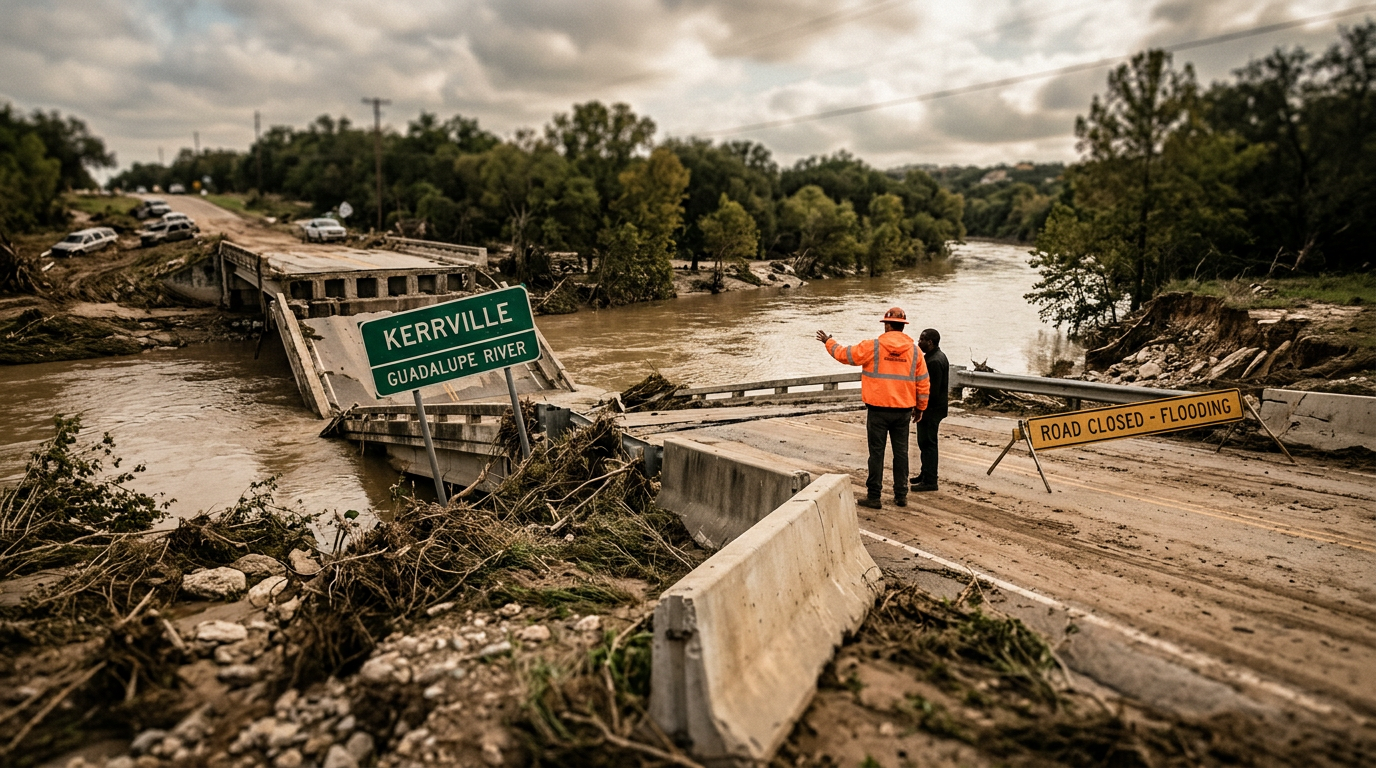
Governor Greg Abbott recently conducted an aerial survey of the Kerrville area following a series of devastating floods that swept through the Texas Hill Country. This surveillance mission allowed state leadership to assess the structural integrity of critical infrastructure, including bridges and secondary roadways that were submerged during the height of the storm. Historically, Central Texas and the Hill Country are known as 'Flash Flood Alley' due to the region's unique topography and thin soil layers, which provide little absorption for high-intensity rainfall. This geological reality has frequently put local communities at risk, necessitating a high level of preparedness and rapid state response when large-scale weather systems stall over the Edwards Plateau. The current recovery operation marks a transition from immediate life-saving rescues to long-term reconstruction and cleanup. State agencies are now pivoting their resources to assist local municipalities with the logistical challenges of removing massive amounts of debris and restoring utility services. Initial damage assessments indicate that nearly 500 residences suffered varying degrees of impact, ranging from minor water intrusion to total destruction. The Governor has emphasized that the timeline for recovery will depend heavily on the coordination between local officials and state agencies like the Texas Division of Emergency Management.
Texas relevance
The flooding in the Kerrville area highlights a recurring vulnerability for residents of the Texas Hill Country. As one of the state’s most scenic regions, it attracts significant tourism and residential growth, yet it remains one of the most flood-prone areas in North America. For Texans living in Kerr and surrounding counties, these state-led recovery efforts are vital for restoring economic stability and ensuring that local infrastructure can withstand future environmental challenges. The state’s involvement provides the necessary capital and equipment that smaller jurisdictions often lack when facing widespread property damage across rural and suburban landscapes.
The Transition to Cleanup and Debris Management
As the floodwaters recede across the Kerrville landscape, the most immediate physical challenge is the accumulation of debris. This includes destroyed household goods, fallen timber, and sediment deposits that have blocked drainage systems and local thoroughfares. The Governor’s office has confirmed that state resources are being deployed to assist Kerr County officials in streamlining the collection and disposal process, which is often the most expensive phase of disaster recovery.
Effective debris management is critical for restoring the flow of commerce in the region. Many affected residents in the Hill Country rely on well-maintained roads for access to essential services. By prioritizing the clearance of critical infrastructure first, the state ensures that a framework for broader residential reconstruction is established. Local contractors are being integrated into the state’s response plan to ensure that economic benefits of the cleanup stay within the impacted community.
Furthermore, the Texas Division of Emergency Management is working to establish temporary debris management sites. these locations serve as staging areas where materials can be sorted and processed before final disposal. This systematic approach is designed to reduce the environmental footprint of the cleanup while maximizing the speed at which neighborhoods can return to a sense of normalcy.
Quantifying the Residential Impact
Data from the initial damage surveys suggest that approximately 490 homes were touched by the floodwaters. While this number is substantial for a community the size of Kerrville, it allows state responders to create a targeted map of the most affected zones. These homes represent families who are now navigating the complex process of insurance claims and temporary housing, necessitating a coordinated support system from both the public and private sectors.
The state's assessment includes not just the number of homes, but the severity of the damage. By categorizing properties into different tiers of impact, the Texas Department of Housing and Community Affairs can better direct resources toward those in the greatest need. This categorical approach helps prevent the misallocation of materials and funds, ensuring that the most vulnerable populations receive priority attention during the rebuilding phase.
Beyond the structural damage, the emotional and financial toll on homeowners is significant. The Governor’s office has pointed to the Rebuild Texas website as a primary conduit for those seeking to offer financial aid. These private donations often fill the gaps left by federal and state programs, providing immediate relief for necessities like clothing, food, and temporary lodging that are not always covered by traditional disaster grants.
Evaluating Infrastructure and Roadway Safety
During the aerial survey, significant attention was paid to the condition of bridges and roadways. The Hill Country’s terrain often results in high-velocity water flow, which can scour the foundations of bridges and wash out sections of asphalt. Engineers from the Texas Department of Transportation are currently on the ground conducting detailed inspections to determine which routes are safe for heavy machinery and residential traffic.
Safety remains the primary concern as long-term repairs begin. Some roads may appear stable on the surface but could have underlying structural compromises caused by soil erosion. State officials have urged residents to obey all road closure signs and avoid crossing low-water bridges until they have been officially cleared. These precautionary measures are essential to prevent further accidents as the cleanup process moves forward.
The restoration of critical infrastructure also includes the repair of utility lines. Power and water services in some low-lying areas were interrupted during the storm to prevent electrical hazards and contamination. Utility crews are working alongside debris removal teams to safely restore these services, which is a prerequisite for many homeowners to begin their own internal repairs and sanitation efforts.
State and Local Coordination
The success of the Kerrville recovery effort hinges on the seamless cooperation between different levels of government. Governor Abbott’s visit serves as a formal signal that state-level assets—ranging from the National Guard to specialized environmental teams—are fully committed to the region. This top-down support provides local mayors and county judges with the logistical backing needed to manage a large-scale crisis without depleating local municipal budgets.
Regular briefings are being held to ensure that message consistency is maintained across all agencies. This is particularly important for informing the public about where to find resources and how to report additional damage that may not have been captured in the first round of surveys. Communication lines remain open between the Kerr County emergency operations center and the state's central command in Austin.
By integrating local knowledge with state power, the response team can address specific regional challenges, such as the unique drainage patterns of the Guadalupe River. Local officials provide the 'ground truth' that allows state resources to be deployed more precisely, avoiding the 'one-size-fits-all' approach that can sometimes hinder disaster relief in geographically diverse states like Texas.
The Role of Volunteerism and Private Charity
In the wake of the floods, the 'Texas Spirit' has been on full display as volunteers from across the state have traveled to the Hill Country to assist with muck-out operations. These grassroots efforts provide immediate labor that is essential in the days following a flood. Organizations such as provide tools, labor, and expertise to help residents strip damaged drywall and flooring before mold can set in.
The Governor specifically highlighted the importance of the Rebuild Texas Fund, which acts as a centralized hub for charitable contributions. By directing donors to a verified platform, the state helps ensure that funds are used effectively and reach those truly in need. This collaborative environment between the government and non-profit sectors creates a comprehensive safety net for the community.
Long-term recovery often lasts much longer than the initial media attention. Private charities play a crucial role in the months following a disaster, providing for the long-term mental health and financial stability of survivors. Maintaining the momentum of these volunteer efforts is a goal of the state leadership as they work to ensure no Texan is left behind during the transition back to normalcy.
Future Mitigation and Planning
While the current focus is on recovery, state leaders are also looking toward future mitigation strategies. Every flood event provides new data on how water moves through the landscape and where previous infrastructure improvements held up or failed. This data will be used to inform future building codes and the construction of more resilient drainage systems throughout the Hill Country.
Investing in mitigation is frequently more cost-effective than repeatedly paying for recovery. The state is exploring various grant programs that could fund the elevation of homes or the expansion of culverts in high-risk zones. By learning from the Kerrville event, Texas aims to harden its communities against the inevitable return of severe weather systems.
The Governor’s update serves as a reminder that disaster preparedness is an ongoing commitment. As the climate and population of Texas continue to evolve, the strategies used to protect its citizens must also advance. The current rebuilding process is not just about restoring what was lost, but about building back in a way that is stronger and better prepared for the challenges of the future.
Analysis
This response reflects the State of Texas's evolved disaster management strategy, which prioritizes rapid assessment and decentralized recovery pipelines. By utilizing the 'Rebuild Texas' fund, the administration is encouraging a public-private partnership model to mitigate costs to the taxpayer while accelerating the delivery of aid. The Governor's focus on debris removal is particularly strategic; in previous Texas floods, the failure to move waste quickly led to secondary public health concerns and hindered the access of insurance adjusters, which in turn delayed the reimbursement of homeowners. This proactive stance aims to prevent the bureaucratic bottlenecks seen in historical flood events like those following Hurricane Harvey or the 2015 Memorial Day floods.
Source attribution
This story was reported using a public release from the Office of the Governor. Keep TX Red rewrote the coverage independently and links to the official statement for verification.
Frequently Asked Questions
- What is the primary focus of the state's current efforts in Kerrville?
- The primary focus has shifted from immediate emergency response to debris removal, infrastructure repair, and assisting homeowners with the rebuilding process. The state is working alongside local officials to clear roadways and conduct thorough damage assessments to prioritize aid distribution.
- How many homes were affected by the recent flooding?
- Based on the latest surveys conducted by the Governor and emergency management teams, roughly 490 homes in the affected area sustained some level of damage. This number may be refined as ground teams complete more granular inspections of individual neighborhoods.
- How can I help Texans impacted by these floods?
- Governor Abbott recommends that those wishing to contribute should visit rebuildtx.org. This platform is a primary resource for donations and ensures that financial support is directed toward the communities most affected by the severe weather.
- Is it safe to drive through the Hill Country after the floods?
- While many roads are reopening, several bridges and low-water crossings may still be closed for inspection or repair. Residents are urged to follow all official signage and avoid driving through any remaining water or onto roads that have not been cleared by the Texas Department of Transportation.
Official Sources
Take the next step
Browse the Newsroom →Read more about Keep Texas Red → Our full guide to what Keep Texas Red means and why Texans support it.
Related Articles
Get Texas updates delivered weekly.
Independent Texas reporting on politics, policy, and daily life. One email a week. Unsubscribe anytime.
Keep TX Red Newsroom
The Keep Texas Red Editorial Staff produces nonpartisan explainers, policy breakdowns, and educational resources to help Texans understand how their government works. All content is reviewed for accuracy and updated regularly.
About Keep TX Red →