Dallas Community Launches West Dallas History and Economics Book Club Near Trinity Groves
A new Dallas history book club is launching in the West Dallas and Trinity Groves area, focusing on economic history and flexible membership rules.
Editorial disclaimer: Opinions and analysis on Keep TX Red are editorial content — not statements of fact. See our editorial standards.
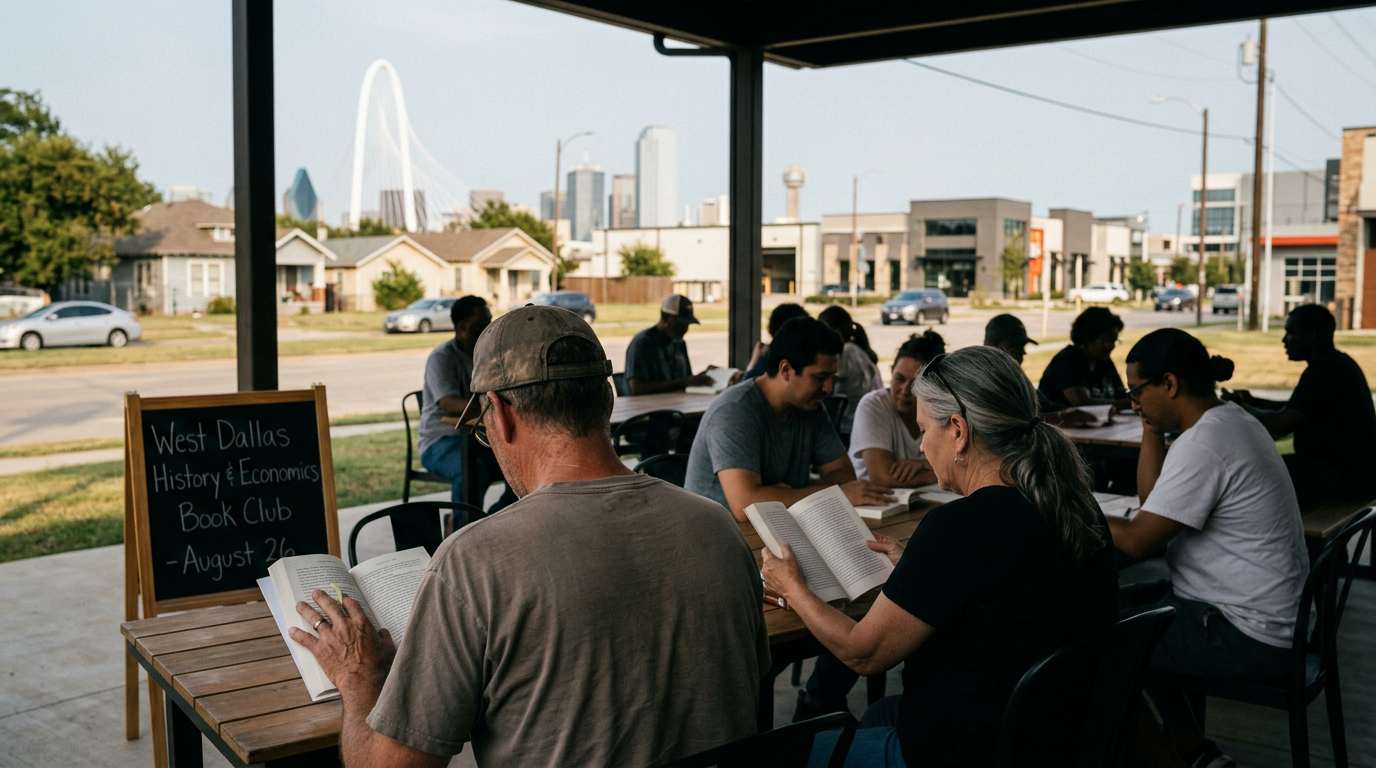
A new intellectual community is forming in the heart of Dallas as local enthusiasts launch a specialized history book club based in the West Dallas and northern Oak Cliff neighborhoods. Scheduled to begin its monthly cycle on August 26, 2026, the group aims to provide a relaxed but intellectually stimulating environment for residents near the Trinity Groves and Downtown areas. Unlike traditional reading groups that enforce strict adherence to a specific text, this initiative prioritizes the conceptual exchange of ideas over finished reading lists, allowing for a more inclusive approach to adult education and community building. This project joins a long tradition of grassroots Texas literary societies that serve as informal educational hubs outside of institutional settings. The startup of this club reflects a growing trend in urban Texas centers where young professionals and lifelong learners seek physical spaces to discuss complex global issues. By focusing on the intersections of history, economics, and social studies, the organizers hope to attract a diverse group of participants who are interested in how past events shape current societal structures. The first meeting will feature a discussion on Kenneth Pomeranz’s influential work regarding global economic shifts, providing a high-level academic starting point for what is intended to become a consistent monthly fixture in the burgeoning West Dallas social scene.
Texas relevance
This initiative is particularly relevant to the Dallas-Fort Worth metroplex as the city continues to see rapid redevelopment in areas like West Dallas and Trinity Groves. As these neighborhoods transform from industrial and residential zones into mixed-use cultural hubs, the demand for community-led intellectual forums increases. Texas has historically fostered strong local networks for civic engagement, and this book club represents a modern iteration of that spirit within one of the state's most dynamic urban environments. It offers a unique opportunity for residents of Oak Cliff and Downtown Dallas to engage with their neighbors on topics that explain the very economic forces currently reshaping their own city skyline.
Bridging the Gap Between Oak Cliff and Downtown
The selection of the Trinity Groves area for this new club is strategic, sitting as a bridge between the historic residential neighborhoods of northern Oak Cliff and the booming commercial expansion of West Dallas. As the Dallas skyline continues to evolve, the space between these districts has become a focal point for new residents who are seeking social connections that go beyond typical bar and restaurant interactions. The club offers a dedicated outlet for those who want to explore the history of the world from a local vantage point.
Historically, the West Dallas area has been defined by its industrial roots and its proximity to the Trinity River. By hosting a history and economics club here, the organizers are layering a new level of cultural engagement onto a district that is currently experiencing a massive influx of investment and population growth. This movement helps solidify the area's reputation not just as a dining destination, but as a residential community with a high premium on shared learning and intellectual curiosity.
A Unique Curatorial Focus on Economic History
The primary focus of this group sits at the intersection of history and economics, a niche that often lacks dedicated public forums. While many book clubs focus on contemporary fiction or popular memoirs, this Dallas group is leaning into academic and seminal works that challenge perceptions of how the modern world was built. This focus provides a valuable service to the community by encouraging deep dives into the systemic forces that govern global markets and social hierarchies.
Kenneth Pomeranz’s 'The Great Divergence'—the first book on the docket—is a significant choice for a Texas-based group. The book explores why certain parts of the world industrialized faster than others, a question that remains at the core of Texas’s own economic identity as a powerhouse of energy and technology. By studying these macro trends, members of the club will gain a better understanding of how regional policies and global shifts dictate the growth patterns seen across the Lone Star State today.
Lowering Barriers to Intellectual Participation
One of the most innovative aspects of this new Dallas club is its 'reading optional' policy. The organizer has explicitly stated that those who listen to related podcasts or read similar books on the same topic are more than welcome to attend and contribute. This methodology recognizes that the goal of a book club should be the exchange of knowledge rather than the completion of a specific task, making it more accessible to working professionals who may struggle to finish a dense 500-page academic text within a single month.
This inclusive approach also encourages a wider variety of viewpoints. Someone who has listened to an interview with an author or read a critiquing essay of the month's selection may bring a perspective that those who only read the primary text might miss. In the context of the Dallas social landscape, this flexibility helps build a 'small but dedicated group' that can sustain itself even when members have varying levels of free time during the month.
The Evolution of Dallas Social Clubs
For decades, the social fabric of Dallas was often woven through large-scale institutions, country clubs, or corporate networking events. However, the last decade has seen a shift toward more grassroots, specialized organizations that cater to specific interests like urban planning, historical preservation, or economic theory. This book club is a prime example of the decentralized social structures that are becoming common in North Texas, where individuals take the lead in curating their own cultural experiences.
These smaller, member-led groups often provide a more authentic sense of belonging than larger, more formal organizations. For residents of West Dallas, having a local group to walk or drive a short distance to on a Wednesday night creates a neighborhood rhythm that is essential for urban stability. As more people move to the Dallas core from other states, these types of community anchors help integrate newcomers into the local culture through shared interests rather than just proximity.
Planning for Consistency and Growth
The group’s inaugural meeting on August 26, 2026, is aimed at setting a consistent monthly cadence. Maintaining a small but dedicated group is a priority for the organizer, as it allows for deeper conversations where every voice can be heard. This format is particularly effective for complex subjects like 'The Great Divergence,' where a large crowd might stifle the ability to explore complicated economic data or historical nuances.
Looking forward, the group has the potential to become a significant part of the West Dallas intellectual ecosystem. If the initial meetings are successful, it could lead to collaborations with local libraries, independent bookstores, or even historical societies across the DFW area. For now, the focus remains on building a core membership of 'history buffs' who are eager to spend their evenings dissecting the social and economic forces that have shaped the human experience over the centuries.
Navigating the Social Studies Landscape in Texas
In a state where education and social studies curriculum are often topics of public debate, independent reading groups like this one offer a space for adults to engage with history on their own terms. These environments allow for the exploration of diverse historical theories and economic models outside of any political or institutional framework. This independence is a hallmark of the Texas spirit, valuing self-education and the free exchange of ideas among neighbors.
By hosting these discussions in a public or semi-public setting near Downtown, the club reinforces the idea that history is a living subject. Conversations about the 'Great Divergence' in the 19th century naturally lead to discussions about the present day, providing participants with the tools to better analyze contemporary news, policy changes, and market trends. For the residents of Dallas, this is about more than just reading; it is about becoming more informed citizens of their city and the world.
Analysis
The decision to make reading the primary text 'optional' is a clever strategy to lower the barrier to entry for busy Texans while still fostering rigorous discussion. In an era where long-form reading often competes with podcasts and digital media, this flexible model acknowledges the realities of modern schedules without sacrificing the quality of intellectual discourse. By selecting 'The Great Divergence' as the pilot text, the group signals an interest in the foundational elements of global trade and development—topics that resonate deeply in Texas, a state that remains a global leader in exports and logistics. This club could serve as a blueprint for other neighborhood-level educational collectives seeking to bridge the gap between academic theory and community conversation.
Source attribution
This story was reported using a public release from the r/dallas. Keep TX Red rewrote the coverage independently and links to the official statement for verification.
Frequently Asked Questions
- Where exactly will the book club meet?
- The meetings are centered in the West Dallas and northern Oak Cliff region, specifically near the Trinity Groves development and within close proximity to Downtown Dallas.
- Do I have to finish the book to attend the meeting?
- No. The club organizer has specified that reading the book is optional. Participants can join the discussion if they have listened to related podcasts, read similar books, or simply have an interest in the month's topic.
- What is the primary focus of the reading material?
- The club focuses on history, economics, and social studies, with a leaning toward academic and seminal texts that explain global historical shifts.
- How often does the group plan to meet?
- The organizer intends to hold meetings once a month to build a consistent and dedicated community of history buffs.
- Who is the intended audience for this group?
- The club is open to anyone interested in history and economics, specifically those living in or near the West Dallas, Oak Cliff, and Downtown areas who want an intellectual social outlet.
Official Sources
Take the next step
Browse the Newsroom →Read more about Keep Texas Red → Our full guide to what Keep Texas Red means and why Texans support it.
Related Articles

Get Texas updates delivered weekly.
Independent Texas reporting on politics, policy, and daily life. One email a week. Unsubscribe anytime.
Keep TX Red Newsroom
The Keep Texas Red Editorial Staff produces nonpartisan explainers, policy breakdowns, and educational resources to help Texans understand how their government works. All content is reviewed for accuracy and updated regularly.
About Keep TX Red →