Comfort Preserves Small-Town Heritage to Advance Hill Country Slow-Tourism Movement
Discover how the historic town of Comfort, Texas is becoming a national model for sustainable heritage tourism and rural preservation.
Editorial disclaimer: Opinions and analysis on Keep TX Red are editorial content — not statements of fact. See our editorial standards.
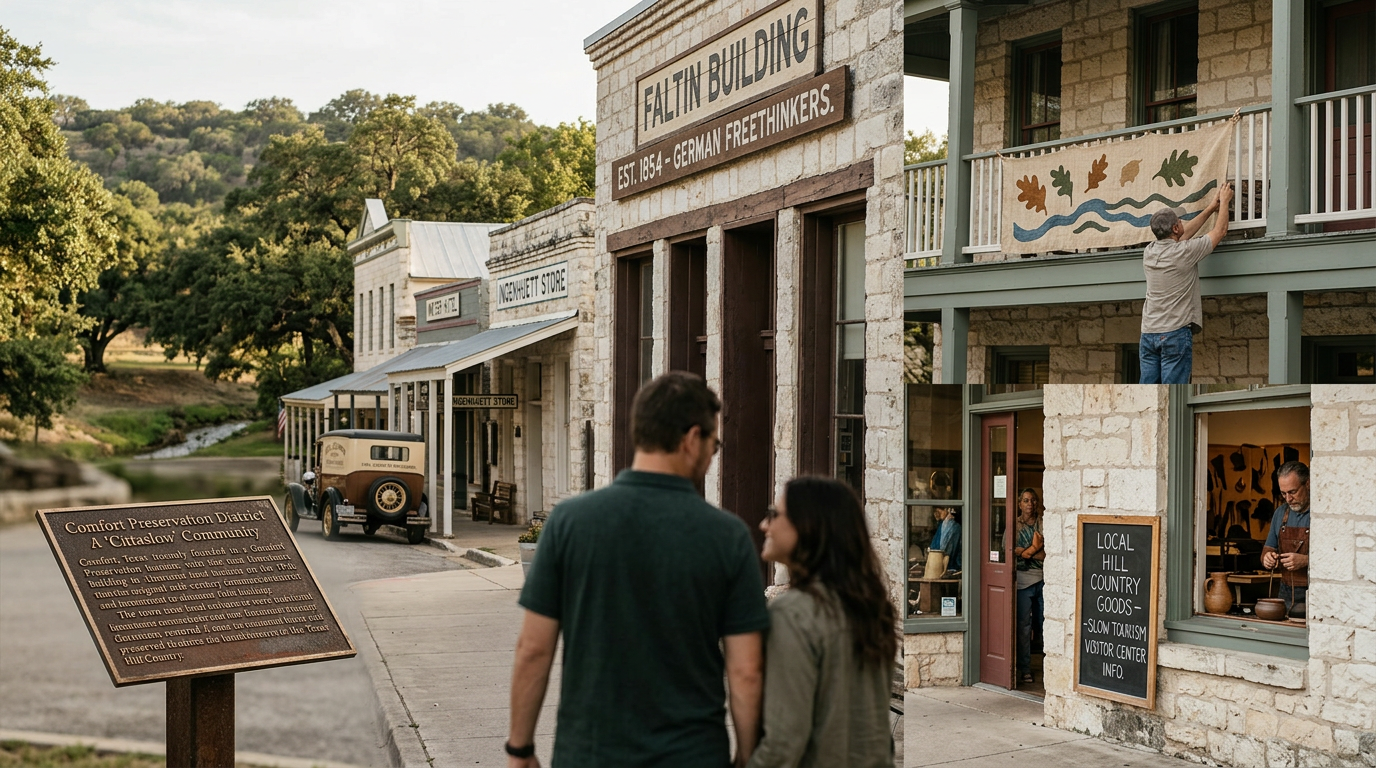
The unincorporated community of Comfort, Texas, is gaining international recognition for its commitment to 'slow tourism,' a movement that prioritizes cultural immersion and historic preservation over rapid commercial development. Established in 1854 by German Freethinkers, the town has managed to maintain one of the most intact 19th-century business districts in the United States. While many neighboring Hill Country towns have succumbed to heavy urbanization and franchise expansion, Comfort's leadership and business owners have focused on revitalizing existing structures. This approach seeks to balance modern economic needs with the protection of the town's unique architectural legacy. Historically, Comfort served as a midpoint for freighting between San Antonio and Fredericksburg, and that spirit of mid-journey respite is now being rebranded for 21st-century travelers seeking an escape from digital saturation. The current initiative involves a strategic blueprint for high-value, low-impact travel. Local stakeholders are emphasizing the reuse of historic inns, general stores, and gathering halls to host visitors without constructing high-rise hotels or intrusive infrastructure. This sustainable model is designed to protect the natural beauty of the Cypress Creek and Guadalupe River areas while ensuring that the town's character remains the primary draw. By focusing on quality of experience over quantity of foot traffic, Comfort is positioning itself as a premier destination for heritage enthusiasts and nature lovers who value authenticity. The effort is not merely about aesthetic appeal; it is a calculated economic strategy to ensure long-term viability for small-town Texas in an era of rapid statewide growth.
Texas relevance
Comfort is located in Kendall County, one of the fastest-growing regions in the entire state of Texas. The town's shift toward slow tourism is a direct response to the pressures of the San Antonio-Austin growth corridor, which threatens to homogenize rural communities. By establishing a blueprint for preservation-based travel, Comfort provides a case study for school districts, local councils, and business owners across the Texas Hill Country who fear losing their cultural identity to suburban sprawl. For Texans, this represents a shift in how rural economies can function without relying on industrial expansion or mass-market retail, providing a template for preserving the state's deep German and pioneer roots.
The Rise of Slow Tourism in Texas
In a state known for being 'bigger and faster,' the concept of slow tourism represents a significant cultural pivot. This philosophy encourages travelers to stay longer in one location, eat at locally owned establishments, and engage deeply with the local geography and history. In Comfort, this is manifested through the adaptive reuse of buildings like the hotel designed by renowned architect Alfred Giles, which continues to anchor the town’s hospitality sector.
The movement serves as a counterweight to the 'Instagrammable' tourism that often leads to overcrowded destinations. Instead of seeking a single photo-opportunity, visitors are encouraged to explore the antique shops along High Street or spend an afternoon by the banks of the Guadalupe River. This deliberate slowing down helps mitigate the environmental impact on the delicate Hill Country ecosystem, ensuring that the local groundwater and wildlife habitats are not overwhelmed by seasonal surges.
Local entrepreneurs have found that this model attracts a demographic of travelers who are willing to pay a premium for silence, privacy, and historical context. This higher spending per visitor allows the town to thrive economically even with smaller crowds than nearby Fredericksburg or New Braunfels. The focus is squarely on the intrinsic value of the location rather than the extrinsic gadgets of modern entertainment.
Architectural Integrity as an Economic Asset
Comfort boasts nearly 100 historic structures within a walking radius of its center, many of which date back to the mid-to-late 1800s. The preservation of these buildings is not just a matter of pride; it is the town's most potent economic engine. By refusing to tear down weathered facades for modern parking lots or shopping centers, the community has preserved a tangible link to the Texas frontier that is increasingly rare.
The blueprint for this 'Southern Escape' involves rigorous standards for renovations. Property owners often work with historical societies to ensure that materials and methods remain consistent with the original craftsmanship. This dedication prevents the 'theme park' feel that can occur when history is simulated rather than saved. The result is a town that feels lived-in and authentic, attracting filmmakers, historians, and tourists alike.
Furthermore, this commitment to architecture has spurred a niche market for specialized trades in Pennsylvania-style timber framing and German stone masonry. Local artisans have seen a resurgence in demand for traditional building techniques, creating a localized economy centered around the maintenance of the town's historic fabric. This ensures that the labor and capital associated with tourism stay within the county.
Balancing Growth and Heritage
One of the primary challenges facing Comfort is its proximity to the rapidly expanding I-10 corridor. As San Antonio grows northward, the pressure to develop the surrounding ranch land into residential subdivisions is immense. The slow tourism initiative acts as a defensive strategy, proving that the land is more valuable in its preserved state than as a generic housing development.
By branding itself as a 'Southern Escape,' Comfort is successfully lobbying for its own survival. The town’s status as a National Historic District provides some protections, but the real power lies in the community’s collective refusal to prioritize short-term gains over long-term character. This requires a delicate balance between welcoming new residents and ensuring that the infrastructure—such as the quiet two-lane roads—remains unchanged.
Local leadership emphasizes that growth must be 'incremental rather than exponential.' This means that new businesses are vetted for how they fit into the existing skyline and community culture. The aim is to foster an environment where a visitor from the 1880s would still recognize the streets, even if the horses have been replaced by classic cars and bicycles.
The Cultural Impact of the German Freethinkers
To understand Comfort’s modern appeal, one must understand its founders. The German Freethinkers who settled the area were intellectuals who valued education, social justice, and a deep connection to the land. This heritage is still palpable in the town’s layout and its community events. Unlike many towns of the era, Comfort did not prioritize the construction of a central church, focusing instead on community halls and spaces for rational discourse.
This unique cultural footprint makes Comfort a standout destination for those interested in the 'other' history of Texas. The Treue der Union monument, the only monument to the Union outside of the North to be located on former Confederate soil, serves as a poignant reminder of the town’s independent spirit. This history is a core component of the slow tourism experience, offering educational depth that goes beyond traditional leisure.
Today’s residents continue this tradition of independent thought by resisting the homogenization of rural America. The slow-tourism movement is a natural extension of the Freethinker philosophy—it is a rational, well-planned approach to living that rejects the frenetic pace of modern commercialism in favor of a more considered existence.
Future Outlook for Hill Country Preservation
As Texas continues to lead the nation in population growth, towns like Comfort will become increasingly vital as 'cultural preserves.' The blueprint established here is expected to be studied by urban planners across the South. It highlights that the most sustainable form of tourism is one that respects the permanent residents as much as the temporary visitors.
The long-term success of this vision will depend on the continued involvement of the younger generation of Texans. By marketing the town to younger families who value sustainability and history, Comfort is ensuring that its legacy is handed down to those who will continue to protect it. The town is proving that being 'old-fashioned' is actually a forward-thinking survival strategy.
In the coming years, we can expect to see more boutique lodging, farm-to-table dining, and curated heritage tours in Comfort. However, these will be carefully managed to ensure they do not detract from the town’s quietude. The 'New Travel Alert' for Comfort is clear: the town is open for business, but only for those who are willing to slow down and listen to the stories the old buildings have to tell.
Analysis
The success of Comfort’s preservation model suggests a maturing Texas tourism market that is no longer satisfied with generic roadside attractions. By leaning into its 'unincorporated' status, the town avoids some of the bureaucratic hurdles and zoning mandates that often lead to sterile municipal development. This 'slow tourism' push is fundamentally a conservative approach to economic development; it conserves resources, conserves history, and conserves the pace of life that drew residents to the Hill Country in the first place. If other Texas towns follow this lead, the state could see a resurgence in heritage-based entrepreneurship, where the most valuable asset a town owns is its own past.
Source attribution
This story was reported using a public release from the Texas Travel Stories (Google News). Keep TX Red rewrote the coverage independently and links to the official statement for verification.
Frequently Asked Questions
- What exactly is 'slow tourism' in a Texas context?
- In Texas, slow tourism refers to traveling in a way that is sustainable and meaningful. Instead of a 'check-list' approach to sightseeing, it encourages visitors to stay in historic accommodations, support local artisans, and spend time in nature. In Comfort, this means enjoying the town's historic architecture and river access without the distraction of mass-market commercialism or high-traffic amusement venues.
- Is Comfort, Texas, an incorporated city?
- No, Comfort is an unincorporated community. This status has historically given the town more flexibility in how it manages its growth and preservation efforts, though it relies heavily on the Kendall County government and local non-profits to maintain its historic district and public spaces.
- Why is the preservation of Comfort considered a 'blueprint' for other towns?
- Comfort is seen as a blueprint because it has successfully resisted the common pitfalls of rural development, such as the destruction of historic buildings for modern retail. By proving that a town can remain economically vibrant through preservation and 'slowness,' it provides a roadmap for other Texas Hill Country towns facing pressure from urban expansion.
Official Sources
Take the next step
Browse the Newsroom →Read more about Keep Texas Red → Our full guide to what Keep Texas Red means and why Texans support it.
Related Articles

Get Texas updates delivered weekly.
Independent Texas reporting on politics, policy, and daily life. One email a week. Unsubscribe anytime.
Keep TX Red Newsroom
The Keep Texas Red Editorial Staff produces nonpartisan explainers, policy breakdowns, and educational resources to help Texans understand how their government works. All content is reviewed for accuracy and updated regularly.
About Keep TX Red →