Central Texas Wildlife: Rare Green Anoles Spotted Near Spicewood Springs
A rare glimpse into the life of the Texas Green Anole highlights the unique biodiversity of the Austin-area Hill Country during the summer peak.
Editorial disclaimer: Opinions and analysis on Keep TX Red are editorial content — not statements of fact. See our editorial standards.
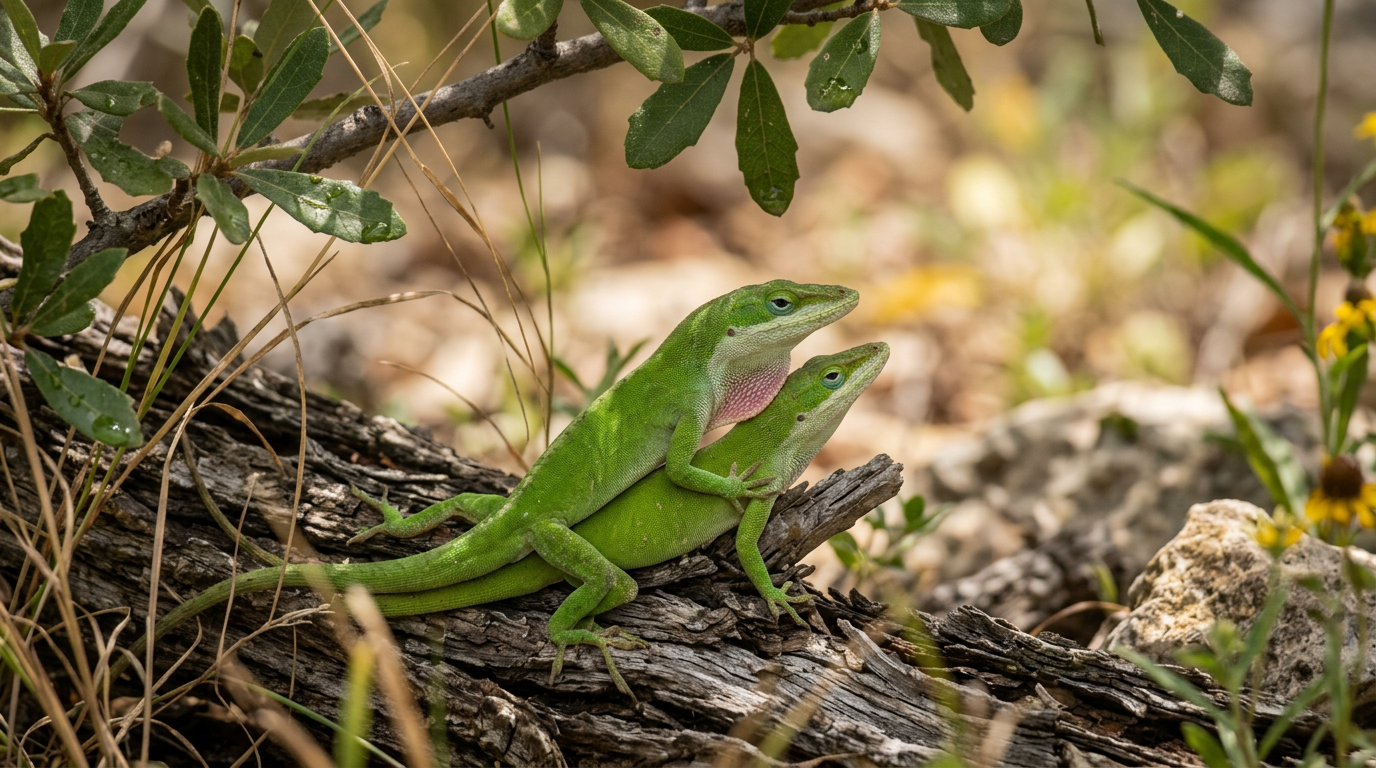
Recent observations in the Texas Hill Country have brought a charming and biologically significant moment to the forefront for local nature enthusiasts. Near the Spicewood Springs area, just outside the Austin city limits, a resident documented two Green Anoles (Anolis carolinensis) in what is technically a mating embrace, though playfully described by observers as a 'hug.' While sighting a single lizard is common across the Lone Star State, capturing a pair in such proximity during the height of the summer sun provides a unique window into the reproductive cycles of native Texas reptiles. Historically, the Green Anole has been a staple of the Southern United States ecosystem, and Texas serves as one of its most vital habitats due to the diverse garden and forest landscapes found in the central region of the state. The photograph, which gained significant traction on local digital platforms, showcases the vibrant coloring and delicate physical traits of these arboreal creatures. This specific sighting is notable not just for the proximity of the animals, but for the location within the rugged terrain of the Hill Country, where limestone outcrops and specific vegetation create microclimates ideal for reptile thermoregulation. The documentation of such behavior serves as a reminder of the thriving urban and peri-urban ecosystems that coexist alongside the rapid development of the Austin metropolitan area. Experts often point to these moments as indicators of a healthy local environment where native species can still find the resources necessary to compete and reproduce.
Texas relevance
This story is deeply rooted in the natural heritage of Central Texas, specifically the intersection of Austin's urban sprawl and the preserved lands near Spicewood Springs. In Texas, the Green Anole holds a special place in the hearts of residents, often referred to as the 'American Chameleon' for its ability to shift colors from bright green to dark brown. These lizards are widely considered the 'good guys' of Texas gardens, as they serve as a natural pest control system, consuming small insects that might otherwise plague local agriculture and home landscapes. For Texans, the presence of these lizards is a hallmark of the state's outdoor identity, and understanding their behavior contributes to a greater appreciation for the conservation of wild spaces in the Hill Country.
Understanding the Texas Green Anole
The Green Anole is a relatively small lizard, typically reaching lengths of five to eight inches, with a long, slender tail and a pointed snout. In Texas, they are most frequently found in areas with high humidity and plenty of vertical structures, such as trees, fences, and the walls of Hill Country homes. Their ability to change color is not for camouflage alone; it is heavily influenced by temperature, stress levels, and social status. When a Texan sees a bright green lizard basking in the sun, it is often a sign that the animal is at its most comfortable and healthy state.
Crucial to their survival in the Texas heat is the dewlap, a colorful throat fan primarily exhibited by males. During the mating season, which typically runs from April through August, males will extend this pink or reddish flap of skin to attract females or to warn off rivals. The sighting near Spicewood Springs occurred during the peak of this seasonal window, highlighting the active biological rhythm that takes place in the background of everyday life in Central Texas. These interactions are essential for the continuation of the species throughout the varied climates of the state.
The Geography of Spicewood Springs and Local Biodiversity
Spicewood Springs represents a unique transition zone between the urban density of Austin and the rolling elevations of the Hill Country. This area is characterized by spring-fed creeks and dense canopies of cedar and oak, which provide the perfect humidity levels for lizards like the Green Anole. Because anoles are primarily insectivores, they thrive in these lush corridors where bug populations are high. The specific terrain around this part of Travis County allows for a higher concentration of reptilian life than more arid parts of Western Texas.
Environmentalists often look to the Spicewood area as a bellwether for the health of Austin's outlying ecosystems. When native species like the Green Anole are observed engaging in reproductive behaviors, it indicates that the local food chain remains intact despite the pressures of human encroachment. These lizards act as a bridge between the world of insects and larger predators, such as Texas birds of prey and snakes, making them a cornerstone of the regional food web that keeps the Hill Country's nature in balance.
Texas A&M AgriLife and Educational Resources
The identification of these creatures is often aided by the extensive work of the Texas A&M AgriLife Extension Service. This statewide agency provides critical data on native species, helping Texans distinguish between the native Green Anole and the invasive Brown Anole, which has begun to move into certain parts of the state. By utilizing these resources, citizen scientists can contribute to a larger body of knowledge that tracks the movements and health of reptile populations across various Texas counties.
Educational outreach is a significant part of the AgriLife mission in Williamson and Travis counties. Through their digital portals and community workshops, they teach residents how to foster environments that support local wildlife. Simple acts like maintaining native plantings or reducing the use of harsh pesticides can ensure that sightings of 'hugging' lizards remain a common treat for the next generation of Texans. This partnership between public university research and community observation defines the modern approach to conservation in the state.
Seasonal Behaviors and the Texas Sun
Summer in Texas is the prime time for reptile activity because anoles are ectothermic, meaning they rely on external heat sources to regulate their body temperature. The intense sunshine typical of a July afternoon in Austin provides the energy these lizards need for hunting and mating. However, excessively high temperatures can also drive them into the shade of Texas porches or dense shrubs. The observers near Spicewood Springs caught these lizards during a perfect thermal window where they were active enough to engage in social interaction.
During this time of year, it is common to see Getty-like displays of territoriality among lizards on Texas fences. While the photograph captured a moment of reproduction, it is just as common to see 'push-up' contests where males bob their heads to assert dominance. These behaviors are fascinating to watch and represent the complex social hierarchies that exist within even the smallest members of the Texas wild. For nature photographers in the Austin area, the summer months offer the best lighting and the highest probability of catching these animals in action.
Distinguishing Native Species from Invasive Intruders
One of the reasons this sighting is celebrated is that the Green Anole is a native Texan, whereas its relative, the Brown Anole (Anolis sagrei), is an introduced species from the Caribbean and Florida. The Brown Anole is often more aggressive and tends to stay closer to the ground, whereas the native Green Anole prefers the heights of trees and rooftops. In many urban parts of Texas, the native species is being pushed higher into the canopy or forced out entirely by the invaders, making a documented pair in the Hill Country a positive sign of a native stronghold.
Texans can help their native lizards by providing diverse habitat heights in their backyards. Since Green Anoles are adaptable but prefer their space, a healthy mix of tall trees and shrubs allows them to find niches that the invasive Brown Anoles might not occupy. Understanding this distinction is key for local conservationists who want to preserve the specific biological heritage of the Central Texas region. Reports of thriving Green Anole pairs suggest that the native species is still holding its ground in the canyons and springs outside Austin.
The Value of Citizen Science in the Lone Star State
The fact that a simple walk in the Hill Country led to a widely shared scientific observation highlights the power of citizen science. In a state as large as Texas, professional wildlife biologists cannot be everywhere at once. When residents use their cameras and smartphones to document nature, they provide 'eyes on the ground' that can help track species migration and reproductive health. This data is invaluable for local parks and wildlife departments as they plan for the future of Texas's green spaces.
Furthermore, these documented moments foster a sense of stewardship among the public. When a photo of 'hugging' lizards goes viral, it sparks a conversation about the species and its habitat. This awareness often translates into support for regional conservation efforts and a greater respect for the wildlife that shares the Texas landscape. Whether in the heart of Austin or the outskirts near Spicewood Springs, the connection between Texans and their native environment is strengthened through these shared observations.
Analysis
While this observation is framed as a lighthearted moment of 'hugging,' it actually underscores the resilience of native Texas species in the face of ongoing climate and habitat shifts. As Austin continues to expand, the preservation of corridor habitats like those found near Spicewood Springs remains crucial for maintaining the state's biodiversity. The viral nature of such sightings suggests that despite the high-tech boom in Central Texas, residents remain deeply connected to the local flora and fauna, frequently turning to resources like the Texas A&M AgriLife Extension to better understand the world around them.
Source attribution
This story was reported using a public release from the r/austin. Keep TX Red rewrote the coverage independently and links to the official statement for verification.
Frequently Asked Questions
- Is the Green Anole found throughout all of Texas?
- While they are very common in East and Central Texas where humidity is higher, they are less frequently found in the arid regions of the Panhandle or the far West Texas desert. They thrive best in the wooded and riparian areas of the state.
- How can I tell a Green Anole from an invasive Brown Anole?
- Green Anoles are characterized by their emerald green color (though they can turn brown) and a smooth, pointed snout. Brown Anoles are always brown or gray, usually have diamond patterns on their backs, and have a more blunt snout. If you see a lizard that is bright green, it is almost certainly the native Texas species.
- Are these lizards dangerous to pets or children?
- Not at all. Green Anoles are non-venomous and generally shy. They are beneficial to have around homes because they eat spiders, moths, and other small insects. They should be observed from a distance to avoid stressing the animal.
Official Sources
Take the next step
Browse the Newsroom →Read more about Keep Texas Red → Our full guide to what Keep Texas Red means and why Texans support it.
Related Articles


Get Texas updates delivered weekly.
Independent Texas reporting on politics, policy, and daily life. One email a week. Unsubscribe anytime.
Keep TX Red Newsroom
The Keep Texas Red Editorial Staff produces nonpartisan explainers, policy breakdowns, and educational resources to help Texans understand how their government works. All content is reviewed for accuracy and updated regularly.
About Keep TX Red →