Texas Roadside Rivalry: Prasek’s vs. Buc-ee’s Gourmet Market Showdown
A look at the expanding world of Texas roadside snack destinations as family-owned Prasek’s takes on the corporate might of the Buc-ee's beaver.
Editorial disclaimer: Opinions and analysis on Keep TX Red are editorial content — not statements of fact. See our editorial standards.
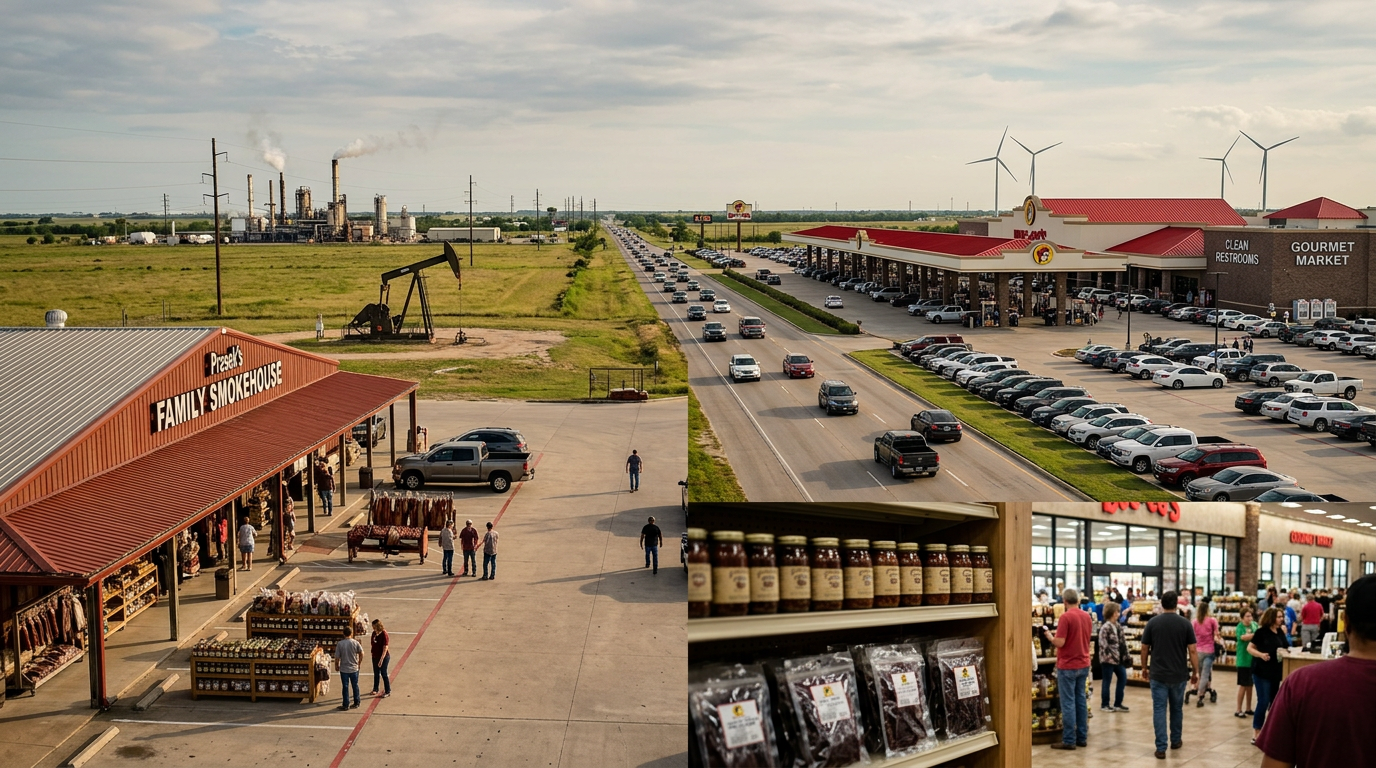
The landscape of Texas highway travel has long been defined by the quest for clean restrooms and high-quality gas station snacks. While Buc-ee’s has transformed from a regional convenience store into a global cultural phenomenon, smaller legacy operations like Prasek’s Family Smokehouse continue to command a loyal following by focusing on artisanal goods. Historically, the Texas roadside market was dominated by small mom-and-pop general stores. Over the last three decades, however, the industry has shifted toward massive destination centers that combine retail, fuel, and fresh-prepared meats. This competition recently intensified as travelers began comparing the niche, smokehouse-driven offerings of Prasek’s against the mass-produced yet iconic catalog of the Beaver. As Prasek’s expands its footprint along major corridors like I-10, the battle for the Texas traveler's wallet is no longer just about fuel prices, but about the specific texture of their beef jerky and the authenticity of their Czech-inspired pastries.
Texas relevance
This competition is centered entirely within the Texas triangle, specifically impacting the travel corridors between Houston, San Antonio, and Austin. For Texans, these stops are more than just bathroom breaks; they are economic engines for small towns like Hillje and Sealy. The success of these brands dictates local employment trends and tax revenue for rural counties. Traditionally, Buc-ee’s has set the gold standard for Texas roadside scale, but Prasek’s represents a different Texas tradition—the European-influenced meat markets that have dotted the Central and Coastal Plains for over a century. The growth of these businesses reflects the increasing demand for high-quality, Texas-made food products among the state's rapidly growing population.
The Battle of the Beef Jerky
At the heart of the rivalry is the signature snack of the Lone Star State: beef jerky. Buc-ee’s offers an overwhelming variety of flavors, often displayed in glass cases that stretch several yards. Their jerky is known for being tender and heavily seasoned, catering to a broad palette that enjoys everything from 'Bohemian Garlic' to 'Hill Country Pepper.' The mass appeal of their jerky lies in its consistency and the sheer volume of choices available to the casual traveler.
Prasek’s, by contrast, relies on its smokehouse roots to differentiate its product. Their jerky is often described as having a more traditional, tougher texture that requires more effort to chew but offers a deeper, smoky profile. Utilizing recipes that have been passed down through the family, Prasek’s leans into the heritage of Texas barbecue culture. For jerky purists, the lack of chemical preservatives and the presence of real wood smoke are the deciding factors that favor the smokehouse over the convenience giant.
The comparison between the two often comes down to the shopper's intent. If one is looking for a gift or a trendy snack, Buc-ee’s is the clear winner. However, for those seeking a protein staple that tastes like it came from a backyard smoker, Prasek’s holds a significant advantage. This divergence in product philosophy shows how two different business models can target the same customer base with vastly different results.
Czech Heritage and Kolache Quality
In Texas, the kolache is a cultural landmark, and both establishments take their pastry case seriously. Buc-ee’s provides a wide array of sweet and savory kolaches, including the popular jalapeno-cheese sausage variety. These are designed for quick consumption, often served warm in paper sleeves. While they are a staple for morning commuters, some critics argue that the dough is more akin to a standard bread roll than a traditional Czech pastry.
Prasek’s, located in the heart of the Texas Czech belt, prides itself on a more authentic approach to the kolache. Their dough is typically fluffier and richer, adhering closer to the traditions of the Central Texas immigrants who popularized the dish. Their fruit fillings are often praised for tasting more like preserves and less like jelly. This attention to detail has earned them a reputation among foodies who are willing to drive slightly out of their way to avoid the corporate versions found at larger stops.
The cultural significance of these pastries cannot be overstated in Texas. As Buc-ee’s expands into states like Alabama and Florida, they are exporting a version of Texas culture that includes the kolache. Prasek’s, meanwhile, remains a guardian of the original style, ensuring that the 'Real Texas' version of the snack doesn't get lost in the shuffle of mass production.
Atmosphere and Efficiency vs. Experience
Walking into a Buc-ee’s is an exercise in sensory overload. The bright lights, wall-to-wall merchandise, and bustling crowds create an energetic atmosphere. The efficiency is unmatched, with dozens of gas pumps and cashier stations designed to get travelers back on the road in record time. For many, the stop itself is the destination, a place to buy t-shirts, home decor, and toys alongside their fuel.
Prasek’s offers a decidedly different vibe. The locations feel more like a rustic lodge or a large-scale butcher shop. While they have expanded their retail offerings to include clothing and kitchenware, the focus remains firmly on the food. The pace is slower, and the layout encourages browsing through the deli and meat counters. It is a destination for people who want to buy a week's worth of groceries or a specific cut of steak, rather than just a quick pit stop.
This difference in atmosphere reflects the varying needs of the Texas driver. Some travelers prioritize the speed and variety of the Beaver, while others seek the respite and artisanal quality of the Smokehouse. The coexistence of these two brands highlights the diversity of the Texas retail market and the ability for different scales of business to thrive simultaneously.
Expansion Strategies and Regional Footprints
Buc-ee’s has embarked on an aggressive national expansion campaign, building massive centers across the Southeast. This strategy aims to make their brand synonymous with American road travel. However, this growth requires a level of standardization that can sometimes alienate local customers who remember the brand's humbler beginnings as a collection of small-format stores in Lake Jackson and the surrounding areas.
Prasek’s has taken a more measured approach to growth. By focusing on key locations like Hillje and Sealy, they maintain a strong grip on the Houston-to-San Antonio corridor. Their expansion is centered on maintaining the quality of their smokehouse production, ensuring that every new location can meet the high standards of their original site. This localized focus helps them maintain a 'hometown' feel even as they serve thousands of highway travelers daily.
The geography of these stores is a map of Texas growth. As the populations of major cities spill out into the surrounding counties, areas that were once quiet rural stops are becoming major commercial hubs. The competition between Prasek’s and Buc-ee’s is a direct result of this sprawl, as both companies vie for the attention of the millions of people now traversing the state's highways.
The Rise of Bison and Exotic Meats
A new frontier in the roadside food war is the introduction of exotic meats like bison and elk. Prasek’s has leaned heavily into this niche, offering bison bites and specialty sausages that appeal to health-conscious snackers or those looking for something beyond standard beef. These products are often locally sourced or processed in-house, giving them a level of freshness that is difficult for larger chains to replicate.
Buc-ee’s has also entered the exotic meat arena, though their offerings are typically pre-packaged and shelf-stable. By providing options like teriyaki jerky or turkey sticks, they cater to a demographic that wants variety without the perceived risk of a butcher-counter experience. While they may not have the artisanal variety of a smokehouse, their ability to stock these items in every location means they reach a much larger audience.
The popularity of bison and other non-traditional meats reflects a broader trend in Texas toward adventurous eating. Travelers are no longer satisfied with just a bag of potato chips; they want high-protein, unique snacks that represent the rugged nature of the state. Both Prasek’s and Buc-ee’s are capitalizing on this trend, though their methods of delivery remain distinct.
Local Economic Impact and Community Roots
Prasek’s remains deeply embedded in the communities where it operates. As a family-owned business, it often sponsors local events and relies on a workforce that has been with the company for years. This creates a level of brand loyalty that is difficult for a large corporation to disrupt. Residents in Sealy and Hillje view Prasek’s as a point of local pride, a business that successfully competes on a large stage while staying true to its roots.
Buc-ee’s, while now a massive entity, also contributes significantly to local economies through high wages and massive tax contributions. They are known for paying their employees well above the industry standard, which has forced other convenience stores to raise their wages to remain competitive. The presence of a Buc-ee’s often spurs further development in the surrounding area, turning empty exits into thriving commercial zones.
Ultimately, the competition between a family smokehouse and a corporate giant is a testament to the strength of the Texas economy. There is enough room in the state for both models to succeed. While they compete for the same customers, they provide different services that contribute to the unique experience of traveling through Texas.
Analysis
OPINION: While Buc-ee’s serves as the 'Disney World' of Texas travel, the rise of Prasek’s highlights a growing consumer preference for authenticity over spectacle. Buc-ee’s excels at branding and logistical efficiency, moving thousands of people through checkout lines with surgical precision. However, Prasek’s maintains an edge by preserving a 'small-town' butcher shop feel that feels increasingly rare in a state dominated by corporate expansion. The fact that a family-owned operation can compete with a multi-billion dollar entity suggests that the Texas market still values heritage and specific culinary techniques, such as genuine wood-smoking, over just convenience and catchy mascots. Ultimately, healthy competition between these two entities benefits Texas travelers by keeping prices competitive and food quality high.
Source attribution
This story was reported using a public release from the Buc-ee's (Google News). Keep TX Red rewrote the coverage independently and links to the official statement for verification.
Frequently Asked Questions
- Which store has better jerky, Prasek's or Buc-ee's?
- It depends on preference. Buc-ee's offers a softer, more variety-heavy selection with modern flavors. Prasek's is preferred by those who want a traditional, dry-smoke texture and authentic Hill Country seasoning.
- Where are Prasek's locations found?
- Prasek’s primarily operates in Hillje and Sealy, Texas, strategically positioned along the main travel corridors between Houston and San Antonio.
- Does Prasek's offer the same merchandise as Buc-ee's?
- While Prasek's has a retail section with kitchenware and Texas gifts, it is much smaller and more focused on the smokehouse experience compared to the massive gift shop departments found at Buc-ee's.
Official Sources
Take the next step
Browse the Newsroom →Read more about Keep Texas Red → Our full guide to what Keep Texas Red means and why Texans support it.
Related Articles

Get Texas updates delivered weekly.
Independent Texas reporting on politics, policy, and daily life. One email a week. Unsubscribe anytime.
Keep TX Red Newsroom
The Keep Texas Red Editorial Staff produces nonpartisan explainers, policy breakdowns, and educational resources to help Texans understand how their government works. All content is reviewed for accuracy and updated regularly.
About Keep TX Red →