North Texas Peace Officer Saves Motorist from Vehicle Engulfed in Flames
A North Texas police corporal is being recognized for his bravery after pulling a driver from a burning car following a major traffic collision.
Editorial disclaimer: Opinions and analysis on Keep TX Red are editorial content — not statements of fact. See our editorial standards.
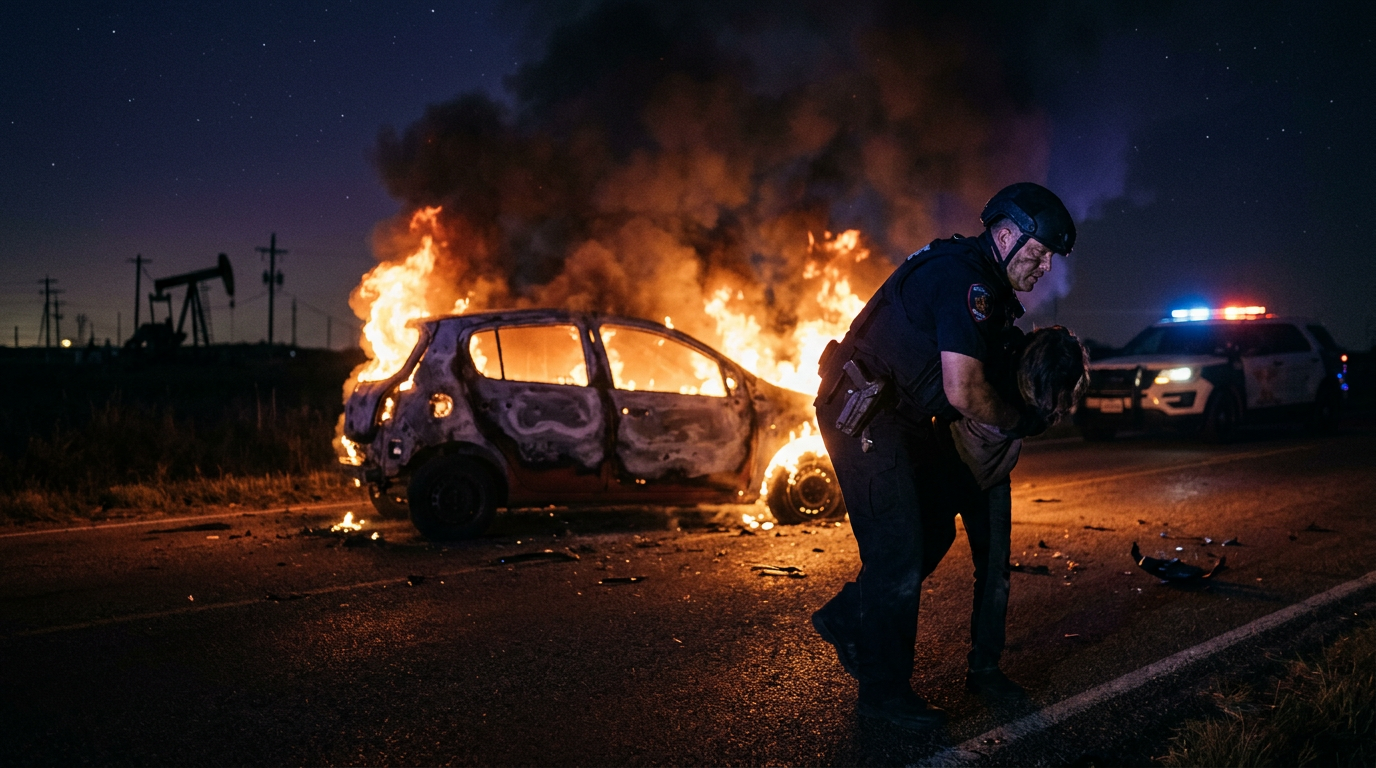
In the early hours of this week, a routine patrol in the North Texas region transformed into a life-saving mission for a veteran police corporal. The officer encountered a severe traffic accident where a vehicle had ignited, trapping the occupant inside as flames began to consume the chassis. Acting without hesitation, the corporal reached the vehicle and successfully extracted the driver just moments before the cabin was overwhelmed by fire. The incident serves as a stark reminder of the unpredictable dangers faced by Texas law enforcement officers who often serve as the first line of defense in medical and fire emergencies prior to the arrival of specialized rescue teams. This rescue underscores the critical nature of rapid response times in urban and suburban corridors where high-speed collisions frequently result in secondary hazards like fuel leaks and electrical fires. Historically, the role of a Texas peace officer has expanded far beyond traditional law enforcement. In a state with over 300,000 miles of public road, patrol officers are frequently the first to encounter trauma-inducing events. This specific rescue follows a decades-long precedent in Texas where the 'all-hazards' approach is baked into police academy curriculum. Prior to modern dispatch integration, a driver in this situation might have waited minutes for a fire engine, but the proximity of patrol units in North Texas’s dense highway grid often changes the math of survival. Such events highlight the evolving nature of public safety where the line between police work and emergency medical services is increasingly blurred for the benefit of the community.
Texas relevance
This event took place within the Dallas-Fort Worth metroplex, one of the most densely populated regions of Texas. Traffic safety and the efficiency of local law enforcement are paramount issues for residents of North Texas, where sprawling highway systems lead to a high volume of vehicular accidents. The actions of this corporal highlight the multi-disciplinary training required of Texas peace officers, who must be prepared to act as firefighters and medics during the 'golden hour' of trauma response. The safety of the I-35 and local artery corridors remains a top priority for regional public safety officials. As North Texas continues to grow, the density of commute-heavy areas makes these high-intensity rescues more frequent, necessitating a robust and well-funded local police presence alongside traditional fire and rescue services.
The Moments Leading to the Rescue
The rescue began when the corporal was alerted to a significant collision involving at least one vehicle. Upon arriving at the scene, the officer observed smoke and visible flames emanating from the engine compartment of a sedan. Standard operating procedures for police often involve securing the scene for traffic, but the immediate threat to life forced the officer to pivot toward active extraction.
Eyewitness reports and preliminary findings suggest the fire moved with significant speed, fueled by fluids released during the impact of the crash. The officer had to manage the intense heat and the potential for an explosion while working to free the individual pinned behind the steering wheel. This level of physical risk is a constant reality for those patrolling Texas highways.
The timeline of the event suggests that only a few minutes passed between the initial dispatch call and the moment the car became a total loss. This narrow window highlights the importance of localized patrolling, where an officer is already within a few miles of a major thoroughfare when a crisis occurs.
Tactical Challenges in Extraction
Vehicle extractions during a fire present unique tactical challenges that deviate from standard law enforcement duties. Doors are often jammed due to frame deformation from the impact, and the presence of thick, toxic smoke can disorient both the victim and the rescuer. The North Texas corporal had to utilize manual force to gain access to the driver’s side of the vehicle.
The weight of the driver and the restricted space of the mangled vehicle meant the corporal had to apply significant leverage to pull the individual to safety. This process took place while the fire spread from the engine block toward the dashboard. The window of opportunity for such a rescue is measured in seconds rather than minutes, requiring decisive action over cautious deliberation.
Modern vehicle components, including magnesium parts and high-pressure fuel lines, can cause fires to burn at temperatures that exceed 1,000 degrees Fahrenheit. For a lone officer without a thermal suit or heavy respiratory gear, the environmental hazards are extreme, making the decision to reach into the cabin even more remarkable.
Stakeholders and Community Impact
The primary stakeholders in this incident include not only the rescued driver and the officer's department but also the local taxpayers who fund the training programs that make these rescues possible. When a life is saved through professional intervention, it reinforces the social contract between the citizenry and those who wear the badge. The psychological impact on a community that sees its officers performing heroic acts cannot be overstated.
Neighboring municipalities in the DFW area also monitor such incidents to adjust their own mutual aid agreements. Because Texas highways often cut through multiple small jurisdictions, the ability of one department's corporal to handle a catastrophe independently reduces the immediate burden on adjacent fire districts that may be minutes further away.
Furthermore, insurance companies and local road authorities have a stake in how these scenes are managed. A rapid rescue allows for the scene to be transitioned to fire suppression and eventually cleanup more quickly, reducing the economic impact caused by closed lanes on major North Texas arteries.
Regional Implications for Public Safety
Communities across North Texas rely on the quick thinking of patrol officers who often arrive at accident scenes minutes before fire departments. This incident highlights the need for continued investment in emergency equipment carried in patrol cruisers, such as heavy-duty fire extinguishers and glass-breaking tools. The successful outcome of this rescue is a testament to the rigorous training standards maintained by departments in the region.
Local officials often point to these scenarios when discussing the importance of law enforcement funding and staffing. When response times are low, the likelihood of a fatal outcome in a vehicle fire increases exponentially. The bravery exhibited by the corporal is being reviewed by department leadership as a prime example of service above self in the line of duty.
The DFW metroplex serves as a testing ground for integrated emergency response. As the region grows, the data from these rescues is used to determine where to station more patrol units. This incident will likely be used in upcoming legislative or city council briefings to illustrate the life-saving 'return on investment' for specialized officer training.
The State of Vehicle Fires in Texas
Texas sees thousands of vehicle fires annually, many of which are the result of high-speed collisions on the state's vast network of tollways and freeways. While modern automotive safety features have improved crash survivability, the risk of fire remains a pertinent threat. Responders in North Texas are trained to identify the signs of a thermal event early to initiate immediate life-saving measures.
Public safety data suggests that the North Texas region experiences a higher frequency of these incidents due to the sheer volume of traffic and the complexity of the road interchanges. Strengthening the coordination between police and fire units remains a central goal for municipal governments in cities like Dallas, Fort Worth, and the surrounding suburbs.
In rural parts of Texas, the wait for a fire truck can be upwards of twenty minutes. While this specific rescue happened in a more urban setting, it highlights a state-wide reality: the police officer is the most likely individual to be on-scene during the most critical moments of an accident. Training for these scenarios is a vital component of the Texas Commission on Law Enforcement (TCOLE) standards.
What Changes Next for Local Training
Following a high-profile rescue like this, many Texas departments conduct an After-Action Review (AAR) to determine if specific tools or techniques could have further mitigated the risk. The success of the corporal may lead to a push for more advanced fire-retardant blankets or improved extrication gear to be kept in the trunks of every patrol vehicle in the district.
There is also a growing conversation surrounding the mental health of first responders who engage in such life-or-death struggles. Ensuring that the corporal and his colleagues have access to the necessary support systems after a traumatic event is a burgeoning priority for Texas law enforcement leadership.
Finally, this event may serve as a catalyst for public education campaigns. Texas drivers are often encouraged to keep their own emergency kits, including fire extinguishers, but the presence of a trained professional who can navigate a burning wreckage remains the most effective variable in saving lives on the road.
The Officer's Perspective on the Incident
Reflecting on the event, the corporal emphasized that there was little time for conscious thought or fear. The primary focus remained on the person inside the vehicle and the necessity of getting them to a safe distance before the fire reached the fuel tank. This mindset is indicative of the professional culture within Texas law enforcement agencies.
While the officer has been hailed as a hero by the local community, he maintains that he was simply fulfilling the requirements of his oath. Such humility is common among first responders, but the community recognition serves to bridge the gap between the public and the men and women who protect them on the roads every day.
The officer's account underscores the physical toll of the rescue. Dealing with intense heat and the physical weight of a trapped occupant requires a level of fitness and composure that is a hallmark of Texas peace officers. His story serves as an inspiration for recruits entering police academies across the Lone Star State.
Analysis
This incident highlights the indispensable role of patrol officers in non-criminal emergency scenarios. Critics of law enforcement funding often overlook the fact that a significant portion of a patrol officer's shift involves responding to medical crises and traffic disasters where every second counts. The corporal's ability to act as a one-man rescue crew demonstrates why local municipal budgets prioritize mobile police units equipped with more than just standard tactical gear. Furthermore, the outcome of this specific event provides a strong argument for the continued support of high-speed chase and accident response protocols that allow officers to reach scenes before flames can become fatal.
Source attribution
This story was reported using a public release from the Texas Police / Public Safety Video (Google News). Keep TX Red rewrote the coverage independently and links to the official statement for verification.
Frequently Asked Questions
- Where did the rescue take place?
- The rescue occurred in the North Texas region, specifically within the Dallas-Fort Worth metroplex following a vehicle collision on a local thoroughfare.
- Was the driver injured in the crash?
- While the corporal successfully extracted the driver from the burning vehicle, avoiding life-threatening burns, the driver was evaluated for injuries sustained during the initial impact of the collision.
- How did the officer get the driver out of the car?
- The corporal had to use manual force and leverage to open the vehicle and pull the driver out because the flames were rapidly spreading from the engine to the cabin area.
- Is this type of rescue common for Texas police?
- While every incident is unique, Texas peace officers are frequently the first on the scene of major accidents and are trained to perform life-saving extractions when fire or medical services are still en route.
- What training do these officers receive for fire rescues?
- Texas officers receive training through the Texas Commission on Law Enforcement (TCOLE) which includes basic emergency medical response and scene management, though individual departments often provide additional specialized training for vehicle extractions.
Official Sources
Take the next step
Browse the Newsroom →Read more about Keep Texas Red → Our full guide to what Keep Texas Red means and why Texans support it.
Related Articles


Get Texas updates delivered weekly.
Independent Texas reporting on politics, policy, and daily life. One email a week. Unsubscribe anytime.
Keep TX Red Newsroom
The Keep Texas Red Editorial Staff produces nonpartisan explainers, policy breakdowns, and educational resources to help Texans understand how their government works. All content is reviewed for accuracy and updated regularly.
About Keep TX Red →