How to spot a Copperhead: A guide to Central Texas' venomous snakes
Learn how to spot camouflaged copperheads in Austin and Central Texas as wildlife experts warn residents to stay vigilant during peak activity months.
Editorial disclaimer: Opinions and analysis on Keep TX Red are editorial content — not statements of fact. See our editorial standards.
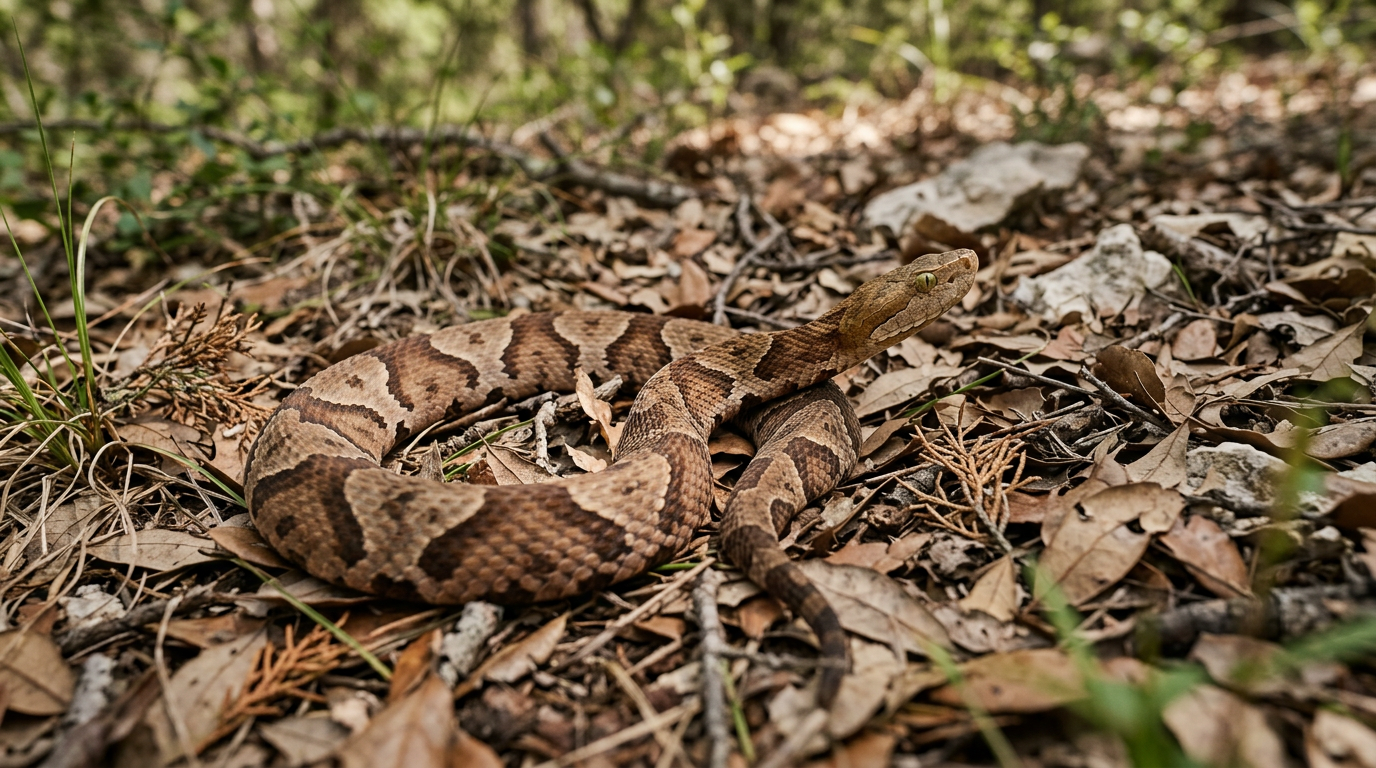
Recent sightings of copperhead snakes in the Austin area have sparked renewed discussions about the incredible camouflage capabilities of these venomous pit vipers. Local wildlife enthusiasts and herpetologists frequently share images of these reptiles blending seamlessly into leaf litter, emphasizing that what appears to be a pile of dry oak leaves may actually be a coiled predator. Historically, Texas has been home to various subspecies of copperheads, including the Broad-banded and Eastern varieties, which thrive in the transitional zones between forests and residential neighborhoods. As urban sprawl continues to push into the edges of the Texas Hill Country, human-wildlife encounters are becoming a daily reality for residents in Travis, Hays, and Williamson counties. Understanding the behavior of the copperhead is essential for anyone spending time outdoors in the Lone Star State. Unlike some rattlesnakes that may retreat when approached, copperheads often rely on their 'dead leaf' pattern to remain undetected, staying perfectly still even when a person or pet is only inches away. This freeze response, while effective for avoiding predators, often leads to accidental bites when hikers or gardeners inadvertently step on or reach near the hidden snake. This seasonal increase in sightings serves as a critical reminder for Texans to use caution when clearing brush, walking trails at dusk, or letting pets into backyard areas where ground cover is thick.
Texas relevance
For residents of Austin and the surrounding Central Texas region, the presence of copperheads is a constant geographical reality. The area's specific ecology—a mix of limestone outcroppings, cedar brakes, and deciduous creek beds—provides the ideal habitat for these snakes. In cities like Austin, where outdoor culture and hiking are central to the lifestyle, the risk of an encounter is significantly higher than in more urbanized coastal plains. Local emergency rooms across Central Texas are well-versed in treating copperhead envenomation, which, while rarely fatal to healthy adults, requires immediate medical attention and can be particularly dangerous for small children and domestic animals. This story hits home for every Texan who enjoys the state's greenbelts or maintains a backyard garden in the humid subtropical climate.
Visual Markers and Camouflage Mastery
The most distinctive feature of the copperhead snake found in Central Texas is its hourglass-shaped banding. These bands are typically a darker brown or copper color against a lighter tan or gray background. When viewed from the side, the dark bands look like wide triangles, but from the top, they pinch in the middle to form the iconic hourglass shape. This pattern is specifically evolved to break up the snake's outline against the floor of a forest or a backyard garden bed.
In addition to the body pattern, the head of the snake is a solid coppery-orange color, which gives the species its name. Unlike many non-venomous water snakes that residents often confuse with copperheads, the copperhead has a distinct, pit-viper-shaped triangular head and vertical, cat-like pupils. Juveniles possess a bright sulfur-yellow tip on their tails, which they use as a lure to attract frogs and lizards, a behavior known as caudal luring.
Finding a copperhead in the wild is often a test of patience and observation. Because their scales lack the reflective sheen found in some other species, they do not glint in the sunlight. This flat, matte finish allows them to disappear into the shadows of a cedar elm or under a pile of discarded lawn clippings. Experts recommend that if you are looking for them, you should look for the 'Hershey's Kiss' shape along the side of the body, which is a hallmark of their markings.
Habitat Preferences in the Austin Metro
Copperheads are remarkably adaptable and can be found in a variety of environments across the state, but they show a strong preference for 'edge' habitats. This includes the areas where a manicured lawn meets a wooded ravine or where a hiking trail borders a creek. In the Austin area, the Barton Creek Greenbelt and the various parks along Lake Travis are prime locations for copperhead activity, especially during the transition from late spring into the heat of summer.
During the hottest parts of the Texas summer, copperheads often shift their behavior to become more nocturnal. They seek out moisture and cooler temperatures, leading them to congregate around leaky outdoor faucets, ornamental ponds, and swimming pool perimeters. It is not uncommon for a homeowner in suburban Austin to find a copperhead stretched out on a cool stone patio after the sun goes down, soaking up the residual heat while waiting for prey.
Beyond water sources, these snakes are frequently found in woodpiles, under flat landscape rocks, and within dense ground covers like jasmine or ivy. The removal of these hiding spots is often the most effective way to discourage snakes from dwelling in high-traffic areas of a property. Keeping grass mowed short and removing debris piles can significantly reduce the likelihood of a backyard encounter.
The Importance of the Freeze Response
One of the most dangerous traits of the copperhead is its reliance on crypsis—the ability to avoid detection through camouflage. Unlike the Western Diamondback Rattlesnake, which will often give a loud auditory warning via its rattle, the copperhead remains silent. This lack of a warning signal means that a person can be inches away from a snake without ever realizing it is there. If the snake feels it has been spotted, it may slowly begin to retreat, but its first instinct is almost always to stay still and blend in.
This behavior is why most copperhead bites occur on the hands and feet. Gardeners reaching into a flower bed to pull weeds may inadvertently place their hand directly on a coiled snake. Similarly, hikers wearing sandals or light shoes might step on a snake that is resting on a leaf-strewn path. Because the copperhead is a pit viper, it possesses heat-sensing pits located between the eye and the nostril, allowing it to detect the warmth of a human limb long before the human sees the snake.
It is worth noting that copperheads are generally not aggressive. They do not 'hunt' humans or go out of their way to attack. Bites are defensive reactions to perceived threats. Most wildlife experts in Texas suggest that if you see a copperhead, the best course of action is to simply back away and give the animal space. In most cases, the snake will eventually move on once it feels the area is clear of danger.
Understanding Envenomation and Medical Response
While a bite from a copperhead is a medical emergency, it is rarely life-threatening for healthy adults. However, the venom is hemotoxic, meaning it breaks down tissue and interferes with blood clotting. This can lead to significant swelling, intense pain, and temporary loss of function in the affected limb. In some cases, the snake may deliver a 'dry bite'—a defensive strike where no venom is injected—but this should never be assumed by the victim.
If bitten, the old myths of 'sucking out the venom' or using a tourniquet are strictly discouraged by Texas medical professionals. These methods often cause more tissue damage than the venom itself. Instead, the victim should remain as calm as possible to keep their heart rate down, remove any rings or tight clothing near the bite site to accommodate swelling, and seek transportation to the nearest emergency room immediately.
For pet owners in Central Texas, the risk is slightly different. Dogs, in particular, are prone to 'sniffing out' snakes and getting bitten on the nose or face. While copperhead venom is often less potent than that of a large rattlesnake, it can still cause severe respiratory distress if the swelling occurs in the throat area. Many Austin-area veterinarians offer 'snake avoidance training' for dogs, which can be a literal lifesaver for pets that spend time in rural or wooded areas.
Ecological Role and Conservation
Despite the fear they often instill, copperheads are a vital component of the Texas ecosystem. They serve as a natural form of pest control, feeding on a wide range of prey including mice, rats, cicadas, and even large caterpillars. By keeping rodent populations in check, they indirectly help reduce the spread of diseases that rodents can carry. In the delicate balance of the Highland Lakes and Hill Country ecosystems, removing an apex predator like the copperhead can have unforeseen consequences on the food chain.
Education is the primary tool for conservation. Many snakes killed by residents are actually non-venomous look-alikes, such as the dekay's brown snake or the banded water snake. Learning to distinguish between these harmless species and the copperhead can prevent the unnecessary destruction of native Texas wildlife. Local organizations like the Texas Parks and Wildlife Department offer extensive resources for species identification and advice on how to coexist with these reptiles safely.
As Austin grows, the preservation of natural corridors allows wildlife to bypass residential areas. Supporting local land trusts and keeping natural areas intact helps ensure that copperheads have sufficient habitat away from human dwellings. For the average Texan, the goal should not be the total elimination of snakes, but rather a respectful awareness of their presence and an understanding of how to share the land safely.
Analysis
The frequent appearance of snake-related alerts in local community forums reflects a broader trend of rapid urbanization in Texas. As more limestone and brush are cleared for housing developments, the remaining green spaces become concentrated corridors for wildlife. There is an educational gap that needs to be filled; many new residents moving to the Austin metro area from non-native regions may not recognize the subtle visual cues of a copperhead. Promoting 'living with wildlife' initiatives rather than eradication is vital for the local ecosystem, as these snakes play a key role in controlling rodent populations. However, public safety must remain the priority, and ongoing digital awareness campaigns are the modern solution to preventing unnecessary hospital visits.
Source attribution
This story was reported using a public release from the r/austin. Keep TX Red rewrote the coverage independently and links to the official statement for verification.
Frequently Asked Questions
- How can I tell the difference between a copperhead and a harmless water snake?
- Copperheads have distinct hourglass-shaped bands that are wider on the sides and narrower on the spine. Their heads are triangular and solid copper-colored, and they have vertical pupils. Most harmless water snakes in Texas have round pupils and different banding patterns that do not form the 'Hershey's Kiss' shape on the sides.
- What should I do if I find a copperhead in my yard?
- The safest action is to leave it alone. Most bites occur when people try to kill or capture the snake. If the snake is in a high-traffic area, you can spray it gently with a garden hose from a distance to encourage it to move along. For persistent issues, contact a professional wildlife relocation service.
- Are copperheads active all year round in Texas?
- In the warmer parts of Texas, copperheads can be active for much of the year. However, they are most active from early spring through late fall. During the winter, they may go into a state of brumation (the reptilian version of hibernation) but can still emerge on unusually warm winter days.
Official Sources
Take the next step
Browse the Newsroom →Read more about Keep Texas Red → Our full guide to what Keep Texas Red means and why Texans support it.
Related Articles


Get Texas updates delivered weekly.
Independent Texas reporting on politics, policy, and daily life. One email a week. Unsubscribe anytime.
Keep TX Red Newsroom
The Keep Texas Red Editorial Staff produces nonpartisan explainers, policy breakdowns, and educational resources to help Texans understand how their government works. All content is reviewed for accuracy and updated regularly.
About Keep TX Red →