Texas HOA Reform: Homeowners Demand Action Over Petty Fines and Rules
Texans share their wildest HOA horror stories as activists and lawmakers push for more property rights protections across the Lone Star State.
Editorial disclaimer: Opinions and analysis on Keep TX Red are editorial content — not statements of fact. See our editorial standards.
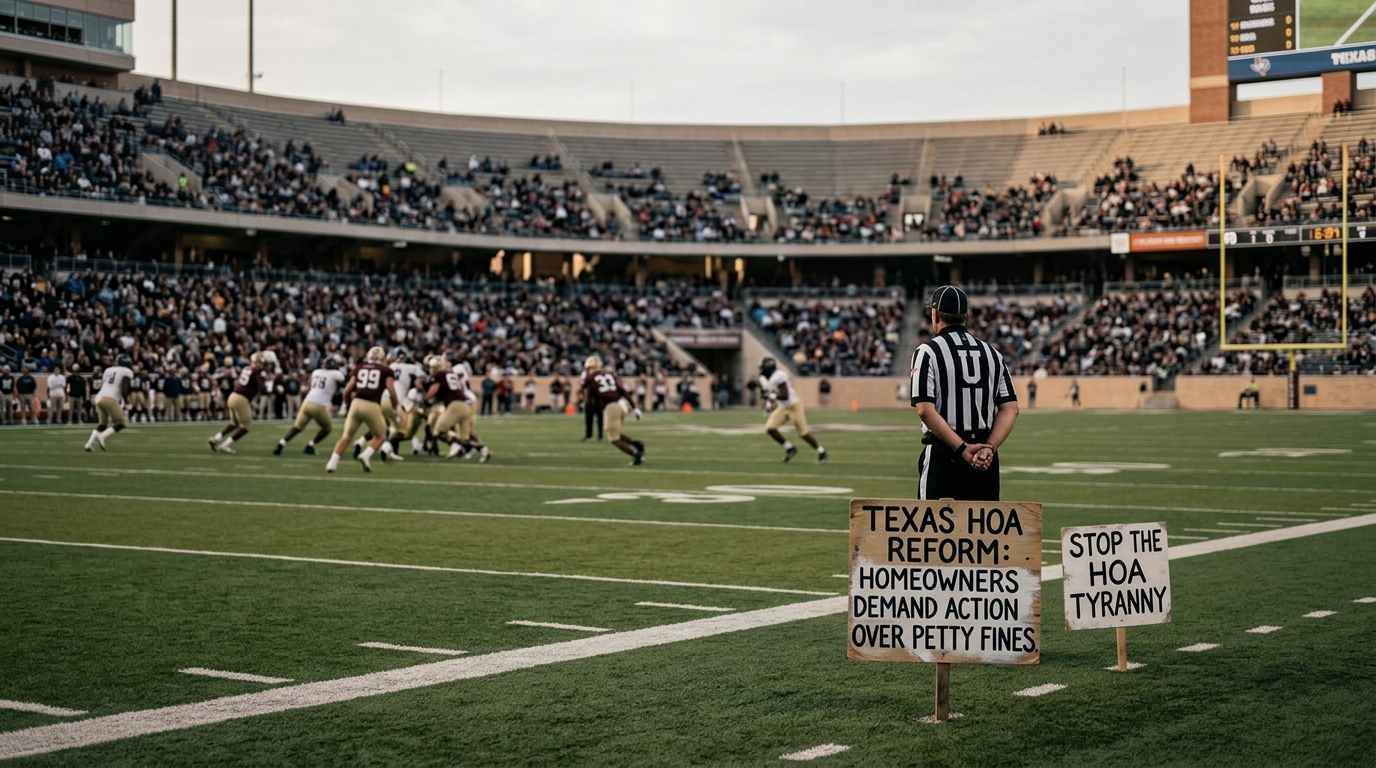
Throughout various communities across the Lone Star State, homeowners are increasingly vocal about the eccentric and often restrictive nature of Homeowners Associations (HOAs). While these organizations were originally conceived to protect property values through aesthetic consistency and common area maintenance, recent accounts from residents in major metropolitan hubs like Houston, Dallas, and Austin highlight a trend toward hyper-vigilance. Homeowners have reported everything from height requirements for trash cans to specific shade requirements for front door colors. This tension between private property sovereignty and community collective oversight has become a staple of local civil discourse in Texas. Historically, Texas has been a state that prides itself on individual land ownership rights, dating back to the Republic era. However, the rise of planned developments in the 1980s and 1990s led to a surge in HOA formations. For decades, these entities operated with significant autonomy, often possessing the power to foreclose on homes over unpaid fines. It wasn't until the last few legislative sessions that Texas began to rein in some of these powers, yet as the latest wave of anecdotes suggests, the friction between residents and board members remains at an all-time high.
Texas relevance
Texas is currently one of the states with the highest density of HOA-governed neighborhoods, particularly in rapidly growing areas like Collin, Denton, and Fort Bend counties. The relevance to Texans is found in the legal evolution of the Texas Property Code. Legislative actions such as Senate Bill 1588 have sought to provide more transparency, yet many Texans find that the day-to-day enforcement of community bylaws remains a point of significant frustration. For the millions of Texans living under these jurisdictions, these bizarre complaints are not just social media fodder; they represent potential liens against their primary financial assets.
The Rise of Aesthetic Nitpicking in Texas Suburbs
In the vast suburban corridors of North Texas and the Greater Houston area, some residents describe an environment that feels more like a military inspection than a neighborhood. Reports have surfaced of homeowners being fined for 'non-conforming' lawn furniture that was placed on a back patio invisible from the street, or for using a shade of mulch that was a half-shade off from the approved community palette. These stories illustrate a growing gap between reasonable maintenance and obsessive control.
Critics argue that these hyper-specific rules do little to actually impact the market value of a home. Instead, they create a hostile living environment where neighbors are encouraged to report one another for minor infractions. In some cases, the cost of fighting a twenty-five-dollar fine for a visible garden hose can escalate into thousands of dollars in legal fees, highlighting a systemic imbalance in the way these disputes are adjudicated.
The psychological impact on Texans is notable. For many in the Lone Star State, the home is a sanctuary where they expect to exercise their personal freedoms. When an HOA board dictates what type of flowers can be planted or how many days a holiday wreath can remain on a door, it directly challenges the cultural identity of Texan independence.
Financial Implications of Unchecked Board Authority
Beyond the annoyance of petty letters, the financial structure of Texas HOAs can pose a genuine risk to middle-class families. Fines that go unpaid can quickly snowball. In Texas, HOAs often have the authority to apply payments first to attorney fees and late charges rather than the principal fine, meaning a resident can struggle to clear their debt even if they attempt to pay the original penalty. This 'priority of payment' system has been a target of state reformers for years.
The collection practices of some management companies have also come under fire. Many HOAs in Texas outsource their enforcement to third-party firms that may have a financial incentive to issue as many violations as possible. This fee-based model of enforcement changes the dynamic from community improvement to revenue generation, further souring the relationship between the board and the homeowners.
For many Texas families, the HOA fee is a 'second property tax' that comes without the same level of constitutional protection or public oversight. While a city council meeting is a matter of public record, an HOA board meeting can sometimes feel like a closed-door session where decisions are made without the full input of the community members who fund the entire operation.
Historical Context of Texas Property Rights
To understand why Texans are so passionate about HOA complaints, one must look at the state's legal history. Texas has some of the strongest homestead protection laws in the United States, designed to prevent families from losing their homes due to economic hardship. However, the rise of planned communities created a loophole where private contracts (the HOA bylaws) could supersede certain traditional protections.
This led to a decades-long struggle in the Texas Capitol as lawmakers tried to reconcile the rights of a private organization to enforce its contracts with the rights of an individual to live securely in their home. Major reforms in 2011 and 2021 have moved the needle toward the homeowner, requiring more notice before foreclosure and limiting the ability of boards to ban certain items like solar panels or religious displays.
Despite these wins, the current climate of complaints suggests that the 'bizarre' rules often fall into gray areas not yet covered by state law. Until the Texas Property Code specifically addresses things like the placement of bird feeders or the exact width of a driveway, these localized conflicts will likely continue to populate neighborhood message boards and legislative calendars alike.
The Impact of Social Media on Neighborhood Disputes
Platforms like Reddit and Nextdoor have radically changed how Texans handle HOA friction. Previously, a resident might complain to a spouse or a close neighbor about a strange 'weeds' violation. Today, that resident can post a photo of their perfectly manicured lawn—next to the violation notice—and garner thousands of sympathetic views from across the country. This digital transparency has put more pressure on HOA boards to act reasonably.
Social media has also allowed for a more organized form of 'neighbor activism.' Groups can now quickly coordinate to vote out unpopular board members or to demand changes to particularly restrictive bylaws. This democratization of neighborhood governance is a double-edged sword, however, as it can also lead to public shaming and the escalation of minor disagreements into community-wide feuds.
In cities like San Antonio and El Paso, these digital forums have become the new 'town square.' They serve as an early warning system for residents, alerting them to overzealous inspectors or upcoming fee hikes. This shift from private grumbling to public accountability is likely to influence future real estate trends as buyers increasingly research a neighborhood's 'HOA reputation' before making an offer.
The Role of Management Companies in Enforcement
A common thread in the most bizarre Texas HOA stories is the role of the management company. Most HOAs are not run day-to-day by the neighbors themselves, but by professional management firms. These companies employ 'compliance officers' whose sole job is to drive through neighborhoods and spot violations. This professionalization of enforcement often removes the 'human element' from the process.
When a neighbor sees your trash can left out, they might know you were working a double shift and offer to pull it in for you. When a compliance officer sees it, they simply take a photo and generate a computer-mailed fine. This lack of context is what often leads to the most absurd outcomes, such as a resident being fined for an 'unauthorized vehicle' when they were simply unloading groceries.
Reforming the behavior of these management firms is a frequent topic in Austin during legislative sessions. Advocates argue that these companies should be held to higher standards of transparency and that their contracts should be structured to reward community harmony rather than the sheer volume of violation letters sent.
Future Outlook: Will Texas Law Clamp Down Further?
As Texas continues to grow, with thousands of new residents moving into HOA-governed communities every month, the pressure on the state government to provide clarity will only increase. Future legislative efforts may focus on capping the amount of fines that can be levied or providing a more streamlined, low-cost way for homeowners to challenge 'arbitrary and capricious' enforcement in small claims court.
There is also a growing movement to protect 'natural' landscaping in Texas. With water conservation becoming a critical issue in West Texas and the Hill Country, many residents are pushing for the right to replace traditional lawns with drought-resistant plants—something many HOAs currently forbid for aesthetic reasons. This intersection of environmental policy and property rights could be the next major battleground.
Ultimately, the goal for most Texans is a middle ground: neighborhoods that are well-maintained and safe, but where the 'king' of the castle still has the final word on what color their front door is. Until that balance is struck, the stories of bizarre complaints and overreaching boards will continue to be a staple of Texas life.
Analysis
OPINION: The shift from community stewardship to bureaucratic overreach suggests that many Texas HOAs have strayed far from their original mission of 'value preservation.' When boards focus on the exact length of a blade of grass or the specific hue of a floral arrangement rather than essential safety and infrastructure, they risk alienating the very residents they serve. The ongoing outcry suggests that the Texas Legislature may need to revisit the balance of power, ensuring that a homeowner’s castle cannot be easily besieged by a neighbor with a measuring tape and a grudge. True community is built on mutual respect and shared interests, not fear-based enforcement of subjective aesthetics.
Source attribution
This story was reported using a public release from the r/texas. Keep TX Red rewrote the coverage independently and links to the official statement for verification.
Frequently Asked Questions
- Can a Texas HOA legally take my home over a fine?
- In Texas, an HOA does have the power to foreclose on a property, but there are significant legal hurdles they must cross first. Under the Texas Property Code, most HOAs must obtain a court order before they can proceed with a foreclosure sale. Additionally, recent laws have made it more difficult for HOAs to foreclose solely on the basis of unpaid fines; they generally must be related to unpaid assessments and follows a specific notice-and-cure period.
- What should I do if I receive a bizarre or unfair fine from my HOA?
- First, carefully read your community's official 'Conditions, Covenants, and Restrictions' (CC&Rs) to see if the rule actually exists. You have the right to request a hearing with the HOA board to contest the violation. Document everything with photos and time-stamped evidence. If the board is uncooperative, you may need to consult with a real estate attorney who specializes in Texas property law.
- Are there things an HOA in Texas is forbidden from banning?
- Yes, Texas law protects certain rights regardless of what an HOA says. For example, HOAs generally cannot prohibit you from displaying the United States flag, the Texas flag, or certain religious displays on your front door. They also cannot completely ban solar panels, rain barrels, or standby electric generators, though they can have reasonable rules about how and where these are installed.
Official Sources
Take the next step
Browse the Newsroom →Read more about Keep Texas Red → Our full guide to what Keep Texas Red means and why Texans support it.
Related Articles

Get Texas updates delivered weekly.
Independent Texas reporting on politics, policy, and daily life. One email a week. Unsubscribe anytime.
Keep TX Red Newsroom
The Keep Texas Red Editorial Staff produces nonpartisan explainers, policy breakdowns, and educational resources to help Texans understand how their government works. All content is reviewed for accuracy and updated regularly.
About Keep TX Red →