Service Lapses on Houston Light Rail Highlight Growing Pains for METRO Transit Reliability
Houston travelers report unexpected service outages on the METRO Red Line, raising concerns over public transit communication and reliability.
Editorial disclaimer: Opinions and analysis on Keep TX Red are editorial content — not statements of fact. See our editorial standards.
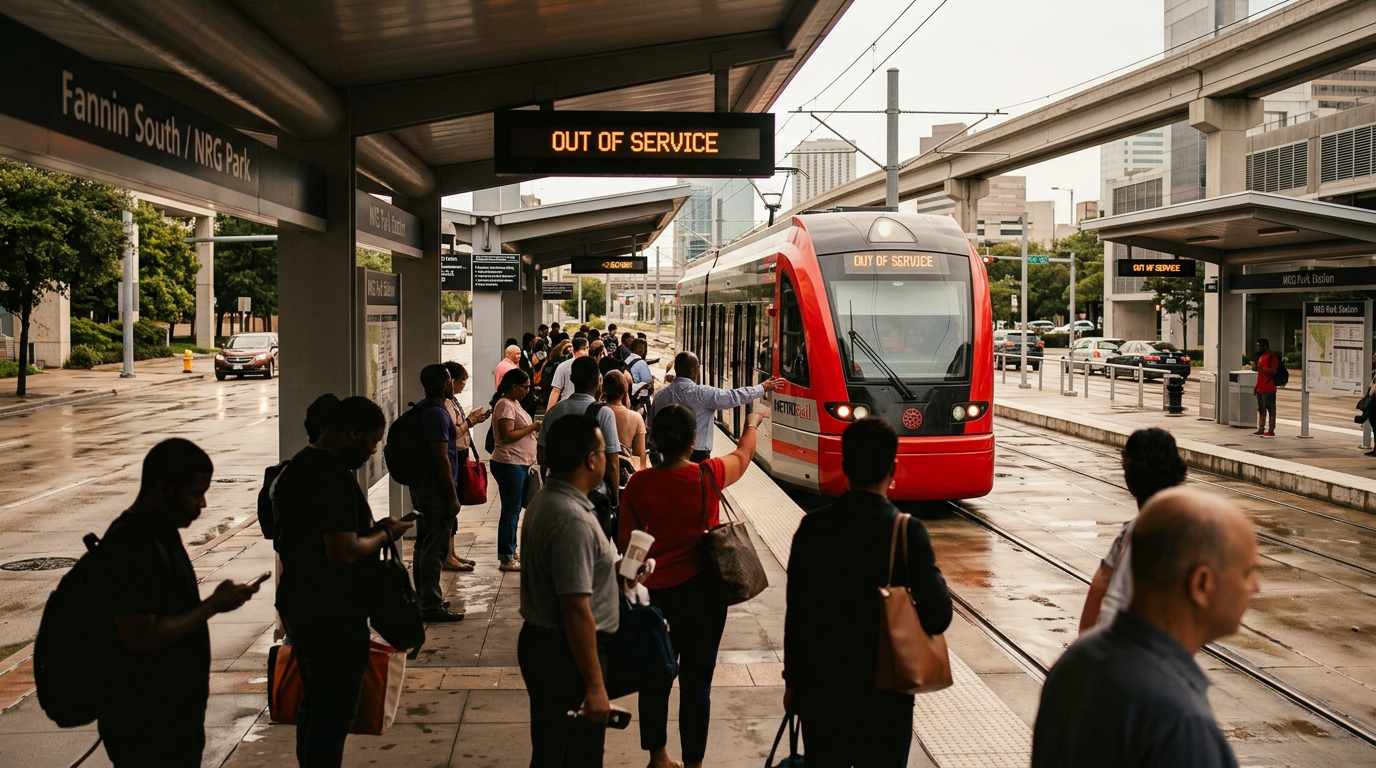
Public transportation in Houston recently faced scrutiny following reports of unannounced service interruptions on the METRO Red Line. During a summer weekend that featured major events like local dog shows and seasonal festivities at NRG Park, passengers attempting to use the rail system found themselves stranded. Historically, the METRO light rail system, which launched its initial Red Line in 2004, has been touted as a primary solution for alleviating traffic congestion between Downtown, the Museum District, and the Texas Medical Center. However, recent rider experiences suggest that a gap remains between the infrastructure's capacity and the operational communication required to support a growing metropolitan population. In this specific instance, a family attempting a recreational outing was forced to disembark one stop away from their destination without prior notification via digital platforms or onboard announcements. This incident reflects broader challenges in maintaining public trust for a transit system that is vital for attendees of the Houston Livestock Show and Rodeo, Houston Texans games, and daily medical center commutes. Historically, the METRO rail has faced criticism for its layout and the frequency of accidents with motor vehicles, but the current conversation has shifted toward reliability and the 'last-mile' problem. Riders have previously pointed to the 2021 winter storm and subsequent infrastructure strain as turning points for how the agency handles emergency communications. While the city continues to invest in transit-oriented development, the lack of real-time data for passengers remains a sticking point for those accustomed to the predictability of suburban car travel. For a city as sprawling as Houston, even a minor interruption in rail service can lead to significant delays, especially when temperatures soar during the peak of summer, making outdoor waits for replacement buses both inconvenient and potentially hazardous for families with young children.
Texas relevance
As the largest city in Texas and the fourth largest in the United States, Houston serves as a bellwether for transit issues across the Lone State. The METRO system is essential for the economic vitality of the Texas Medical Center, which is the world's largest medical complex. When the rail system fails to communicate service gaps to residents of the surrounding suburbs or local urbanites, it directly impacts the density and accessibility of Harris County’s core economic hubs. Texas policymakers have long debated the funding of rail versus road expansion, and incidents of poor service on the Red Line provide data points for those evaluating the return on investment for high-capacity public transit in car-centric Texas environments.
The Breakdown in Passenger Communication
One of the most significant complaints arising from the recent service lapse is the absolute lack of pre-trip information. In the modern era of smart cities, passengers expect real-time updates regarding service disruptions. Unfortunately, riders reported that digital signage and the official METRO website failed to reflect the closure of the track segments approaching NRG Park. This forced families into a situation where they were already committed to the journey before being told they could not finish it.
The role of the train conductor in these scenarios is often limited to operational safety, yet they become the face of the agency's failures when no other information is available. In this case, the lack of a timeline for the 'bus bridge'—a standard practice where buses replace stalled rail cars—exacerbated the problem. Without knowing if a bus would arrive in five minutes or fifty, many families were left with a difficult choice: wait in the Texas heat or find an alternative, more expensive transport method like a ride-share.
NRG Park and the Strategic Importance of the Red Line
The Red Line is arguably the most critical artery in the METRO rail system, connecting the high-density residential areas of Downtown and Midtown with the cultural hubs of the Museum District and the massive event spaces at NRG Park. Because NRG Park hosts everything from international sporting events to specialized local exhibitions, the rail is often the only way to avoid the astronomical parking fees and gridlock associated with the 610 Loop.
When the rail fails during an event weekend, the ripple effects are felt throughout the district. Traffic increases as confused drivers attempt to navigate back to parking garages, and the overall perception of the city's hospitality suffers. For many Texans visiting from suburbs like Pearland, Katy, or The Woodlands, the rail is their only interaction with Houston's urban core. A failed trip reinforces the stereotype that public transit is unreliable compared to private vehicle ownership.
The Challenge of the 'Bus Bridge' Solution
METRO's standard procedure for rail outages is to implement a bus bridge, where shuttle buses carry passengers between the defunct stations. While this is a common strategy globally, its execution in Houston often leaves much to be desired. The transition from a climate-controlled train platform to an outdoor bus stop is a major deterrent for casual riders, particularly when wait times are undefined.
The logistical difficulty of moving a trainload of passengers onto a bus—which has significantly lower capacity—cannot be overstated. This often results in multiple buses being needed for a single train's worth of people, leading to crowding and further delays. For the agency to succeed, the transition between modes of transport must be seamless and well-announced, involving staff members on the ground to direct the flow of traffic.
Operational Reliability and Maintenance Needs
While the specific cause of the recent out-of-service status was not publicly detailed, it points to the ongoing need for rigorous maintenance on the Red Line. Houston’s extreme weather, characterized by humidity and high heat, puts immense strain on electrical systems and rail infrastructure. Over time, these components require planned maintenance, which should ideally be scheduled during low-traffic periods and communicated weeks in advance.
Alternatively, if the stoppage was due to an unplanned mechanical failure or an obstruction on the tracks, it highlights the need for a more robust emergency response protocol. Ensuring that the rail system can quickly recover from an incident is just as important as the initial construction of the line. Transit advocates suggest that METRO must invest more in its automated alert systems to keep pace with the city's growth.
Impact on Family-Friendly Tourism
Houston has made a concerted effort to market its central corridor as a destination for families, touting the ease of visiting the Zoo, various museums, and event centers via the light rail. However, families traveling with small children have different requirements than solo commuters, including the need for predictable schedules and stroller-friendly transitions. A sudden service termination represents a significant hurdle for these users.
By failing to provide a reliable experience for recreational users, METRO misses an opportunity to build a long-term culture of transit use. Children who have positive experiences on the light rail are more likely to become adult commuters. Conversely, an afternoon spent stranded at a rail stop becomes a negative family memory that influences future transportation choices for years to come.
Comparing Houston to Other Texas Transit Hubs
Houston is not the only Texas city grappling with rail reliability. Dallas (DART) and Austin (CapMetro) both face similar challenges in integrating rail into sprawling urban landscapes. However, DART’s significantly larger rail footprint often allows for more alternatives when a single line goes down. In Houston, the Red Line is so central to the north-south transit axis that its failure is disproportionately felt by the public.
As Austin prepares for its own multi-billion dollar Project Connect rail expansion, the lessons from Houston’s communication failures are becoming increasingly relevant. Texas cities must realize that building the rail is only half the battle; the other half is providing a level of service and information that makes the rail a viable competitor to the freedom of the car. Houston’s recent struggles should serve as a wake-up call for transit agencies across the state.
Analysis
The frustration expressed by Houstonians regarding METRO operations highlights a recurring theme in urban Texas politics: the struggle to balance massive infrastructure projects with day-to-day operational excellence. While METRO has been trying to rebrand itself as a modern, efficient choice for families, failure to utilize basic communication tools—like loudspeaker announcements or mobile app alerts—undermines millions of dollars in marketing. For a state that prides itself on efficiency and a 'can-do' attitude, seeing a premier transit line stall out just short of its goal is a symbolic failure. It suggests that while the steel and concrete are in place, the administrative 'human element' is lagging. If Houston intends to remain competitive with other major transit-heavy metros, the agency must prioritize transparency, realizing that a single bad experience can permanently alienate a suburban family from choosing transit over their vehicles for the next decade.
Source attribution
This story was reported using a public release from the r/houston. Keep TX Red rewrote the coverage independently and links to the official statement for verification.
Frequently Asked Questions
- What is a 'bus bridge' in the METRO system?
- A bus bridge is a temporary shuttle service that METRO deploys when a section of the light rail track is closed or obstructed. Buses follow the rail route to transport passengers between the active stations, though wait times and capacity may vary compared to the train.
- How can I check for real-time METRO service alerts?
- Passengers are encouraged to check the METRO Houston website, use the RideMETRO app, or sign up for email and text alerts. However, as noted in recent reports, there can sometimes be a delay between a service disruption and an update being posted to these platforms.
- Why was the METRO Red Line out of service near NRG Park?
- The specific reason for the recent service stoppage wasn't immediately provided by the conductor to the passengers. Common reasons for such outages include mechanical issues with the train, maintenance work on the tracks, or emergency incidents requiring a temporary shutdown of a specific segment.
Official Sources
Take the next step
Browse the Newsroom →Read more about Keep Texas Red → Our full guide to what Keep Texas Red means and why Texans support it.
Related Articles


Get Texas updates delivered weekly.
Independent Texas reporting on politics, policy, and daily life. One email a week. Unsubscribe anytime.
Keep TX Red Newsroom
The Keep Texas Red Editorial Staff produces nonpartisan explainers, policy breakdowns, and educational resources to help Texans understand how their government works. All content is reviewed for accuracy and updated regularly.
About Keep TX Red →