Houston ICE Incident Sparks Local Protests and Enforcement Policy Debate
Community concerns rise in Houston after a federal immigration enforcement operation results in a fatal shooting and heightened neighborhood tension.
Editorial disclaimer: Opinions and analysis on Keep TX Red are editorial content — not statements of fact. See our editorial standards.
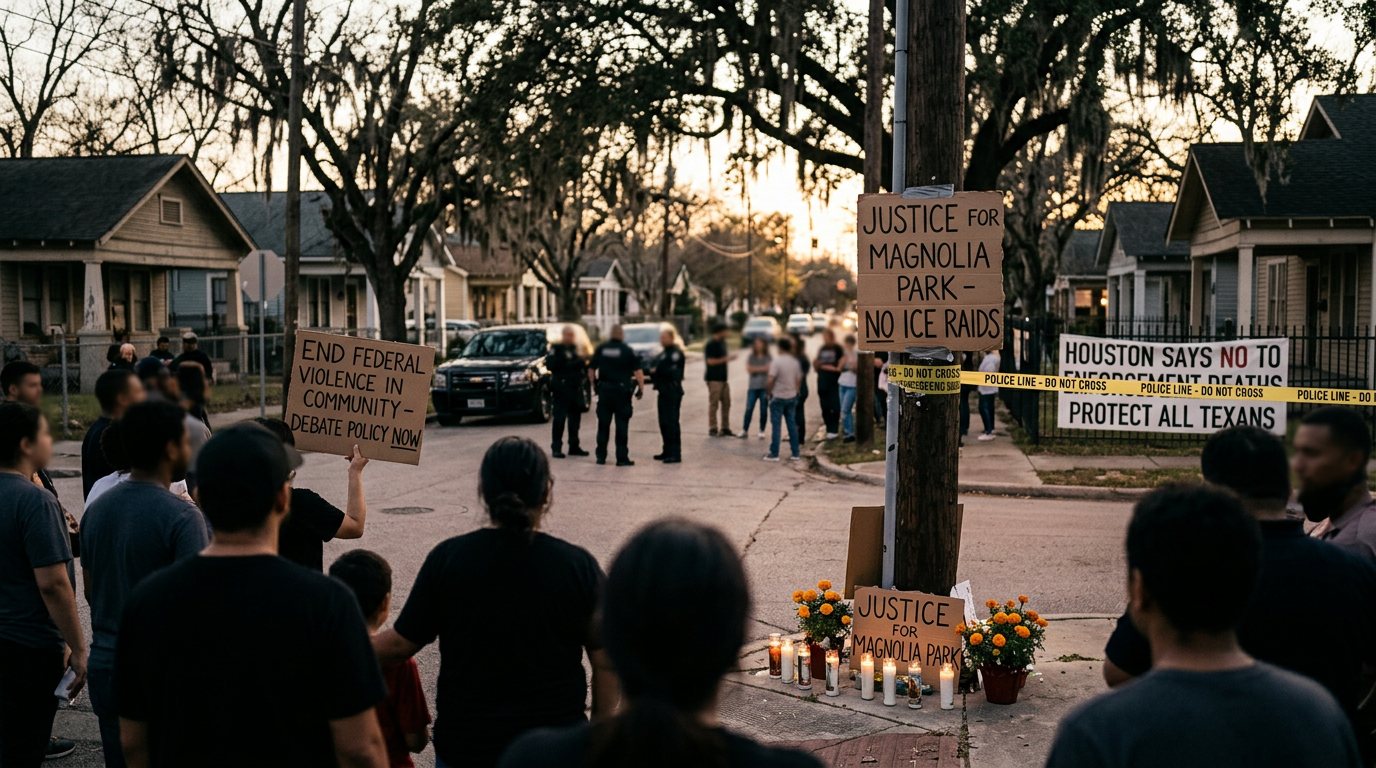
A recent high-stakes operation conducted by federal Immigration and Customs Enforcement (ICE) agents in one of Houston's historic neighborhoods has resulted in a fatal discharge of a firearm, leaving the local community in a state of shock and escalating the ongoing debate over federal enforcement strategies within municipal limits. The incident occurred during what officials described as a targeted enforcement action intended to apprehend a high-priority individual. However, the outcome—a loss of life occurring in a densely populated residential area—has triggered immediate scrutiny from local leaders and civil rights advocates. Historically, Houston has served as a central hub for immigration enforcement due to its proximity to the Gulf Coast and the southern border, yet the presence of federal tactical units in established residential barrios often creates friction between federal mandates and local neighborhood stability. This specific event represents a significant escalation in the physical risks associated with urban enforcement actions, marking a departure from quieter administrative removals and placing a spotlight on the rules of engagement utilized by federal agents when operating in Texas metropolitan centers. Contextually, this event follows years of evolving state and federal cooperation agreements, such as those outlined in Senate Bill 4, which have fundamentally altered how state and local law enforcement interact with federal immigration authorities. While the state government in Austin has consistently pushed for more aggressive enforcement to maintain the rule of law, local municipalities like Houston often face the immediate social and safety consequences when these operations turn violent. The historical backdrop of the Magnolia Park and Second Ward areas—neighborhoods with deep cultural roots stretching back over a century—provides a poignant setting for this conflict, as generations of residents now find themselves caught between the rigid application of federal law and the desire for neighborhood peace. This clash is not merely a legal dispute but a fundamental disagreement on the visibility and intensity of federal policing in the private lives of Texans.
Texas relevance
Texas remains the primary theater for the nation's immigration enforcement battles, and Houston, as the state's largest city, serves as the operational epicenter for Region 10 ICE faaliyetleri (activities). The relevance of this incident to the broader Texas public cannot be overstated, as it tests the resilience of state laws designed to facilitate federal-local cooperation. In many Texas cities, the line between municipal police duties and federal immigration enforcement has blurred, leading to complex jurisdictional questions when a shooting occurs on city streets involving federal agents. Residents across the Lone Star State are increasingly concerned with how these operations impact public safety, property values, and the general trust in law enforcement. Furthermore, the political landscape in Texas is heavily influenced by how these events are framed; while some see them as necessary measures for national security, others view them as disruptions to the commerce and social fabric of Texas cities. The outcome of the investigations into this shooting will likely set a precedent for how similar operations are conducted in other major Texas hubs like Dallas, San Antonio, and El Paso.
Operational Details and the Sequence of Events
The enforcement action was initiated in the early hours of the morning, a time typically chosen by federal agencies to minimize traffic and maximize the element of surprise. According to preliminary reports, the target was an individual identified through biometric data as having a prior criminal record and multiple previous deportations. As agents moved to secure the perimeter of the residence, a confrontation ensued that quickly escalated into a lethal force encounter. Precise details regarding who drew first or the specific verbal commands given remain under investigation by the federal Office of Professional Responsibility.
Witnesses in the surrounding area described a chaotic scene involving unmarked vehicles and individuals in tactical gear who were not immediately identifiable as law enforcement. This lack of clear identification is a recurring point of contention in urban enforcement, as it can lead to defensive reactions from residents who believe they are witnessing a crime rather than a legal arrest. The discharge of multiple rounds in an area where children were preparing for school has intensified the call for a review of how these warrants are served in the future.
Historical Significance of the Magnolia Park Area
To understand the depth of the community's reaction, one must look at the history of the neighborhood where the shooting occurred. Magnolia Park is one of the oldest and most culturally significant Hispanic neighborhoods in Texas, established by families who provided the labor that built the Houston Ship Channel and the surrounding industrial base. For over a hundred years, this area has been a gateway for those seeking the American dream, fostering a tight-knit environment where neighbors often know one another’s families for generations.
When federal enforcement enters such an environment with force, it is perceived not just as an individual arrest but as an intrusion into a sanctuary. The psychological impact on long-term residents is profound, leading to a breakdown in communication between the community and any form of government authority. This erosion of trust can have long-term negative effects on public safety, as residents become less likely to report local crimes or cooperate with police investigations for fear of attracting federal attention to their doorsteps.
Legislative Tension and State-Federal Dynamics
The incident in Houston occurs against a backdrop of intense legislative maneuvering in Austin. Texas lawmakers have spent recent sessions strengthening the requirements for local officials to engage with federal immigration agencies. However, these laws do not always account for the tactical realities on the ground. When a federal operation goes wrong, the local police department often finds itself in the difficult position of managing the public's anger despite having had no part in the planning or execution of the federal raid.
Governor Greg Abbott and other state leaders have consistently prioritized border security and immigration enforcement as pillars of their administration's platform. Nevertheless, even among those who support strict immigration laws, there is a growing conversation about the 'how' rather than the 'what' of enforcement. The use of firearms in a neighborhood setting brings up questions of liability and the potential for collateral damage that resonate with Texans' values regarding the sanctity of the home and the safety of the community.
Civil Rights and Legal Implications
Legal experts are already weighing the potential for civil litigation stemming from the shooting. While federal agents generally enjoy a level of qualified immunity, the specific circumstances under which they use lethal force are subject to constitutional standards. If it is found that the agents acted outside of established protocols, the federal government could face significant legal challenges. This would not only affect the individuals involved but could also lead to court-mandated reforms for ICE operations nationwide.
Furthermore, the rights of the bystanders who witnessed the event are being championed by local legal clinics. In Texas, the right to record police activity from a safe distance is a protected activity, yet reports have surfaced of agents attempting to confiscate phones or intimidate witnesses in the immediate aftermath of the shooting. These allegations, if proven true, would represent a secondary violation of civil liberties that complicates the primary investigation into the use of force.
Economic and Social Consequences for Houston
Beyond the immediate tragedy, there are broader economic implications for the city of Houston. Neighborhoods that feel under siege often experience a decline in economic activity as residents avoid public spaces and local businesses. The 'chilling effect' of visible immigration enforcement can lead to a drop in consumer spending in specific corridors, affecting the very small businesses that form the backbone of the Houston economy. For a city that prides itself on being an international hub of trade and diversity, these incidents present a branding challenge.
Socially, the incident has galvanized local activist groups who are now organizing town halls and protests to demand accountability. This mobilization represents a significant shift in Houston's political climate, as younger generations of Latino leaders take a more vocal stance against federal policies they perceive as targeted. The intersection of local activism and federal policy is likely to be a major theme in upcoming municipal elections, as candidates are forced to clarify their positions on federal cooperation.
Future Outlook for Federal Enforcement in Texas
In the wake of this shooting, federal authorities are likely to face pressure to modify their urban engagement strategies. Suggestions have been made to increase the use of surveillance technology and administrative arrests in lieu of high-risk tactical entries. However, the effectiveness of these alternatives remains a topic of hot debate among law enforcement experts. Some argue that without the threat of physical apprehension, the immigration system lacks a credible deterrent, while others insist that the human cost of current methods is simply too high.
As Texas continues to grow and diversify, the friction between federal law and local community life will only intensify. The Houston incident serves as a precursor to future conflicts that will require a more nuanced approach from both Washington D.C. and Austin. Whether through legislative reform or a change in agency culture, the goal must be to find a path that upholds the law without turning Texas neighborhoods into tactical zones. The eyes of the state—and the country—will remain on Houston as the full facts of this case come to light.
Analysis
From a policy perspective, the Houston shooting highlights the inherent dangers of conducting tactical arrests in high-density urban environments. While the federal government maintains the legal authority to enforce immigration statutes, the tactical execution of these laws must be balanced against the safety of the general public. Critics of the current approach argue that the 'shock and awe' style of enforcement often used in these neighborhoods is counterproductive, while proponents argue that high-priority targets pose an even greater risk if left at large. In a state like Texas, where the right to self-defense and the importance of due process are held in high regard, the sight of plainclothes federal agents discharging weapons in residential zones sparks a unique type of bipartisan concern. The political fallout will likely involve demands for increased transparency regarding ICE’s use-of-force policies and better communication with local law enforcement to prevent 'blue-on-blue' confusion or civilian friendly-fire incidents.
Source attribution
This story was reported using a public release from the r/texas. Keep TX Red rewrote the coverage independently and links to the official statement for verification.
Frequently Asked Questions
- Why was ICE conducting an operation in this specific Houston neighborhood?
- ICE officials stated the operation was a targeted enforcement action aimed at apprehending a specific individual with a criminal record. Federal agencies often conduct these operations in residential areas where targets are believed to reside, though this practice is frequently criticized for its impact on unintended bystanders.
- What is the official status of the investigation into the shooting?
- The shooting is currently under a multi-agency review. This typically includes an internal investigation by the ICE Office of Professional Responsibility and may involve local law enforcement agencies to ensure that all state and federal laws were followed during the discharge of the weapon.
- How does Texas law affect these types of federal operations?
- Texas law, specifically measures following SB 4, encourages or even mandates that local law enforcement cooperate with federal immigration authorities. However, the tactical planning of federal raids is generally handled solely by the federal agency, often leaving local police with little information until after an incident has occurred.
Official Sources
Take the next step
Browse the Newsroom →Read more about Keep Texas Red → Our full guide to what Keep Texas Red means and why Texans support it.
Related Articles


Get Texas updates delivered weekly.
Independent Texas reporting on politics, policy, and daily life. One email a week. Unsubscribe anytime.
Keep TX Red Newsroom
The Keep Texas Red Editorial Staff produces nonpartisan explainers, policy breakdowns, and educational resources to help Texans understand how their government works. All content is reviewed for accuracy and updated regularly.
About Keep TX Red →