Governor Abbott Mobilizes State Resources Following Severe Flash Flooding Across Texas Regions
Governor Abbott activates emergency response teams as heavy rainfall and flash flooding impact communities across Texas. Stay updated on safety measures.
Editorial disclaimer: Opinions and analysis on Keep TX Red are editorial content — not statements of fact. See our editorial standards.
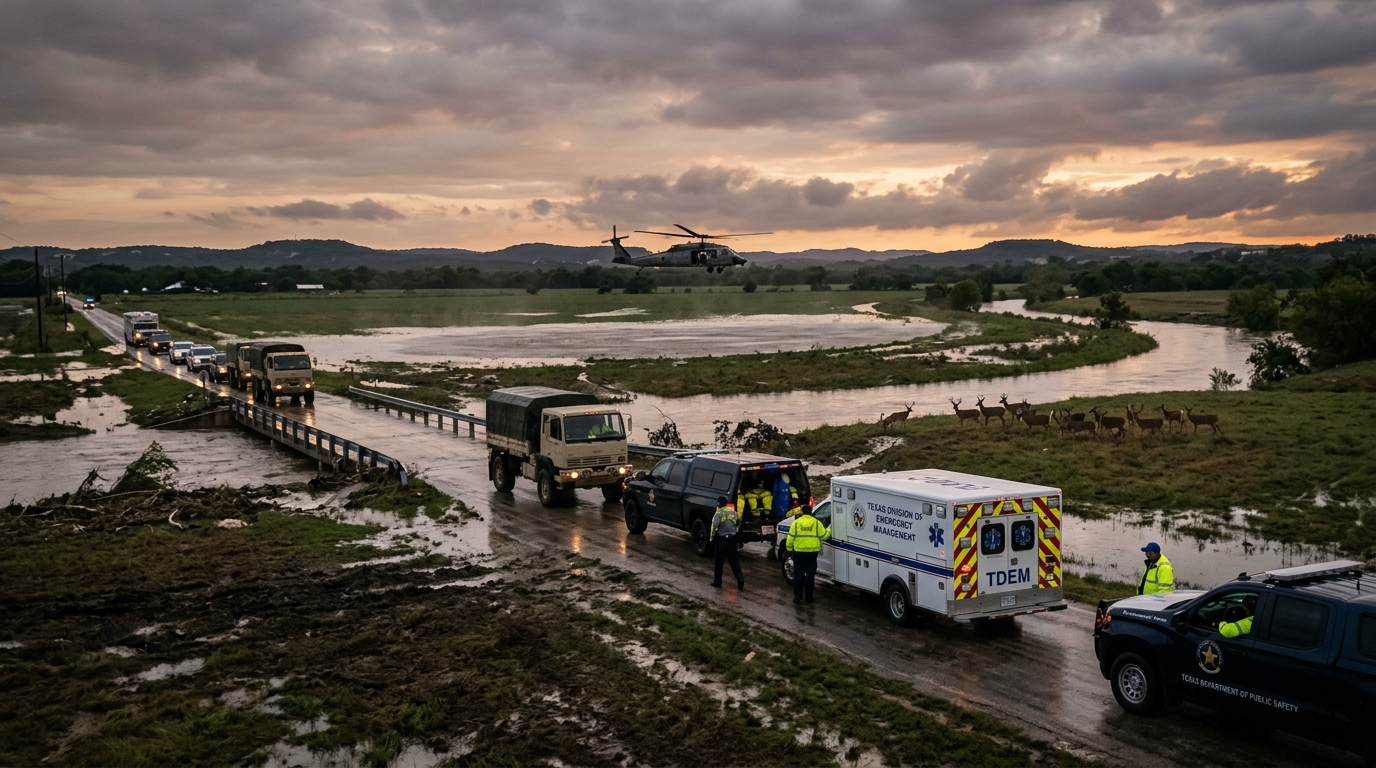
Governor Greg Abbott has coordinated an extensive multi-agency response to address a surge in flash flooding incidents threatening various regions of the state. This activation comes as a series of heavy rain bands stalled over central and eastern corridors, overwhelming local drainage systems and necessitating swift water rescues. Historically, Texas has faced significant challenges with flash flooding due to its unique geography and the 'Flash Flood Alley' that runs through the heart of the state. Prior disasters, such as the 2015 Memorial Day floods, established a precedent for the state to preemptively stage resources like high-water vehicles and rescue boats before peak saturation occurs. The current response focuses on rapid deployment to protect life and property in areas where infrastructure remains most vulnerable. The Governor's office confirmed that the Texas Division of Emergency Management (TDEM) is leading the logistical charge, ensuring that local municipalities have the state-level backing required to handle rising waters. By coordinating with the Texas Department of Public Safety and the Texas Parks and Wildlife Department, the state is providing specialized rescue personnel to assist local first responders who have been working around the clock. The emphasis remains on public safety and the importance of adhering to road closures, as a significant percentage of flood-related fatalities in Texas occur within vehicles on flooded roadways.
Texas relevance
The current flooding crisis is of paramount importance to Texas as it directly impacts major metropolitan hubs and rural farming communities alike. Austin and central Texas regions are particularly susceptible due to the rocky terrain of the Hill Country, which prevents water absorption and causes rapid runoff into urban centers. This emergency highlights the ongoing need for state-level infrastructure investment and the critical nature of the 'Turn Around Don't Drown' initiative. Every Texan, whether in an affected zone or not, is impacted by the economic and social disruptions caused by major weather events that sever transportation arteries across the Lone Star State.
The Geographic Scope of the Emergency
The current surge of severe weather has not been confined to a single county, instead stretching across a broad swath of the state's interior. As tropical moisture continues to feed into a stalled front, the resulting downpours have targeted regions that were already experiencing soil saturation from previous weeks of rainfall. This saturation means that even moderate additional amounts of rain can lead to immediate runoff, turning small creeks into raging rivers within a matter of minutes.
Forecasters and emergency management officials have noted that the unpredictability of these storm cells makes the state's role even more vital. Unlike hurricanes, which offer days of preparation time, flash flooding requires a localized and immediate response. The state has focused its primary efforts on high-risk zones where the topography directs water toward residential developments, as seen in many burgeoning suburbs around the Interstate 35 corridor.
Local officials in several jurisdictions have reported that rainfall totals surpassed several inches in less than two hours. Such intensity exceeds the design capacity of historical culverts and bridges, many of which were built decades ago. The Governor's briefing served as a reminder that the state is prepared to bridge the gap between local resource exhaustion and the total stabilization of these affected communities.
State Agencies and Resource Allocation
A cornerstone of the Texas response plan is the integration of the Texas Division of Emergency Management with various search and rescue task forces. These units are equipped with specialized gear, including sonar for underwater searches and aerial drones to assess damage in inaccessible areas. The Governor highlighted that these assets were positioned in 'strike teams' to allow for rapid movement as the weather front shifts eastward.
In addition to life-saving measures, the Texas Department of Transportation (TxDOT) has been tasked with monitoring the integrity of thousands of miles of state-maintained roads. Flash flooding often causes 'invisible' damage, where the road surface appears intact but the underlying foundation has been washed away. This has led to widespread closures that require thorough inspections before the public can safely return to the roads.
The Texas Military Department has also been placed on standby, a move that provides an extra layer of manpower should the situation call for large-scale evacuations or the delivery of supplies to isolated towns. This multi-tiered approach ensures that no single agency is overwhelmed, maintaining a sustainable rotation of personnel for what could be a multi-day recovery operation.
Public Safety and Prevention Strategies
The Governor utilized the press conference to reinforce the dangers of navigating flooded streets. State data consistently shows that the majority of flood-related deaths involve drivers who underestimate the depth or velocity of water crossing a road. Even as little as six inches of moving water can knock over an adult, and twelve to eighteen inches can carry away a modern passenger vehicle, including high-clearance trucks.
Emergency officials are stressing the importance of having local alerts enabled on mobile devices. Because flash floods can occur at night or while residents are indoors, these digital warnings are often the only way to notify the public of an immediate threat. The state is encouraging all Texans to use the 'iTexas' and other official weather apps to stay informed of changing conditions in real-time.
Beyond immediate physical danger, there is also a focus on health risks associated with floodwaters. Runoff often contains contaminants ranging from sewage to hazardous chemicals from agricultural or industrial sites. State health officials are advising residents to avoid contact with standing water and to be wary of displaced wildlife, such as snakes and rodents, that are frequently forced into human habitats during floods.
Impact on Infrastructure and Utilities
Significant rainfall often leads to power outages as soil erosion can cause utility poles to shift or fall. Electric cooperatives and private utility companies across the state are currently working in tandem with the state operations center to prioritize grid stability. While the Texas power grid remains stable, localized distribution failures remain a concern for thousands of residents in the hardest-hit counties.
Water treatment facilities also face challenges during extreme weather. High turbidity—a measure of water cloudiness caused by suspended sediments—can slow down the purification process at local treatment plants. Some communities have already issued boil-water notices as a precautionary measure until the systems can be stabilized and tested for safety. This highlights the interconnectedness of weather events and basic utility survival.
Telecommunications infrastructure is another primary focus. The state is ensuring that emergency communication towers remain functional so that 911 services are not interrupted. In rural areas, where signal strength can already be intermittent, the state has deployed mobile communication units to ensure that first responders can maintain contact with central command centers throughout the duration of the storm.
Economic Implications and Recovery Path
While the immediate focus is on life safety, the long-term economic impact of flash flooding on the Texas economy is substantial. Flooded businesses, damaged inventory, and lost productivity during road closures can cost the state millions of dollars per day. Small business owners in downtown areas of affected cities are often the hardest hit, as they may lack the extensive flood insurance required for total recovery.
The Texas Department of Insurance is beginning to prepare for an influx of claims. The Governor’s office is tracking damage assessments across every impacted county to determine if thresholds for a federal disaster declaration will be met. Such a declaration would unlock low-interest loans and direct grants for both homeowners and local governments, providing a critical lifeline for rebuilding efforts.
Agricultural interests in the coastal plains and central corridors are also monitoring the situation closely. While rain is often welcomed in a state prone to drought, excessive moisture at the wrong time in the growing season can ruin crops and delay harvests. The Texas Department of Agriculture is working to assess the impact on the state's ranching and farming sectors, which form a foundational block of the Texas GDP.
Future Mitigation and Legislative Action
This latest emergency once again brings the topic of flood mitigation to the forefront of state policy. In previous years, the Texas Water Development Board has been tasked with creating a comprehensive state flood plan. The current event serves as a living laboratory for those plans, testing the effectiveness of recent investments in retention ponds, bypass channels, and advanced early-warning systems.
Legislators are likely to scrutinize the response to this event to determine if further funding is needed for the Texas Resilience Fund. The goal is to move from a purely reactive stance to one that builds resilient communities capable of weathering these intense bursts of precipitation without catastrophic loss. This includes reevaluating building codes in floodplains and providing more state support for local flood control districts.
The Governor’s office maintains that while weather cannot be controlled, the state's readiness is a variable that can be perfected. By conducting regular drills and upgrading technology, Texas aims to set a national standard for disaster management. The lessons learned from this week's flooding will undoubtedly be integrated into the next iteration of the state's emergency response manuals.
Analysis
The Governor’s proactive stance reflects a shift toward more aggressive emergency management that has defined recent Texas administrations. By holding public briefings during the height of the event, the state aims to maintain a unified narrative and prevent the chaos often associated with localized disasters. While some may view these briefings as standard protocol, the political and logistical weight behind a Governor-led response often speeds up federal aid requests (FEMA) and ensures that private utility providers prioritize restoration in affected zones. Moving forward, the effectiveness of the current mitigation strategies will likely be a point of discussion in the next legislative session regarding drainage and dam safety.
Source attribution
This story was reported using a public release from the Governor Abbott — Video Moments (Google News). Keep TX Red rewrote the coverage independently and links to the official statement for verification.
Frequently Asked Questions
- What should I do if my home begins to flood?
- If water enters your home, immediately move to the highest level possible, such as a second floor. Avoid climbing into a closed attic where you could become trapped; instead, get onto the roof only if necessary and signal for help. Turn off your electricity at the breaker box if it is safe to do so before water reaches the outlets.
- Where can I find real-time road closure information in Texas?
- The best resource for official road conditions is DriveTexas.org, which is maintained by the Texas Department of Transportation (TxDOT). It provides an interactive map showing closures due to flooding, accidents, and construction across the entire state.
- Does the state provide assistance for private property damage?
- State assistance typically begins with damage reporting. Residents should use the Individual State of Texas Assessment Tool (iSTAT) to report damage to their homes. This data helps the state prove the need for federal assistance, which can eventually lead to grants or low-interest loans for individuals.
Official Sources
Take the next step
Browse the Newsroom →Read more about Keep Texas Red → Our full guide to what Keep Texas Red means and why Texans support it.
Related Articles
Get Texas updates delivered weekly.
Independent Texas reporting on politics, policy, and daily life. One email a week. Unsubscribe anytime.
Keep TX Red Newsroom
The Keep Texas Red Editorial Staff produces nonpartisan explainers, policy breakdowns, and educational resources to help Texans understand how their government works. All content is reviewed for accuracy and updated regularly.
About Keep TX Red →