Bizarre Blueprints: Navigating the Most Unusual Road Signs Across the Texas Landscape
Discover the peculiar and unique road signage that defines the Texas driving experience, from prancing deers to cautionary cryptids.
Editorial disclaimer: Opinions and analysis on Keep TX Red are editorial content — not statements of fact. See our editorial standards.
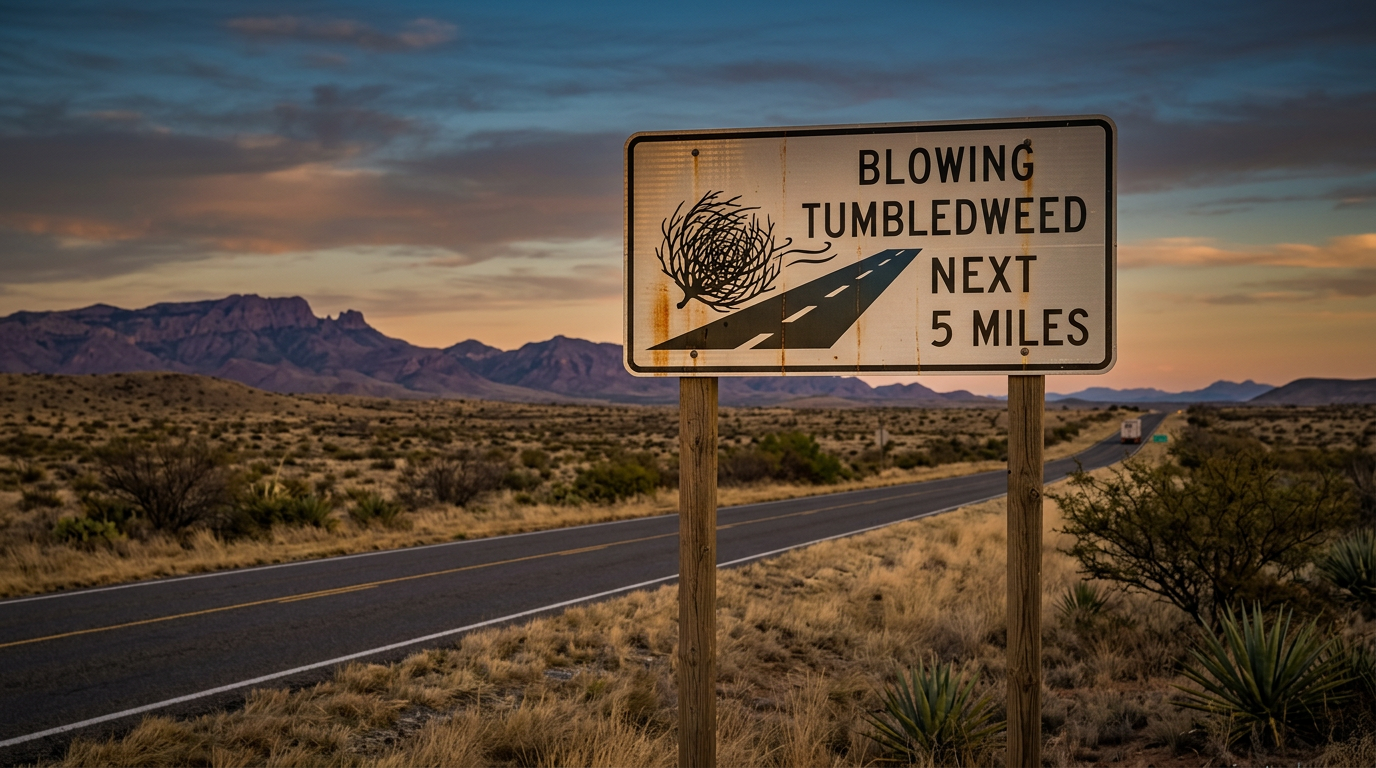
The vast expanse of the Texas highway system is more than just a network of asphalt connecting bustling cities; it is a sprawling canvas of local personality and regional quirks. While most drivers are accustomed to the standard regulatory shapes and colors dictated by federal manuals, Texas frequently deviates from the norm to address its specific environmental and cultural needs. From the high deserts of West Texas to the humid coastal plains, the signage encountered by motorists often tells a deeper story about the communities they are passing through and the unique hazards or points of pride found within them. These markers serve as accidental monuments to the Lone Star State's distinct identity, blending official state government communication with a touch of local flair that is rarely seen in other parts of the country. Historically, the Texas Department of Transportation (TxDOT) has managed one of the largest road networks in the world, giving it significant leeway in how it communicates with the public. Over the decades, this has led to the adoption of signs that might baffle outsiders but make perfect sense to those who call Texas home. Whether it is a warning about specific local wildlife or directions to a destination that exists only in the realm of quirky geography, these signs provide a break from the monotony of long-distance driving. This collection of atypical markers highlights the intersection of public safety, regional legend, and the sheer geographic diversity that makes Texas unlike any other state in the union.
Texas relevance
Every sign discussed is physically located within the borders of Texas, impactfully shaping the experience for millions of resident drivers and tourists alike. In cities like Austin, Houston, and San Antonio, as well as the remote stretches of Trans-Pecos, these signs are maintained by the state and local municipalities. They represent the administrative reality of governing a state that is larger than many European nations, requiring hyper-local communication strategies that reflect the varied terrain of the Texas landscape.
The Evolution of Texas Road Directives
Texas road signage has evolved significantly since the early 20th century when the first state highways were designated. Initially, most signs were simple wooden posts with hand-painted directions, but as the petrochemical and automotive industries boomed, the need for sturdy, standardized metal signs grew. However, because Texas is so vast, a one-size-fits-all approach to signage often failed. Engineers and local officials began creating specialized markers to address specific regional issues, such as extreme flash flooding or the migration paths of indigenous animals.
Today, TxDOT oversees hundreds of thousands of miles of road, and within that system, anomalous signs have become cherished landmarks. These signs are more than just transit tools; they are part of the state's visual heritage. They represent the practical solutions devised by Texans to navigate a land that is often rugged and unpredictable. By looking closely at these markers, one can see the shifting priorities of the state, from promoting ranching and agriculture to protecting unique environmental habitats along the Gulf Coast and the Hill Country.
Wildlife Warnings: Beyond the Standard Deer Crossing
While most states feature a standard yellow diamond with a leaping stag, Texas takes its wildlife warnings to a more specific level. In various parts of the state, motorists may encounter signs warning of tarantula migrations, alligator crossings near coastal wetlands, or even slow-moving turtles in protected areas. These aren't just for novelty; they are critical for the survival of local ecosystems and the safety of drivers who might otherwise ignore a generic warning.
The specificity of these signs highlights the biodiversity of the state. For instance, in the southern reaches of the state, signs alerting drivers to Ocelot crossings are part of a multi-million dollar federal and state effort to save the endangered cats from vehicle strikes. These signs are tailored to the specific silhouette of the animal, ensuring that drivers know exactly what to look for on the horizon during dawn and dusk hours.
The Cultural Significance of Naming Conventions
Texas geography is famous for its colorful place names, and the signs directing travelers to these locations often catch the eye of the uninitiated. Names like 'Dime Box,' 'Tarzan,' or 'Breakfast' appear on official highway green-boards, sparking curiosity about the history of the settlements they represent. These names are often rooted in 19th-century history, local lore, or the specific whims of early postmasters who were tasked with identifying fledgling communities.
When a driver sees a sign for 'Cut and Shoot, Texas,' they aren't just seeing a destination; they are seeing a reference to a 1912 community dispute that nearly led to violence. The state maintains these names on its signage as a way of preserving the narrative of the 'Old Texas' while moving toward a modern future. It keeps the history of the state alive by forcing travelers to ask questions about the origin of such unique nomenclature.
Safety First: The Humor of Digital Highway Signs
In recent years, Texas has gained national attention for the creative using of its Intelligent Transportation System (ITS) boards. These large electronic displays, usually reserved for traffic updates and Amber Alerts, are frequently used to broadcast safety messages with a uniquely Texan sense of humor. Phrases like 'Designated Drivers are the real MVPs' or 'Drive like your momma's watching' have become a staple of the Texas driving experience.
This approach to safety communication is designed to combat 'sign fatigue,' where drivers stop paying attention to repetitive messages. By using wit and pop culture references, Texas transportation officials hope to engage the driver's brain and encourage safer behavior on the road. While the federal government has occasionally pushed back on the use of humor in signage, the Texas approach remains popular among residents who appreciate the state's refusal to be boring.
Navigating the 'Texas Turnaround'
One piece of signage that is virtually unique to Texas is the instruction for the 'Texas U-Turn' or 'Texas Turnaround.' These signs are found at the intersections of highway frontage roads and overpasses, allowing drivers to switch directions without ever having to wait at a traditional traffic light. While common to locals, the signage and the maneuver itself are often perplexing to out-of-state visitors who are used to more traditional grid systems.
The existence of the frontage road system itself necessitated a unique library of signs that find no home in states like New York or California. These signs dictate the flow of traffic on the 'marginal' roads that run parallel to the main freeways. They are a physical manifestation of Texas civil engineering, designed to facilitate growth and commercial access along the state's burgeoning corridors.
Ghost Towns and Forgotten Corridors
Across the rural stretches of the Panhandle and the South Texas Plains, road signs often point toward locations that no longer appear on modern digital maps. These signs serve as the only remaining public acknowledgement of ghost towns and defunct railway stops. They provide a haunting reminder of the booms and busts that have defined the Texas economy, from the oil rushes of the early 1900s to the decline of the small-scale cotton industry.
The state continues to maintain these signs as a service to the remaining residents in these areas and as a nod to historical preservation. For the modern explorer, these signs act as breadcrumbs leading to abandoned schoolhouses, crumbling general stores, and the silent ruins of a Texas that once was. They represent the persistence of the Texas identity even in the face of geographic and economic shifting.
Analysis
The existence of 'strange' signs in Texas is a testament to the state's decentralized spirit and its willingness to embrace non-conformity. While the federal Manual on Uniform Traffic Control Devices (MUTCD) attempts to standardize road appearances, Texas consistently chooses to add its own 'Texan' layer to the mix. These signs reflect a culture that prioritizes local context over bureaucratic uniformity. For example, a sign warning of 'Chupacabras' or specific local oddities functions both as a safety measure and as a brand-building tool for the state's tourism. It reinforces the idea that once you cross the border into Texas, the rules—and the sights—are fundamentally different from the rest of the United States. This independent streak is visible even in the way our infrastructure communicates with us, turning a routine commute into an exploration of regional character.
Source attribution
This story was reported using a public release from the Unusual Texas / Only In Texas (Google News). Keep TX Red rewrote the coverage independently and links to the official statement for verification.
Frequently Asked Questions
- Why does Texas have signs for unusual animals?
- Because Texas contains several distinct ecological zones, TxDOT implements specific signage to protect drivers and local species. This includes warnings for alligators in the east, ocelots in the south, and even elk in the west, which are more effective than generic deer signs.
- What is a 'Texas Turnaround' as seen on road signs?
- A Texas Turnaround is a specialized lane that allows drivers on a frontage road to make a U-turn onto the opposite frontage road without entering the main intersection or stopping at a light. Dedicated signs help guide drivers into these lanes.
- Can the federal government ban Texas's funny road signs?
- While the Federal Highway Administration has issued guidelines suggesting that safety messages should be clear and direct rather than humorous, Texas has historically defended its right to use creative language to better engage its specific driving population.
Official Sources
Take the next step
Browse the Newsroom →Read more about Keep Texas Red → Our full guide to what Keep Texas Red means and why Texans support it.
Related Articles
Get Texas updates delivered weekly.
Independent Texas reporting on politics, policy, and daily life. One email a week. Unsubscribe anytime.
Keep TX Red Newsroom
The Keep Texas Red Editorial Staff produces nonpartisan explainers, policy breakdowns, and educational resources to help Texans understand how their government works. All content is reviewed for accuracy and updated regularly.
About Keep TX Red →