Severe Flooding Triggers Major Bridge Collapse in Uvalde County During Storm Recovery
South Texas faces new infrastructure challenges as rising waters destroy a bridge in Uvalde County amid ongoing storm recovery efforts.
Editorial disclaimer: Opinions and analysis on Keep TX Red are editorial content — not statements of fact. See our editorial standards.
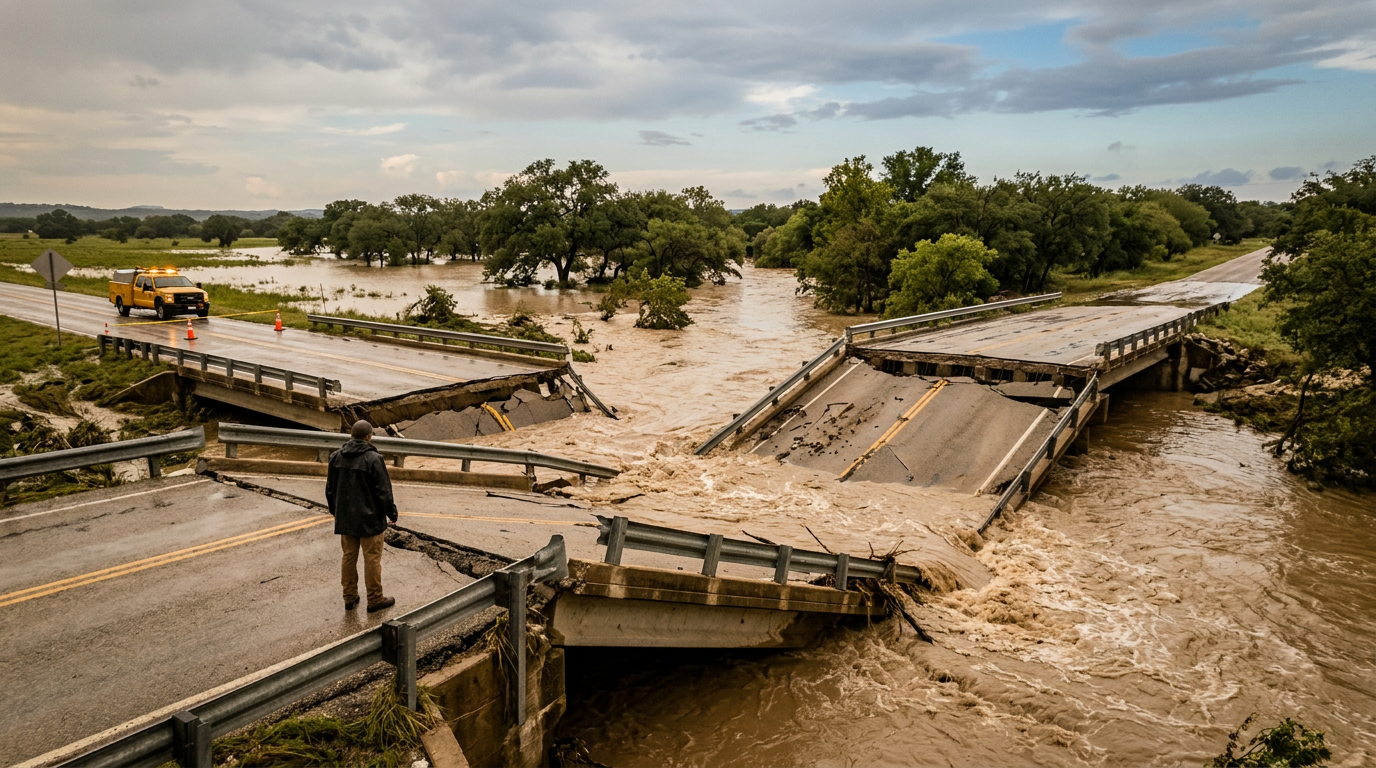
Infrastructure in Uvalde County suffered a significant failure this week as a bridge collapsed under the pressure of severe regional flooding. The incident occurred on July 17, 2026, as South Texas continues to grapple with the aftermath of intense summer storms that have saturated the ground and pushed waterways beyond their capacities. Local authorities reported the collapse as part of an ongoing emergency response that has stretched across multiple counties in the region, focusing on both immediate life-safety issues and long-term structural integrity assessments. This failure represents a tangible setback for the area, which was already in the process of clearing debris and restoring utility services following the initial wave of heavy rainfall. Historically, South Texas infrastructure has been tested by the volatile nature of the region's weather patterns, which often swing between extreme drought and flash flooding. In previous years, similar events in rural counties have highlighted the aging state of bridge crossings that serve as vital links for agricultural transportation and emergency services. This latest event in Uvalde County serves as a reminder of the vulnerability of rural crossings when faced with rapid water accumulation. The collapse coincides with a broader state-level focus on hardening infrastructure against natural disasters, though rural areas often face the steepest hurdles in securing the necessary funding and engineering resources to prevent such occurrences.
Texas relevance
The bridge collapse in Uvalde County is a critical concern for residents of South Texas, specifically those residing in the Hill Country and Brush Country transition zones. For Texans in these areas, bridges are not just conveniences but essential conduits for the transport of cattle, produce, and equipment. When a crossing fails in a rural county like Uvalde, the detour routes can often add thirty minutes or more to a commute, impacting the response times of volunteer fire departments and sheriff's deputies. Furthermore, the event underscores the importance of the Texas Department of Transportation's role in supporting county road departments that lack the heavy specialized equipment needed for rapid bridge replacement.
The Impact of Intense Rainfall on Local Tributaries
The collapse in Uvalde County was primarily driven by the saturation levels of the soil and the sheer force of moving water in local creeks and rivers. When South Texas experiences high-volume rainfall over a short period, the dry, rocky terrain of the area often cannot absorb the moisture quickly enough. This results in heavy runoff that channels into narrow waterways, creating a 'battering ram' effect against bridge piers and abutments.
In this specific instance, the structural failure occurred after days of sustained water pressure. The integrity of the bridge's foundation was compromised as the rushing water caused scouring, a process where sediment is washed away from the base of the bridge supports. Once the underlying soil was removed, the weight of the bridge deck became unsustainable, leading to the localized collapse that has now severed a key local route.
Emergency crews have been monitoring several other crossings in the area, as the water levels have not yet fully receded. The saturation of the surrounding banks makes it difficult for heavy machinery to access the site immediately, meaning that a full assessment of the damage and the beginning of the reconstruction process may be delayed until the ground stabilizes sufficiently to support repair vehicles.
Regional Recovery Efforts and Public Safety
The bridge failure is just one component of a larger recovery operation currently underway across South Texas. Communities from the Rio Grande Valley up through the Edwards Plateau have been dealing with inundated roadways, power outages, and property damage. Uvalde County officials have been working in tandem with neighboring jurisdictions to share resources and coordinate the closure of unsafe roads to prevent motorists from being trapped by rising waters.
Public safety remains the top priority for local leadership. Signage and barricades have been deployed to redirect traffic away from the collapsed structure. Residents are being urged to respect these barriers, as the stability of the remaining sections of the roadway cannot be guaranteed. In past flooding events, the leading cause of injury has been individuals attempting to bypass road closures or drive through low-water crossings that appear shallow but contain powerful undercurrents.
Local law enforcement has increased patrols in the vicinity of the collapse to ensure that travelers are aware of the detour. The closure has already begun to affect local school bus routes and mail delivery services, forcing a temporary reorganization of routes that will likely remain in place for the foreseeable future while the county seeks state assistance for the rebuild.
The Challenges of Rural Infrastructure Maintenance
Maintaining bridges in sprawling rural counties presents a unique set of challenges for Texas officials. Uvalde County, like many of its neighbors, manages a vast network of roads on a budget that is often limited by the local tax base. While major highways are maintained by the state, hundreds of smaller bridges fall under the responsibility of the county road departments, which must balance routine maintenance with emergency repairs.
The cost of replacing a bridge has risen significantly in recent years due to the increased price of steel and concrete, as well as more stringent engineering standards designed to withstand millennial flood events. For a county currently in recovery mode, the sudden loss of a bridge creates a budgetary vacuum that often requires a declaration of disaster to trigger state or federal fiscal support.
This incident serves as a catalyst for renewed discussions regarding the Texas infrastructure fund and how it is distributed to non-urban areas. While the state's major cities receive significant attention for highway expansions, the reliability of the 'farm-to-market' network and county crossings is what sustains the state's multi-billion dollar agricultural industry. Without functional bridges, the movement of Texas goods becomes stalled.
Geographic Vulnerabilities of Uvalde and South Texas
Uvalde County sits in an area of Texas where the topography can quickly turn a localized thunderstorm into a downstream disaster. The region's limestone bedrock and varied elevation mean that water moves quickly and unpredictably. When the Frio, Sabinal, or Nueces rivers swell, they carry debris such as large cypress logs and boulders that act as projectiles, further damaging any structures in their path.
Recent weather patterns have shown an increase in the intensity of these 'rain bombs,' where months' worth of rain falls in a single afternoon. This makes it increasingly difficult for engineers to predict the necessary load-bearing and flow-through capacities for local bridges. The bridge that collapsed this week was likely designed for a different era of weather expectations, highlighting the need for modernized construction techniques.
As the recovery continues, hydrological surveys will be conducted to determine if the river channel itself has shifted. Often, a major flood will alter the course of a creek, meaning that a replacement bridge cannot simply be built in the exact same spot without risking another failure in the future. These environmental factors add layers of complexity to the recovery phase that extend beyond simple construction.
Future Outlook and State Assistance
The path forward for Uvalde County involves a multi-step process beginning with the formal damage assessment. Once the waters recede, engineers will determine if any parts of the existing structure are salvageable or if a complete redesign is required. This process will involve the Uvalde County Commissioners Court and likely the Texas Division of Emergency Management, which oversees the distribution of recovery funds.
State leaders have historically been responsive to infrastructure failures in the wake of natural disasters, but the queue for assistance can be long when multiple counties are affected by the same storm system. The speed of the reconstruction will depend heavily on the availability of contractors and the prioritization of the route within the county's broader transportation plan.
In the meantime, the resilience of the local community is being tested as they navigate the logistical hurdles of a severed artery. For the people of Uvalde, this bridge collapse is more than just a news headline; it is a daily obstacle that necessitates patience and community cooperation. The lessons learned from this failure will likely inform how other South Texas counties approach their own bridge safety inspections in the months to come.
Source attribution
This story was reported using a public release from the Texas Travel Stories (Google News). Keep TX Red rewrote the coverage independently and links to the official statement for verification.
Frequently Asked Questions
- Where exactly did the bridge collapse occur?
- The bridge is located within Uvalde County, part of the South Texas region. Local authorities have placed barricades at the site to prevent traffic from approaching the structural failure.
- Are there any injuries reported from the collapse?
- As of the latest reports, there have been no confirmed injuries resulting directly from the bridge's failure. Officials credit the preemptive monitoring of road conditions for preventing accidents.
- How long will it take to repair the bridge?
- A specific timeline has not been established. Repairs cannot begin until the floodwaters recede and the ground dries enough to support heavy equipment. Rural bridge replacements often take several months to design and fund.
- What should residents do if they encounter flooded roads?
- Texas emergency officials remind motorists to 'Turn Around, Don't Drown.' Most flood-related fatalities occur in vehicles. Never drive around barricades, even if the road appears safe.
Official Sources
Take the next step
Browse the Newsroom →Read more about Keep Texas Red → Our full guide to what Keep Texas Red means and why Texans support it.
Related Articles
Get Texas updates delivered weekly.
Independent Texas reporting on politics, policy, and daily life. One email a week. Unsubscribe anytime.
Keep TX Red Newsroom
The Keep Texas Red Editorial Staff produces nonpartisan explainers, policy breakdowns, and educational resources to help Texans understand how their government works. All content is reviewed for accuracy and updated regularly.
About Keep TX Red →