Kerrville Volunteers Rally to Resurrect Iconic Guadalupe River Eatery After Historic Flood Damage
The Kerrville community joins forces to restore a local landmark after devastating rains caused severe flood damage to a popular riverside restaurant.
Editorial disclaimer: Opinions and analysis on Keep TX Red are editorial content — not statements of fact. See our editorial standards.
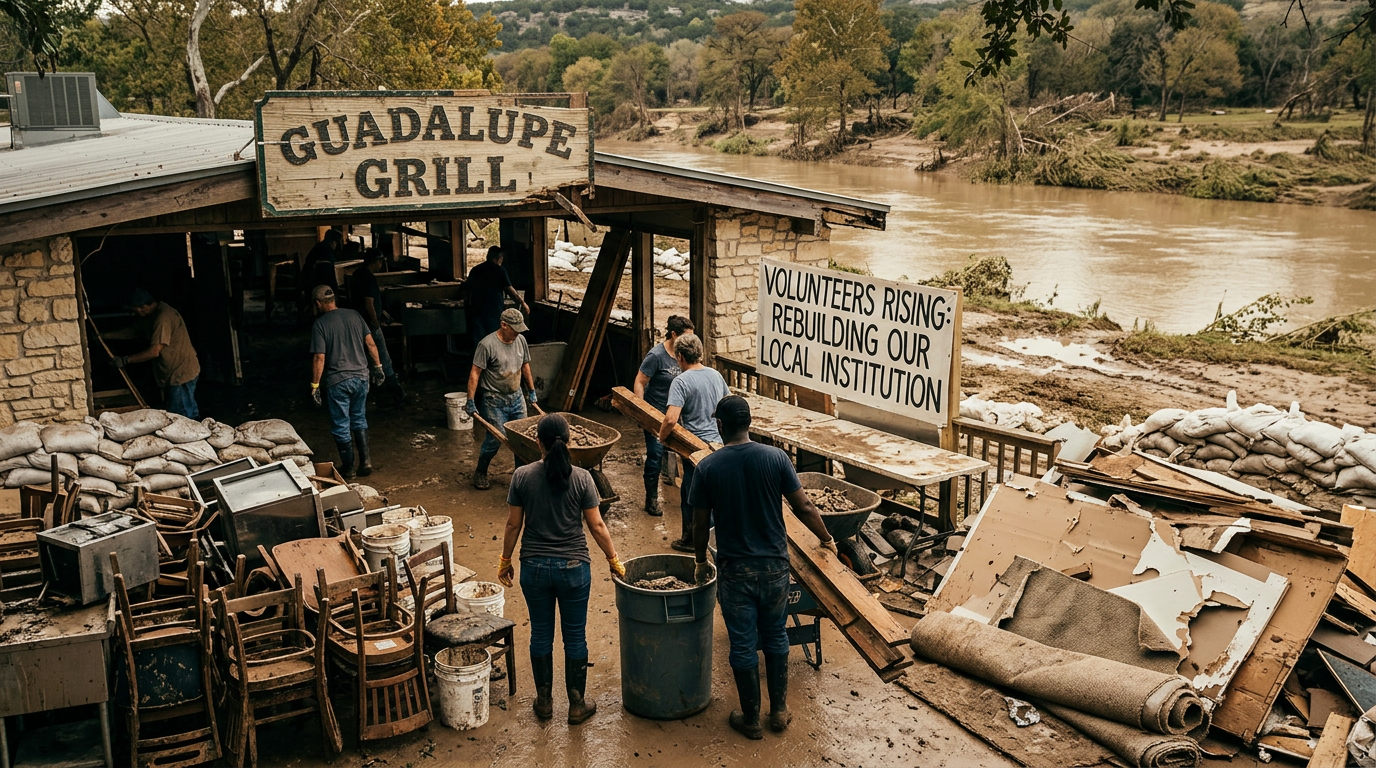
In the wake of unrelenting rainfall that sent the Guadalupe River over its banks, the Kerrville community has launched a massive grassroots effort to restore one of the city's most cherished dining institutions. The recent weather event saw water levels rise with such speed that the local establishment suffered extensive structural and interior damage, leaving the owners with a daunting path to various repairs. Historically, the Texas Hill Country has been prone to flash flooding, with major events in 1932, 1978, and 2002 shaping how local residents respond to natural disasters. This latest surge serves as a stark reminder of the river's power, yet it has simultaneously ignited a spirit of volunteerism rarely seen in the region. Rather than waiting for federal assistance or insurance adjusters to finalize documentation, residents of Kerr County took matters into their own hands. Within hours of the water receding, dozens of volunteers arrived with industrial fans, shovels, and cleaning supplies. The goal is not just to clean up the mud left behind, but to rebuild a space that has served as a social hub for decades. The owners, overwhelmed by the sudden loss of their livelihood, have expressed profound gratitude as neighbors they have never met showed up to haul away ruined furniture and strip water-logged drywall. This surge of local support underscores the unique resilience found in central Texas towns where small businesses are viewed as the heart of the community.
Texas relevance
Kerrville, located in the heart of the Texas Hill Country, depends heavily on the Guadalupe River for both its beauty and its tourism economy. However, as residents of Kerr County know all too well, the same river that provides recreation can become a destructive force during the spring and summer storm seasons. The restoration of this specific restaurant is vital to the local economy, as it employs numerous residents and attracts visitors from San Antonio and Austin. The community's swift action demonstrates a 'Texas Strong' philosophy, ensuring that a staple of the local culinary scene does not become a permanent casualty of the state's volatile weather patterns.
The Impact of the Guadalupe River Surge
The Guadalupe River is the lifeblood of Kerrville, but its proximity to the downtown and hospitality sectors creates a constant risk during heavy rainfall. When the recent storms hit, the river's rise was exacerbated by runoff from the surrounding rocky terrain of the Hill Country. Unlike flatter regions where water can soak into the ground, the limestone-heavy soil of the Kerrville area causes water to rush rapidly into low-lying basins.
The restaurant in question, positioned for years to give patrons a scenic view of the water, found itself directly in the path of the torrent. The force of the water was strong enough to bypass traditional sandbagging efforts, inundating the kitchen and dining areas with several feet of silt and debris. The structural integrity of the outdoor seating areas was also compromised, as the fast-moving current eroded the banks and damaged the foundational supports of the riverside deck.
Beyond the physical damage, the closure of such a high-traffic establishment creates a ripple effect throughout the local supply chain. Local farmers, beverage distributors, and service staff all face immediate financial hardship when a cornerstone business is forced to shutter. This economic threat is precisely why the community felt such urgency to begin the restoration process immediately, bypassing the usual delays associated with major flood recovery.
Mobilizing the Kerrville Grassroots Response
The response from the citizens of Kerrville was almost instantaneous once the floodwaters retreated. Social media platforms became the primary hub for organizing work shifts, with local residents coordinating the delivery of food for volunteers and the sourcing of heavy machinery. It was not uncommon to see local contractors donating their time and equipment to help with the heavy lifting, showcasing a level of professional camaraderie that defines the Texas business spirit.
Cleanup efforts involved more than just removing water; the volunteers had to contend with the hazardous silt and mud left behind by the Guadalupe. This required specialized cleaning agents and a coordinated effort to ensure the kitchen facilities could eventually meet health department standards again. The commitment shown by the volunteers, many of whom have their own jobs and families to tend to, highlights the deep-seated cultural value of 'neighbor helping neighbor' that persists in smaller Texas municipalities.
By day three of the recovery effort, the progress was visible. Most of the debris had been cleared, and the focus shifted to the 'gutting' phase, where damaged walls and flooring were removed to prevent the growth of mold. This phase is critical in the humid Texas climate, where delays can lead to permanent structural issues. The speed at which this was accomplished through volunteer labor saved the business owners thousands of dollars in professional remediation costs.
The Financial Challenge of Reconstruction
While labor has been largely provided by the community, the material costs for rebuilding remain a significant hurdle. Modern building codes and the need for flood-resistant materials mean that the second iteration of the restaurant will likely be more expensive to construct than the original. The owners are now navigating the complex world of insurance claims, which often fail to cover the full extent of losses in high-risk flood zones.
To bridge the financial gap, several local organizations have stepped up to host fundraisers. From 'tip-share' nights at other local eateries to online crowdfunding campaigns, the financial support from the broader Hill Country region has been robust. These funds are destined for the purchase of new industrial kitchen equipment, which was lost to the water, and the high-grade lumber needed to rebuild the outdoor dining spaces to current safety standards.
This financial struggle is common for Texas businesses located near the state's major waterways. State-level discussions often revolve around how to provide better low-interest loan programs for small businesses affected by localized flooding that doesn't quite reach the threshold of a federal disaster declaration. In the absence of such programs, the burden remains on the local community to provide the capital necessary for a full recovery.
Historical Context of Hill Country Flooding
Flash floods are a historical constant in the Texas Hill Country, often referred to as 'Flash Flood Alley.' The geography of the region, featuring steep hills and narrow valleys, creates a funnel effect for rainwater. In the past, Kerrville has seen the Guadalupe River rise more than 30 feet in a matter of hours, a phenomenon that has repeatedly tested the resolve of its inhabitants.
The restaurant's struggle is a new chapter in a long history of local resilience. Following the massive floods of the late 20th century, many Kerrville businesses implemented their own flood-mitigation strategies, but the sheer volume of the most recent event bypassed many of these precautions. This history of flooding has created a localized knowledge base, where residents know exactly what needs to be done the moment the water starts to drop.
Lessons learned from these historical events have also influenced how the current cleanup is being handled. Older residents have been advising younger volunteers on the best ways to dry out antique wood and salvaged materials, passing down the practical skills necessary for survival in a flood-prone environment. This intergenerational cooperation is a vital part of the social fabric in Kerr County.
Environmental and Safety Considerations
As the rebuild continues, there is a heightened focus on future-proofing the establishment. This includes relocating sensitive electrical systems to higher elevations and using materials that can withstand total immersion. The goal is to ensure that if the Guadalupe rises again, the cleanup will be a matter of days rather than months. This forward-thinking approach is being adopted by several riverside businesses in the area.
Environmental safety is also a priority during the restoration. Volunteers have been careful to prevent cleaning chemicals and construction debris from washing back into the river, which remains a pristine natural resource for the state. The Texas Commission on Environmental Quality (TCEQ) provides guidelines for such cleanups, and local organizers have been diligent in following these to protect the river's ecosystem.
Safety for the volunteers themselves has also been a major concern. The heat of the Texas summer, combined with the physical exertion of cleaning a flooded building, presents risks of dehydration and heatstroke. Local businesses have donated pallets of water and ice to keep the workers safe, proving that the community's care extends beyond the building to the people doing the work.
The Future of the Riverside Dining Scene
The success of this rebuilding effort will likely serve as a model for other businesses in the Hill Country. It demonstrates that a combination of community spirit, strategic planning, and financial resilience can overcome the challenges posed by Texas's unpredictable environment. The restaurant is currently aiming for a grand reopening in the coming months, an event that is expected to be one of the largest community gatherings of the year.
When the doors finally reopen, it will not just be a victory for the owners, but for the entire city of Kerrville. It will signal that the community's identity is stronger than any storm and that the local economy can weather even the most severe natural disasters. The story of this restaurant is becoming a testament to the enduring bond between a business and the people it serves.
As Kerrville looks forward, there is a renewed sense of pride in the local culture. The willingness of strangers to sweat and toil for the sake of a local landmark is a powerful rebuttal to the idea that community ties are weakening in the modern era. In the Texas Hill Country, at least, those ties remain as strong as the currents of the Guadalupe.
Analysis
This situation highlights a recurring theme in rural Texas: the primary safety net for small businesses is often the community itself rather than government bureaucracy. While state and federal disaster declarations provide long-term funding, the immediate needs of a business—mitigating mold, clearing debris, and securing the structure—are best met by local mobilization. The outpouring of help in Kerrville reflects a broader trend of Texans prioritizing local commerce and heritage over modern, franchised alternatives. It also points to the necessity of improved flood mitigation infrastructure in the Hill Country, as these 'once-in-a-century' events seem to be occurring with greater frequency, threatening the economic stability of riverfront districts.
Source attribution
This story was reported using a public release from the Texas Food Stories (Google News). Keep TX Red rewrote the coverage independently and links to the official statement for verification.
Frequently Asked Questions
- Was this a federally declared disaster area?
- While the rainfall was severe across the Hill Country, the immediate response in Kerrville has been driven by the local community and private donations rather than waiting for a federal disaster declaration, which can often take weeks or months to process.
- How can people from outside Kerrville help with the effort?
- Many local organizations in Kerrville have set up digital fundraising pages and are accepting donations for building materials. Additionally, supporting other local businesses in the area helps keep the regional economy stable during the recovery period.
- Are there plans to prevent future flooding at this location?
- As part of the rebuilding process, the owners are looking into flood-resilient construction materials and moving vital mechanical and electrical systems to higher points in the building to mitigate damage from future river surges.
Official Sources
Take the next step
Browse the Newsroom →Read more about Keep Texas Red → Our full guide to what Keep Texas Red means and why Texans support it.
Related Articles
Get Texas updates delivered weekly.
Independent Texas reporting on politics, policy, and daily life. One email a week. Unsubscribe anytime.
Keep TX Red Newsroom
The Keep Texas Red Editorial Staff produces nonpartisan explainers, policy breakdowns, and educational resources to help Texans understand how their government works. All content is reviewed for accuracy and updated regularly.
About Keep TX Red →