Hill Country Flood Risks Return as Guadalupe River Levels Threaten Kerrville Businesses
Kerrville business owners remain on high alert as rising Guadalupe River levels evoke memories of last year's tragic flash flooding events.
Editorial disclaimer: Opinions and analysis on Keep TX Red are editorial content — not statements of fact. See our editorial standards.
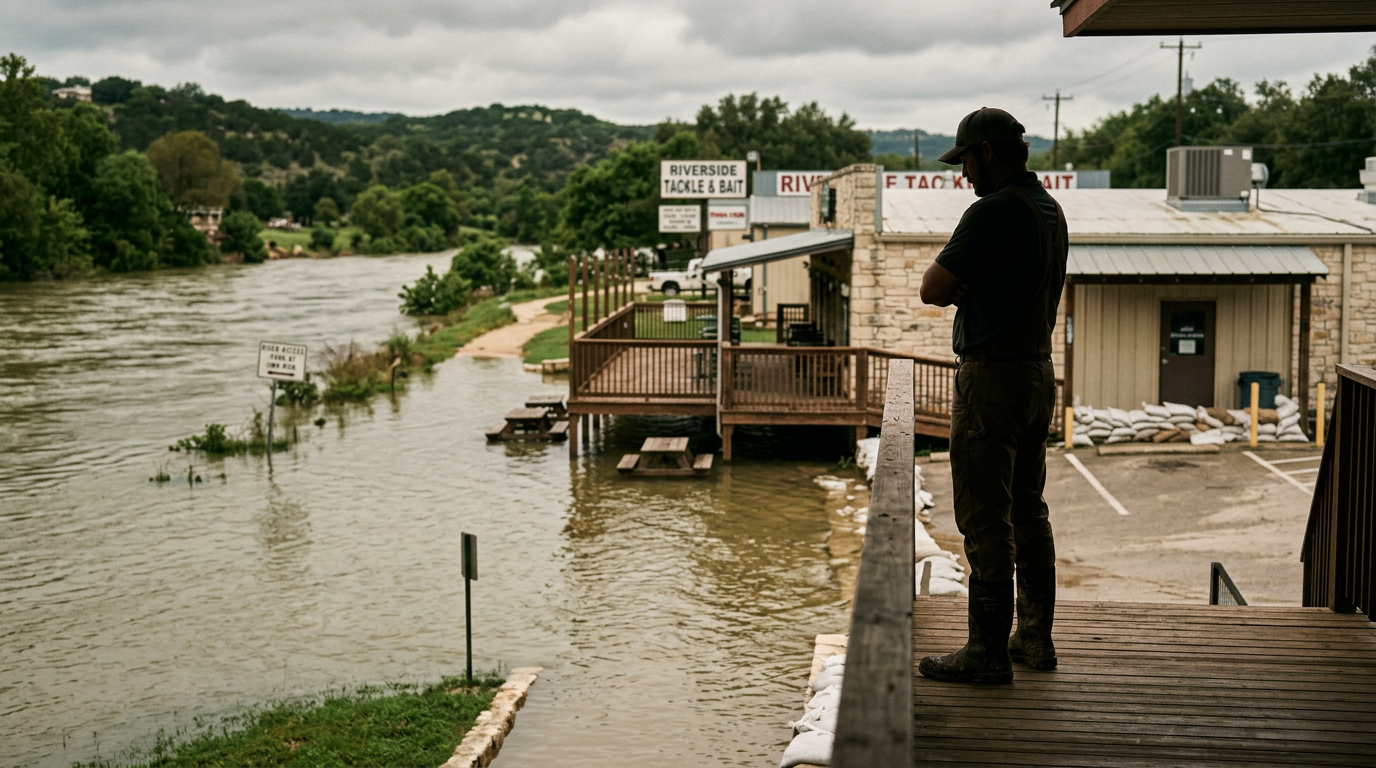
Recent heavy rainfall across the Texas Hill Country has once again pushed the Guadalupe River toward critical levels, forcing local business owners and residents in Kerrville to prepare for potential catastrophe. This heightened state of alert comes roughly one year after a devastating flood event fundamentally altered the landscape of the riverfront. The psychological and financial impact of these seasonal surges remains a heavy burden for the community, particularly for those whose livelihoods are tied to the water’s edge. Historical data suggests that the Hill Country's unique topography, characterized by rocky soil and steep limestone canyons, makes it one of the most flash-flood-prone regions in the United States. Local proprietors are closely monitoring gauge heights as tributary runoff continues to flow downstream into the main channel near the city's popular recreational corridors. The current weather patterns mirror the atmospheric conditions that led to previous disasters in the region. When the soil reaches a saturation point, additional rainfall has nowhere to go but into the river system, creating rapid rises that can occur in a matter of minutes. For the owners of establishments such as the Blue Oak RV Park, these environmental shifts are more than just weather reports; they are existential threats to infrastructure and human life. The community is now at a crossroads where long-term disaster mitigation strategies must be balanced against the immediate need for emergency response and evacuation planning. This cycle of rebuilding and bracing has become a defining characteristic of life along the Guadalupe, highlighting the resilience and vulnerability of those who call the Hill Country home.
Texas relevance
Kerrville and the broader Kerr County area serve as the primary focus of this narrative, highlighting a specific Texas vulnerability. The Guadalupe River is a central economic and recreational lifeline for Central Texas, but it also presents a recurring hazard to the state’s infrastructure. In Texas, water rights and flood zone management are critical legislative and local policy issues. The events in the Hill Country serve as a cautionary tale for other Texas river communities, such as those along the Blanco and Pedernales rivers, which share similar hydrological risks. Ensuring the safety of Texas residents in these high-risk zones requires coordinated efforts between the Texas Water Development Board and local emergency management departments.
The Weight of Historical Precedent
To understand the current anxiety in Kerrville, one must look back at the catastrophic events of the previous year. During that time, the Guadalupe River transformed from a peaceful stream into a violent force of nature that overran its banks with unprecedented speed. The most tragic aspect of that event was the loss of a family who was swept away by the raging current at an RV park, a memory that still haunts the local community and emergency responders.
This legacy of loss has changed how business owners perceive every rain cloud that gathers over the Edwards Plateau. The trauma of seeing buildings destroyed and lives extinguished has led to a culture of hyper-vigilance. Residents no longer wait for official sirens; they watch the river’s color and debris flow as indicators of what is coming from upstream. This grassroots monitoring is a testament to the community's survival instincts in a region where nature can turn hostile without warning.
The historical context of Hill Country flooding dates back over a century, with major events in the 1930s and 1950s shaping the current engineering of dams and spillways. However, as development increases in Central Texas, the amount of impervious cover grows, leading to faster runoff and higher peak flows. Today’s business owners are dealing with a different landscape than their predecessors, necessitating a modernized approach to flood preparedness and structural reinforcement.
Economic Instability for Waterfront Businesses
Small businesses along the Guadalupe River face unique insurance and operational hurdles that are rarely seen in other parts of the state. Every time the river rises, these owners must decide whether to evacuate expensive equipment or risk it being submerged. This constant 'wait and see' game creates a significant financial strain, as temporary closures lead to lost revenue during the peak tourism seasons when the Hill Country is typically most profitable.
Insurance premiums in these high-risk zones have skyrocketed, making it difficult for many small-scale operators to maintain coverage. For an RV park owner, the loss of electrical pedestals, plumbing, and landscaping can cost tens of thousands of dollars to repair. When these events happen annually, the cost of doing business becomes nearly unsustainable, leading to a slow exodus of the very establishments that define the local culture.
Furthermore, the labor market in these areas is impacted. Employees at riverfront bars and campgrounds often face sudden layoffs or reduced hours when flooding occurs. The ripple effect touches everything from local craft breweries to supply companies that provide services to the hospitality sector. Maintaining economic stability in a flood zone requires a level of grit and financial planning that is unique to the Texas Hill Country's entrepreneurial class.
The Role of Meteorological Forecasting
Accurate forecasting is the first line of defense against the Guadalupe's unpredictable nature. Meteorologists focus on 'training' storms—weather patterns where multiple cells follow the same path, dumping massive amounts of rain over a concentrated area. In the Hill Country, even a few inches of rain falling twenty miles upstream can result in a massive wall of water reaching Kerrville hours later.
The National Weather Service and the Lower Colorado River Authority (LCRA) provide data through a network of stream gauges, but local residents often feel that these tools have limitations during fast-moving events. The topographical complexity of the region means that micro-climates can produce isolated deluges that sensors might not catch immediately. Consequently, there is a push for more localized sensor networks to provide micro-data to business owners.
Improvements in satellite imaging and Doppler radar have helped, yet the human element remains vital. Local 'river-watchers' often communicate via social media groups to share real-time photos of rising waters at low-water crossings. This bridge between high-tech forecasting and down-home observation is what currently keeps the residents of Kerrville one step ahead of the next major surge.
Infrastructure and Mitigation Strategies
In response to the recurring damage, some Texas leaders are calling for renewed investment in flood control infrastructure. This includes the expansion of retention ponds and the clearing of invasive vegetation that can snag debris and create makeshift dams during high-flow events. However, the Guadalupe is a wild river for much of its length, and taming it with concrete is both geographically difficult and environmentally controversial.
Local business owners have begun taking mitigation into their own hands. Some are installing heavy-duty breakaway walls in their structures, designed to let water pass through without collapsing the entire building. Others have moved critical electrical systems to rooftops or elevated platforms. These self-funded adaptations represent a shift from relying on government aid to building a more resilient, privately-led defense system.
Kerr County officials continue to evaluate the effectiveness of low-water crossing closures and the timing of emergency alerts. The challenge lies in ensuring that the message reaches tourists and campers who may not be familiar with the speed at which Texas rivers can rise. Educating the public about the dangers of 'Turn Around, Don't Drown' remains a top priority to prevent those who are just visiting the area from becoming statistics.
Community Resilience and the Path Forward
Despite the perennial threat, the sense of community in the Hill Country remains unwavering. When the waters receded last year, neighbors showed up with chainsaws and trailers to help one another clear the mud and debris. This spirit of mutual aid is what allows businesses to reopen after disasters that would permanently shutter establishments elsewhere. The shared experience of surviving the Guadalupe's power has forged a strong bond among the locals.
Looking forward, the goal is to shift from a reactive stance to a proactive one. There is an ongoing dialogue about how to preserve the natural beauty and recreational appeal of the river while acknowledging that it is a dangerous neighbor. Decisions made by the Texas Legislature regarding flood infrastructure funding will be closely watched by Kerrville residents who feel the direct impact of every budget cycle.
The story of the Kerrville bar and RV park owners is a microcosm of the larger Texas struggle with a volatile climate. As the state continues to grow, more people are moving into these scenic but hazardous areas. The lessons learned on the banks of the Guadalupe today will likely serve as the blueprint for how Texas manages its water resources and protects its citizens in the decades to come.
Analysis
The recurring flooding in the Hill Country underscores a significant policy challenge regarding land use and emergency notification systems in rural Texas. While the spirit of rugged individualism is strong in Kerrville, the increasing frequency of extreme weather events may necessitate tougher zoning regulations for structures built within the 100-year floodplain. There is a clear tension between property rights and public safety, especially when commercial enterprises like RV parks are situated in high-velocity water paths. From a conservative governance perspective, the focus must remain on improving infrastructure and early warning technological investments rather than intrusive federal mandates, ensuring that local communities have the tools to protect themselves without sacrificing their economic foundations.
Source attribution
This story was reported using a public release from the Texas Standard. Keep TX Red rewrote the coverage independently and links to the official statement for verification.
Frequently Asked Questions
- Why is the Guadalupe River so dangerous compared to other rivers?
- The Guadalupe River flows through the Texas Hill Country, which has thin soil and a high concentration of limestone. This prevents the ground from absorbing heavy rainfall, causing water to run off immediately into river channels. The result is a 'flash' flood that can rise several feet in an hour, often carrying large debris like cypress trees.
- What happened last year to the Blue Oak RV Park?
- Last year, the park experienced a catastrophic flooding event where the Guadalupe River overran its banks. The surge was powerful enough to sweep away a family, leading to a tragic loss of life. The incident served as a wake-up call for the region regarding the dangers of camping in close proximity to the water during storm season.
- How can business owners protect their property from recurring floods?
- Many owners are now using 'wet floodproofing' techniques, such as using flood-resistant materials, elevating electrical outlets, and designing walls that allow water to flow through. Others focus on rapid evacuation plans for moveable assets like RVs and equipment to minimize financial loss.
- Which Texas agencies manage flood responses in this area?
- The Texas Division of Emergency Management (TDEM) oversees regional responses, while the Texas Water Development Board manages long-term planning. Locally, the Kerr County Sheriff's Office and Kerrville Fire Department are the primary entities responsible for water rescues and immediate safety alerts.
Official Sources
Take the next step
Browse the Newsroom →Read more about Keep Texas Red → Our full guide to what Keep Texas Red means and why Texans support it.
Related Articles
Get Texas updates delivered weekly.
Independent Texas reporting on politics, policy, and daily life. One email a week. Unsubscribe anytime.
Keep TX Red Newsroom
The Keep Texas Red Editorial Staff produces nonpartisan explainers, policy breakdowns, and educational resources to help Texans understand how their government works. All content is reviewed for accuracy and updated regularly.
About Keep TX Red →