Castroville Heritage: Exploring the French Alsatian Roots of Rural Texas
A visitor from Alsace, France, discovers how 19th-century traditions and architecture remain preserved in Castroville, the 'Little Alsace' of Texas.
Editorial disclaimer: Opinions and analysis on Keep TX Red are editorial content — not statements of fact. See our editorial standards.
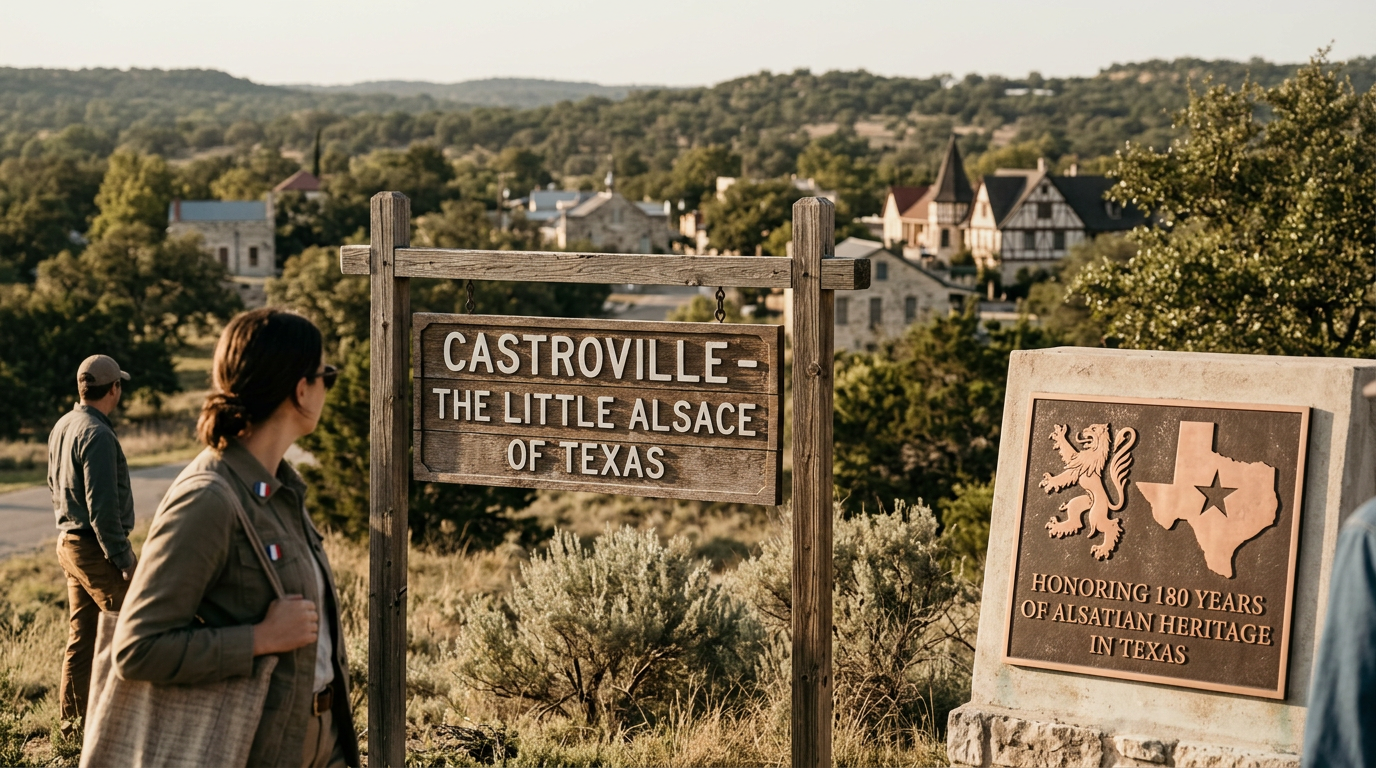
Deep within the heart of the Texas Hill Country, the town of Castroville serves as a living monument to a migration that began nearly two centuries ago. While many Texas towns boast German or Czech heritage, Castroville retains a unique cultural thumbprint derived specifically from the Alsace region of France. Recently, a traveler from the modern-day Alsace region visited the community to observe how much of the original culture survived the passage of 180 years. This exploration revealed that while the world has modernized, the architectural styles, linguistic echoes, and community spirit of the 1840s remain remarkably intact. The visitor found a profound sense of continuity in the limestone structures and the layout of the town, which mirrors the villages nestled between the Vosges Mountains and the Rhine River. Historically, the settlement was founded by Henri Castro, a visionary who recruited hundreds of families from Eastern France to settle in the Republic of Texas. These pioneers were not merely seeking land; they were escaping economic hardship and political instability in Europe. In the modern era, the connection between the 'Old World' and the 'New World' is often severed by the homogenization of global culture. However, Castroville stands as an outlier. By maintaining the Steinbach House—a structure actually relocated from France to Texas—and preserving the Alsatian dialect among older residents, the town provides a Rare bridge across the Atlantic. This cultural preservation highlights the enduring nature of Texas’s identity as a patchwork of global influences that take root and evolve uniquely in the Lone Star soil.
Texas relevance
Castroville represents a significant chapter in the settlement of Medina County and the broader expansion of the Texas frontier. Unlike the larger urban centers of San Antonio or Austin, Castroville has resisted complete modernization in its historic district, making it a critical site for Texas heritage tourism. For Texans, the persistence of Alsatian identity serves as a reminder of the diverse European ethnic groups that defined the state’s early Republic and early statehood years. The town remains a focal point for researchers studying the intersection of French and German cultures in the United States, as the Alsatian identity traditionally blends both linguistic and culinary traditions.
The Founding Vision of Henri Castro
The story of Castroville begins with Henri Castro, a Frenchman of Portuguese descent who entered into a colonization contract with the Republic of Texas in 1842. Castro was tasked with bringing settlers to the west of San Antonio, a region that was then considered a dangerous frontier. Despite the risks of indigenous conflict and the harshness of the semi-arid climate, Castro successfully recruited over 2,000 people, mostly from the Alsace region. These settlers were specifically chosen for their agricultural skills and their reputation for hard work, which were essential for surviving the transition from the lush fields of France to the rugged Texas brush.
When the first 27 families arrived in September 1844, they found a landscape that was entirely foreign to them. However, they immediately began utilizing the local limestone to build homes that mirrored the steeply pitched roofs and timber-framed aesthetics of their homeland. This architectural choice was not just about aesthetics; it was a way to recreate the comfort and familiarity of the villages they had left behind. Today, more than 90 of these original structures still stand, forming one of the most significant collections of mid-19th-century architecture in the American South.
Architectural Echoes of the Old World
Walking through the historic core of Castroville, a modern visitor from France is immediately struck by the 'Fachwerk' or half-timbering styles that are common in Alsatian villages. The settlers adapted their traditional techniques to the materials available in Texas, using massive limestone blocks and cypress wood from the nearby Medina River. The resulting 'Castroville Style' is distinct—a blend of frontier practicality and European elegance. The houses often feature asymmetrical rooflines designed to capture rainwater or provide shaded porches, adaptations that were necessary for the hot Texas climate but executed with French flair.
The focal point of this architectural preservation is the Steinbach House. Originally built in the 1600s in Wahlbach, France, the house was dismantled and shipped to Castroville in 1998 as a gift from the people of Alsace. It serves as a literal piece of France on Texas soil. For the French visitor, seeing this house—surrounded by Texas oaks but looking as though it were plucked from the Rhine valley—underlines the deep commitment the community has toward its origins. It serves as an educational hub where the specific history of the migration is taught to younger generations.
Linguistic Survival and the Alsatian Dialect
One of the most surprising elements for visitors is the lingering presence of the Alsatian dialect. Because Alsace has historically shifted between French and German control, the language is a unique Germanic dialect with significant French influences. In Castroville, this dialect survived for over a century as a primary language of the home. While English eventually became dominant, especially after World War II, the 'Texas Alsatian' dialect can still be heard among the town's elders. This linguistic fossil offers a window into the past, as the version spoken in Texas has evolved differently than the versions currently spoken in modern Europe.
The French visitor noted that while the accent has changed, the core vocabulary remains recognizable. This linguistic link is one of the most fragile parts of Castroville’s heritage. Efforts by local groups and the Castroville Heritage Foundation seek to document these speakers before the dialect fades entirely. The existence of this language variant highlights the isolation of early Texas settlements, which allowed European cultures to simmer in a 'slow cooker' environment, preserving nuances that were lost in the rapid modernization of the European continent.
Culinary Traditions: The Alsatian Palate in Texas
No exploration of Castroville's heritage is complete without mentioning the food. The town is famous for its parisa—a raw beef dish that is seasoned with onions, peppers, and citrus. While parisa is uniquely associated with Medina County, its roots can be traced back to the steak tartare traditions of Europe, adapted with the ingredients favored by Texas cattle ranchers. The visitor from France found the local bakeries particularly evocative of home, where Alsatian-style breads and pastries are still produced using traditional methods.
The presence of local meat markets and bakeries that focus on Alsatian specialties ensures that the culture is experienced through all the senses. These businesses are often family-owned, passing down recipes that have been in the community since the mid-1800s. For a traveler from Alsace, tasting these flavors in the middle of Texas is a jarring but beautiful experience. It demonstrates how immigrant communities do not simply abandon their tastes, but instead integrate them into the local landscape, contributing to the rich 'Tex-Mex-German' culinary fusion that the state is known for.
A Community Bound by History
The social fabric of Castroville remains tightly knit around its history. Annual events like Saint Louis Day celebrate the town's patron saint and serve as a homecoming for the descendants of the original settlers. During these festivals, the town square becomes a sea of Alsatian flags and traditional costumes. The French visitor observed that the sense of pride in one’s ancestry is perhaps even stronger in Castroville than it is in many parts of modern-day France. In Texas, being 'Alsatian' is a badge of honor that signifies resilience and a pioneering spirit.
This community bond extends to the preservation of the landscape itself. The Medina River remains a central feature of the town’s identity, much as it was when Henri Castro first chose the site for its water source. The residents’ commitment to maintaining the scale and character of their town against the encroachment of San Antonio’s urban sprawl is a testament to their values. They view their history not as a static museum piece, but as a living environment that must be protected for future generations of Texans.
Cultural Tourism and the Future of Little Alsace
As Texas continues to grow, towns like Castroville face the challenge of balancing development with preservation. The influx of new residents who may not have Alsatian roots means that the town must work harder to educate its population about its unique beginnings. However, the visitor from Alsace noted that the 'Texas-Alsatian' identity is welcoming rather than exclusive. It is an identity that invites others to participate in its history, whether through visiting the local museum or staying in a restored historic inn.
The future of 'Little Alsace' likely lies in its role as a premier destination for cultural tourism. By highlighting the specific story of the Alsatian migration, Castroville distinguishes itself from the generic rural experience. For the visitor who returned to France after their journey, the takeaway was clear: a piece of their home is in safe hands. The spirit of 1844 is alive in the 21st century, proving that even in the vastness of Texas, the smallest cultural threads can create the strongest bonds.
Analysis
The survival of Alsatian culture in Castroville is a testament to the strength of rural Texas communities in protecting their localized history. While many ethnic enclaves across the United States have seen their traditions diluted over five or six generations, Castroville has successfully leaned into its branding as 'Little Alsace.' This isn't just about nostalgia; it is a deliberate economic and social choice. By preserving historical landmarks and fostering sister-city relationships with French municipalities, Castroville ensures that its history remains a functional part of its modern identity. This demonstrates that historical preservation is a powerful tool for community cohesion, proving that a clear sense of 'place' is a valuable asset in an increasingly digital and disconnected world.
Source attribution
This story was reported using a public release from the r/texas. Keep TX Red rewrote the coverage independently and links to the official statement for verification.
Frequently Asked Questions
- Why is Castroville called 'Little Alsace'?
- It was settled by Henri Castro and approximately 2,000 migrants from the Alsace region of France. The town’s architecture, language, and customs were modeled directly after Alsatian villages, a tradition that residents have fought to preserve for nearly two centuries.
- Is the Alsatian dialect still spoken in Texas?
- Yes, although it is considered an endangered dialect. It is primarily spoken by older generations in Castroville and surrounding rural areas. It is a unique linguistic blend of German and French that has evolved independently from modern European Alsatian.
- What is the Steinbach House?
- The Steinbach House is a historic timber-framed home originally built in Alsace, France, between 1618 and 1648. It was gifted to the city of Castroville by the people of Alsace and relocated to the town in the late 1990s as a symbol of the enduring cultural connection between the two regions.
- Can you visit the historic school and church in Castroville?
- Yes, many of the historic sites, including the Moye Retreat Center (formerly a convent and school) and St. Louis Catholic Church, are open to the public. The town's historic district is easily walkable and offers guided tours through the Castroville Heritage Foundation.
Official Sources
Take the next step
Browse the Newsroom →Read more about Keep Texas Red → Our full guide to what Keep Texas Red means and why Texans support it.
Related Articles

Get Texas updates delivered weekly.
Independent Texas reporting on politics, policy, and daily life. One email a week. Unsubscribe anytime.
Keep TX Red Newsroom
The Keep Texas Red Editorial Staff produces nonpartisan explainers, policy breakdowns, and educational resources to help Texans understand how their government works. All content is reviewed for accuracy and updated regularly.
About Keep TX Red →