Texas Emergency Management Scales Up Response as Record Flooding Threatens 59 Counties
Governor Abbott activates 1,300 state personnel and dozens of craft to combat historic flood conditions across 59 Texas counties following heavy rainfall.
Editorial disclaimer: Opinions and analysis on Keep TX Red are editorial content — not statements of fact. See our editorial standards.
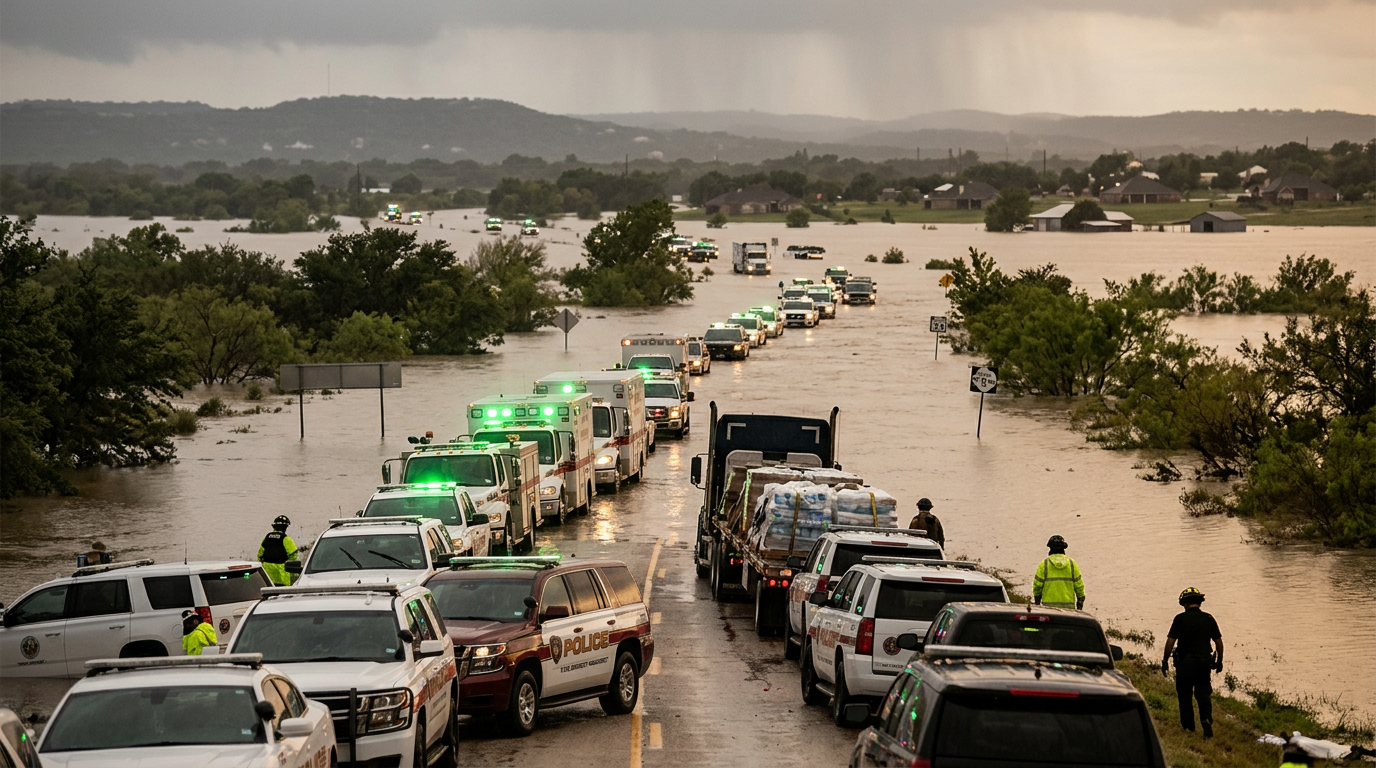
Governor Greg Abbott gathered with emergency management officials at the State Operations Center in Austin to address the escalating flood crisis currently impacting a wide swath of the state. With predictions suggesting that water levels in several regions could surpass historical records, the Governor emphasized that the immediate survival of residents remains the administration's top priority. The state has surged resources into the field, engaging over 30 separate agencies to coordinate a massive logistics and rescue operation. This proactive mobilization follows a series of heavy storms that have saturated Texas soil, leaving nowhere for additional rainfall to drain except into local communities and river systems. Historically, Texas has a long-standing pattern of flash and riverine flooding, particularly in areas known as 'Flash Flood Alley' which stretches through the Central and Hill Country regions. The current response effort builds upon lessons learned from previous catastrophes like Hurricane Harvey and the 2015 Memorial Day floods, utilizing a more centralized command structure through the Texas Division of Emergency Management (TDEM). By pre-positioning assets before the heaviest rains arrived, state leaders are attempting to minimize the response time for water rescues and road closures that often lead to fatalities during such events.
Texas relevance
This emergency response directly affects those living in a 59-county area of Texas, spanning from rural landscapes to major suburban corridors. Texas law grants the Governor the authority to issue disaster declarations, which streamlines the procurement of supplies and allows for the deployment of the Texas National Guard if necessary. Residents in these specific counties are now under redirected state authority for emergency protocols, meaning that local resources are being supplemented by massive infusions of state-funded equipment and personnel. The infrastructure of the Lone Star State is being tested as major throughways and residential streets face inundation that could lead to long-term economic and structural challenges for Texas municipalities.
The Magnitude of the State Mobilization
The sheer volume of resources committed to this flooding event underscores its severity. Over 1,300 state personnel have been pulled from a variety of departments, including the Texas Department of Public Safety, Texas A&M Forest Service, and the Texas Parks and Wildlife Department. These individuals are not just administrative support; they represent the boots on the ground who are actively engaged in water rescues, traffic control, and emergency medical services in the hardest-hit zones.
In addition to the personnel, the state has deployed a fleet of over 800 specialized vehicles designed to navigate high-water environments. This land-based effort is bolstered by roughly 75 rescue boats and 20 aircraft that provide aerial reconnaissance and hoist capabilities. This multi-modal approach ensures that even isolated communities, cut off by rising river levels or washed-out bridges, can still receive essential supplies or evacuation assistance if the situation becomes life-threatening.
The coordination of these 30-plus agencies is managed through the State Operations Center, which acts as the 'brain' of the Texas emergency response. By having representatives from every major department in a single room, the state avoids the logistical bottlenecks that often plague large-scale disaster responses. This allows for real-time adjustments as weather patterns shift and new flood crests are identified by the National Weather Service.
County-Level Impact and Disaster Declarations
The disaster declaration signed by Governor Abbott covers 59 counties, which encompasses a significant percentage of the state's geography. These declarations are critical because they suspend certain regulatory statutes that might otherwise hinder emergency response. For example, they can allow for quicker debris removal, easier transport of fuel, and the immediate release of state funds to local jurisdictions that have exhausted their own budgets fighting the rising waters.
Local officials in these 59 counties now have a direct line to state resources that would typically be unavailable during standard weather events. This includes access to high-profile assets like the Texas Task Force 1 search and rescue teams. For many rural counties with limited budgets and small volunteer fire departments, the arrival of state-funded assets is the only way to ensure comprehensive coverage of their territory during a record-breaking flood event.
The declaration also serves as a formal notification to the federal government. Should the damage reach certain monetary thresholds, the state's proactive disaster declaration simplifies the process for requesting a major disaster declaration from the President. This could eventually open the door for FEMA assistance for individuals and public infrastructure, which will be vital once the waters recede and the full extent of the damage to Texas roads and homes is assessed.
Focus on Life Safety and Rescue Operations
Governor Abbott explicitly stated that the primary focus for all active personnel is the preservation of life. This directive prioritizes high-water rescues over property protection in the immediate term. Texas search and rescue teams are trained to operate in turbulent currents, and their deployment at this stage suggests that the state expects a high volume of emergency calls as residents find themselves trapped by rapidly rising creek and river levels.
The use of 20 aircraft is particularly telling of the danger involved. These helicopters are equipped with thermal imaging and hoist systems, allowing them to locate and extract individuals from rooftops or from vehicles swept off the road during the night. In previous floods, Texas has seen numerous fatalities resulting from 'turn around, don't drown' warnings being ignored; the current aerial presence is a direct countermeasure to the risks posed by submerged roadways.
Emergency shelters are also being monitored and supported as part of the life-safety mission. As homes become uninhabitable, the state works with organizations like the Red Cross to ensure that displaced Texans have a safe place to go. This involves not only providing physical space but also ensuring that medical needs and food supplies are maintained throughout the duration of the weather event.
Infrastructure Challenges and Road Closures
One of the greatest challenges during this flooding event is the integrity of the Texas highway system. With 800 vehicles deployed, many are dedicated to monitoring low-water crossings and major interstates that are prone to flooding. The Texas Department of Transportation (TxDOT) is working around the clock to update road condition maps, but the speed of the rising water means that conditions can change in a matter of minutes, rendering even recently 'safe' roads impassable.
Secondary damage to infrastructure, such as the erosion of bridge pilings and the collapse of culverts, remains a secondary but grave concern. Even after the rain stops, the massive weight and force of moving water continue to stress concrete and steel structures. State engineers will be required to conduct thousands of inspections before the 59-county area can be considered fully functional again, leading to potential long-term detours for Texas commuters and freight traffic.
The economic impact of these closures is significant. Texas serves as a major hub for cross-country logistics, and when major highways are shut down due to flooding, the ripple effect is felt across the national supply chain. By deploying resources early, the state hopes to clear debris and reopen vital transit corridors as quickly as possible once the water levels stabilize.
State Agencies and Collaborative Efforts
The collaboration between more than 30 agencies is a testament to the Texas emergency management model. This includes the Texas Military Department, which provides high-clearance vehicles and logistical support, and the Texas Department of State Health Services, which manages the public health implications of contaminated floodwaters. Each agency brings a specific subset of expertise to the table, creating a comprehensive safety net for the affected counties.
The Texas A&M Engineering Extension Service (TEEX) also plays a pivotal role by providing specialized training for the responders on the ground. This ensures that every person deployed—whether they are a game warden from West Texas or a state trooper from the Panhandle—is operating under a unified set of safety protocols. This consistency is vital in high-stress environments where split-second decisions can mean the difference between a successful rescue and a tragedy.
Analysis
The Governor's decision to issue a disaster declaration for 59 counties simultaneously reflects a strategic shift toward aggressive prevention rather than reactive recovery. By mobilizing 1,300 personnel before the floodwaters reached their peak, the state is making a clear localized statement on the importance of infrastructure readiness. However, the sheer scale of the deployment—involving hundreds of vehicles and dozens of aircraft—highlights the persistent vulnerability of the Texas landscape to extreme meteorological shifts. This event will likely serve as a benchmark for future legislative discussions regarding the Texas Water Development Board's flood mitigation funding and the necessity of enhanced drainage systems across rapidly developing regions of the state.
Source attribution
This story was reported using a public release from the Office of the Governor. Keep TX Red rewrote the coverage independently and links to the official statement for verification.
Frequently Asked Questions
- Which counties are included in the disaster declaration?
- The declaration currently covers 59 counties across Texas that are most at risk for severe flooding. Residents should check official state lists or local news outlets to see if their specific county is included, which grants local authorities access to additional state resources and funding.
- What should residents do if they encounter flooded roads?
- The state's primary advice is 'Turn Around, Don't Drown.' Most flood-related deaths occur in vehicles. If you see water over a roadway, do not attempt to cross it, as the road underneath may be washed out or the current may be strong enough to sweep your vehicle away.
- How is the state prioritizing rescue efforts?
- The priority is currently on 'life safety.' This means personnel and assets like helicopters and boats are being directed toward immediate water rescues and evacuations of people trapped by rising water, rather than property protection or cleanup.
- Are there enough resources to handle the entire 59-county area?
- By activating 1,300 personnel and 30 agencies, the state has launched one of its largest non-hurricane responses. The Governor has indicated that these resources were pre-positioned to ensure that as the flooding moves or expands, assets can be shifted to the areas of highest need quickly.
Official Sources
Take the next step
Browse the Newsroom →Read more about Keep Texas Red → Our full guide to what Keep Texas Red means and why Texans support it.
Related Articles


Get Texas updates delivered weekly.
Independent Texas reporting on politics, policy, and daily life. One email a week. Unsubscribe anytime.
Keep TX Red Newsroom
The Keep Texas Red Editorial Staff produces nonpartisan explainers, policy breakdowns, and educational resources to help Texans understand how their government works. All content is reviewed for accuracy and updated regularly.
About Keep TX Red →