Mapping the Modern Texas Migration: Navigating Costs Job Markets and Quality of Life in the Lone Star State
Discover how newcomers and residents are navigating the evolving landscape of Texas living costs, employment trends, and regional identity in 2026.
Editorial disclaimer: Opinions and analysis on Keep TX Red are editorial content — not statements of fact. See our editorial standards.
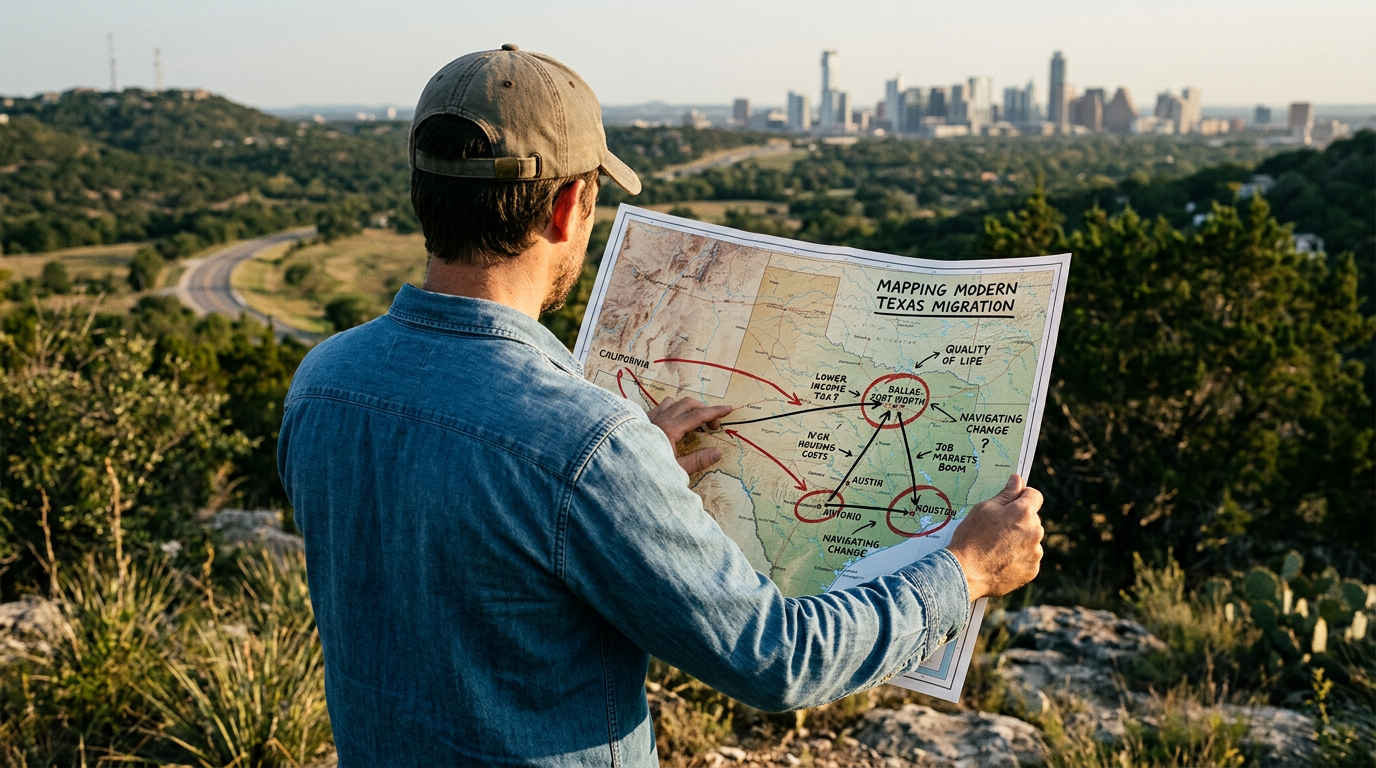
Texas continues to stand as a primary destination for internal migration within the United States, prompting a surge in localized inquiries regarding the practicalities of living, working, and traveling across its vast geography. Historically, the state's appeal was anchored in its lack of personal income tax and a relatively low cost of living, but recent years have seen a transition toward a more complex economic reality. As major metropolitan hubs like the Texas Triangle experience rapid densification, prospective residents are increasingly seeking granular data on neighborhood safety, commute times, and diverse cultural climates. This shift has necessitated centralized hubs for information exchange, where long-term residents and experts provide real-time updates on the state's fluctuating baseline for affordability and lifestyle expectations in a post-2025 economic environment. The current atmosphere of Texas growth is defined by a dichotomy between soaring urban demand and the preservation of rural tradition. While legacy industries such as energy and agriculture remain foundational, the expansion of the domestic technology and aerospace sectors has fundamentally altered the demographic makeup of regions like Central and North Texas. Consequently, the discourse surrounding relocation has moved beyond simple geography to encompass deep dives into school district quality, property tax implications, and the regional availability of specialized healthcare. As the state nears its next major developmental milestones, the reliance on peer-to-peer data sharing has become a critical tool for those attempting to navigate the complexities of a state that functions almost as its own sovereign economic entity.
Texas relevance
As the most significant destination for corporate relocation in the American South, the entire state of Texas is directly impacted by how information regarding its cities is disseminated and consumed. Cities like Fort Worth, El Paso, and Corpus Christi are seeing secondary effects of the 'growth spillover' from primary tech hubs, making the accuracy of local data essential for statewide economic stability. The relevance lies in the impact on infrastructure, as thousands of daily inquiries about moving to Texas eventually translate into physical strain on the state’s highway systems, power grid, and water supplies. Understanding the 'vibe' and 'budget' of specific areas helps distribute the population more evenly, preventing the over-saturation of Austin or Dallas while revitalizing smaller municipalities that are eager for new investment and talent.
Economic Hubs and the Shift in Texas Employment
The Texas job market has evolved into a multi-tiered ecosystem where various cities specialize in distinct economic sectors. While Houston remains the global epicenter for energy and medical research, Dallas and the surrounding Metroplex have solidified their position as a financial services and logistics powerhouse. This specialization means that for prospective Texans, 'finding work' is no longer a generic task but a targeted search for specific geographic clusters. The growth of the 'Silicon Hills' in Austin and its surrounding suburbs like Round Rock and Pflugerville continues to attract high-skill labor, though the rising cost of entry is now pushing some candidates to consider emerging tech corridors in the San Antonio area.
Infrastructure and localized economic policies in these regions play a massive role in where a professional might land. For instance, the expansion of space exploration ventures in Brownsville and the Gulf Coast has sparked a new wave of interest in South Texas, an area previously overlooked by tech-centric migrants. These regional shifts provide a buffer against statewide economic downturns, as the decline in one sector is often mitigated by growth in another. Understanding these nuances is vital for anyone looking to build a career rather than just find a job, as the Texas economy increasingly rewards those who align their skills with specific regional strengths.
The Reality of the Texas Cost of Living
In 2026, the narrative of Texas being a universally 'cheap' place to live has been scrutinized. While the state still offers competitive pricing compared to California or New York, the internal inflation within Texas has created significant disparities. Property taxes remain a central point of contention for many residents, as the lack of state income tax is balanced by some of the highest effective property tax rates in the nation. For a family moving from out of state, the initial savings on a paycheck are often redirected into annual tax assessments, making it necessary to calculate total monthly housing costs with precision before committing to a mortgage.
Beyond housing, the cost of utilities and insurance has surged. The state's unique independent power grid can lead to price volatility during extreme weather events, and insurance premiums for both homeowners and drivers are influenced by the state's susceptibility to severe storms and rapid urbanization. Prospective residents are now being advised to look beyond the sticker price of a home and examine the long-term fiscal responsibilities of living in specific utility districts or areas with high homeowner association fees. This level of financial complexity is a new hallmark of the Texas experience, requiring a more sophisticated approach to budgeting than in decades past.
Suburban Expansion and the Commuter Experience
The typical Texas commute has undergone a transformation as the 'sprawl' of major cities pushes further into the countryside. What were once quiet farming communities are now thriving suburban satellites, connected to urban cores by an ever-expanding network of toll roads and highways. This expansion has created a new class of Texan: the long-distance commuter who chooses the space and relative affordability of the exurbs over the convenience of the city. Cities like Prosper, Liberty Hill, and Fulshear are representative of this trend, offering large lots and new schools at the cost of significant time spent in traffic.
As a result, the discussion of 'where to live' is almost always tethered to the discussion of 'how to get around.' Public transportation remains limited in most of Texas, making vehicle ownership nearly mandatory outside of a few select urban pockets. Residents are increasingly turning to alternative work arrangements, such as remote or hybrid roles, to mitigate the stress of the Texas commute. The growth of high-speed internet in rural areas has further enabled this shift, allowing the Texas landscape to be reimagined as a series of interconnected nodes rather than a single centralized hub.
Cultural Diversity and Regional Identity
Texas is often described as several states in one, and its cultural diversity is one of its most significant draws. East Texas offers a piney-woods aesthetic and a culture deeply rooted in Southern traditions, while West Texas provides the rugged, high-desert landscapes of El Paso and Marfa. The cultural experience of living in the Rio Grande Valley is fundamentally different from a life spent in the High Plains of the Panhandle. This geographic diversity means that there is a 'vibe' for nearly every personality type, from the cosmopolitan luxury of uptown Dallas to the quirky, artistic enclaves of South Austin.
Food, music, and festivals serve as the glue that holds these diverse regions together. The state’s demographic evolution has led to a culinary explosion, where traditional Tex-Mex and barbecue are now part of a broader menu including world-class Vietnamese, Indian, and Ethiopian cuisines. This cultural richness is not just a perk of living in Texas but a primary driver of the tourism industry, as visitors from across the globe flock to events like the San Antonio Fiesta or the Houston Livestock Show and Rodeo. The identity of a Texan in 2026 is increasingly inclusive, reflecting a population that is as global as it is local.
Tourism and the Texas Travel Industry
Travel within Texas has seen a major uptick as 'staycations' become more popular among residents. The state’s park system, including iconic locations like Big Bend National Park and Enchanted Rock, sees record attendance as people seek out the unique natural beauty of the Southwest. Coastal tourism in places like Galveston and South Padre Island continues to thrive, supported by a steady stream of visitors looking for affordable beach access and deep-sea fishing opportunities. These destinations serve as vital economic drivers for their respective regions, supporting thousands of small businesses and local service workers.
The rise of short-term rentals and boutique hotels has also changed the way people experience Texas. While the 'big city' experience remains popular, there is a growing interest in the smaller 'Main Street' towns that offer a slower pace of life. Fredericksburg’s wine country and the historic squares of Georgetown or Granbury provide a contrast to the high-energy environments of the major metros. By highlighting these destinations, the state’s tourism sector is able to spread wealth more effectively throughout the rural counties, ensuring that the benefits of the Texas growth story are felt far beyond the skyscrapers of the city centers.
Analysis
The professionalization of resident-led community forums reflects a broader trend in how the 'Texas Brand' is managed. By consolidating migration inquiries into structured environments, the state’s digital gatekeepers are attempting to minimize the political friction and 'neighbor-on-neighbor' hostility that often accompanies rapid demographic shifts. This move toward curated, civil interaction suggests an awareness that Texas is no longer just a cheap alternative to the coasts, but a premium market that requires careful navigation. The focus on 'quality of life' and 'vibe' over mere survival statistics indicates that the Texas middle class is becoming more discerning, prioritizing long-term community integration over short-term financial gains.
Source attribution
This story was reported using a public release from the r/texas. Keep TX Red rewrote the coverage independently and links to the official statement for verification.
Frequently Asked Questions
- What is the best way to determine the true cost of living in a Texas city?
- To accurately gauge the cost of living, one must look beyond the home price and investigate local property tax rates and utility costs. In Texas, these can vary wildly between counties and municipal utility districts (MUDs). Using a local tax calculator and checking average electric rates on the state's 'Power to Choose' website is highly recommended before finalizing any relocation plans.
- How is the job market in Texas holding up against national trends?
- Texas generally outpaces the national average in job creation, largely due to its diverse economic base. While tech has slowed slightly in 2024-2025, sectors like healthcare, manufacturing, and aerospace have picked up the slack. The state's 'pro-business' environment continues to attract headquarters, but competition for high-paying roles increasingly requires specific certifications or advanced degrees.
- Are there still affordable areas to live in Texas?
- Yes, but they are increasingly located outside of the major 'growth triangle.' Areas in East Texas, the Panhandle, and parts of the Gulf Coast remain significantly more affordable than the Austin or Dallas metro areas. However, these regions may have different job market dynamics and may require longer commutes to major urban service centers.
Official Sources
Take the next step
Browse the Newsroom →Read more about Keep Texas Red → Our full guide to what Keep Texas Red means and why Texans support it.
Related Articles
Get Texas updates delivered weekly.
Independent Texas reporting on politics, policy, and daily life. One email a week. Unsubscribe anytime.
Keep TX Red Newsroom
The Keep Texas Red Editorial Staff produces nonpartisan explainers, policy breakdowns, and educational resources to help Texans understand how their government works. All content is reviewed for accuracy and updated regularly.
About Keep TX Red →