Frisco Community Dynamics Evolve Amid Rising Demographic Shifts and Social Media Scrutiny
Examine the shifting cultural landscape in Frisco as the city navigates growth, rapid demographic changes, and the impact of online discourse.
Editorial disclaimer: Opinions and analysis on Keep TX Red are editorial content — not statements of fact. See our editorial standards.
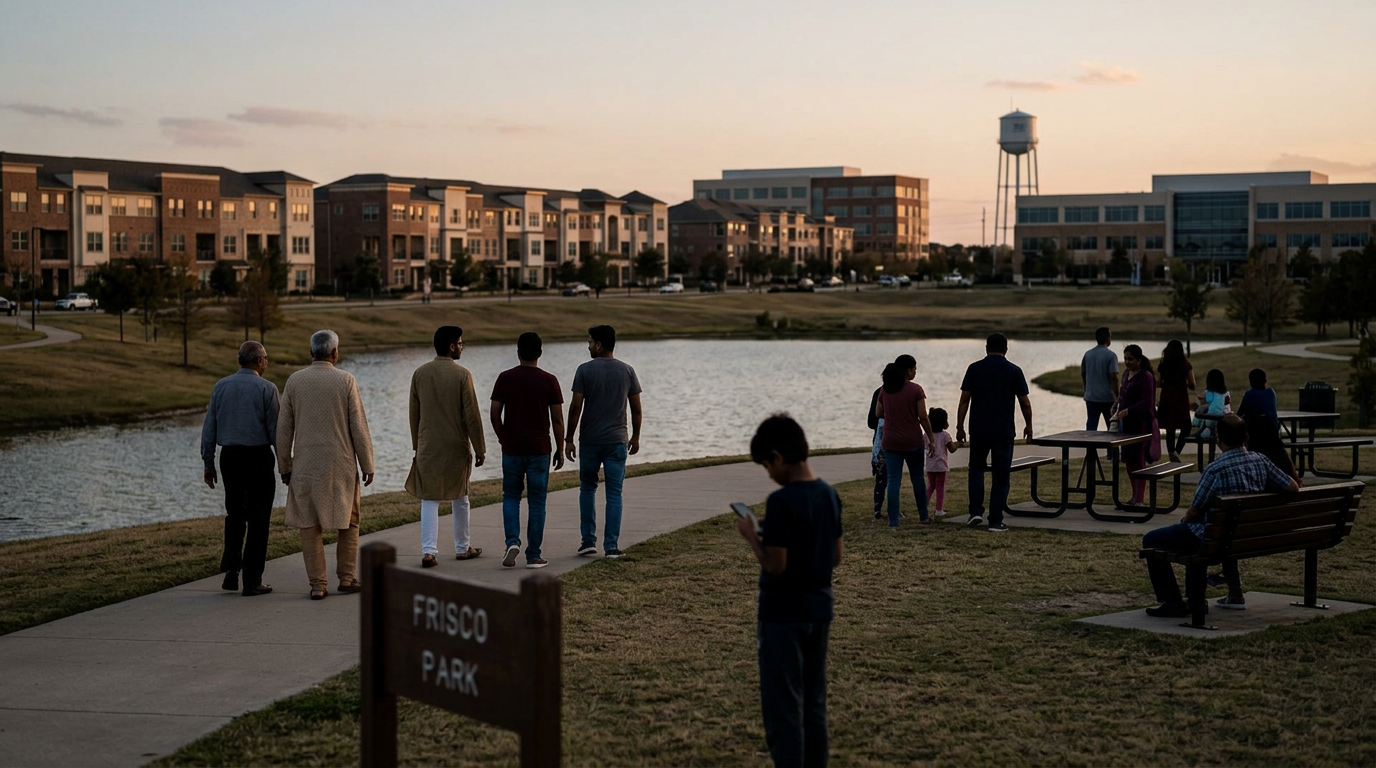
The city of Frisco, situated within the rapidly expanding Dallas-Fort Worth metroplex, has become a focal point for discussions regarding demographic shifts and community cohesion. Recent data indicates that approximately one-third of the city's population identifies as Asian, with a significant majority within that group being of Indian descent. Historically, Frisco transitioned from a small farming community into a major corporate and residential hub over the last three decades, experiencing one of the highest growth rates in the United States. This rapid transformation has brought about a unique set of social challenges as the local culture adapts to a more international resident base. Concerns have recently surfaced regarding an increase in negative sentiment toward Indian American residents, a trend that some local observers attribute to the heightened visibility of the community and the influence of national social media narratives. To understand the current climate, one must look at the long-term trajectory of Collin and Denton counties, which have consistently seen aggressive development and a high influx of tech-sector workers. The integration of diverse populations into existing suburban structures often creates friction points related to housing, school competition, and political representation. In Frisco, these tensions are manifesting in public forums and digital spaces, prompting local leaders to address the importance of maintaining civic unity while acknowledging the pressures of hyper-growth. This situation serves as a primary case study for how modern Texas suburbs negotiate the intersection of global migration and local identity in an era of polarized digital communication.
Texas relevance
This issue is central to the future of Texas, particularly the North Texas region which serves as the economic engine for much of the state. As North Texas continues to attract multinational corporations and a highly skilled workforce, the social fabric of cities like Frisco, Plano, and McKinney is being fundamentally reshaped. The state's ability to maintain a business-friendly environment depends largely on social stability and the successful integration of various ethnic groups into the local economy and governance structures. For Texas residents,特に those in the 'Texas Triangle,' the developments in Frisco provide a blueprint for the cultural and political shifts likely to occur in other suburban areas over the coming decade.
The Scale of Demographic Transformation in North Texas
In the early 1990s, Frisco was a quiet town with fewer than 10,000 residents, defined largely by its proximity to larger neighbors and its agricultural roots. Today, the population has surged past 200,000, driven by an unprecedented boom in the technology and financial sectors. This growth has not been uniform; it has been characterized by a massive influx of international professionals, particularly those arriving on H-1B visas to work for major firms in the Legacy West and Hall Park areas. The Indian American community has been a major pillar of this expansion, contributing to the local tax base and the performance of the Frisco Independent School District.
As the Indian American population grew to represent a third of the city, the visibility of their culture—from Hindu temples to cricket fields—became more pronounced. For many, this is a sign of a thriving, globalized Texas. However, for a segment of the established population, the rapid pace of change has created a sense of alienation. This is a common sociological phenomenon seen in high-growth corridors where the local identity is perceived to be secondary to the needs of a mobile, international labor force. The resulting tension is not unique to Frisco, but it is exceptionally visible there due to the specific demographics involved.
The concentration of Asian Americans in Frisco has also shifted the local market. Retail centers that once housed legacy Texas brands are now home to Indian grocery chains like Patel Brothers and various authentic eateries. While this has been an economic boon, it has physically altered the landscape of the city. For some residents, these changes are a point of pride and convenience; for others, they serve as a daily reminder of how much the city has moved away from its mid-20th-century origins. This divide is the primary fault line upon which current social tensions are built.
Furthermore, the educational system has become a primary arena for these demographic shifts. Frisco ISD is known for its high standards, which is a major draw for Indian immigrant families who prioritize academic excellence. This has led to intense competition within schools, which some local parents feel has changed the nature of the traditional high school experience. The intersection of meritocracy, cultural differences in parenting, and school funding has created a complex environment where common goals are sometimes overshadowed by perceived differences in values and methods.
The Role of Digital Platforms in Local Discourse
The rise of anti-Indian sentiment in Frisco cannot be detached from the broader trends of social media influence. Platforms like X (formerly Twitter), Nextdoor, and Facebook have become the primary battlegrounds for local grievances. Influencers with broad reaches often take local incidents—such as a dispute at a park or a debate at a school board meeting—and frame them as part of a national or global struggle. This process, often referred to as 'outrage farming,' takes localized issues and strips them of their specific context to serve a broader ideological narrative.
In Frisco, specific viral videos and posts have targeted the habits, cultural practices, and even the professional status of Indian residents. These posts often utilize tropes about 'colonization' or 'replacement,' which resonate with a specific subset of the population feeling left behind by the modern economy. Because these messages are amplified by high-profile accounts, they gain an air of legitimacy that they might not otherwise have if they remained on local message boards. This turns local neighbors against one another by introducing external biases into everyday interactions.
The anonymity of the internet further exacerbates the problem. Many of the most inflammatory comments regarding the Indian American community in Frisco do not come from residents themselves, but from national users participating in a broader digital culture war. However, the impact is felt locally. When a resident sees their community being criticized or mocked on a national stage, it creates a siege mentality. For the Indian American community, this translates to a feeling of being unwelcome in their own homes; for those who sympathize with the influencers, it validates their feelings of displacement.
Local community leaders have struggled to combat this digital wave. Traditional town hall meetings and official city communication channels are often less effective than the rapid-fire, emotional appeals found on social media. The challenge for Frisco's local government is to create a digital presence that can counter misinformation without infringing on free speech rights. This requires a sophisticated understanding of how online narratives are formed and the specific language used to target minority groups within the city.
Impact on Local Business and Real Estate
The economic contribution of the Indian American community to Frisco is substantial. They represent a significant portion of the city's high-earning households, which in turn fuels the luxury real estate market and supports high-end retail and services. However, some analysts suggest that the current social climate could have long-term economic repercussions. If a city gains a reputation for being unwelcoming or host to ethnic tensions, it may become less attractive to the very tech talent that drove its initial boom. Real estate agents in North Texas are already monitoring these shifts closely.
Historically, the Indian American community has been a stable and growing segment of homeowners in North Texas. Their preference for certain school zones and neighborhoods has helped maintain high property values even during broader economic downturns. If negative sentiment leads to a slowdown in this demographic's migration to Frisco, the city could see a cooling of its red-hot housing market. This creates an economic incentive for the city to address social cohesion, as the financial health of Frisco is intricately tied to its status as a diverse, welcoming professional hub.
Moreover, the commercial sector depends on the patronage of all residents. The growth of 'little India' corridors has brought millions of dollars in investment and thousands of jobs to Frisco and surrounding areas. These businesses are not just for the Indian community; they are part of the broader tax base that pays for Frisco's parks, roads, and emergency services. Hostility toward this sector would essentially be hostility toward the city's own financial stability. Business leaders are increasingly calling for a focus on 'economic unity' as a way to bridge cultural gaps.
The professional workforce also sees this as a corporate issue. Major employers in the area, such as Toyota, JPMorgan Chase, and Liberty Mutual, have robust diversity and inclusion initiatives. These companies may find it difficult to recruit talent to a region where their employees face harassment or social exclusion. As such, the 'anti-Indian sentiment' is not just a social issue; it is a business risk that threatens the 'Texas Miracle' of corporate relocation. Maintaining the state's reputation as a meritocratic land of opportunity is vital for future growth.
Community Response and Grassroots Efforts
In response to the rising tensions, several grassroots organizations within Frisco have begun to host inter-community dialogues. These events aim to bring together residents of different backgrounds to discuss common goals, such as public safety and education. By focusing on shared interests rather than ideological differences, these groups hope to lower the temperature of local discourse. The 'Frisco Inclusive' movement, among others, has been vocal about the need for residents to stand up against online harassment and support their neighbors.
The Indian American community has also become more politically active in response to recent events. In the past, this demographic was often characterized by high economic participation but low political engagement. Today, more Indian American residents are running for local office, serving on municipal boards, and participating in city council meetings. This increased representation is seen as a necessary step in ensuring that the community's concerns are heard and that they have a seat at the table when the city's future is being planned.
Public safety officials have also been forced to adapt. The Frisco Police Department has had to address concerns regarding targeted harassment and ensuring that all residents feel safe reporting crimes. While there hasn't been a massive spike in physical violence, the 'fear factor' associated with online threats and verbal altercations in public spaces is a top concern. Police outreach programs specifically targeting the immigrant community aim to build trust and ensure that the law is applied equally across all demographic groups.
Educational programs in schools have also been updated to address the reality of a globalized student body. By teaching students about the history of migration in Texas and the contributions of various ethnic groups, educators hope to foster a more tolerant environment for the next generation. These efforts are often met with resistance by those who view such programs as 'social engineering,' highlighting the difficulty of finding a middle ground in a polarized cultural climate. However, the focus remains on preparing students for a workforce that is inherently international.
Historical Context of Migration in Texas
Texas has always been a state defined by migration, though the sources of that migration have shifted over time. In the 19th century, it was German, Czech, and Polish immigrants who faced skepticism from 'native' Texans. In the mid-20th century, the surge of residents from the Midwest and Northeast seeking jobs in the oil and gas industry changed the cultural dynamics of cities like Houston and Dallas. Each of these waves brought about a period of adjustment where the existing population had to reconcile their traditions with the new arrivals.
The current surge of Indian Americans is the latest chapter in this long history. Unlike previous waves, this group is characterized by high levels of education and professional success, which changes the power dynamics of the migration. Rather than entering at the bottom of the economic ladder, many Indian immigrants are entering at the top or middle, which can create a different type of resentment among those who feel the 'American Dream' is becoming harder to achieve. Understanding this historical context helps to de-personalize the current tensions in Frisco.
The state's leadership has historically taken a pragmatic approach to these shifts. Texas has long marketed itself as a place where anyone can succeed if they are willing to work hard, regardless of their origin. This 'frontier' mentality is still a core part of the Texan identity. The challenge for Frisco is to re-apply this ethos to the 21st century. If the city can successfully integrate its newest residents as 'new Texans,' it will reinforce the state's traditional values of independence and opportunity. If it fails, it risks becoming a site of permanent cultural division.
Furthermore, the role of religion in Texas culture is evolving. While the state remains a stronghold of Christianity, the growth of temples and mosques in suburban areas is a physical manifestation of Texas's religious pluralism. In Frisco, the presence of various faiths has led to interfaith councils that work together on charitable projects. These inter-religious partnerships often serve as the most effective bridges between communities, demonstrating that shared moral values can often overcome cultural and linguistic differences.
The Future of Suburban Politics in the Lone Star State
Frisco is a bellwether for the 'purple' shift in Texas politics. As suburban demographics change, traditional voting blocks are being challenged. The Indian American community does not vote as a monolith; it contains a wide range of political views, from fiscal conservatives who favor low taxes and deregulation to social progressives who prioritize inclusivity. This makes the Frisco electorate highly unpredictable and a key target for both major political parties. The current tensions are partially a reflection of this political jockeying.
Political candidates are finding that they can no longer ignore the diverse suburbs of Collin and Denton counties. Winning a seat on the city council or the school board now requires a coalition that includes both legacy residents and newcomers. This necessity for coalition-building may ultimately be the force that moderates the current anti-Indian sentiment. In a democratic system, the need for votes often forces politicians to find common ground and move away from divisive rhetoric that alienates entire segments of the population.
However, there is also the risk of 'political balkanization,' where different groups retreat into their own ideological and ethnic enclaves. This would lead to a fractured city government where decisions are made based on group grievances rather than the common good. To avoid this, Frisco's leaders must promote a vision of the city that transcends ethnic and cultural lines, focusing instead on the shared identity of being 'Frisco residents.' This is a difficult task in the age of social media, but it is essential for the city's long-term health.
Looking ahead, the Frisco experience will likely be replicated in other fast-growing Texas cities like Round Rock, Sugar Land, and Pearland. The lessons learned in North Texas regarding community integration, the management of digital discourse, and the benefits of a diverse economy will become a playbook for the rest of the state. As Texas moves toward a more diverse future, the ability of suburbs like Frisco to remain cohesive will determine whether the state continues its path of economic dominance or becomes bogged down in internal social strife.
Analysis
The friction in Frisco is less about a failure of integration and more about the speed of demographic change. When a city's makeup shifts so significantly in less than a generation, the traditional 'small town' identity often feels threatened to long-term residents. This creates a vacuum that is easily filled by external rhetoric from influencers who capitalize on local anxieties. While some point toward right-wing influencers as the catalyst, it is more likely that these figures are merely amplifying existing concerns regarding infrastructure strain and cultural shifts. To maintain its status as a premier destination for families and businesses, Frisco must find a way to honor its Texan roots while embracing the global nature of its modern population.
Source attribution
This story was reported using a public release from the Texas Standard. Keep TX Red rewrote the coverage independently and links to the official statement for verification.
Frequently Asked Questions
- How much of Frisco's population is Indian American?
- While specific sub-group data varies by year, the Asian American population in Frisco makes up approximately 30-33% of the city. A substantial majority of this group is of Indian descent, drawn to the area by its thriving tech sector and highly-rated school district.
- What is causing the rise in anti-Indian sentiment?
- Observers point to a combination of rapid demographic change, the physical transformation of the city's retail and social landscape, and the influence of national social media figures who use local growth as a talking point for 'replacement' narratives.
- How are local leaders responding to these social tensions?
- Responses include the formation of interfaith and inter-community councils, police department outreach to immigrant communities, and a push for more diverse representation within the city council and school board to ensure all residents have a voice in governance.
- Is this situation impacting the local economy?
- Currently, the economy remains strong, but there are concerns that if Frisco is perceived as unfriendly to international professionals, it may struggle to recruit high-tech talent and maintain the corporate relocation momentum that has fueled its growth for decades.
- Is this specific to Frisco or a broader Texas issue?
- While Frisco is a prominent example due to its extreme growth rate, similar demographic shifts and social adjustments are occurring in suburbs across the Texas Triangle, including areas around Austin, Houston, and San Antonio.
Official Sources
Take the next step
Browse the Newsroom →Read more about Keep Texas Red → Our full guide to what Keep Texas Red means and why Texans support it.
Related Articles

Get Texas updates delivered weekly.
Independent Texas reporting on politics, policy, and daily life. One email a week. Unsubscribe anytime.
Keep TX Red Newsroom
The Keep Texas Red Editorial Staff produces nonpartisan explainers, policy breakdowns, and educational resources to help Texans understand how their government works. All content is reviewed for accuracy and updated regularly.
About Keep TX Red →