TxDOT Officials Mobilize Rapid Response for Heat-Damaged Pavement Across North Texas
Emergency crews deploy in the DFW Metroplex as record temperatures cause highway buckling, threatening commuter safety and vehicle health.
Editorial disclaimer: Opinions and analysis on Keep TX Red are editorial content — not statements of fact. See our editorial standards.
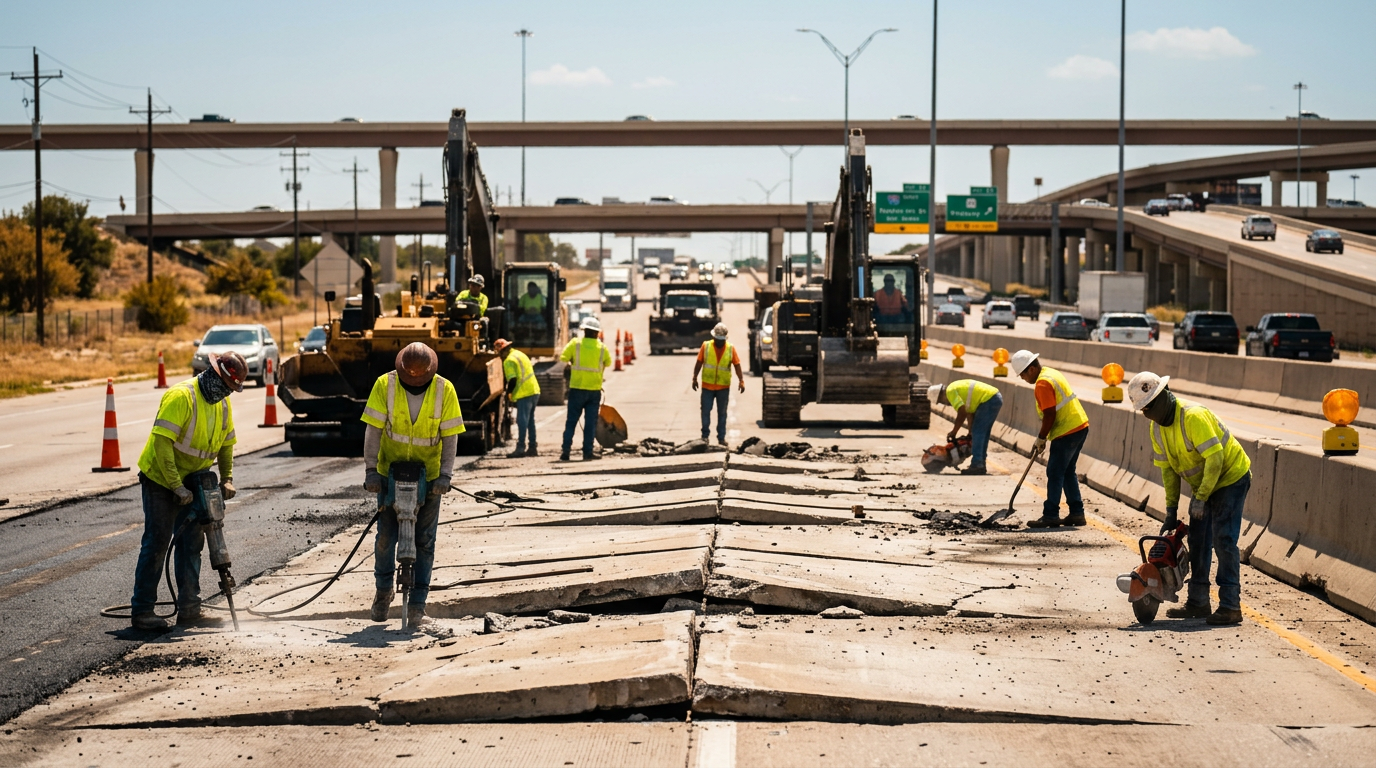
On July 10, 2026, the Texas Department of Transportation (TxDOT) initiated a large-scale emergency repair protocol throughout the North Texas region. This mobilization follows a period of persistent, extreme heat that has compromised the physical integrity of major transit corridors in the Dallas-Fort Worth area. The core issue involves high-temperature pavement buckling, where the thermal expansion of concrete and asphalt exceeds the capacity of the road’s design. This leads to sections of highway physically heaving upward or shifting, creating potentially lethal obstacles for high-speed traffic. Traditionally, Texas infrastructure is built to survive significant heat, but the current environmental load has reached a threshold where failures are occurring faster than routine maintenance cycles can accommodate. Historically, the Texas highway system has served as a benchmark for national infrastructure, yet heat-related buckling has become an increasingly frequent summer occurrence since the early 2010s. Similar emergencies were declared during the blistering summers of 2011 and 2022, when state authorities had to reallocate millions in funding to prevent catastrophic failures of arterial interstates. This latest action by TxDOT underscores a critical vulnerability in the state’s logistical backbone, as the agency moves beyond monitoring and into active, 24-hour repair cycles. The emergency status allows the department to bypass certain procurement delays, ensuring that contracting crews and local maintenance staff can be dispatched to hazard zones as soon as they are identified by air or ground patrols.
Texas relevance
Texas residents, particularly those in Collin, Dallas, Denton, and Tarrant counties, are the immediate stakeholders in this infrastructure crisis. North Texas is home to some of the busiest logistics corridors in the United States, including I-35 and I-20, which are essential for the movement of goods and services across the state. When road integrity fails due to heat, it results in more than just minor delays; it impacts the safety of millions of Texas drivers and the efficiency of the state’s economy. This situation forced TxDOT to issue warnings for the DFW Metroplex, highlighting that the region's expansive network of overpasses and interchanges are uniquely susceptible to the thermal stress currently being observed.
The Mechanics of Thermal Expansion in Roadways
To understand the current crisis, one must look at the physics of road construction in the American South. Most Texas highways are constructed using reinforced concrete slabs or multiple layers of asphalt. Engineers include small gaps, known as expansion joints, between these slabs to allow the material to swell when it gets hot and shrink when it cools. This is a standard practice designed to handle the normal range of Texas temperatures.
The problem arises when the heat remains above 100 degrees for consecutive days and the ground beneath the road begins to bake. When the pavement reaches its expansion limit, the kinetic energy has nowhere to go but up. This creates a 'buckle'—a protrusion that can range from a few inches to a foot in height. For a passenger vehicle traveling at 70 miles per hour, hitting one of these ridges is equivalent to hitting a permanent, immovable concrete curb, often resulting in immediate suspension failure or loss of control.
Furthermore, North Texas sits on highly reactive clay soils. As the heat dries out the earth beneath the pavement, the soil shrinks and shifts, removing the uniform support the road needs. This 'subgrade' failure exacerbates the buckling at the surface, making repairs more complex than simply smoothing out a bump. Crews often have to dig several feet down to stabilize the foundation before they can repave the surface.
Economic Implications of Emergency Infrastructure Fixes
The cost of emergency road work far exceeds the cost of scheduled maintenance. When TxDOT declares an emergency repair event, it involves overtime pay for state workers and rush-delivery premiums for materials like concrete and specialized asphalt mixes. Because these failures often occur during peak daytime heat, crews are often forced to work under lights at night to ensure the new materials can cure properly without immediately overheating again.
Beyond the direct budgetary impact on the state, there is a hidden cost to the Texas consumer. The North Texas region is a global hub for e-commerce and trucking. When a major interchange like the 'High Five' or sections of the LBJ Freeway are narrowed to a single lane for emergency repairs, it adds thousands of hours of delay to the supply chain. These delays eventually manifest as higher prices for goods delivered throughout the state.
Taxpayers also have a stake in the longevity of these repairs. Temporary patches, or 'cold patches,' are often used during emergency mobilizations to get traffic moving quickly. However, these patches are not as durable as full-depth reconstruction. If the heat wave persists, these temporary fixes may fail within weeks, leading to a redundant spending cycle that could be avoided with more robust, long-term infrastructure planning and investment.
Prioritizing the Most Vulnerable Transit Points
TxDOT does not deploy crews randomly; they utilize a priority matrix based on traffic volume and the severity of the damage. The focus remains on 'Level 1' routes, which include major interstates and evacuation paths. In the current DFW mobilization, heat-related damage has been most prevalent on older sections of highway that were built before current thermal-load standards were established. These legacy roads lack the modern 'wide-flange' joints that allow for more significant movement.
Bridge approaches are another high-priority area. Because bridges are exposed to air on all sides, they heat and cool at different rates than the road sections that sit on solid ground. This temperature differential causes the transition points—where the bridge meets the land—to crack or buckle more frequently. Specialized teams are currently patrolling the hundreds of bridges across the Metroplex to catch these issues before they lead to bridge closures.
Collaboration with local police and sheriff's departments is also a key part of the strategy. Law enforcement officers are often the first to see a buckle as they patrol. TxDOT has set up a direct communication line with North Texas dispatch centers to ensure that police can quickly cordoned off hazardous lanes until the orange cones and repair trucks can arrive on the scene.
Technological Solutions for Future Resilience
In response to the recurring nature of these events, researchers at institutions like the Texas A&M Transportation Institute (TTI) are working on new paving materials. One promising technology is the use of 'cool pavement' coatings that reflect more sunlight rather than absorbing it. By keeping the surface temperature just 10 or 15 degrees cooler, the internal pressure within the concrete slabs can stay below the buckling threshold.
Another area of development is the use of sensors embedded directly into the pavement. These Smart Infrastructure sensors can measure the internal pressure and moisture levels of the roadbed in real-time. By monitoring these data points, TxDOT could theoretically predict where a buckle is likely to occur 24 to 48 hours before it happens, allowing for preventive measures like 'pressure relief cutting,' where a small strip of pavement is removed to give the slabs room to expand.
The adoption of these technologies face legislative and budgetary hurdles. Upgrading a single mile of highway with advanced sensor and cooling technology can increase construction costs significantly. However, compared to the cost of repeated emergency calls and the risk to human life, proponents argue that the investment is a fiscal necessity for a state that prides itself on being a leader in national commerce.
What North Texas Drivers Need to Know Now
Safety during this repair surge is a shared responsibility between the state and the motorist. TxDOT emphasizes that work zones during a heat emergency are uniquely dangerous because they often appear suddenly and without the days of warning associated with scheduled construction. Drivers are urged to double their following distance and prepare for sudden braking, as a buckled road can cause the vehicle ahead to jump or swerve unexpectedly.
The department is also reminding the public of the 'Move Over or Slow Down' law. With more crews on the shoulder and in the lanes than usual, the risk of roadside accidents increases. When approaching a TxDOT truck with flashing lights, Texas law requires drivers to move out of the adjacent lane or drop their speed to 20 miles per hour below the posted limit. Failure to do so can result in heavy fines and, more importantly, endangers the lives of those working to fix the state's infrastructure.
Finally, drivers should utilize the 'DriveTexas.org' portal, which provides a real-time map of road conditions and closures across the state. During this emergency period, the map is updated frequently as reports come in from the field. Planning routes ahead of time to avoid known trouble spots can save hours of frustration and reduce the overall traffic volume on sections of the road that are currently under significant thermal stress.
Analysis
OPINION: While the rapid mobilization by TxDOT is a necessary short-term fix, it exposes a looming financial and structural challenge for the Lone Star State. If these emergency repair cycles become an annual tradition, the Lone Star state may find itself trapped in a 'patch-and-pray' cycle that drains the State Highway Fund. The Texas Legislature may soon be forced to move beyond funding new lanes and instead prioritize massive appropriations for 'climate-hardened' materials. Investing in polymer-modified bitumen and more sophisticated expansion joint technology is no longer a luxury for the future; it is a necessity for the present if Texas wants to keep its residents safe and its economy moving throughout the summer months.
Source attribution
This story was reported using a public release from the Texas Emergency Video (Google News). Keep TX Red rewrote the coverage independently and links to the official statement for verification.
Frequently Asked Questions
- Why is this road damage happening now instead of earlier in the summer?
- Pavement buckling is often the result of cumulative heat. After weeks of high temperatures with no nighttime cooling, the heat penetrates deep into the roadbed. Once the material reaches a saturation point where it can no longer expand horizontally, it eventually yields to the internal pressure and pops upward.
- Is my vehicle insurance responsible for damage caused by a buckled road?
- Generally, damage to a vehicle from a road hazard is covered under the collision portion of an auto insurance policy. Drivers may also attempt to file a claim with the state, through the Texas Tort Claims Act, though these are often difficult to prove unless it can be shown that the state was aware of the specific hazard and failed to act within a reasonable timeframe.
- How can I tell if a road is about to buckle?
- Visible signs often include small cracks that look like they are 'tenting' upward, or a shimmering effect on the horizon that looks like a bump. If you feel a rhythmic thumping or see a visible heave in the asphalt, you should immediately report it to authorities and avoid that specific lane.
Official Sources
Take the next step
Browse the Newsroom →Read more about Keep Texas Red → Our full guide to what Keep Texas Red means and why Texans support it.
Related Articles
Get Texas updates delivered weekly.
Independent Texas reporting on politics, policy, and daily life. One email a week. Unsubscribe anytime.
Keep TX Red Newsroom
The Keep Texas Red Editorial Staff produces nonpartisan explainers, policy breakdowns, and educational resources to help Texans understand how their government works. All content is reviewed for accuracy and updated regularly.
About Keep TX Red →