Texas A&M AgriLife Research Sends Lone Star Wine Seeds to International Space Station
Texas researchers are launching grapevine seeds into orbit to study how space radiation affects the resilience of the state's booming wine industry.
Editorial disclaimer: Opinions and analysis on Keep TX Red are editorial content — not statements of fact. See our editorial standards.
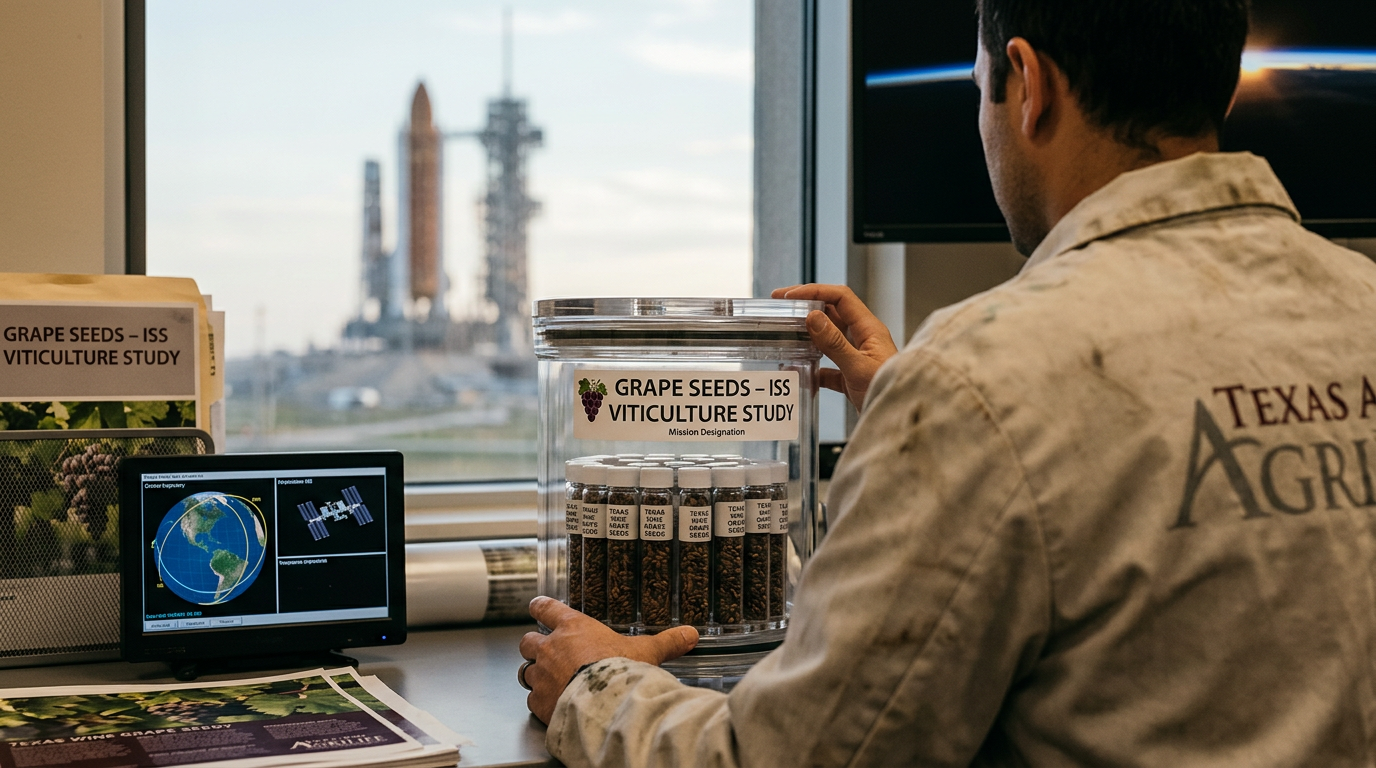
In a pioneering collaboration between Texas A&M AgriLife Research and aerospace partners, a collection of Texas wine grape seeds has been launched into orbit toward the International Space Station (ISS). This scientific mission is designed to push the boundaries of viticulture by exposing the seeds to the extreme environment of low-Earth orbit. For a duration of approximately six months, these biological samples will endure high levels of cosmic radiation and microgravity, factors that are impossible to replicate perfectly in terrestrial laboratories. This project follows a history of Texas-led agricultural innovation, where land-grant institutions have sought to protect the state’s crops from evolving environmental pressures through high-tech genetic and biological research. Historically, Texas A&M has been at the forefront of agricultural resilience, dating back to the development of the 1015 onion and various heat-resistant cattle breeds. This space mission represents the next chapter in that legacy, moving from the laboratory to the stars to address challenges on the ground. Once the seeds return to Earth, they will be meticulously germinated and monitored by scientists in College Station to determine if their DNA has undergone any mutations or structural changes that could prove beneficial. The goal is to identify traits that might improve the hardiness of grapevines against the harsh climate variations often seen in the Texas High Plains and Hill Country.
Texas relevance
The Texas wine industry contributes billions of dollars to the state's economy, supporting thousands of jobs in rural communities and major metropolitan areas alike. By utilizing the unique conditions of space, Texas A&M is effectively looking for ways to future-proof one of the state's most prestigious agricultural sectors. The mission is particularly relevant to regions like Fredericksburg and the Texas Panhandle, where growers face unpredictable frost, extreme heat, and drought. Any genetic insight gained from this orbital experiment could lead to the development of more robust grapevine varieties specifically tailored for the rugged Texas landscape, ensuring that the Lone Star State remains a global leader in wine production.
The Science of Cosmic Radiation and Mutation
The primary scientific driver behind this mission is the study of how cosmic radiation affects plant biology. On Earth, our atmosphere and magnetic field protect living organisms from the bulk of solar and galactic radiation. In the environment of the ISS, however, the grape seeds are subjected to a much higher flux of high-energy particles. These particles can cause micro-lesions or reshuffling in the seed’s genetic code, a process known as induced mutation.
While mutations are often seen as negative, they are also the primary engine of natural selection. By intentionally exposing the seeds to these conditions, researchers hope to accelerate the discovery of beneficial traits that might take decades to appear through traditional breeding methods. If a specific mutation leads to a vine that requires less water or possesses a higher resistance to fungal pathogens, it could revolutionize viticulture in the South.
Upon their return, the space-flown seeds will be compared against a 'control group' that remained on Earth. This side-by-side growth study will allow Texas A&M scientists to pinpoint exactly which physical changes in the plants were caused by their time in orbit. Every aspect of the plant's life—from germination speed to leaf structure and eventual fruit quality—will be documented to build a comprehensive data set on orbital agriculture.
Strengthening the Texas High Plains Economy
The Texas High Plains region produces the vast majority of the wine grapes used in the state. However, this region is also one of the most difficult places in North America to maintain consistent yields due to late-spring freezes and scorching summer temperatures. The Texas A&M space mission focuses on viticulture because it is a high-value crop that warrants this level of sophisticated investment to ensure its long-term viability.
By focusing on the most popular varieties grown in Texas, such as Tempranillo and Mourvèdre, researchers are ensuring that the results of the study have immediate commercial application. Local growers are watching the mission closely, as many believe that the 'next generation' of Texas wine will need to be specifically engineered for the unique soil and climate conditions of the Llano Estacado. A successful outcome could mean less reliance on chemical interventions and irrigation.
Furthermore, this project serves as a powerful marketing tool for Texas agriculture. It positions the state’s wine industry as an innovator on the global stage, blending the tradition of the vineyard with the technology of the space age. For small-town economies in the Texas Hill Country that rely on wine tourism, the promise of more resilient and higher-quality harvests is a vital component of their future financial stability.
The Role of Texas A&M AgriLife
Texas A&M AgriLife is the largest comprehensive agriculture program in the United States, and this mission reflects its mandate to solve real-world problems through advanced science. The program oversees millions of acres of research land and dozens of laboratories, but the move into space research represents a significant expansion of its portfolio. This collaboration involves cross-disciplinary teams, including geneticists, agronomists, and aerospace engineers.
The logistical complexity of sending biological samples into space requires rigorous preparation. The seeds had to be carefully packaged to withstand the vibrations of launch and the vacuum-sealed environment of the transport vehicle. This project demonstrates that the university’s agricultural mission is no longer tied strictly to the soil of the Brazos Valley, but extends into the frontiers of modern technology.
As part of the mission, data will be shared across the university system to involve students in the burgeoning field of 'astro-botany.' This provides a unique educational opportunity for Texas students to engage with NASA and private space companies while pursuing degrees in biology or agriculture. The integration of space science into the agricultural curriculum ensures that the next generation of Texas farmers will be well-versed in the highest levels of technological advancement.
The Half-Year Orbit: What Happens Next?
The seeds are scheduled to remain on the International Space Station for approximately 180 days. During this time, they will be stored in a controlled environment that mimics the temperature and humidity of a typical storage facility on Earth, with the sole exception being the radiation and gravity variables. This ensures that any changes observed in the seeds can be attributed directly to the space environment rather than environmental mismanagement.
Once the seeds splash down or land via a return capsule, they will be transported immediately back to College Station under strict quarantine protocols. This is to ensure that no terrestrial contaminants interfere with the samples before the initial analysis begins. The first phase of testing will involve scanning the seeds for structural integrity and viability to see how many were able to survive the journey and the prolonged exposure.
Follow-up studies will take years as the vines mature. Since grapevines are perennial crops, it will take several seasons to see if the genetic changes result in different flowering patterns or fruit composition. This is a long-term investment in the future of the state, representing a commitment to scientific discovery that looks decades ahead rather than just at the next harvest cycle.
Collaborative Innovation in the Private Sector
This mission was made possible through partnerships with private space organizations that facilitate research payloads for the ISS. In recent years, the cost of sending small biological samples into orbit has decreased, allowing institutions like Texas A&M to participate in what was once the exclusive domain of federal agencies. This democratization of space access is a boon for the Texas tech sector.
The insights gained from the grapevine study may also assist in the development of life-support systems for long-duration human space flight. If researchers can understand how to grow hardy plants in space, that knowledge can be applied to future missions to the Moon or Mars, where sustainable food sources will be essential. Texas is essentially using its wine industry as a test case for the future of human habitation in space.
This commercial-academic partnership serves as a model for how other Texas industries—such as energy or textiles—might utilize space research to improve their products. By being the first to send wine seeds into orbit, Texas A&M has set a precedent for innovative resource management that could inspire similar projects across various sectors of the state's economy.
Analysis
This initiative underscores the strategic intersection of Texas’s two greatest modern strengths: aerospace and agriculture. By leveraging the proximity of NASA’s Johnson Space Center and the research power of Texas A&M, the state is creating a unique synergy that other wine-producing regions like California or France cannot easily replicate. While some may see sending seeds to space as a novelty, it is a calculated effort to induce rapid evolutionary responses. In the high-stakes world of global agriculture, the ability to develop crops that can survive extreme stress is not just a scientific curiosity; it is an economic necessity that protects Texas landowners and consumers from the volatility of changing weather patterns.
Source attribution
This story was reported using a public release from the Texas Standard. Keep TX Red rewrote the coverage independently and links to the official statement for verification.
Frequently Asked Questions
- Why use space radiation instead of a lab on Earth?
- Low-Earth orbit provides a unique 'broad spectrum' of radiation and microgravity conditions that are difficult and expensive to replicate precisely in a laboratory. The constant exposure over six months allows for natural-style mutations that can reveal unexpected biological resilience.
- What specific wine varieties were sent into orbit?
- The research focuses on seeds from varieties that are already popular and economically significant in Texas, such as those that thrive in the High Plains and the Hill Country regions. This ensures the resulting data is applicable to local growers.
- Will the space wine be safe to drink in the future?
- Yes. This research is focused on the seeds and the genetic makeup of the vines, not the fermentation process. Any vines grown from these seeds will be subjected to the same safety and quality standards as traditional Texas wines.
- How long will it take to see the results of this experiment?
- While initial genetic testing will happen shortly after the seeds return in early 2027, the full viticultural results will take several years as the vines must reach maturity and produce fruit to fully observe the effects of the space exposure.
Official Sources
Take the next step
Browse the Newsroom →Read more about Keep Texas Red → Our full guide to what Keep Texas Red means and why Texans support it.
Related Articles


Get Texas updates delivered weekly.
Independent Texas reporting on politics, policy, and daily life. One email a week. Unsubscribe anytime.
Keep TX Red Newsroom
The Keep Texas Red Editorial Staff produces nonpartisan explainers, policy breakdowns, and educational resources to help Texans understand how their government works. All content is reviewed for accuracy and updated regularly.
About Keep TX Red →