Texas Ranchers Brace for Potential Resurgence of Invasive Screwworm in Feral Hog Populations
Texas agricultural experts warn that the return of the deadly screwworm fly could devastate livestock and wildlife if embedded in the feral hog population.
Editorial disclaimer: Opinions and analysis on Keep TX Red are editorial content — not statements of fact. See our editorial standards.
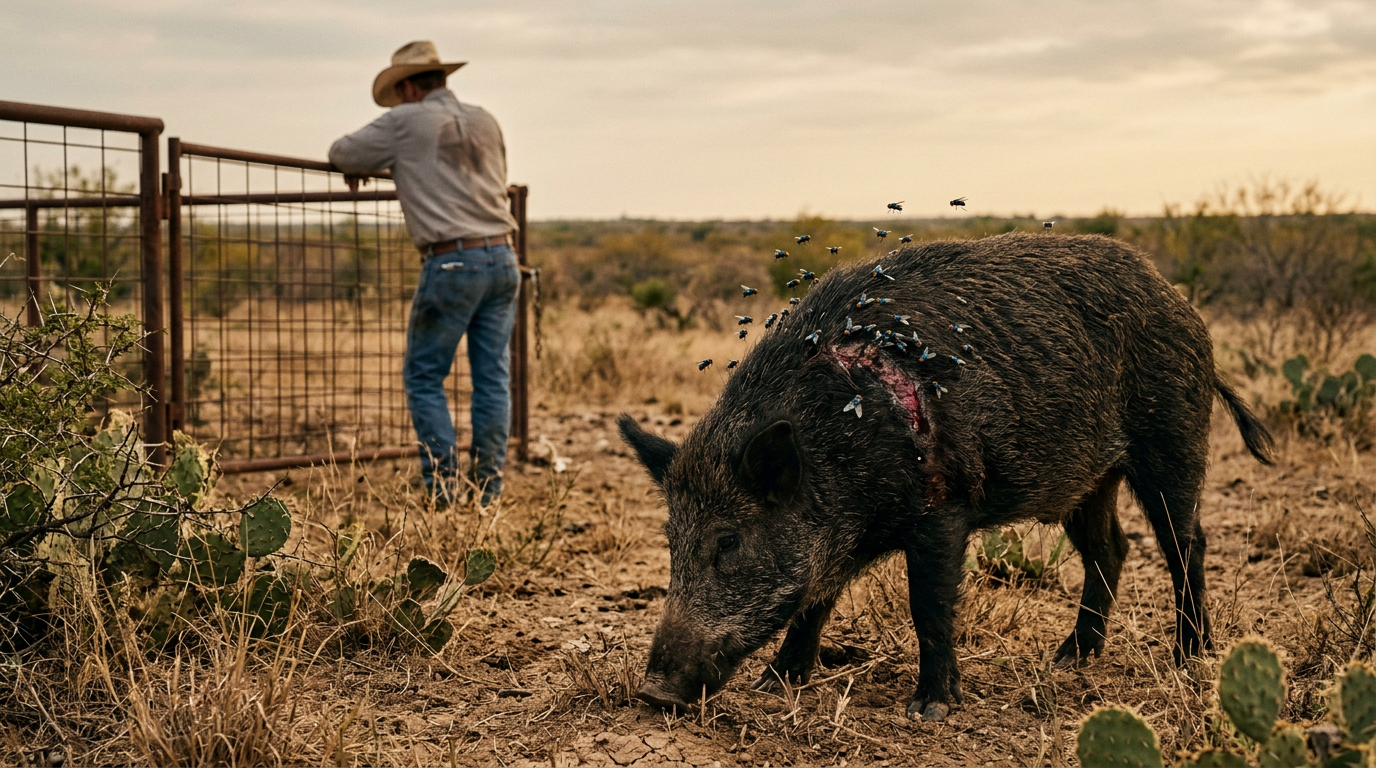
The state of Texas is currently facing a silent but catastrophic biological nightmare: the potential return of the primary screwworm fly. Historically, this parasite was the scourge of the American South, costing the livestock industry hundreds of millions of dollars annually before being eradicated in the 1960s through an innovative sterile fly release program. However, recent developments and the sheer density of the invasive feral hog population in Texas have reignited fears that this parasite could find a permanent, uncontrollable reservoir within the state's borders. Unlike most flies that feed on decaying tissue, the larvae of the screwworm infest living flesh, entering through even the smallest scratches or wounds to consume their host from the inside out. Contextually, the battle against the screwworm is one of the greatest success stories in the history of the United States Department of Agriculture. By flooding the environment with laboratory-reared sterile males, the biological cycle was broken, effectively pushing the species south of the Panama Canal. For decades, a 'buffer zone' in the Darien Gap has kept the pest at bay. Yet, with changing climates and shifting migratory patterns, the wall is showing cracks. The primary concern now is not just the arrival of the fly, but where it will go when it lands. In the mid-20th century, Texas had millions of cattle but relatively few feral hogs. Today, the hog population exceeds three million across the state, creating a massive, mobile, and untreated host network that did not exist during the last major outbreak.
Texas relevance
Texas is the absolute ground zero for this threat due to its unique position as both the nation's leading cattle producer and the state with the highest concentration of feral hogs. In cities from San Antonio to Fort Worth, and deep into the Brush Country of South Texas, the intersection of wild swine and commercial livestock is constant. If a screwworm infestation were to take root in a sounder of feral hogs, it would be nearly impossible to treat or contain using traditional methods. Managed herds can be inspected and treated with topical medications, but wild hogs roaming through the thickets of the Hill Country or the Post Oak Savannah are beyond the reach of veterinary intervention. This makes the Lone Star State uniquely vulnerable to a multi-billion dollar economic hit that could cripple the Texas agricultural infrastructure for a generation.
The Biological Mechanism of a Flesh-Eating Predator
To understand the gravity of the screwworm threat, one must understand the parasitic life cycle of Cochliomyia hominivorax. Unlike the common blowfly, the female screwworm is attracted to the scent of fresh blood from open wounds. This can be something as significant as a surgical incision from branding or dehorning, or as minor as a tick bite or a scratch from a mesquite thorn. Once she finds a host, she lays hundreds of eggs along the edge of the wound. Within hours, the larvae hatch and begin their feast.
The maggots use specialized mouth hooks to burrow deep into the living muscle tissue of the host. This process is not only excruciatingly painful for the animal but also introduces secondary infections and leads to rapid physical decline. If left untreated, a healthy adult cow or deer can be killed by a screwworm infestation in less than two weeks. The terrifying efficiency of this parasite is what led to the 'scorched earth' biological warfare tactics used by the USDA in the 1960s, which remains the only time a major pest has been completely liquidated through sterile release.
The Feral Hog Complexity Factor
In the 1950s, when the last great Texas screwworm wars were fought, the landscape was different. Feral hogs were present, but they were localized and far fewer in number. Today, feral hogs are an ecological disaster in Texas, causing over $52 million in damage to the state's agricultural industry every year. They are highly mobile, often traveling miles in a single night, and they possess a thick hide that is frequently scarred from fighting or pushing through dense brush. These scars provide the perfect environment for screwworm larvae to take hold.
Because feral hogs are not managed by humans, an infestation in a wild sounder would go unnoticed until it were too late. A single infested hog could potentially drop thousands of pupae across several counties as it migrates, effectively acting as a biological delivery system for the parasite. This creates a scenario where the fly could re-establish itself in Texas faster than the USDA could ramp up sterile fly production. Ranchers would be fighting a ghost that lives in the woods, constantly re-infecting their clean pastures.
Economic Implications for the Texas Cattle Industry
The Texas beef industry is a pillar of the state economy, contributing billions to the GDP. The reintroduction of the screwworm would immediately trigger a collapse in export markets and a massive spike in labor costs for producers. During the pre-eradication era, ranchers had to check every single animal in their herd daily for signs of strikes. In the modern era, where many operations are managed with less labor and larger acreage, such intensive monitoring is nearly impossible.
Beyond the labor costs, the medical expenses for treating infested animals would be staggering. While modern insecticides are effective, they require physical application. For a state like Texas, which boasts a cattle population of over 12 million, the logistical nightmare of rounding up and treating animals on a recurring basis would drive many many smaller-scale family operations out of business. The psychological toll on the ranching community, watching their animals suffer from such a grisly parasite, cannot be understated either.
The Sterile Insect Technique: A Fragile Shield
The primary defense against the screwworm is the Sterile Insect Technique (SIT). This involves breeding millions of flies in a facility in Panama, exposing them to just enough radiation to make the males sterile, and then dropping them from airplanes over known infestation zones. When the sterile males mate with wild females, the resulting eggs are non-viable, causing the population to crash. It is an elegant, chemical-free solution that has worked for decades.
However, the SIT program is under constant pressure. The facility in Panama is aging, and the budget for these fly drops is often a target for federal cuts. If a major outbreak occurred in Texas, the Panama facility might not be able to produce enough flies to cover the thousands of square miles of the Texas brush country. There are also concerns that the flies could develop 'mating discrimination,' where wild females eventually learn to avoid the laboratory-reared sterile males, rendering the entire program useless.
The Threat to Texas Wildlife and Biodiversity
It is not just the livestock industry at risk; the iconic wildlife of Texas would be devastated. White-tailed deer are particularly susceptible to screwworm strikes, especially during the fawning season. Newborn fawns, with their unhealed navels, are prime targets for the fly. Historical records from the early 20th century suggest that in years of heavy screwworm activity, fawn survival rates in South Texas dropped by as much as 80 percent, leading to a near-collapse of the deer population in certain regions.
Other species, including the endangered ocelot and various ground-nesting birds, would also be in the crosshairs. Because wildlife cannot be rounded up for treatment, the only way to protect them is to prevent the fly from ever gaining a foothold on the mainland. The presence of millions of feral hogs significantly increases the likelihood that a small, localized outbreak in a remote area would go undetected long enough to become a state-wide wildlife catastrophe.
Looking Forward: Prevention and Vigilance
As of now, the United States remains free of the primary screwworm, but the threat is closer than most realize. Recent detections in Florida (2016) in a population of Key deer proved that the parasite can still hitch a ride into the country via pets or illegal livestock movements. In that instance, it took months and millions of dollars to eradicate the pest from a small island chain. Scaling that effort to the size of Texas would be a monumental task that the state is not currently fully prepared to handle.
Texas residents and agricultural stakeholders are encouraged to remain vigilant. Reporting unusual wounds in livestock or seeing 'maggots' that seem to be burrowing into healthy tissue is the first line of defense. Cooperation between state agencies like the Texas Parks and Wildlife Department and federal authorities is essential. The message from experts is clear: we must treat the feral hog crisis as a biosecurity issue, because the hog is the bridge that could bring one of the most terrifying pests in history back to the doorsteps of Texas ranchers.
Analysis
The potential intersection of feral hogs and screwworms represents a regulatory and logistical 'perfect storm' for Texas officials. While organizations like the Texas Animal Health Commission and the USDA have robust protocols for domestic outbreaks, the 'hog factor' introduces a wild card that current technology may not be able to handle. Some experts argue that the current federal focus on maintaining the Panama barrier is insufficient given the rise in international trade and the resilience of invasive species. From a policy perspective, this underscores the urgent need for more aggressive feral hog eradication programs, not just for land management, but as a critical component of national biosecurity. If the screwworm returns, the cost of inaction on the hog problem will be measured in the collapse of the Texas beef and wool markets.
Source attribution
This story was reported using a public release from the Texas Wildlife Stories (Google News). Keep TX Red rewrote the coverage independently and links to the official statement for verification.
Frequently Asked Questions
- What makes the screwworm different from normal flies?
- Common flies typically lay eggs on dead or decaying matter. The screwworm fly specifically seeks out living hosts with open wounds. Their larvae, or 'maggots,' use sharp mouthparts to burrow into and eat the living muscle and tissue of the animal, which can lead to death if the animal is not treated with insecticide manually.
- Why can't we just treat the feral hogs with medicine?
- Feral hogs in Texas are wild, highly mobile, and number in the millions. There is no feasible way to capture and treat every hog for parasites. Unlike cattle, which are kept in fences and can be run through a chute for medical care, feral hogs live in deep brush and can spread the parasite across vast distances without ever coming into contact with humans.
- How did the U.S. get rid of them the first time?
- The USDA utilized the Sterile Insect Technique (SIT). They released millions of sterile male flies into the wild. Because female screwworms only mate once in their life, mating with a sterile male results in no offspring. Over time, this caused the entire population to collapse.
- Could screwworms affect humans?
- Yes. While they primarily target livestock and wildlife, screwworm flies can and will lay eggs in the wounds of humans if given the opportunity. This makes the parasite a public health concern in addition to an agricultural one.
Official Sources
Take the next step
Browse the Newsroom →Read more about Keep Texas Red → Our full guide to what Keep Texas Red means and why Texans support it.
Related Articles


Get Texas updates delivered weekly.
Independent Texas reporting on politics, policy, and daily life. One email a week. Unsubscribe anytime.
Keep TX Red Newsroom
The Keep Texas Red Editorial Staff produces nonpartisan explainers, policy breakdowns, and educational resources to help Texans understand how their government works. All content is reviewed for accuracy and updated regularly.
About Keep TX Red →