New State Department Travel Warnings Impact Texas Residents Planning International Vacations
Texas travelers face new advisories for 27 global destinations due to rising safety concerns. Check these high-risk areas before booking your next trip.
Editorial disclaimer: Opinions and analysis on Keep TX Red are editorial content — not statements of fact. See our editorial standards.
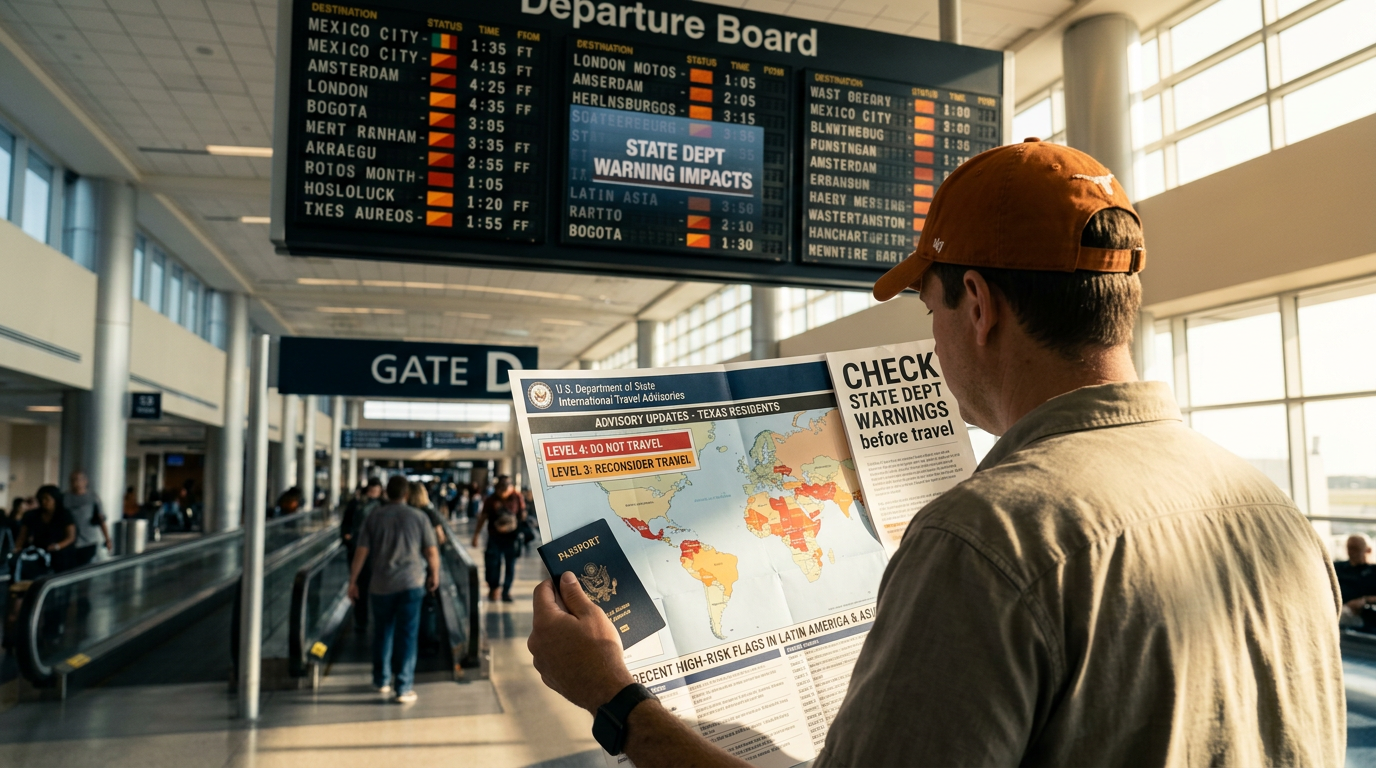
Recent updates from the U.S. State Department have flagged 27 different international locations as high-risk areas, prompting a localized warning for Texas residents who are among the most frequent international travelers in the nation. Historically, Texas has maintained high outbound travel numbers due to its major international hubs in Dallas, Houston, and Austin. However, shifting geopolitical tensions and localized civil unrest in several popular and emerging tourist markets have necessitated a reevaluation of safety protocols. These advisories range from 'Level 3: Reconsider Travel' to the most severe 'Level 4: Do Not Travel,' covering regions across five continents. The warnings specifically mention risks such as organized crime, health infrastructure deficiencies, and political instability that could impact the ability of the U.S. government to provide emergency assistance to citizens abroad. For Texas residents, who often seek destinations in Latin America, Southeast Asia, and parts of Europe, these updates serve as a critical reminder of the volatility inherent in international movement during the current calendar year. The State Department utilizes a combination of intelligence from local embassies, crime statistics, and health data to determine these rankings. Travelers are encouraged to enroll in the Smart Traveler Enrollment Program (STEP) before departing from Texas soil to ensure they receive real-time updates while on the ground in these flagged territories. While some zones remain popular for their natural beauty or historical significance, the federal guidance suggests that the risk profile for 2024 and 2025 has shifted significantly enough to warrant a formal pause or cancellation of non-essential trips.
Texas relevance
Texas serves as one of the primary gateways for international transit in the southern United States. With Dallas-Fort Worth (DFW) International Airport and Houston's George Bush Intercontinental Airport (IAH) consistently ranking as top-tier hubs for global connectivity, any shift in State Department advisories disproportionately impacts the Texas economy and its residents. Texas travelers often have high exposure to regions currently under scrutiny, particularly due to the proximity of the state to Mexico and Central America, where several Level 3 advisories remain in place. Furthermore, the local Texas travel agency industry and luxury tourism planners based in metros like San Antonio and El Paso must now navigate these legal and safety updates to ensure the well-being of their clientele during the peak summer and winter holiday seasons.
Understanding the Risk Levels for Texas Hubs
The U.S. State Department categorizes risks into four distinct tiers. Level 1 suggests exercising normal precautions, while Level 2 calls for increased awareness. The recent warnings focused on by the Statesman and other local outlets involve Level 3 and Level 4. For a traveler leaving from Austin-Bergstrom, a Level 3 designation means that while travel is not explicitly prohibited, the department strongly advises against it unless necessary. This is often due to persistent issues like high kidnapping rates or unstable local governance that can change within a matter of hours.
Level 4 is the most stringent advisory, essentially serving as a 'no-go' directive. In these instances, the U.S. government warns that it may have extremely limited ability to intervene if a Texan is arrested, injured, or caught in a natural disaster. These areas often include zones of active conflict or nations where diplomatic relations have soured to the point where embassy staff have been withdrawn. For Texans, identifying which bracket their destination falls into is the first step in responsible planning.
Leading Destinations Under Scrutiny
Among the 27 destinations mentioned, several are frequent stops for Texas-based businesses and vacationers. Countries in the Middle East and parts of Northern Africa remain on the list due to regional volatility. However, more surprising to some travelers are the inclusions of certain Caribbean and South American nations that have seen a recent surge in petty crime and systemic violence. These regions often attract Texans looking for beach getaways, but the new data suggests that the security perimeter of many all-inclusive resorts may no longer be sufficient to guarantee safety.
Additionally, parts of Eastern Europe continue to be flagged due to ongoing military conflicts nearby. Even if a country is not directly involved in active warfare, the spillover effects—such as cyber threats or sudden border closures—can trap unsuspecting travelers. Texas residents who have family ties to these regions are urged to maintain constant communication with the U.S. Embassy in the host country to facilitate a quick exit if the security situation deteriorates further.
The Economic Impact on Texas Travel Agencies
Texas is home to thousands of independent travel consultants and large-scale agencies that manage corporate accounts for the energy and technology sectors. These advisories create a significant administrative burden, as agencies must now reach out to clients to discuss cancellations or rerouting options. When a destination moves from Level 2 to Level 3, insurance policies often change, and many standard travel insurance plans may no longer cover incidents related to 'known risks' listed in the federal advisories.
This shift also impacts the airline industry operating out of Texas. Major carriers like Southwest and American Airlines, both headquartered in North Texas, monitor these advisories closely. A sudden drop in demand for a specific destination due to a Level 4 warning can lead to flight cancellations and a reorganization of flight paths. For the Texas traveler, this means that even if they are willing to take the risk, the airline may choose to terminate service to that region entirely for the season.
Preparing for Emergencies Abroad
For those who must travel to these areas for work or family emergencies, the State Department offers several protocols. The most critical for Texans is the Smart Traveler Enrollment Program. By registering, the local embassy knows exactly who is in the country and where they are staying. This information is used to coordinate evacuations or provide updates during civil unrest. It is also recommended that travelers leave a detailed itinerary with a family member back in Texas and ensure their mobile devices have international roaming capabilities that work in low-coverage zones.
Furthermore, travelers should be aware of 'no-go' zones within specific cities. Even in countries that are generally safe, specific neighborhoods may be flagged for high rates of violent crime. Texas travelers are advised to consult the 'Detailed Security Information' section of the State Department website, which breaks down risks by state or province within a foreign country. This granular data is often the difference between a successful trip and a dangerous encounter.
The Role of Health and Infrastructure
Not all travel warnings are based on crime or war; some are issued due to the collapse of local health infrastructure. In several of the 27 destinations, a lack of reliable medical care is the primary reason for the advisory. For elderly Texans or those with pre-existing conditions, a trip to a Level 3 zone could be life-threatening if they require urgent care. The State Department warns that in these locations, even private hospitals may lack basic supplies or specialized physicians.
Infrastructure also includes the reliability of transportation and communications. In some flagged areas, the risk of road accidents is exponentially higher than in the U.S. due to poorly maintained highways and a lack of traffic enforcement. For Texans accustomed to the massive highway systems of the Lone Star State, navigating the rural roads of a high-risk nation can be an unexpected and deadly challenge. Checking the 'Transportation' section of the advisory is just as important as checking the 'Crime' section.
Future Outlook for International Travel
As we move further into the decade, the nature of these travel advisories is expected to evolve. Climate-related risks, such as extreme weather patterns or resource scarcity, are beginning to influence State Department rankings alongside traditional security threats. Texas travelers should expect these lists to be updated more frequently as global conditions fluctuate. The ability to pivot and change plans at the last minute will become a standard part of the international travel experience for residents of the Lone Star State.
In conclusion, while the world remains a vast and beautiful place for exploration, the safety of Texas citizens is paramount. By adhering to the guidelines provided by the State Department and staying informed through local news outlets, travelers can ensure that their journeys are memorable for the right reasons. Before packing your bags and heading to DFW or IAH, a final check of the current 27-destination warning list is a necessary step for every responsible Texan.
Analysis
Opinion: While the State Department often issues these warnings out of an abundance of caution, the current list of 27 destinations indicates a broader trend of global instability that Texas families cannot ignore. It is vital for travelers to look beyond the appeal of cheap airfare out of Houston or Austin and consider the logistical nightmare of becoming stranded in a 'Level 4' zone. The responsibility lies with the individual to prioritize safety over leisure, especially as consular services in these specific regions may be operating at a reduced capacity. Texans have always been adventurous, but in today's climate, being a 'smart traveler' is more important than being a 'frequent traveler.'
Source attribution
This story was reported using a public release from the Texas Travel Stories (Google News). Keep TX Red rewrote the coverage independently and links to the official statement for verification.
Frequently Asked Questions
- What happens if I already booked a trip to a Level 4 destination?
- The State Department strongly advises cancelling or postponing travel to Level 4 areas. You should contact your airline and travel insurance provider immediately. Many insurance policies have clauses that allow for cancellations if the government issues a new, higher-level warning after the policy was purchased, though this varies by provider.
- How often is this list of 27 destinations updated?
- The U.S. State Department reviews travel advisories continuously. A country can be added or removed at any time based on new intelligence, health reports, or political changes. It is recommended that Texas residents check the official travel.state.gov website at least once a week leading up to their departure.
- Does a Level 3 warning mean I will be arrested if I go?
- No, a Level 3: Reconsider Travel warning is an advisory, not a legal prohibition for U.S. citizens. However, it indicates that the U.S. government believes there are significant risks to your safety and that they may be limited in how they can help you if you encounter trouble. It is a steer to avoid the area for non-essential purposes.
Official Sources
Take the next step
Browse the Newsroom →Read more about Keep Texas Red → Our full guide to what Keep Texas Red means and why Texans support it.
Related Articles

Get Texas updates delivered weekly.
Independent Texas reporting on politics, policy, and daily life. One email a week. Unsubscribe anytime.
Keep TX Red Newsroom
The Keep Texas Red Editorial Staff produces nonpartisan explainers, policy breakdowns, and educational resources to help Texans understand how their government works. All content is reviewed for accuracy and updated regularly.
About Keep TX Red →