Ecological Collision: How the Return of Screwworms Could Impact Texas Feral Hog Control
Texas faces a potential clash between feral hogs and the New World screwworm, raising complex questions for the state's agricultural stability.
Editorial disclaimer: Opinions and analysis on Keep TX Red are editorial content — not statements of fact. See our editorial standards.
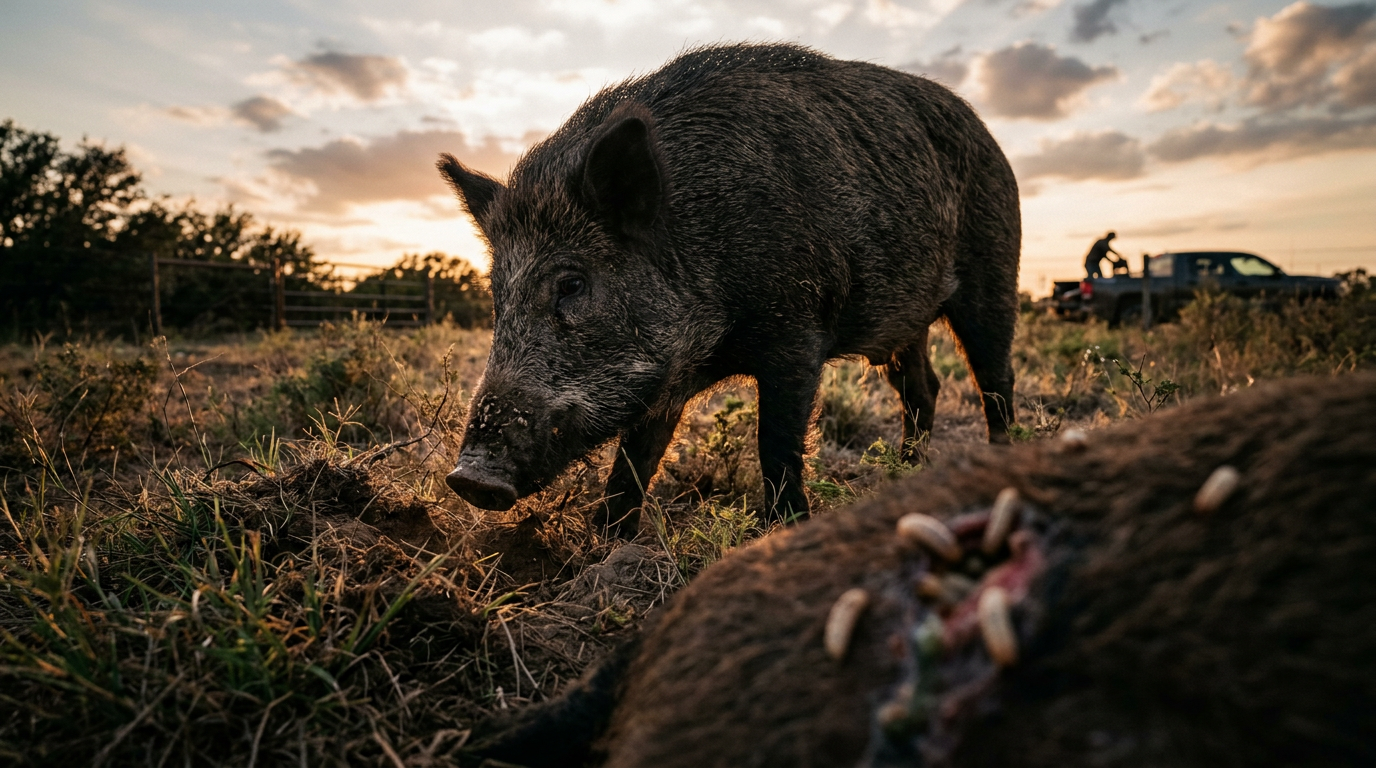
The ecological landscape of Texas is bracing for a potential intersection between two of its most significant biological challenges: the invasive feral hog and the parasitic New World screwworm. For decades, Texas has struggled to suppress a feral hog population that exceeds three million, causing hundreds of millions of dollars in annual agricultural damage. Simultaneously, the state remains vigilant against the re-emergence of the screwworm fly, a pest eradicated from the United States in the 1960s but still persistent in regions south of the Darien Gap. The potential for these two species to interact presents a unique biological scenario that could either inadvertently assist in hog population control or, more likely, create a catastrophic health crisis for the state's multibillion-dollar cattle industry. Historically, Texas was the primary battleground for screwworm eradication. The United States Department of Agriculture (USDA) utilized a sterile insect technique, releasing billions of sterile flies to break the breeding cycle. This success allowed the Texas livestock industry to flourish without the constant threat of 'fly blow'—a condition where screwworm larvae consume the living tissue of warm-blooded animals. However, the sheer density of the modern feral hog population provides a massive, unchecked reservoir of hosts that could complicate any future efforts to contain a screwworm outbreak. Unlike domestic cattle, which are routinely inspected by ranchers, wild hogs roam inaccessible brush country, making them the perfect clandestine vector for larvae to thrive and spread throughout the Southern Plains.
Texas relevance
Texas is the epicenter of this potential biological conflict. As the nation's leading producer of cattle and a state with an ever-expanding feral hog footprint, the intersection of these two pests directly threatens the economic security of rural Texas. From the Panhandle to the Rio Grande Valley, the state’s agricultural infrastructure is built on the assumption that screwworms remain localized far to the south. If these parasites penetrate the border and find a hospitable home within the feral hog population, the cost of livestock management in Texas would skyrocket, necessitating a return to labor-intensive animal husbandry practices not seen since the mid-20th century.
The Biological Mechanism of the Screwworm
The New World screwworm (Cochliomyia hominivorax) is not a typical scavenger fly. Unlike most flies that lay eggs in decaying organic matter or carcasses, the screwworm specifically seeks out open wounds on living, warm-blooded animals. This behavior makes it a mandatory parasite. Once the eggs are laid in a scratch, tick bite, or branding mark, the larvae hatch and begin burrowing deeper into the living flesh of the host, creating extensive tissue damage and often leading to systemic infection or death if untreated.
In a state like Texas, where thorns, barbed wire, and territorial fighting among wildlife are common, the opportunities for screwworms to find host wounds are endless. The parasite’s life cycle is rapid, allowing for explosive population growth during warm, humid months. For a feral hog population that already suffers from various skin lesions and injuries due to their aggressive nature, the arrival of screwworm flies could lead to a massive die-off within that specific species, but at an unacceptably high risk to all other mammals in the vicinity.
The Feral Hog Crisis in Modern Texas
Texas currently hosts the largest population of feral swine in the United States. These animals are descendants of escaped domestic pigs and Eurasian wild boars, resulting in an incredibly hardy and prolific hybrid. Experts estimate that to simply maintain the current population—without even reducing it—landowners must remove approximately 66 percent of the hogs every year. Despite aggressive efforts by Texas Parks and Wildlife and private contractors, the population continues to expand into suburban and even urban areas.
The damage caused by these animals is multifaceted. They destroy row crops, contaminate water sources with E. coli, and outcompete native species like the Rio Grande turkey and white-tailed deer for food. Because they are highly mobile and semi-nocturnal, tracking their health status is nearly impossible. This lack of oversight is exactly what makes them a primary concern for veterinarians and state animal health officials who fear the hogs could become a permanent 'bridge' for foreign animal diseases entering from the south.
Economic Implications for the Cattle Industry
Before the eradication of the screwworm, Texas ranchers lost tens of millions of dollars annually to the pest. Ranching required a much higher ratio of workers to livestock, as every animal had to be checked daily for infestations. Calving seasons had to be carefully timed to avoid the peak fly season, as the umbilical cords of newborns were a prime target for the flies. A return of this pest would effectively roll back decades of efficiency gains in the Texas beef industry.
If screwworms were to be reintroduced via the feral hog population, the immediate economic impact would be felt through increased labor costs, death losses, and potentially severe international trade restrictions. Texas beef exports could be halted if other countries fear the movement of screwworms through traded hides or live animals. The financial stability of the Texas agricultural corridor relies on maintaining a 'screwworm-free' status, making the hog-parasite interaction a top-tier veterinary concern.
The Challenge of Wild Host Management
Managing a disease or parasite in a domestic population is a matter of logistics and compliance, but managing it in a wild population is a matter of biology. In the 1960s, the sterile fly releases worked because there were fewer wild reservoirs compared to domestic stock. Today, the ratio has shifted significantly. The sheer density of feral hogs in the Texas Hill Country and the Piney Woods provides a sprawling 'breeding ground' that sterile flies may not be able to effectively saturate.
Scientists are also concerned about the 'deadly clash' because it creates a nightmare scenario for surveillance. Identifying a screwworm outbreak in a cattle pasture is relatively easy; identifying one in the middle of a 10,000-acre brush-choked ranch where feral hogs are dying undetected is much harder. By the time a rancher notices a problem in his herd, the parasite could have already established a massive foothold within the local swine population, making eradication efforts much more expensive and lengthy.
Potential State and Federal Responses
Texas officials are already coordinating with the USDA’s Animal and Plant Health Inspection Service (APHIS) to monitor the 'buffer zone' in Panama and southern Mexico. However, the movement of animals across the border—both legal and illegal—remains a persistent variable. State agencies are currently focusing on educating hunters and landowners to report any unusual wound infestations in wildlife, particularly feral hogs, to the Texas Animal Health Commission.
Future strategies may include intensifying feral hog removal programs specifically in border regions to create a biological 'firebreak.' By reducing the density of potential hosts in high-risk zones, the state can lower the probability of a screwworm population becoming self-sustaining. This approach requires a combination of aerial thermal hunting, large-scale corral trapping, and the development of hog-specific toxicants that do not harm native wildlife.
Ecological Risks Beyond the Ranch
It is not just the economy at stake; the native ecology of Texas would also suffer. Species such as the white-tailed deer, which are vital to the multi-billion dollar Texas hunting industry, are just as susceptible to screwworm infestation as domestic cattle. An outbreak fueled by feral hogs would inevitably spill over into deer populations, potentially leading to significant declines in fawn survival rates and overall herd health.
Furthermore, domestic pets and even humans are not immune. While human cases are rare in modern times, they are not unheard of in regions where screwworms are endemic. The 'clash' between these pests represents a systemic threat to the outdoor lifestyle and public health of Texans. As climate patterns shift and feral hog ranges expand even further north, the geographic area at risk of these biological threats continues to grow, demanding a proactive and unified response from the state.
Analysis
While the idea of a parasite reducing the destructive feral hog population might seem like a natural solution, it is a dangerous gamble for Texas. The biological fallout of using an indiscriminate parasite like the screwworm as a control agent far outweighs any territorial gains made against the hogs. A screwworm that can kill a pig can just as easily kill a prize bull, a family pet, or even local deer populations. The policy focus must remain on multi-pronged hog eradication such as trapping and aerial gunning, rather than relying on a high-risk biological 'silver bullet' that could inadvertently devastate the legitimate ranching economy that defines the Texas interior.
Source attribution
This story was reported using a public release from the Texas Monthly. Keep TX Red rewrote the coverage independently and links to the official statement for verification.
Frequently Asked Questions
- What exactly is a New World screwworm?
- It is a species of fly whose larvae (maggots) are unique because they feed exclusively on the living tissue of warm-blooded animals. Unlike most maggots that eat dead tissue, screwworms create deep, painful wounds that can kill an animal if not treated within days.
- Why can't we just let the screwworms kill off the feral hogs?
- Because the screwworm is not host-specific. While it would kill feral hogs, it would also infest cattle, horses, sheep, goats, white-tailed deer, and even human beings. The collateral damage to the Texas economy and ecosystem would be catastrophic.
- How was the screwworm eradicated originally?
- The U.S. used the Sterile Insect Technique, which involved breeding millions of flies, sterilizing them with radiation, and releasing them via aircraft. Since female flies only mate once, mating with a sterile male results in no offspring, eventually causing the population to collapse.
- Is the screwworm currently in Texas?
- No, the United States is currently considered screwworm-free. However, there are occasional detections in the Florida Keys or near the border that require immediate and aggressive response to prevent the pest from re-establishing itself.
- What should I do if I find a suspicious wound on an animal?
- Texans are encouraged to contact the Texas Animal Health Commission or their local veterinarian immediately. It is important to collect a sample of the larvae in alcohol if possible, as early detection is the only way to prevent a widespread outbreak.
Official Sources
Take the next step
Browse the Newsroom →Read more about Keep Texas Red → Our full guide to what Keep Texas Red means and why Texans support it.
Related Articles

Get Texas updates delivered weekly.
Independent Texas reporting on politics, policy, and daily life. One email a week. Unsubscribe anytime.
Keep TX Red Newsroom
The Keep Texas Red Editorial Staff produces nonpartisan explainers, policy breakdowns, and educational resources to help Texans understand how their government works. All content is reviewed for accuracy and updated regularly.
About Keep TX Red →