One Year Later: Travis County Residents Honor Victims of Devastating Sandy Creek Floods
Sandy Creek survivors gather to remember nine neighbors lost during the historic 2025 Travis County floods as local calls for drainage reform continue.
Editorial disclaimer: Opinions and analysis on Keep TX Red are editorial content — not statements of fact. See our editorial standards.
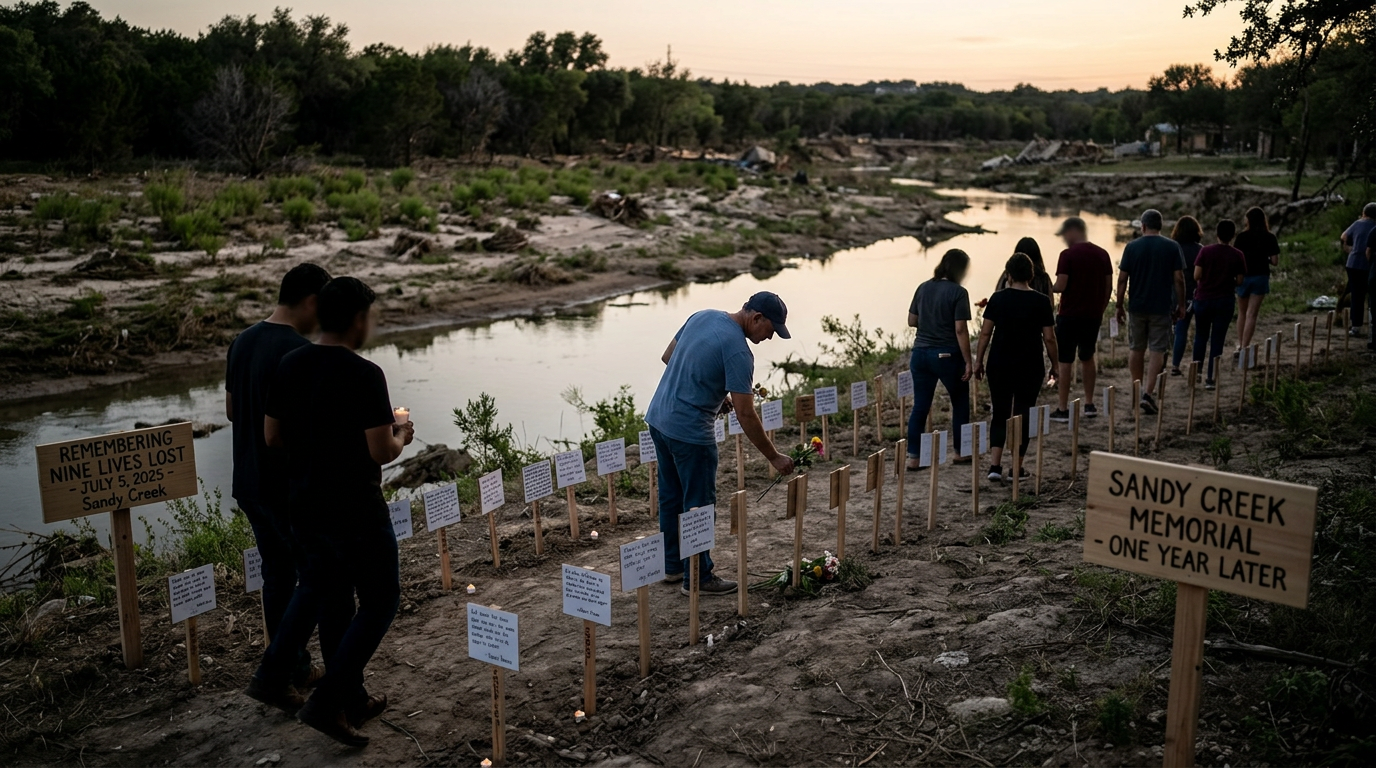
Residents of the Sandy Creek neighborhood in northwest Travis County gathered this week to observe a solemn milestone: the one-year anniversary of one of the deadliest localized flooding events in recent Central Texas history. On July 5, 2025, an unprecedented wall of water surged through the community, claiming the lives of nine individuals and destroying dozens of homes. The memorial service served not only as a space for mourning but as a focal point for a community still struggling to reconcile their sense of safety with the geographical realities of the Texas Hill Country. Historically, the Austin metropolitan area has been part of 'Flash Flood Alley,' a region where rocky terrain and intense rainfall patterns create high-risk scenarios, but the Sandy Creek event exceeded all previous predictive modeling according to local authorities. The recovery process over the last twelve months has been slow and emotionally taxing for the survivors. Many homes remain in varying states of repair, while other lots sit vacant where structures were once swept away by the current. As families laid wreaths and shared stories of those lost, the atmosphere was one of shared grief and resilience. Local organizers emphasized that the anniversary is a necessary step in the long-term healing process, ensuring that the names of the victims remain at the forefront of the conversation regarding future infrastructure and public safety measures. The event marks a critical moment for Travis County as it balances the need for emotional closure with the technical demands of disaster mitigation strategy following such a significant loss of life.
Texas relevance
The Sandy Creek tragedy is a direct reminder of the environmental vulnerabilities facing Travis County and the broader Central Texas region. As the population expands further into the hills and canyons of the northwest corridor, the intersection of residential development and natural drainage basins becomes a primary safety concern for state and local officials. This anniversary highlights the ongoing Texas debate over property rights, floodplain management, and the state's responsibility to fund large-scale drainage improvements in unincorporated areas. For Austin-area residents, the event serves as a call to action for better emergency alert systems and a deeper understanding of the flash flood risks inherent to the unique topography of the Balcones Escarpment.
The Anatomy of the 2025 Flood Event
The disaster began when a stagnant weather system dropped nearly ten inches of rain across the Hill Country in a matter of hours. Because the ground was already saturated from previous spring storms, the runoff had nowhere to go but the local creek beds. Sandy Creek, which typically flows as a gentle stream, transformed into a raging torrent that rose over fifteen feet in a shockingly short period. This rapid rise caught many residents off guard, particularly those who believed their homes were outside the high-risk flood zones according to older topographical maps.
Emergency responders from across Travis County faced immense challenges during the height of the storm. High-water rescue teams were deployed, but the sheer force of the debris-filled water made some areas inaccessible by boat or truck. The nine victims were largely caught in their homes or swept away while attempting to evacuate in vehicles. This specific failure of the evacuation window has prompted a year-long investigation into how meteorological data is communicated to residents in rural and semi-rural pockets of the county.
Remembering the Nine Victims
The anniversary event focused heavily on the human cost of the flood. Each of the nine victims was recognized by name, with surviving family members sharing anecdotes about their lives. The group included several long-term residents who had lived in Sandy Creek for decades, as well as newer families who had moved to the area seeking the tranquility of the Texas Hill Country. The loss of these individuals has left a permanent gap in the social fabric of the neighborhood, which was previously a tight-knit community of weekend boaters and retiree residents.
A permanent memorial is currently in the planning stages, with proponents hoping to place a marker near the creek banks where the worst damage occurred. Organizers believe that a physical monument will serve as a permanent reminder of the power of nature and the importance of community vigilance. For many, the act of gathering at the one-year mark was the first time they had seen certain neighbors since the nights spent in emergency shelters immediately following the surge.
Infrastructure Challenges in Northwest Travis County
One of the most pressing issues discussed in the wake of the anniversary is the state of infrastructure in older subdivisions like Sandy Creek. Many of the roads in this part of the county were designed decades ago, before the current level of residential density. These roads often lack sufficient culverts or elevated crossings, leading to 'low-water crossings' that become death traps during heavy rain. Local leaders are now under pressure to secure state and federal grants to bridge these gaps and ensure that residents have at least one reliable exit route during a weather emergency.
The cost of these upgrades is estimated in the tens of millions of dollars. Travis County commissioners have been reviewing drainage studies conducted over the past year to prioritize which projects will provide the most benefit to the Sandy Creek and surrounding basins. However, the complexity of Texas water law and property rights often slows down the process of acquiring easements necessary for expanded drainage channels, leading to frustration among residents who feel that the pace of government action does not match the urgency of the threat.
The Role of the National Weather Service and Alerts
A central theme of the recovery year has been the efficacy of the emergency alert system. During the 2025 flood, some residents reported receiving alerts on their mobile devices only minutes before the water reached their doorsteps, while others reported no alerts at all due to power and cell tower outages. This 'last-mile' communication problem is a focus for Texas emergency management experts who are looking for ways to integrate satellite-based or analog siren systems back into the safety net.
The National Weather Service has worked closely with local meteorologists to refine 'nowcasting' capabilities for the Hill Country. Because the terrain causes water to move so quickly, even a five-minute delay in a warning can be the difference between life and death. The Sandy Creek anniversary served as a testing ground for new community-based alert networks where neighbors take on the responsibility of checking on vulnerable residents as soon as a flash flood watch is issued, rather than waiting for formal government orders.
Economic and Housing Impact of the Recovery
Beyond the emotional toll, the economic impact on the Sandy Creek area has been profound. Many residents found that their standard homeowners' insurance did not cover flood damage, and those without specific National Flood Insurance Program (NFIP) policies were left to rely on small FEMA grants that often did not cover the full cost of rebuilding. This has led to a slow migration out of the neighborhood, as some families simply cannot afford to restore their properties to modern building codes that require elevated foundations.
Real estate values in the immediate vicinity of the creek have fluctuated as buyers weigh the scenic beauty of the area against the documented risk. However, Texas remains a high-growth state, and the demand for housing in Travis County continues to push development into these sensitive areas. Stakeholders are calling for more transparent disclosure laws that would require sellers to provide detailed histories of water intrusion on a property, ensuring that new residents are fully aware of the environmental history of the land they are purchasing.
The Search for Long-Term Solutions
As the local community looks toward the future, the focus is shifting toward long-term resilience strategies. This includes 'buyout' programs where the county or state purchases property in the most dangerous flood-prone areas to convert them into green belts or parks. While some Sandy Creek residents are eager to move to safer ground, others are resistant to leaving the land their families have owned for generations. This clash between public safety and private heritage is a common feature of the Texas experience in disaster-prone regions.
The next legislative session in Austin may see renewed interest in statewide flood planning. Successive seasons of extreme weather have made it clear that localized flooding is not just a coastal problem but a threat to the rapidly growing interior of the state. The lessons learned from the Sandy Creek tragedy—specifically regarding the speed of water movement in the Hill Country and the need for redundant communication systems—will likely inform the testimony of experts and survivors as they lobby for more robust state-level disaster preparedness funding.
Analysis
The Sandy Creek memorial highlights a growing tension in Texas governance between rapid suburban expansion and the physical limitations of the land. While the emotional weight of the anniversary is significant, the underlying story is one of a community seeking accountability. The loss of nine lives in a single neighborhood suggests that existing warning systems or infrastructure were insufficient for an event of this magnitude. Moving forward, the political narrative in Travis County will likely shift toward how public funds are allocated for pre-disaster mitigation versus post-disaster recovery. Conservative and local leaders alike face the challenge of modernizing infrastructure without imposing undue tax burdens, yet the Sandy Creek event proves that the cost of inaction can be measured in human lives.
Source attribution
This story was reported using a public release from the Texas Standard. Keep TX Red rewrote the coverage independently and links to the official statement for verification.
Frequently Asked Questions
- Where exactly is Sandy Creek located?
- Sandy Creek is situated in the northwest portion of Travis County, near the shores of Lake Travis, an area characterized by steep hills and deep drainage basins.
- Why was the 2025 flood so much more dangerous than previous ones?
- The 2025 event was caused by a combination of extreme rainfall intensity—nearly 10 inches in a few hours—and already saturated soil from previous storms, which led to a record-breaking surge in the creek.
- Is the government providing help to rebuild Sandy Creek?
- While FEMA and local grants have provided some assistance, many residents have had to rely on personal savings and community fundraising due to gaps in private insurance coverage for flood events.
- What is being done to prevent another tragedy in this area?
- Travis County is currently conducting drainage studies and reviewing emergency alert protocols, including the potential for new infrastructure projects like elevated bridges and better culverts.
Official Sources
Take the next step
Browse the Newsroom →Read more about Keep Texas Red → Our full guide to what Keep Texas Red means and why Texans support it.
Related Articles



Get Texas updates delivered weekly.
Independent Texas reporting on politics, policy, and daily life. One email a week. Unsubscribe anytime.
Keep TX Red Newsroom
The Keep Texas Red Editorial Staff produces nonpartisan explainers, policy breakdowns, and educational resources to help Texans understand how their government works. All content is reviewed for accuracy and updated regularly.
About Keep TX Red →