Kerrville Resilience Takes Center Stage One Year After Devastating Hill Country Floods
Kerrville residents gathered to honor flood victims and first-day responders one year after the Guadalupe River overflowed its banks.
Editorial disclaimer: Opinions and analysis on Keep TX Red are editorial content — not statements of fact. See our editorial standards.
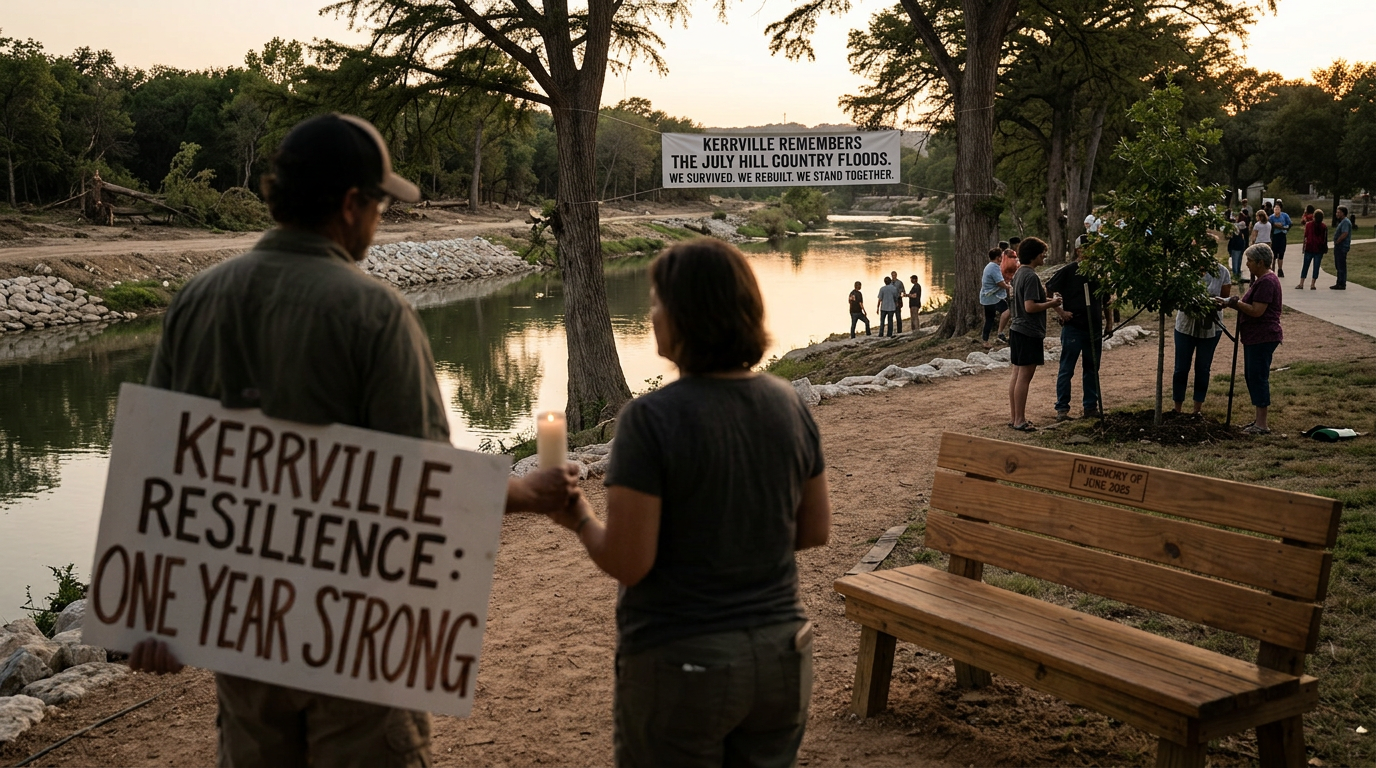
One year after the devastating surges of the Guadalupe River, the community of Kerrville gathered for a series of commemorative events over the Independence Day weekend. The observance served as both a memorial for the lives lost during the flash flooding and a tribute to the emergency personnel and volunteers who coordinated rescue efforts. In the summer of 2025, historic rainfall levels caused the river to crest significantly above its flood stage, catching many residents and holiday travelers by surprise. The impact was felt most acutely in the low-lying areas under the massive cypress trees that line the riverbanks. This year, the celebratory atmosphere of July 4th was tempered by a solemn recognition of the landscape's transformation and the long road to recovery that many local businesses and families have navigated over the past twelve months. The history of the Texas Hill Country is defined by a cycle of extreme drought followed by intense, localized flooding—a phenomenon often referred to by meteorologists as 'Flash Flood Alley.' These events have shaped regional infrastructure and emergency management policies for decades. In Kerrville, the memory of previous floods, such as those in 1987 and 2002, provided a baseline for the response, yet the speed of the 2025 event challenged even the most prepared residents. The recent anniversary gathering underscored a shared commitment to rebuilding while acknowledging that the natural beauty of the Guadalupe carries inherent risks that require constant vigilance.
Texas relevance
Texas Hill Country communities like Kerrville are uniquely vulnerable to the topography of the Edwards Plateau, where rocky soil and steep terrain funnel rainwater rapidly into river systems. The events in Kerrville are representative of a broader statewide concern regarding water management and disaster preparedness as Texas continues to see an influx of new residents into flood-prone rural areas. For the state of Texas, the recovery in Kerrville serves as a case study in how local municipalities can leverage community spirit and state resources to restore economic activity after a climate catastrophe. The resilience of the Guadalupe River basin is tied directly to the tourism economy of Central Texas, making the area's recovery a priority for both local stakeholders and state-level officials who monitor the health of Texas's primary waterways.
The Anatomy of the 2025 Flood Event
The disaster that struck Kerrville one year ago was the result of a 'training' storm system, where multiple cells of heavy rain passed over the same geographic area in rapid succession. This led to localized rainfall totals exceeding double-digit inches within a twenty-four-hour window, overwhelming the natural drainage capacity of the Guadalupe River. In the Hill Country, where the soil layer is often thin over limestone bedrock, there is little opportunity for the ground to absorb such a deluge, leading to immediate runoff.
As the water level rose, the river's character changed from a slow-moving recreational stream to a violent torrent carrying large logs, debris, and even vehicles. This physical transformation of the riverbed caused significant damage to public parks and private properties alike. The immediate aftermath required a massive mobilization of the Texas Game Wardens and local fire departments, who performed dozens of high-water rescues as the river peaked during a period normally reserved for summer festivities.
The anniversary events specifically highlighted how the community managed the immediate chaos. By reflecting on the timeline of the flood, local leaders aimed to educate the public on how quickly conditions can deteriorate. Understanding the mechanics of these floods is essential for future safety, as the Guadalupe remains one of the most popular yet dangerous river systems in the state during heavy rain cycles.
Economic Recovery of the Guadalupe Riverfront
Economically, Kerrville relies heavily on the tourism dollars generated by visitors seeking the cool shade of the cypress trees and the gentle flow of the river. The 2025 floods threatened this economic engine by damaging the very infrastructure that supports tourism. One year later, many of the riverside businesses that were inundated have successfully reopened, though the visible scars on the landscape—such as downed old-growth trees—remain as a reminder of the water's power.
The recovery effort involved a combination of private investment and public grants designed to harden the riverfront against future events. Business owners reported that the outpouring of local support in the weeks following the flood was the primary reason they chose to rebuild rather than relocate. This local loyalty has been a cornerstone of the 'Kerrville Strong' sentiment that dominated the recent anniversary proceedings.
However, the cost of recovery has not been uniform. Smaller enterprises without the benefit of extensive flood insurance faced significant hurdles. The community gathering served as a fundraiser for ongoing restoration projects, ensuring that the public spaces along the Guadalupe remain accessible to all residents, regardless of their financial standing after the disaster.
Honoring the First Responders and Volunteers
A central theme of the July 4th weekend was the recognition of the 'human element' in disaster response. When the 2025 floods hit, the response was not limited to professionals. Neighbors utilized their own boats and equipment to reach stranded residents, demonstrating a uniquely Texan brand of self-reliance and mutual aid. The anniversary ceremony featured a roll call of organizations that played a pivotal role in the days following the crest.
Special recognition was given to the local volunteer fire departments and the community organizations that set up temporary shelters and kitchens. These groups provided more than just physical sustenance; they offered a sense of stability during a time of extreme uncertainty. The bravery shown during the height of the storm was recounted in speeches that emphasized the values of service and sacrifice.
The bond between the citizens and their emergency services has been strengthened by this shared trauma. Many of the first responders who were honored noted that the public's cooperation during the evacuation orders saved countless lives. The memorial served as a formal venue to express gratitude that was difficult to articulate in the frantic moments of the actual rescue operations.
Environmental Impact and River Restoration
The environmental toll of the flood was immense, particularly for the iconic Montezuma cypress trees that define the Guadalupe riverbank. Many of these trees, which can live for centuries, were uprooted or severely damaged by the force of the water and the debris it carried. Environmentalists and park rangers have spent the last year assessing the damage and beginning the slow process of reforestation and bank stabilization.
Restoring the river is not just an aesthetic concern but a functional one. The root systems of these trees are vital for preventing erosion and maintaining water quality. The anniversary events included educational booths where residents could learn about native plant species that help mitigate the impact of future flooding. This forward-looking approach to environmental stewardship is a key part of the city's long-term resilience strategy.
Volunteers have spent hundreds of hours clearing trash and unnatural debris that were deposited in sensitive habitats. The goal is to return the Guadalupe to its pristine state while acknowledging that the river is a dynamic system that will inevitably change again. The work done over the past year has significantly improved the health of the waterway, preparing it for the next generation of Texans.
Future Preparedness and Infrastructure Upgrades
Lessons learned from the 2025 flood are already being integrated into Kerrville's urban planning. Local officials have highlighted the need for improved communication networks to ensure that even those in remote areas receive timely evacuation warnings. The anniversary served as a launchpoint for new public safety initiatives, including updated flood zone maps and enhanced emergency alert systems that utilize both digital and traditional sirens.
Infrastructure projects are also underway to improve drainage in the most vulnerable neighborhoods. By expanding culverts and creating new retention areas, the city hopes to reduce the 'peaking' effect that happens when runoff enters the river system too quickly. These engineering solutions are a critical part of the promise made to residents that the city will be better prepared for the next 'hundred-year' storm.
The state of Texas has also taken notice, with legislative discussions occurring at the capitol regarding the funding of regional flood planning groups. The experience in Kerrville provides empirical data that can help other Hill Country towns design their own mitigation strategies. As the climate remains unpredictable, the focus on 'hardening' infrastructure has become a non-partisan priority for local government.
Psychological Impact and Community Healing
Beyond the physical and economic damage, the 2025 floods left a psychological mark on the residents of Kerrville. For many, the Sound of rushing water still triggers anxiety. The anniversary ceremony was designed with this in mind, offering a space for collective grieving and the processing of shared trauma. Mental health advocates participated in the event, providing resources for those still struggling with the aftermath of the loss of their homes or loved ones.
The sense of community developed through shared hardship is often the most durable defense against future disasters. Speakers at the event noted that the 'scarred' landscape of the riverbank is a metaphor for the residents themselves: battered by the storm but still standing tall. This communal narrative of strength is vital for maintaining the morale needed to continue the long-term rebuilding process.
As the sun set on the anniversary celebration, the mood was one of quiet optimism. The resilience of Kerrville is not just about moving past the flood, but about incorporating the memory of the event into the town's identity. By facing the past together, the community has built a foundation of trust that will be essential when the Guadalupe inevitably rises again.
Analysis
The one-year anniversary in Kerrville highlights a critical tension in Texas land use: the desire to develop and enjoy scenic riparian corridors versus the reality of their volatility. While the media often focuses on the immediate drama of a rescue, the long-term 'resilience' mentioned by local officials is actually a testament to the quiet, grueling work of clearing debris, reapplying for permits, and dealing with insurance claims that lasted long after the cameras left. The unity displayed during the Independence Day events suggests that the social fabric of Kerrville remains strong, but the event also serves as a subtle warning to the rest of Texas. As more people move to the Hill Country, the burden on first responders grows, and the necessity for robust, state-funded early warning systems becomes more pressing than ever.
Source attribution
This story was reported using a public release from the Texas Standard. Keep TX Red rewrote the coverage independently and links to the official statement for verification.
Frequently Asked Questions
- What caused the specific flooding event in Kerrville a year ago?
- A series of heavy storms 'trained' over the same area of the Hill Country, dropping excessive rainfall on rocky soil that could not absorb the moisture. This caused the Guadalupe River to rise rapidly to historic levels, leading to flash flooding.
- How has the town of Kerrville changed since the flood?
- The town has seen significant physical restoration to its riverfront parks and businesses. Additionally, there is a heightened focus on emergency preparedness, updated flood mapping, and community-wide support systems for disaster survivors.
- Are there ongoing risks for residents in the Texas Hill Country regarding floods?
- Yes, the geography of the Edwards Plateau makes the region one of the most flood-prone areas in the United States. Residents are encouraged to monitor weather alerts closely and understand the specific flood risks associated with their property's elevation.
Official Sources
Take the next step
Browse the Newsroom →Read more about Keep Texas Red → Our full guide to what Keep Texas Red means and why Texans support it.
Related Articles
Get Texas updates delivered weekly.
Independent Texas reporting on politics, policy, and daily life. One email a week. Unsubscribe anytime.
Keep TX Red Newsroom
The Keep Texas Red Editorial Staff produces nonpartisan explainers, policy breakdowns, and educational resources to help Texans understand how their government works. All content is reviewed for accuracy and updated regularly.
About Keep TX Red →