Honoring the Neon Legacy of Tim Walker After Tragic Hill Country Passing
The Houston art community and Hill Country residents mourn Tim Walker, a master neon artist who passed away during recent severe Texas flooding.
Editorial disclaimer: Opinions and analysis on Keep TX Red are editorial content — not statements of fact. See our editorial standards.
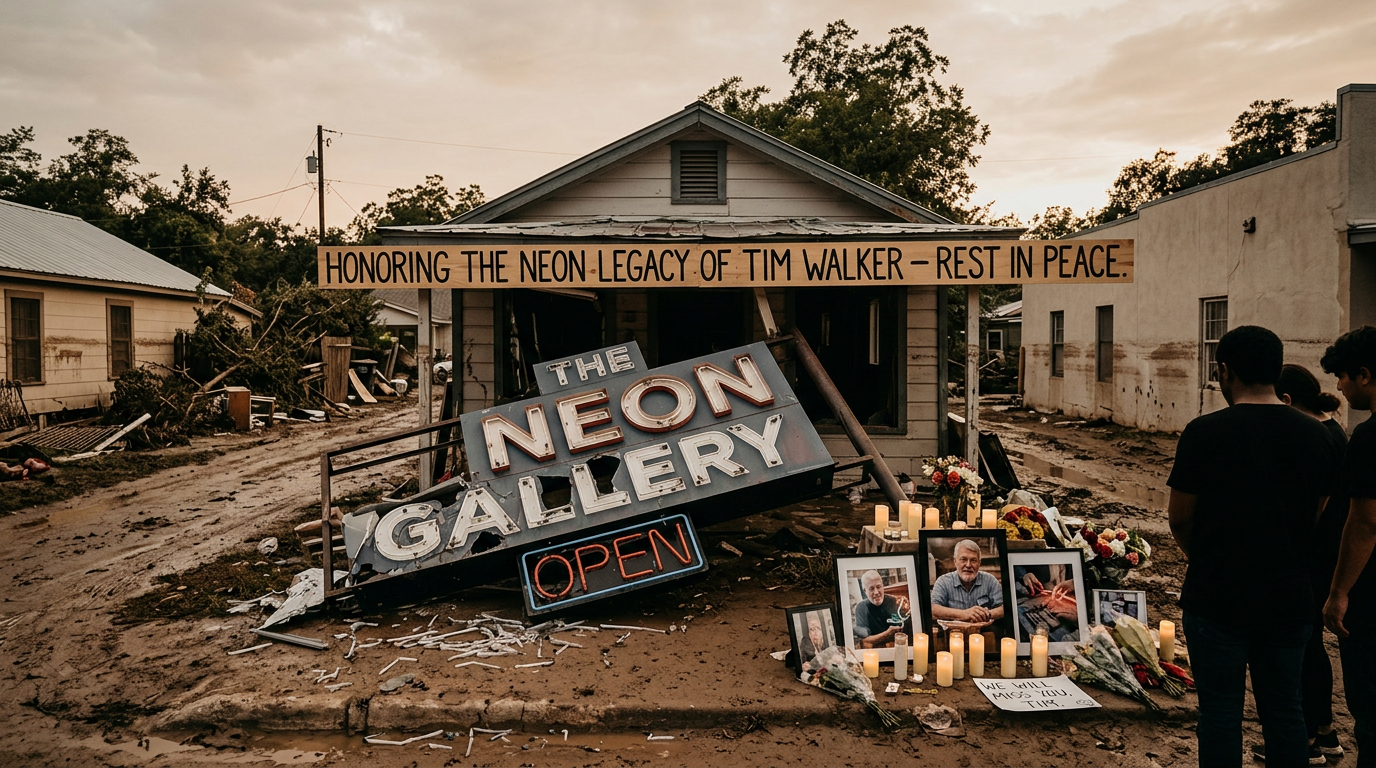
The Texas art world is mourning the loss of Tim Walker, a foundational figure in Houston’s creative landscape and a master of neon craftsmanship. Walker, who spent over four decades operating the iconic Neon Gallery, passed away on July 4, 2025, following a catastrophic flooding event in the Texas Hill Country. Historically, the Hill Country has been prone to 'flash flood alley' conditions, where rapid rainfall transforms serene vacation spots into hazardous zones. Walker was visiting the region with his family when the incident occurred, marking a somber end to a life dedicated to illuminating the urban corridors of the Lone Star State with vibrant, hand-bent light. His work was more than commercial; it was a preservation of a mid-century craft that few modern artisans have mastered with such precision. This tragedy highlights the persistent dangers of Texas weather during the summer months, even as the community turns its focus toward celebrating a man who turned electricity into a fine art form. Friends and colleagues remember him as a steady hand in an ever-changing city, someone whose influence can be seen in the glowing storefronts and gallery walls across Houston.
Texas relevance
This story hits home for residents of Central and Southeast Texas, linking the artistic heartbeat of Houston with the geographical volatility of the Hill Country. Texas has a long history of devastating floods in its central plateau, including the catastrophic events of 1921 and the more recent Wimberley floods of 2015. For Houstonians, the loss of Tim Walker represents the disappearance of a cultural landmark, as his Neon Gallery served as a bridge between the city's blue-collar industrial roots and its contemporary status as an international arts hub. The event also serves as a stark reminder for Texan travelers about the unpredictable nature of the state's river systems, which are prone to rapid rises during holiday weekends when families frequently gather at the water's edge.
Four Decades of Illuminating Houston
Tim Walker’s career was defined by constant motion and the steady glow of noble gases. For more than 40 years, he was the primary steward of the Neon Gallery, a space that functioned as both a workshop and a museum of light. While many business owners in the 1980s and 90s viewed neon simply as a tool for advertising, Walker treated every bend of the glass as a deliberate sculptural choice. He was known for working closely with local entrepreneurs and private collectors to ensure that the spirit of 'Old Houston' remained visible even as the skyline modernized.
His influence extended far beyond simple signage. Walker was a mentor to younger artists and a collaborator with architects who wanted to integrate light into the structural identity of the city. His mastery of the craft meant he understood the chemistry of argon and neon, the physics of transformers, and the delicate touch required to manipulate glass over a ribbon burner. This specialized knowledge is becoming increasingly rare, making his contributions to the Texas aesthetic even more significant in retrospect.
The Hazards of the Hill Country Terrain
The tragedy occurred during a period of intense atmospheric instability that is typical for Texas during the transition into the heat of July. The Hill Country, with its limestone bedrock and steep canyons, does not absorb water quickly; instead, heavy rainfall often funnels directly into creek beds and rivers, creating wall-like surges of water known as flash floods. These events can occur miles away from where the actual rain is falling, catching even the most experienced outdoorsmen off guard.
On July 4, 2025, the combination of holiday crowds and sudden weather shifts proved fatal. Witnesses in the area described a rapid rise in water levels that left little time for evacuation. This specific region of Texas has seen numerous high-profile water rescues over the last decade, yet the allure of the Guadalupe and Llano rivers continues to draw thousands of tourists annually. The loss of a figure like Walker underscores that the natural beauty of the Texas wilderness carries inherent risks that require constant vigilance.
An Artist’s Impact on the Urban Landscape
To walk through certain districts in Houston is to walk through a gallery of Tim Walker’s making. From dive bar windows to high-end restaurant interiors, his work provided a warm, humming ambiance that LEDs simply cannot replicate. His colleagues often remarked that Walker had an 'eye for the glow,' an ability to predict how a specific gas mixture would interact with the ambient light of a room. This attention to detail earned him a reputation as the go-to artisan for anyone seeking authentic neon work in the Southern United States.
His gallery served as a sanctuary for a fading art form. At a time when the world was moving toward disposable technology, Walker’s work was built to last for generations. He spent countless hours repairing vintage signs that others would have discarded, effectively preserving the visual history of Texas commerce. His commitment to the longevity of his pieces meant that he wasn't just making art; he was making artifacts that told the story of a growing state.
The Evolution of Neon in Texas Culture
Neon has long held a special place in the heart of Texas, evoking images of lonely highway motels, vibrant dance halls, and the bustling theaters of the 20th century. Tim Walker understood this nostalgic connection better than anyone. He was able to tap into the collective memory of Texans who associated the flicker of a neon sign with the welcome of a roadside stop or the excitement of a night out in the city. By keeping this art form alive, he helped maintain a sense of continuity in a state that often prizes the 'new' over the 'old.'
The Neon Gallery became a hub where the past met the present. Walker would often showcase contemporary designs alongside restored pieces from the 1950s, demonstrating that neon was a flexible medium capable of expressing modern sensibilities. His death leaves a gap in the specialized labor market of the arts, as the skills required to blow glass and pump it with gas are not easily taught in traditional art schools. The Texas creative community now faces the challenge of how to carry on a legacy that was so closely tied to one man's hands.
Community Response and Future Memorials
In the days following the news of his passing, the Houston art community has seen an outpouring of support for the Walker family. Fellow artists have proposed various ways to honor his memory, including potential public light installations or a scholarship fund for aspiring craftsmen. The sense of loss is palpable in the workshops and studios where Walker was a frequent visitor and a source of technical advice. For many, the light in Houston feels slightly dimmer without his presence.
While the specifics of a public memorial have yet to be finalized, the enduring presence of his signs throughout the city serves as a living monument. Each time a passerby notices the distinctive hum and saturated color of a genuine neon sign in Houston, they are likely seeing the fingerprints of Tim Walker’s career. His family has expressed gratitude for the community's respect for their privacy during this difficult time, while also acknowledging the profound impact Walker had on the state he called home.
A Call for Heightened Weather Awareness
The circumstances surrounding the July 4th incident serve as a somber educational moment for all Texans. Disaster management officials often use these tragedies to reinforce the importance of 'Turn Around, Don't Drown' campaigns and the necessity of monitoring weather alerts even when the sky appears clear. In the Hill Country, a storm twenty miles upstream can result in a life-threatening surge within minutes. For vacationers, understanding the local topography and potential escape routes is a vital component of seasonal safety.
State representatives and local leaders in Hill Country counties continue to look for ways to improve early warning systems. While technology has significantly advanced in terms of radar and mobile notifications, the human element—the split-second decision to move to higher ground—remains the most critical factor in survival. The loss of Tim Walker is a heavy price to pay for a reminder of nature's indifference, and it reinforces the need for a culture of safety among those who enjoy the natural wonders of Texas.
Analysis
The death of Tim Walker is not just a personal tragedy for his family, but a cultural vacuum for the state of Texas. In an era where mass-produced LED lighting has largely supplanted traditional neon, Walker’s dedication to the vacuum-sealed glass tube was an act of artistic resistance. His career spanned the transition of Houston from a burgeoning oil town to a diverse metropolis, and his signs provided the aesthetic backdrop for that transformation. There is a profound irony in a man who spent his life managing high-voltage currents and fragile glass being taken by the raw, natural force of a Texas flash flood. His passing will likely spark renewed conversations regarding flood safety infrastructure in rural Texas vacation zones, as well as the need for historic preservation of the analog arts in an increasingly digital world.
Source attribution
This story was reported using a public release from the Texas Standard. Keep TX Red rewrote the coverage independently and links to the official statement for verification.
Frequently Asked Questions
- What made Tim Walker's work in neon so significant?
- Tim Walker was one of the few remaining master craftsmen who hand-bent glass and used traditional gases like neon and argon. His work spanned over 40 years and preserved the mid-century aesthetic of Houston while creating new pieces that bridged the gap between commercial signage and fine art.
- Where did the flooding occur that led to his death?
- The incident took place in the Texas Hill Country while Walker was on vacation with his family. The Hill Country is notorious for 'flash flood alley' conditions, where rain can cause river levels to rise several feet in a matter of minutes.
- Will the Neon Gallery in Houston remain open?
- Direct plans for the gallery's future have not been officially detailed by the family yet, as they are currently focusing on mourning their loss. However, the gallery stands as a significant part of his 40-year legacy in the Houston art scene.
- How can residents help prevent similar tragedies in the Hill Country?
- Safety experts recommend staying tuned to local weather alerts, understanding that flooding can occur even if it isn't raining in your immediate area, and always choosing higher ground when water begins to rise. The phrase 'Turn Around, Don't Drown' is a key guideline for Texas flash floods.
Official Sources
Take the next step
Browse the Newsroom →Read more about Keep Texas Red → Our full guide to what Keep Texas Red means and why Texans support it.
Related Articles

Get Texas updates delivered weekly.
Independent Texas reporting on politics, policy, and daily life. One email a week. Unsubscribe anytime.
Keep TX Red Newsroom
The Keep Texas Red Editorial Staff produces nonpartisan explainers, policy breakdowns, and educational resources to help Texans understand how their government works. All content is reviewed for accuracy and updated regularly.
About Keep TX Red →