Governor Greg Abbott Commemorates One-Year Anniversary of Destructive Hill Country Flash Floods
Governor Abbott honors victims of the devastating Hill Country floods one year after the disaster, emphasizing resilience and improved state preparation.
Editorial disclaimer: Opinions and analysis on Keep TX Red are editorial content — not statements of fact. See our editorial standards.
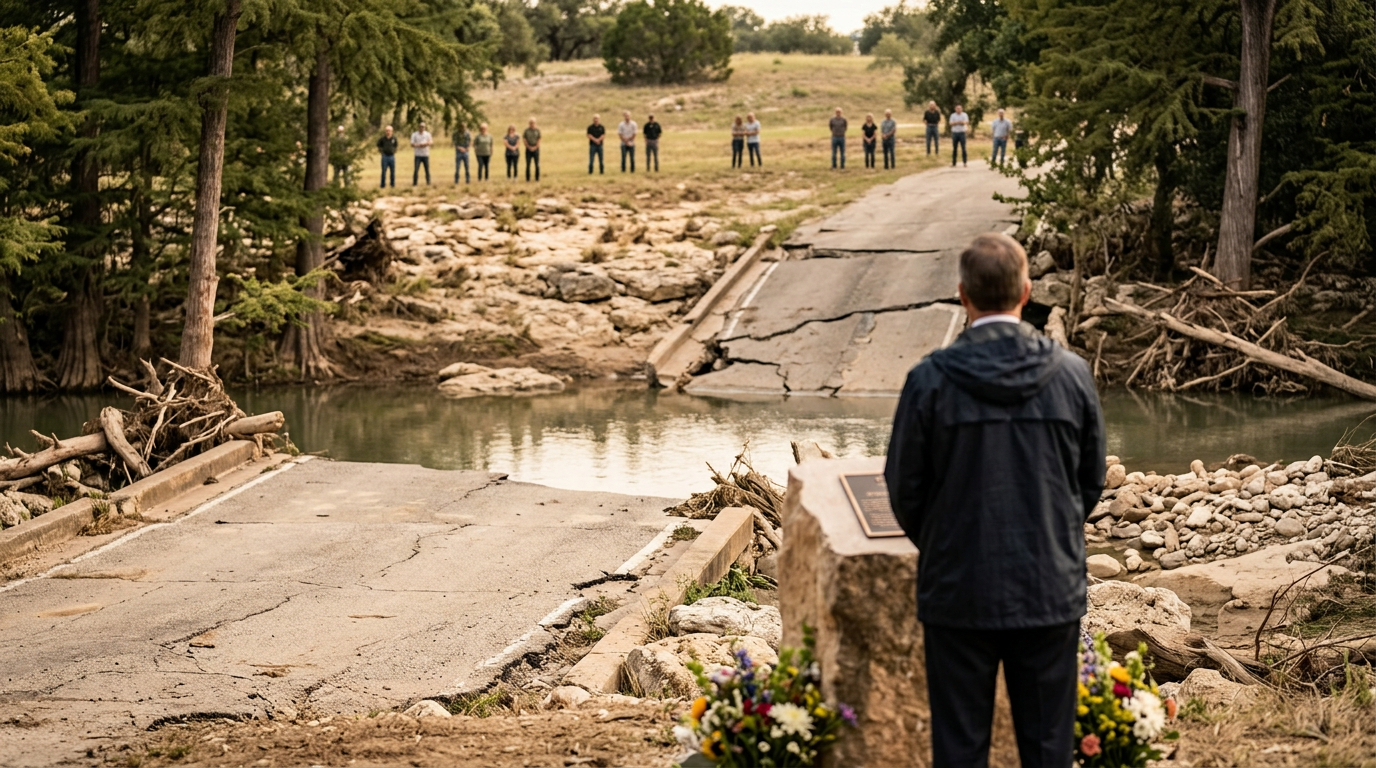
One year after a series of catastrophic flash floods tore through the heart of the Texas Hill Country, Governor Greg Abbott joined local leaders and survivors to reflect on the tragedy and the subsequent recovery efforts. The floods, which occurred exactly twelve months ago, resulted in significant loss of life and destroyed millions of dollars in residential and public infrastructure. During a commemorative ceremony, the Governor emphasized that the victims of the surge would remain at the forefront of the state's memory as officials work to harden Texas against future meteorological threats. Historically, the Texas Hill Country has been referred to as 'Flash Flood Alley' due to its unique topography and thin soil layers that provide limited absorption during heavy rainfall. This anniversary serves as a somber reminder of a 2025 event that saw several inches of rain fall within a very compressed timeframe, causing local rivers to swell beyond their banks in record time. Historically, central Texas has faced similar devastating events in 1998 and 2015, each leading to legislative shifts in how the state manages water flow and emergency alerts.
Texas relevance
This event is deeply relevant to the residents of Central Texas, particularly those in Hays, Travis, and Blanco counties who were directly impacted by the 2025 deluges. The Governor's presence underscores a state-level commitment to the region's long-term infrastructure needs and the ongoing administration of disaster recovery funds. For Texans, these commemorative events are more than just reflections; they signal the priority level the state government places on rural infrastructure and the protection of the Hill Country's unique but dangerous river systems.
Remembering the Human Toll of the 2025 Surge
The primary focus of the Governor's address was the sanctity of human life and the profound loss experienced by families who saw their homes and loved ones taken by the rising waters. Abbott spent a significant portion of his time speaking with survivors, many of whom are still in the process of rebuilding their lives. He noted that while buildings can be replaced with timber and stone, the void left by those who perished remains a permanent fixture in the community.
Local officials joined the Governor in acknowledging the heroic efforts of first responders. During the height of the flooding one year ago, local fire departments and high-water rescue teams performed hundreds of evacuations under extremely perilous conditions. These individuals were credited with preventing the death toll from reaching much higher numbers, showcasing the vital link between state funding for emergency equipment and life-saving outcomes in rural areas.
The ceremony included the reading of the names of the deceased, a move intended to ensure that the statistics of the disaster remain grounded in the reality of the families affected. Families present expressed a mix of grief and gratitude for the continued attention from the state capital, noting that often, rural disasters are forgotten once the national news cycle moves on to the next headline.
Infrastructure Challenges in the Hill Country
In the year since the floods, engineers and state auditors have been assessing the damage to low-water crossings and bridges throughout the Hill Country. Many of these structures, some dating back several decades, were not built to withstand the hydrostatic pressure of the 2025 event. The Governor highlighted that the state is currently reviewing grant applications for the fortification of these critical transit points to ensure that communities do not become isolated during future storms.
One of the major hurdles identified in the aftermath is the sheer cost of upgrading dozens of rural bridges simultaneously. The Texas Department of Transportation has been working in tandem with local county commissioners to prioritize the most vulnerable routes. These routes are essential for emergency services, as blocked crossings can add critical minutes to response times when every second counts during a flash flood scenario.
Furthermore, the discussion has turned toward the implementation of more advanced early-warning systems involving automated sensors in upstream tributaries. By the time many residents realized the severity of the water level last year, the roads were already impassable. New investments are being directed toward real-time data collection that can trigger emergency alerts directly to smartphones even in areas with traditionally spotty cellular service.
The Role of the Texas Division of Emergency Management
Governor Abbott praised the Texas Division of Emergency Management (TDEM) for its role in the immediate response and the year-long cleanup effort. TDEM has become a central pillar of the state's strategy for dealing with the increasing frequency of natural disasters. Their presence in the Hill Country over the last 12 months has facilitated the distribution of millions in federal and state aid to local municipalities that lack the tax base to fund massive reconstruction projects on their own.
The agency's 'Chief of Staff' model, which embeds experienced emergency coordinators within local government offices during a crisis, was credited with streamlining the bureaucratic process that often slows down recovery. Abbott indicated that this model will be expanded and refined based on the lessons learned from the 2025 floods, ensuring that the next regional office is even better prepared to handle complex logistics.
The collaboration between the state and local non-profits has also been a highlight of the recovery. Groups such as the Texas Baptist Men and the American Red Cross were mentioned as essential partners that filled the gaps where government programs could not reach. This public-private partnership is a hallmark of the Texas recovery strategy, emphasizing community-led initiatives over top-down federal mandates.
The Economic Impact of Natural Disasters
Beyond the immediate physical damage, the 2025 floods had a significant economic impact on the Hill Country’s tourism-based economy. With rivers closed to recreational use and several popular state parks damaged, local businesses in towns like Wimberley and New Braunfels saw a sharp decline in revenue during the subsequent peak season. The Governor’s visit also served as an invitation for Texans to return to the region and support the local economy as it nears full recovery.
Economic recovery grants have played a pivotal role in keeping small businesses afloat while they waited for insurance payouts or federal loans. Many shop owners and outfitters had to completely gut their facilities after mud and debris settled inside their buildings. The state’s small business assistance programs were tailored specifically for these rural enterprises to ensure the cultural fabric of the Hill Country remained intact despite the financial strain.
Long-term economic planning now includes 'resilient tourism' strategies, which involve building structures in a way that minimizes damage from future high-water events. This includes using materials that are easier to sanitize after flooding and elevating electrical systems above the 100-year flood line. These proactive measures are seen as an investment in the state's broader economic stability, protecting one of its most popular travel destinations.
Policy and Legislative Outlook for Flood Mitigation
As the Texas Legislature looks toward future sessions, the events of the Hill Country floods are expected to drive several key policy proposals. Specifically, there is growing interest in expanding the Texas Infrastructure Resiliency Fund (TIRF), which provides low-cost loans and grants for flood-control projects. Advocates argue that the cost of prevention is significantly lower than the cost of reconstruction, a sentiment the Governor echoed during his remarks.
There is also a push for better regional water planning that transcends county lines. Because rivers flow through multiple jurisdictions, a flood-control project in one county can inadvertently increase risk in another downstream. The state’s regional flood planning groups, established by previous legislation, are now working to finalize comprehensive maps that will guide development and zoning decisions for years to come.
Governor Abbott’s administration remains focused on a 'Texas-first' approach to disaster management. While federal FEMA funds are a critical component, the Governor has consistently pushed for the state to maintain its own robust rainy-day fund to ensure that immediate needs can be met without waiting for congressional approval. This financial autonomy is viewed as a prerequisite for the rapid response that characterizes the Texas model of governance.
Community Resilience and the Spirit of Texas
The anniversary event concluded with a focus on the 'Spirit of Texas,' a term the Governor frequently uses to describe the neighbor-helping-neighbor ethos that emerges during times of crisis. He recounted stories of individuals who used their own private boats to rescue strangers and neighbors who spent weeks helping each other clear debris. This social cohesion is often what determines the success of a recovery as much as any government policy.
Religious institutions and community centers played a central role in the recovery, serving as distribution hubs for food, clothing, and clean water. The Governor noted that these organizations are often the first on the scene and the last to leave, providing long-term emotional and spiritual support for those who lost everything. The state’s partnership with these faith-based organizations continues to be a primary focus of Abbott's community outreach initiatives.
In the final analysis, the one-year anniversary of the Hill Country flooding is not just about looking back, but looking forward with a sense of purpose. The commitment to 'never forget' is a pledge to learn the difficult lessons of the past to protect the future of all Texans. As the region continues to grow and attract new residents, the importance of this vigilance remains paramount.
Analysis
The Governor’s focus on the 'never be forgotten' theme serves a dual purpose: providing emotional closure for a grieving community while subtly highlighting the success of the Texas Division of Emergency Management (TDEM) in the months following the crisis. By framing the disaster through the lens of community resilience, the administration reinforces the narrative that Texas is capable of self-managed recovery. However, the recurring nature of these 'hundred-year floods' suggests that the state will face increasing pressure to modernize the aging dam and levee systems that were originally designed for a much smaller population and less volatile weather patterns.
Source attribution
This story was reported using a public release from the Governor Abbott — Video Moments (Google News). Keep TX Red rewrote the coverage independently and links to the official statement for verification.
Frequently Asked Questions
- What started the 2025 Hill Country flooding?
- The flooding was triggered by a stalled weather system that dropped massive amounts of rain over a very short period onto terrain that was already saturated. Due to the rocky landscape of the Hill Country, the water quickly channeled into river valleys, creating rapid surge conditions that exceeded traditional flood stages.
- How is the state helping Hill Country residents one year later?
- The state, primarily through the Texas Division of Emergency Management, has been facilitating the distribution of recovery funds, providing grants for infrastructure repair, and working with local officials to improve flood mapping and warning systems. Many residents are also benefiting from low-interest disaster recovery loans.
- What is the Texas Infrastructure Resiliency Fund?
- The Texas Infrastructure Resiliency Fund (TIRF) is a state-managed fund used to provide financial assistance for flood control and mitigation projects. It was designed to help communities build better dams, levees, and drainage systems so they are less vulnerable to future storm events.
- Why is the Texas Hill Country particularly prone to flash floods?
- The region is often called 'Flash Flood Alley' because its limestone-heavy soil does not absorb water quickly. Additionally, the steep elevation changes in the hills cause rainwater to run off rapidly into narrow riverbeds, creating 'wall of water' surges that can be deadly and destructive.
Official Sources
Take the next step
Browse the Newsroom →Read more about Keep Texas Red → Our full guide to what Keep Texas Red means and why Texans support it.
Related Articles


Get Texas updates delivered weekly.
Independent Texas reporting on politics, policy, and daily life. One email a week. Unsubscribe anytime.
Keep TX Red Newsroom
The Keep Texas Red Editorial Staff produces nonpartisan explainers, policy breakdowns, and educational resources to help Texans understand how their government works. All content is reviewed for accuracy and updated regularly.
About Keep TX Red →