Kerr County Infrastructure Update: Hill Country Flood Sirens Installed While Activation Protocols Remain Pending
Following the devastating 2025 floods, Kerr County has installed a new siren system, but officials are still refining the emergency alert protocols.
Editorial disclaimer: Opinions and analysis on Keep TX Red are editorial content — not statements of fact. See our editorial standards.
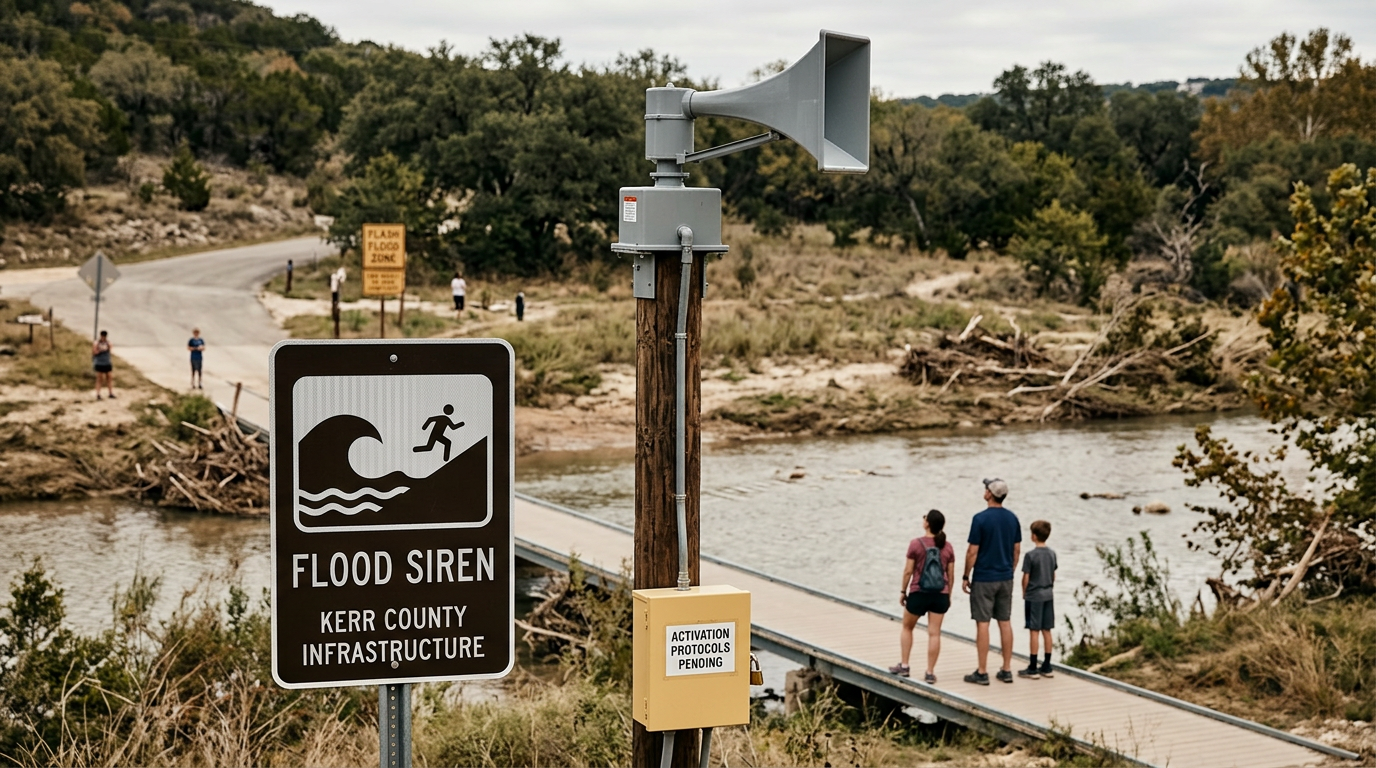
In the wake of the catastrophic July 2025 flooding events that forever changed the landscape of the Texas Hill Country, Kerr County officials have successfully completed the physical installation of a modern outdoor siren system. These devices serve as a tangible response to the public outcry for better warning mechanisms after more than 100 residents and visitors lost their lives when the Guadalupe River surged beyond its banks with unprecedented speed. Historically, the Hill Country has been known as 'Flash Flood Alley' due to its unique topography and thin soil, which allows rainwater to rapidly accumulate in river basins. This specific project represents the first major technological overhaul of the county's warning systems in several decades, aiming to bridge the gap between digital cellular alerts and physical auditory warnings. While the steel poles and high-decibel speakers are now visible fixtures across the county’s lower-lying areas, the administrative task of determining exactly when and how they will be triggered is currently categorized as a 'work in progress' by local leadership. The 2025 disaster highlighted significant vulnerabilities in the existing emergency communication infrastructure, particularly for those camping along the river or living in areas with spotty cellular reception. Residents have been eager to see a comprehensive plan that integrates these sirens with the National Weather Service's alerts and local sheriff's department protocols. The delay in finalization stems from the need to balance the urgency of a life-saving alert with the risk of 'alarm fatigue,' which occurs if sirens are activated too frequently for minor events. Local emergency management coordinators are currently engaged in a series of simulations to determine the precise flood stage levels at various points along the Guadalupe River that should trigger an audible town-wide warning. Unlike coastal hurricane sirens that often provide days of lead time, the Kerr County system must be responsive to flash flooding that can occur in mere minutes. Consequently, the decision-making chain must be tight, localized, and resilient against power outages or communication failures during severe weather. The county is also coordinating with neighboring jurisdictions like Gillespie and Kendall Counties to ensure that warnings are synchronized, preventing confusion for travelers moving across county lines during a storm event.
Texas relevance
Kerr County, nestled in the heart of the Texas Hill Country, serves as a critical focus point for statewide flood mitigation strategies due to its position along the upper Guadalupe River. The geological reality of the Edward’s Plateau creates a scenario where heavy rainfall in West Texas can lead to a 'wall of water' moving through Kerrville and surrounding communities within hours. This makes the effectiveness of the Kerr County siren system a matter of state-level importance, as it serves as a pilot case for how rural Texas counties can integrate legacy acoustic warnings with modern meteorological tech. For travelers from San Antonio or Austin who frequent the local river parks, these infrastructure updates are vital for seasonal safety.
The 2025 Flood Legacy
The impetus for this massive infrastructure project dates back to the tragic events of one year ago. In July 2025, a stalled weather system dropped nearly 20 inches of rain over the Guadalupe River headwaters in a matter of 12 hours. The resulting rise was so rapid that it bypassed traditional sensor warnings in several locations, catching many residents off guard in the middle of the night. The death toll, which exceeded 100 individuals, remains one of the highest from a single flooding event in modern Texas history, prompting an immediate demand for revamped warning systems.
Following the disaster, a blue-ribbon committee was formed to evaluate the failures of the existing Wireless Emergency Alerts (WEA). The committee found that while cell phone alerts were sent, regional tower congestion and 'dead zones' in the river canyons prevented a significant portion of the population from receiving timely notifications. This led to the conclusion that a redundant, low-tech auditory system was necessary to ensure that people outdoors or without active mobile devices could be reached. The sirens are meant to be the final, inescapable layer of the county's safety net.
The funding for these sirens was expedited through a combination of emergency county budget reallocations and state grants focused on disaster resilience. However, the physical hardware is only as effective as the humans and algorithms behind the 'on' switch. As the community approaches the one-year anniversary of the tragedy, the pressure on the Commissioners Court to finalize these operating procedures has reached a fever pitch, with advocacy groups representing the victims' families calling for transparency in the testing phases.
Technical Specifications and Placement
The new system consists of 14 high-powered electronic sirens strategically placed along the river corridor and in high-population density areas of Kerrville. Each unit is equipped with battery backups and solar charging capabilities to ensure functionality even if the local power grid fails—a common occurrence during the high winds and lightning that accompany Hill Country thunderstorms. The sirens are capable of broadcasting both a steady tone for emergencies and pre-recorded voice instructions, which provides a layer of clarity that older mechanical sirens lacked.
Engineers specifically mapped the placement of these towers using acoustic modeling software to account for the way sound bounces off the canyon walls and hills. The goal was to reach a minimum of 70 decibels in all residential zones near the river. This ensures that even those sleeping in air-conditioned homes or recreational vehicles should be able to hear the warning over ambient noise. The county has also integrated the sirens into a centralized radio-frequency control system, allowing the dispatch center to activate all units simultaneously or target specific zones based on the location of the rainfall.
Despite the high-tech nature of the hardware, the county is currently facing challenges with 'dead spots' created by the region's extreme vertical relief. In some of the deeper draws and valleys, the sound of the sirens may still be muffled. To address this, local officials are considering adding smaller 'repeater' sirens in future phases of the project. For now, the current 14 towers represent the core of the network, covering roughly 85% of the high-risk flood zones identified in the 2025 impact report.
The Dilemma of Activation Thresholds
One of the primary reasons the activation plan remains a work in progress is the debate over 'thresholds.' In hydrologic terms, a threshold is the specific river depth or flow rate at which an emergency is declared. If the threshold is set too low, the sirens will go off every time the river enters a minor flood stage, which is a frequent occurrence in the spring. If residents hear the siren several times a year without seeing water in their streets, they may begin to ignore it, leading to apathy when a truly catastrophic event occurs.
Conversely, setting the threshold too high risks a repeat of 2025, where the water may be rising faster than the data can be processed. Emergency management personnel are currently working with the Lower Colorado River Authority (LCRA) and the United States Geological Survey (USGS) to synchronize the sirens with real-time gauge data. The challenge is that gauge data can sometimes be delayed by 15 to 30 minutes, a timeframe that is an eternity during a flash flood. Local officials are debating whether the Sheriff's Office should have the autonomy to trigger sirens based on visual reports from deputies, or if it must remain a data-driven process.
There is also the question of the 'all-clear.' Traditionally, sirens are used to warn of incoming danger, not to signal that it is safe to return. However, in previous flood events, residents often returned to dangerous areas too early, thinking the threat had passed while a second crest was still moving downstream. The new plan must decide if the voice-capable sirens will be used to provide updates throughout the duration of a flood event, or if they will remain strictly for the initial evacuation warning.
Community Education and Testing
A critical component of the pending plan is public education. A siren is useless if the public does not know what to do when they hear it. Kerr County plans to launch a 'Know Your Tone' campaign once the protocols are finalized. This will include door-to-door outreach in high-risk neighborhoods and educational materials distributed to local campgrounds and RV parks. The campaign will emphasize that the siren means 'seek higher ground immediately,' rather than 'check the news' or 'call 911.'
Monthly testing is another hurdle the county must clear. Most cities with siren systems, such as those in Tornado Alley, test their systems at a set time each month. Kerr County is looking at similar schedules, but there is concern that tourists visiting for the weekend might panic if a test occurs without prior notice. The county is exploring mobile-app-based geofencing to send a 'test alert' notification to every phone in the area five minutes before the physical sirens are sounded during drills.
Furthermore, the county is working with local schools to integrate the siren sounds into their safety drills. Since many of the community's youth were impacted by the 2025 floods, there is a recognized need to handle these tests with psychological sensitivity. The goal is to make the sound of the siren a source of empowerment and readiness rather than a trigger for past trauma. This holistic approach to emergency management is one reason why the administrative side of the project is taking longer than the physical installation.
Inter-Agency Coordination Challenges
Kerr County does not exist in a vacuum; the Guadalupe River flows from Kerr through Kendall, Comal, and eventually into the Gulf. Actions taken in Kerrville have immediate downstream effects. The 'work in progress' plan includes establishing a communication bridge with the mayors of downstream cities like Comfort and New Braunfels. If Kerr County activates its sirens, it serves as a 'heads-up' for downstream communities to prepare their own emergency responses. This level of regional coordination is historically difficult to achieve due to varying local budgets and political priorities.
The Texas Division of Emergency Management (TDEM) has been hovering over the project, providing technical assistance but also requiring strict adherence to state disaster guidelines. These guidelines require that any siren system be integrated into the Integrated Public Alert and Warning System (IPAWS). Ensuring that the new hardware 'talks' to the federal IPAWS servers is a technical hurdle that has delayed the official launch. The county must ensure that a local button-press doesn't accidentally trigger a state-wide alert while still ensuring the local alert is logged in federal records.
Additionally, the county is negotiating with the National Weather Service (NWS) in Austin/San Antonio to see if the sirens can be automatically triggered by NWS Flash Flood Warnings. While this sounds efficient, NWS warnings often cover massive polygonal areas that might not perfectly match the localized threat in Kerr County. The struggle remains to find a balance between automation and human oversight, ensuring that the warning is both timely and accurate for the specific geography of northern Kerr County versus the southern river valley.
Looking Ahead: The Completion Timeline
Despite the 'work in progress' label, Kerr County officials have expressed optimism that a finalized protocol will be in place before the peak of the fall storm season. The Commissioners Court has scheduled a series of public hearings to allow residents to weigh in on the proposed activation triggers. This democratic approach to emergency management is intended to build public trust, though it does inherently extend the timeline of the project. Local leaders argue that a slightly delayed, perfect system is better than a rushed, flawed one.
Once the plan is finalized, it will be codified into the county’s Emergency Operations Plan (EOP), which is a living document reviewed annually. The siren project is seen as 'Phase 1' of a larger resiliency initiative. Future phases may include automated road barriers that drop when water touches sensors on low-water crossings, further reducing the risk of motorists being swept away—a major cause of death during the 2025 floods.
For now, the residents of Kerr County live in a state of watchful waiting. The steel towers stand as silent sentinels, reminders of a painful past and a safer future. While the final policies are being drafted, officials continue to urge citizens to rely on multiple weather sources, including NOAA weather radios and local news apps. The sirens, once fully operational, will be the crown jewel of the county’s defense, but officials emphasize that individual preparedness remains the primary survival factor in the Hill Country's volatile environment.
Analysis
The installation of hardware before the finalization of software and policy is a common occurrence in municipal projects, but in the context of public safety, it creates a precarious waiting period. Kerr County's leadership is navigating the difficult space between political accountability and technical precision. While critics might argue that the sirens should have been functional immediately upon installation, the 'work in progress' status likely reflects a desire to avoid the liability and public distrust that follows false alarms. Moving forward, the success of this system will not be measured by the volume of the speakers, but by the clarity of the criteria used to trigger them. The state of Texas has historically leaned on local municipalities to lead their own disaster responses, and Kerr County’s current trajectory will likely serve as either a model or a cautionary tale for the rest of the Hill Country.
Source attribution
This story was reported using a public release from the Texas Standard. Keep TX Red rewrote the coverage independently and links to the official statement for verification.
Frequently Asked Questions
- Why were sirens chosen over digital phone alerts?
- Digital alerts rely on cellular towers and mobile devices, which can fail during severe storms or in areas with poor geography. Sirens provide a physical audio warning that is independent of cellular networks, ensuring that campers, hikers, and residents in dead zones are still notified of immediate danger.
- What caused the 2025 floods in Kerr County?
- A massive, stalled weather system dumped nearly 20 inches of rain in less than a day, causing the Guadalupe River to rise at record speeds. The event resulted in over 100 fatalities and highlighted the need for faster, more reliable emergency warning systems in the Hill Country.
- When will the sirens finally be operational?
- While the hardware is installed, the activation plan is currently a 'work in progress.' Officials expect to have the protocols and public education campaigns finalized in the coming months, ideally before the next major storm season.
- Will the sirens be used for other emergencies like tornadoes?
- While the primary focus is flood safety due to the area's geography, the siren system is capable of being used for other localized emergencies. The specific criteria for non-flood activations will be outlined in the county's final Emergency Operations Plan.
- How can residents stay safe while the plan is being finalized?
- Emergency officials recommend maintaining multiple ways to receive alerts, such as NOAA weather radios, local news apps, and signing up for county-specific text alerts, while also remaining aware of river levels during heavy rain events.
Official Sources
Take the next step
Browse the Newsroom →Read more about Keep Texas Red → Our full guide to what Keep Texas Red means and why Texans support it.
Related Articles


Get Texas updates delivered weekly.
Independent Texas reporting on politics, policy, and daily life. One email a week. Unsubscribe anytime.
Keep TX Red Newsroom
The Keep Texas Red Editorial Staff produces nonpartisan explainers, policy breakdowns, and educational resources to help Texans understand how their government works. All content is reviewed for accuracy and updated regularly.
About Keep TX Red →