Coastal Engineering Meets Artistic Vision at Texas SandFest in Port Aransas
Discover how Port Aransas hosts the largest sand sculpting competition in the U.S., drawing massive crowds and world-class artists to the Texas coast.
Editorial disclaimer: Opinions and analysis on Keep TX Red are editorial content — not statements of fact. See our editorial standards.
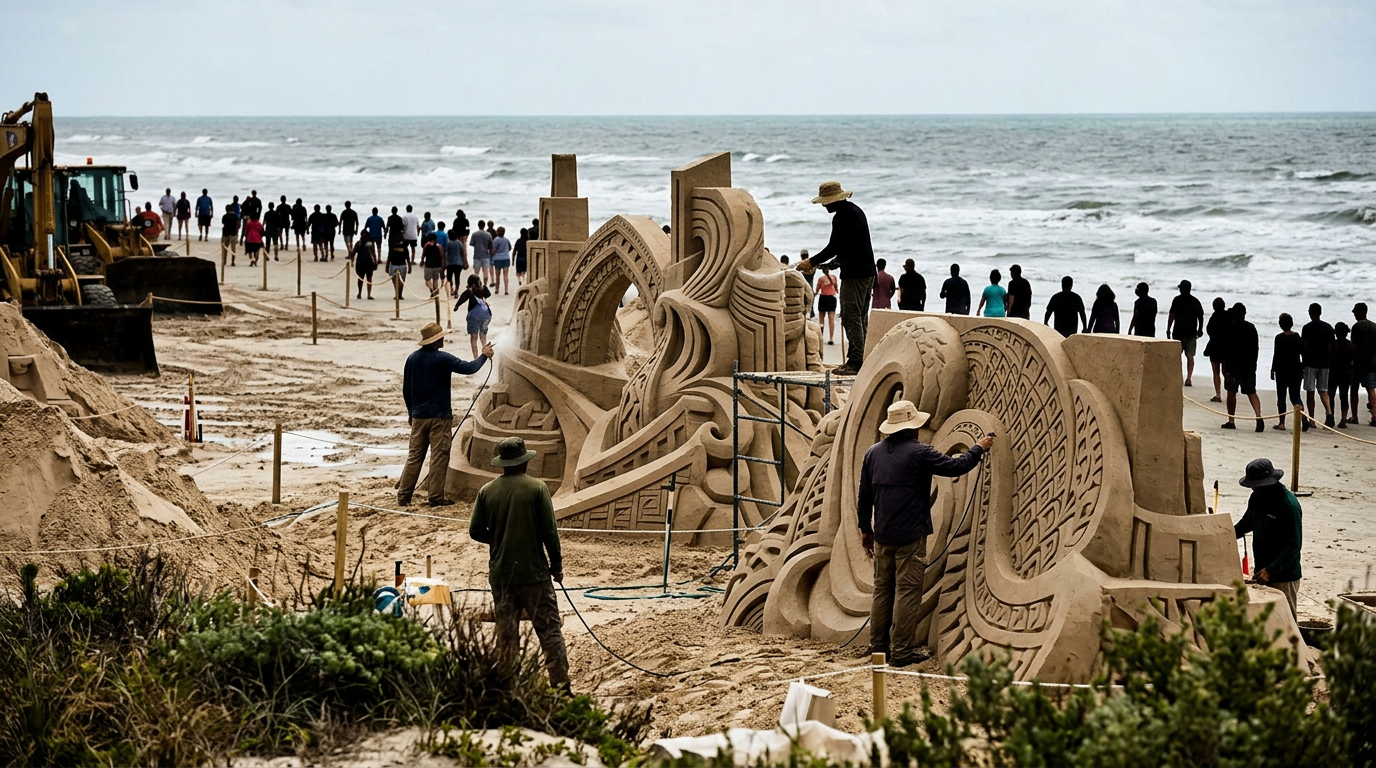
The quiet shores of Mustang Island undergo a dramatic transformation annually as Port Aransas hosts Texas SandFest, recognized as the premier professional sand sculpting competition in the United States. This event traces its roots back to 1997, beginning as a small-scale community gathering intended to draw a few visitors to the coastal town. Over the nearly three decades since its inception, the festival has evolved into a massive cultural phenomenon, attracting master sculptors from across the globe who compete for substantial prize money and international prestige. The competition is unique in its blending of rigorous technical engineering with delicate artistic expression, requiring participants to manipulate millions of grains of sand into gravity-defying structures. Historical context for SandFest is rooted in the long-standing tradition of Texas beach culture, where local communities have historically relied on seasonal tourism to drive the regional economy. Following the devastation of Hurricane Harvey in 2017, events like SandFest took on a renewed importance as symbols of coastal resilience and economic recovery for the Port Aransas area. Today, the festival serves as a non-profit organization that gives back to the community, donating hundreds of thousands of dollars to local charities and scholarship funds. The event stands as a testament to the specialized skills required to combat the volatile elements of the Gulf Coast, including shifting winds and unpredictable humidity levels that can make or break a sculptor's work.
Texas relevance
For Texans, SandFest represents a significant economic engine for the Coastal Bend region, pumping millions of dollars into local hotels, restaurants, and retail shops during the spring season. The event highlights the unique geographical features of the Port Aransas shoreline, where the specific composition of the sand—finer and more 'sticky' than that found on many Atlantic or Pacific beaches—provides the perfect natural medium for large-scale vertical construction. This makes Texas a premier destination for 'master' level sculptors who cannot achieve the same level of height or detail in other coastal environments. Additionally, the festival serves as a point of pride for the state, officially designated as the 'Texas State Sand Sculpting Championship' by the state legislature, ensuring that Port Aransas remains at the center of this niche global community.
The Science of High-Stakes Sand Sculpting
Professional sand sculpting is a grueling physical endeavor that relies as much on civil engineering as it does on artistic talent. Competitors don't just use buckets and spades; they utilize heavy-duty forms, also known as 'pounds,' which are stacked and filled with a mixture of sand and water. These forms are then compacted using mechanical vibrators or manual tamping tools to remove air pockets. This process creates a dense, rock-like block of sand that can be carved from the top down, a technique that distinguishes master sculptors from casual beachgoers who typically build from the bottom up.
The sand at Port Aransas is particularly prized because it is angular and fine, allowing the grains to lock together when wet. This 'silt' content is the secret ingredient for the massive towers and intricate figurines seen at SandFest. However, the coastal environment poses a constant threat. High humidity helps keep the structures together, but excessive heat can cause the sand to dry out too quickly, leading to catastrophic 'cave-ins' that can destroy hours of work in a heartbeat. Sculptors must constantly mist their creations with water to maintain the structural integrity of the outer shell.
Precision tools are the hallmark of the elite division. While a basic shovel is used for the initial move, the fine details are carved using specialized pallet knives, dental tools, and even soft brushes. Many artists spend months planning their designs, creating miniature clay models to study weight distribution before they ever set foot on the Texas sand. This level of preparation highlights the transition of the event from a mere exhibition into a rigorous discipline of temporary architecture.
Economic Impact on the Coastal Bend
Texas SandFest has grown to attract upwards of 100,000 visitors over a single weekend, creating a logistical challenge and a financial boon for the city of Port Aransas. The surge in population during the event week often exceeds the total residential count by a factor of twenty. This influx provides a vital cash injection for the local hospitality sector, ensuring that seasonal businesses can maintain operations throughout the year. The ripple effect extends to Corpus Christi and surrounding areas as hotel rooms in Port Aransas reach 100% occupancy months in advance.
Beyond the immediate tourism dollars, the event operates as a 501(c)(3) non-profit organization. This structure allows the festival to reinvest its proceeds back into the community. Since 2012 alone, the organization has donated over $1.5 million to local causes, including the Helping Hands Food Pantry, the Port Aransas ArtCenter, and various youth programs. This philanthropic angle is a key component of the festival’s identity, aligning the interests of the international artists with the needs of the local Texas permanent residents.
The festival also serves as a marketing platform for the Texas coast as a whole. Media coverage of the intricate sculptures reaches millions of viewers worldwide, showcasing the beauty of Mustang Island and the Gulf of Mexico. This exposure helps to diversify the state’s tourism brand, positioning the Texas coast as a destination for art and culture rather than just fishing and spring break revelry. The professional division of the contest is a major draw for photographers and videographers, creating a digital footprint that promotes the region long after the sculptures have been reclaimed by the tide.
Categories and Levels of Competition
Competition at SandFest is tiered to allow for everyone from toddlers to world-renowned masters to participate. The 'Master' level is by invitation only, featuring artists who travel from countries like the Netherlands, Canada, and Japan. These individuals compete in both solo and duo categories, often working on a single sculpture for three consecutive days. The stakes are high, with the 'Master’s Choice' and 'People’s Choice' awards carrying significant weight in the professional sculpting circuit.
Below the master level are the semi-pro and amateur divisions, which are divided by age groups and team sizes. The 'Guppy' and 'Youth' categories encourage local Texas students to develop an interest in the art form, providing them with a platform to learn from the best in the world. The 'Adult Amateur' categories are frequently populated by Texas families who have made the trek to Port Aransas a multi-generational tradition, often competing for local bragging rights and themed trophies.
The judging criteria are surprisingly strict, focusing on several key pillars: difficulty, detail, use of the entire sand pile, and 'wow factor.' Judges look for clean lines and smooth surfaces, which are notoriously difficult to maintain in a windy coastal environment. Any use of internal supports, such as rebar or wooden stakes, is strictly prohibited in the final sculpture. The structural integrity must be provided entirely by the sand and water mixture, making the finished products a marvel of physics.
Environmental Stewardship and Beach Management
Hosting an event of this magnitude on a public beach requires careful coordination with state and federal environmental agencies. The organizers of SandFest work closely with the Texas General Land Office (GLO) to ensure that the fragile dune systems are protected during the setup and execution of the festival. Foot traffic is strictly managed through designated boardwalks and paths to prevent the destruction of sea oats and other vegetation that stabilize the islands' natural defenses.
Waste management is another critical component of the festival's operations. With tens of thousands of visitors on the sand, the potential for litter to enter the Gulf of Mexico is high. The festival employs a 'leave no trace' philosophy, coordinating massive cleanup efforts each evening. Furthermore, once the competition concludes, the massive sculptures are flattened and the sand is returned to the beach. This ensures that the natural skyline of the coast is restored and that no artificial mounds remain to disrupt the nesting patterns of sea turtles or the movement of local wildlife.
Water usage is also a concern in the arid South Texas climate. The festival utilizes a sophisticated water distribution system to pipe water from the municipal supply out onto the sand, rather than drawing from the sea. This provides the sculptors with the clean, consistent moisture necessary for their work without introducing high levels of salt that could affect the curing process of the sand structures. This careful management of resources demonstrates how large-scale Texas events can coexist with delicate coastal ecosystems.
The Evolution of Sand Art Techniques
Over the years, the methods used at SandFest have shifted from simple hand-stacking to advanced architectural molding. In the early days, a sculpture might stand four feet tall and feature basic circular designs. Today, thanks to the introduction of 'compaction forms,' artists are creating works that reach heights of fifteen feet or more. These structures often feature 'negative space,' where the artist carves entirely through the block of sand, creating windows or floating elements that appear to defy gravity.
The tools have also undergone a revolution. While kitchen spatulas were once the gold standard, modern Texas masters often use tools originally designed for clay pottery or automotive body repair. Some even use brushes made from exotic animal hair to achieve a specific texture on the sand's surface. The use of biodegradable 'wind spray'—a mixture of water and environmentally friendly glue—has become a standard practice to protect the finished surface from the abrasive Texas wind, which can strip away fine details in a matter of minutes.
Despite these technological advances, the core of the craft remains deeply manual. The physical toll on the artists is immense; a three-day competition involves hundreds of pounds of sand being moved by hand under the relentless Texas sun. Dehydration and muscle fatigue are constant threats, requiring the artists to be in peak physical condition. This blend of physical labor and delicate artistry is what continues to captivate the thousands of Texans who line the fences each year to watch the process unfold.
Analysis
While often viewed as a whimsical pastime, the professionalization of sand sculpting at SandFest reflects a broader trend in Texas tourism toward high-concept, specialized events that offer more than just a typical beach experience. By elevating a childhood activity into a high-stakes competition involving heavy machinery and precision tools, Texas has cornered a specific market in the travel industry. This evolution from a local hobbyist meetup to an international sanctioned event mirrors the growth of other Texas-specific industries that leverage natural resources for cultural gain. From a conservative economic perspective, SandFest is a model for regional self-sustainability, using local natural assets to fund municipal services and non-profit initiatives without relying solely on state tax revenue.
Source attribution
This story was reported using a public release from the Texas Monthly. Keep TX Red rewrote the coverage independently and links to the official statement for verification.
Frequently Asked Questions
- Where exactly does Texas SandFest take place?
- The event is held on the beach in Port Aransas, Texas, specifically between Mile Markers 9 and 13 on Mustang Island along the Gulf of Mexico.
- Can anyone participate in the competition?
- Yes, while the 'Master' category is invitation-only, there are several divisions for amateurs, including categories for children (Guppy), teens (Youth), and adults at various skill levels.
- What happens to the sculptures after the event ends?
- To comply with environmental regulations and beach safety, all sculptures are traditionally flattened and the sand is leveled back into the beach shortly after the festival concludes.
- How long do the artists have to complete their work?
- For the professional master class, artists typically have three days to complete their carvings, often working from sunrise to sunset in the coastal elements.
Official Sources
Take the next step
Browse the Newsroom →Read more about Keep Texas Red → Our full guide to what Keep Texas Red means and why Texans support it.
Related Articles
Get Texas updates delivered weekly.
Independent Texas reporting on politics, policy, and daily life. One email a week. Unsubscribe anytime.
Keep TX Red Newsroom
The Keep Texas Red Editorial Staff produces nonpartisan explainers, policy breakdowns, and educational resources to help Texans understand how their government works. All content is reviewed for accuracy and updated regularly.
About Keep TX Red →