Texas Investigative Journalism and the High Stakes of True Crime Reporting
A look at the professional challenges Texas journalists face when confronted by manipulative subjects in the pursuit of long-form justice reporting.
Editorial disclaimer: Opinions and analysis on Keep TX Red are editorial content — not statements of fact. See our editorial standards.
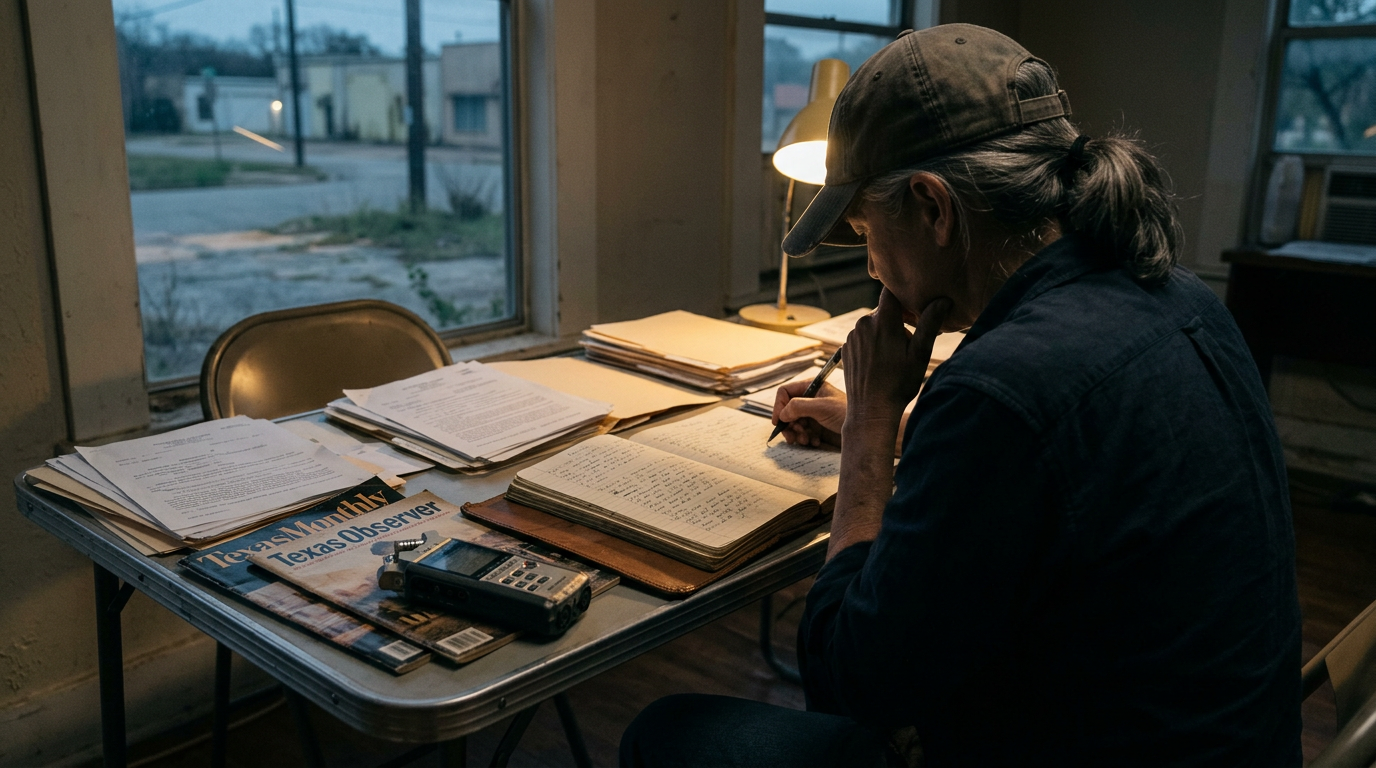
The landscape of Texas investigative journalism often involves deep dives into the state's most complex and harrowing criminal cases. Long-form reporting in the Lone Star State has a storied history of overturning wrongful convictions and exposing systemic failures within various county courtrooms. However, the process of uncovering the truth is fraught with professional hazards, particularly when reporters must build relationships with individuals who have a history of manipulation and deceit. Veteran Texas investigator Pamela Colloff recently highlighted these risks while recounting her years-long engagement with a subject who eventually revealed himself to be a master of fabrication. This case serves as a cautionary tale for the media industry across the Southwest, emphasizing that even the most meticulous researchers are not immune to the charms of a dedicated fraudster. Historically, Texas has been a fertile ground for true crime narratives that spark national conversation. From the early days of courthouse reporting in small rural towns to the sophisticated digital forensics used today, the goal has remained consistent: to provide a voice for those silenced by the system. The challenge arises when the person claiming to be a victim of that system is actually an architect of their own elaborate deception. Colloff’s experience, which spans several years of correspondence and research, underscores a growing concern in the media regarding the psychological toll and professional risks associated with long-term investigative projects. It reminds the public that the pursuit of justice is rarely a straight line and often involves navigating a maze of conflicting testimonies and intentional misdirection.
Texas relevance
Texas has long been a hub for high-stakes investigative reporting, with publications like Texas Monthly and the Texas Observer setting a national standard for long-form storytelling. The state's large and diverse legal landscape, encompassing 254 counties each with its own judicial nuances, provides endless material for journalists. When a prominent Texas reporter faces a breach of trust from a source, it impacts the entire regional media ecosystem, leading to stricter vetting processes and a more skeptical approach to source development. This specific instance involving Colloff highlights the vulnerabilities present within the Austin-based literary and journalistic communities, where the drive to find the next significant Texas story can sometimes lead down dangerous paths.
The Evolution of Lone Star Investigative Narratives
Texas has provided some of the most enduring stories in the history of American journalism. The state's unique combination of frontier history, rapid urbanization, and a robust legal system creates a environment where 'larger-than-life' characters are common. Investigative reporters in Texas often find themselves acting as amateur detectives, combing through decades of paper trails in satellite courthouses from El Paso to Beaumont. This culture of deep-dive reporting has led to significant policy changes and the exoneration of the innocent, but it also creates a vacuum that sophisticated con artists are eager to fill.
The relationship between a reporter and a source is built on a delicate balance of empathy and skepticism. In the Texas media market, building trust often requires months of face-to-face meetings, shared meals, and continuous communication. This proximity is necessary for extraction of deep detail but serves as the perfect cover for a fraudster. The subject in question utilized this inherent professional trust to weave a narrative that aligned perfectly with the tropes of a wrongful conviction story, which is a powerful and frequently successful genre in Texas literature.
Challenges in Verifying Lived Experience
Verifying a subject's personal history becomes exponentially more difficult when the records themselves are decades old or located in jurisdictions with limited digital archives. In rural parts of Texas, paper records are still the norm, and the destruction of files due to age or environmental factors is a common obstacle. A skilled manipulator knows these gaps in the official record and fills them with believable, though entirely fabricated, events. This allows them to create a persona that is legally and historically consistent on the surface, making it difficult for even a seasoned investigator to spot the cracks.
Furthermore, the psychological element of the 'con' cannot be understated. Fraudsters often target individuals who possess a strong sense of justice or a desire to right a perceived wrong. By positioning themselves as the victim of a corrupt or incompetent system—a narrative that resonates strongly with many Texans—these individuals gain an emotional foothold that bypasses a reporter's typical logical defenses. The fallout from such a deception is not just personal embarrassment for the writer, but a potential loss of credibility for the publication and a disservice to actual victims of injustice.
The Impact on Texas Legal Reform Efforts
Journalism plays a critical role in the Texas legislative process, often serving as the catalyst for new laws regarding evidence handling, witness testimony, and sentencing guidelines. When a high-profile story is revealed to be based on deception, it provides ammunition for those who oppose criminal justice reform. Critics may argue that if a top-tier journalist can be fooled, then the entire premise of pursuing innocence claims is flawed. This creates a ripple effect that can stall important bipartisan efforts in the Texas House and Senate to improve the reliability of the state's conviction process.
To mitigate these risks, many Texas newsrooms are beginning to implement more rigorous psychological vetting and tiered verification systems. These protocols involve bringing in 'cold' sets of eyes—editors or other reporters who have no personal connection to the source—to review the findings at various stages of the project. While this adds time and expense to already strained budgets, the cost of being wrong in a state as litigious and politically polarized as Texas is simply too high. The goal is to protect the integrity of the story while maintaining the human element that makes Texas long-form reporting so impactful.
Redefining Success in Long-Form Projects
For many years, the success of an investigative piece in Texas was measured by its ability to secure a release from prison or a change in law. However, the experience of reporters like Pamela Colloff suggests a need to redefine success. Sometimes, the most important story is not the one the reporter set out to tell, but rather the story of the investigation itself. By documenting the process of being deceived, a journalist provides a different kind of public service: an education on the mechanics of fraud and the persistence of falsehood.
This shift in perspective reflects a broader trend in the 'meta-narrative' of Texas media. Audiences are becoming increasingly interested in the 'how' and 'why' of reporting, rather than just the final result. In a state that prides itself on plain-speaking and common sense, this transparency is welcomed. It allows the reader to see the guardrails of the profession and understand that the truth is something that must be fought for, often against individuals who have spent their entire lives training to obscure it.
The Future of Texas True Crime Reporting
Despite the risks, the appetite for true crime and investigative narratives in Texas shows no sign of waning. The state's unique identity continues to produce complex cases that demand deep scrutiny. New technologies, such as AI-driven document analysis and advanced social mapping, are providing journalists with new tools to verify claims. However, these tools are ultimately supplements to, not replacements for, the human intuition and local knowledge that defines Texas reporting. The key for the next generation of Texas journalists will be balancing these technological advantages with the hard-earned lessons of their predecessors.
The legacy of this specific incident will likely be a renewed focus on the 'slow journalism' movement. In a world of instant gratification and 24-hour news cycles, the ability to take years to track a single story is a luxury that comes with great responsibility. By acknowledging the failures and the successes of these long-term projects, the Texas media community can continue to serve as a vital check on power, provided they remain vigilant against the very subjects they seek to understand.
Analysis
Opinion: The vulnerability of investigative journalists is a topic rarely discussed in the public sphere, as reporters are expected to be stalwart guardians of the truth. Colloff's willingness to admit to being duped is a rare moment of transparency that actually strengthens the integrity of the profession. In an era where 'fake news' is a common accusation, seeing a seasoned professional admit to the difficulty of discerning fact from fiction in real-time reinforces the necessity of rigorous, multi-layered verification. It also highlights a broader societal trend where charismatic individuals can exploit the institutional desire for a compelling narrative, a warning that applies as much to voters and jurors as it does to journalists.
Source attribution
This story was reported using a public release from the Texas Monthly. Keep TX Red rewrote the coverage independently and links to the official statement for verification.
Frequently Asked Questions
- Who is Pamela Colloff?
- Pamela Colloff is a renowned investigative journalist based in Texas, known for her award-winning work at Texas Monthly and ProPublica. She has a reputation for deeply researched stories that often focus on wrongful convictions and flaws in the criminal justice system.
- How does a fraudster manage to deceive a professional reporter?
- Professional fraudsters often use 'social engineering' to build trust over long periods. They provide just enough verifiable truth to make their lies plausible and often play into the reporter's natural empathy or desire to uncover a significant injustice.
- What is the impact of such deceptions on the public's trust in media?
- While these incidents can initially harm a publication's reputation, transparently reporting on how the deception occurred can actually build long-term trust. It shows that the organization values the truth over its own ego and is committed to correcting the record.
Official Sources
Take the next step
Browse the Newsroom →Read more about Keep Texas Red → Our full guide to what Keep Texas Red means and why Texans support it.
Related Articles


Get Texas updates delivered weekly.
Independent Texas reporting on politics, policy, and daily life. One email a week. Unsubscribe anytime.
Keep TX Red Newsroom
The Keep Texas Red Editorial Staff produces nonpartisan explainers, policy breakdowns, and educational resources to help Texans understand how their government works. All content is reviewed for accuracy and updated regularly.
About Keep TX Red →