Houston Texans All-Time Defense: Analysts Name the Ultimate Defenders
Houston analysts debate the best defensive lineup in franchise history during a competitive snake-style draft event for Texans fans.
Editorial disclaimer: Opinions and analysis on Keep TX Red are editorial content — not statements of fact. See our editorial standards.
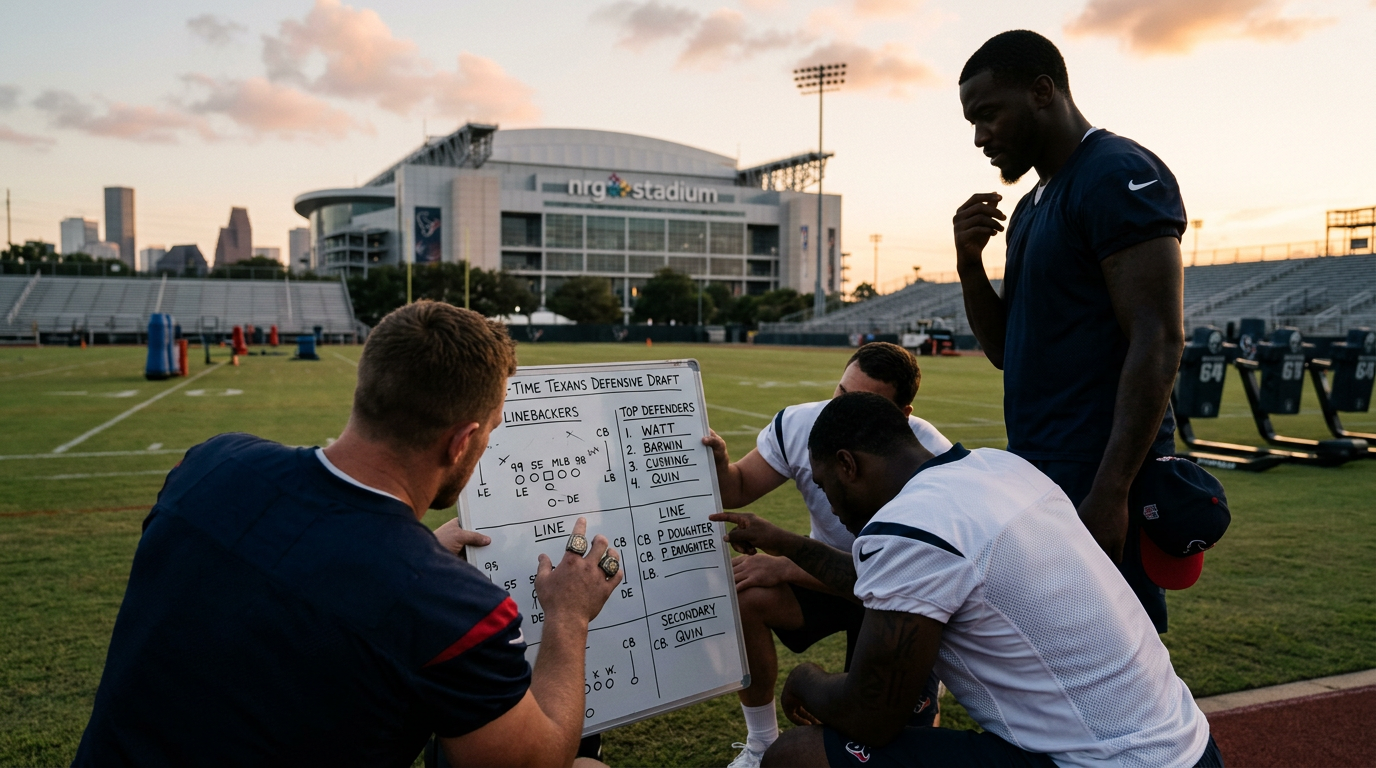
The history of the Houston Texans franchise is often defined by its dominant defensive anchors, and current team analysts recently took a deep dive into that legacy. During a special installment of Texans All-Access, Marc Vandermeer, John Harris, and Sean Pendergast engaged in a snake-style draft to construct the most formidable defensive unit possible using only former and current Houston players. This exercise serves as a historical retrospective on how the franchise has prioritized defensive talent since its inception in 2002. Texas football culture has long prized aggressive, physical defensive play, and the Texans’ front office has historically mirrored this by selecting generational talents in the early rounds of the NFL Draft. The analysts were tasked with making strategic selections across all defensive positions, including the defensive line, linebackers, and the secondary. The draft format meant that once a legend like J.J. Watt was off the board, the remaining participants had to scramble to find high-value alternatives from different eras of the team's history. This event highlights the depth of the Houston defensive catalog, which spans from the early days of expansion struggles to the recent AFC South championship runs. By comparing the statistical peaks of various players, the panel provided fans with a masterclass in Houston football history while sparking a debate on which defensive philosophy—the 3-4 scheme of the Wade Phillips era or the modern aggressive front—reigned supreme.
Texas relevance
As the premier NFL franchise in the nation's fourth-largest city, the Houston Texans hold a massive cultural footprint across Southeast Texas. Discussions regarding the team's all-time defensive greats resonate deeply with a local fanbase that has seen the team's identity shift through multiple coaching regimes. The Texans are a central pillar of the Houston sports economy, and their defensive stars have often become philanthropic leaders within the Texas community. Understanding the history of these players provides context for the current direction of the team under the leadership of a former defensive star who has returned as head coach.
The Evolution of Houston’s Defensive Identity
In the early 2000s, the Houston Texans began their journey as an expansion team with a focus on building from the ground up. This meant a heavy reliance on foundational defensive pieces who could withstand the pressure of playing for a new organization. Over the last two decades, that identity has transitioned from a grit-based survival mode into a powerhouse system that has consistently produced NFL Defensive Player of the Year candidates. The analysts highlighted how the franchise has successfully transitioned through various defensive schemes, ranging from conservative coverages to high-pressure blitz packages.
The draft served as a reminder that Houston has been a destination for some of the most versatile pass rushers in the sport. Players selected in this exercise weren't just chosen for their sack totals, but for their ability to lead on and off the field. This leadership has been a consistent thread in Texas football, where the defensive captain is often seen as the face of the organization. The discussion during the event mirrored the passion seen in local coffee shops and sports bars across Harris County, where fans routinely debate the merits of different eras.
Strategic Selections on the Defensive Line
Unsurprisingly, the defensive line was the most contested area of the draft. The analysts recognized that without a strong push at the line of scrimmage, even the best secondary in the world would struggle. The discussion centered on players who could disrupt the pocket and shut down the run, which is a necessity in the often physical AFC South division. Key names from the mid-2010s dominated the early rounds, illustrating just how much talent was concentrated during the team's peak defensive years.
Selecting interior linemen versus edge rushers proved to be a strategic hurdle for the participants. In the context of Houston’s history, some linemen provided more than just statistics; they provided a 'swagger' that defined the entire city’s view of the team. The analysts debated the longevity of certain players against the high-peak performance of others, acknowledging that some of the most impactful defensive ends in team history had shorter windows of dominance but higher ceilings of production.
The Linebacker Tradition in Houston
The linebacker position has always been a point of pride for the Texans. From the franchise’s first-ever draft pick to the stars of the current era, the middle of the Houston defense has often been occupied by high-IQ players who act as the 'quarterback' of the defense. During the All-Access draft, the participants looked for linebackers with 'sideline-to-sideline' speed, a trait that has become increasingly important in the modern, pass-heavy NFL.
Local fans often remember the linebackers who played through injuries and represented the tough-as-nails Houston work ethic. The analysts weighed the value of outside linebackers who could drop into coverage against those who were pure pass-rushing threats. This section of the draft revealed the depth of the Texans' scouting department over the years, as many of the top linebacker targets were found outside of the top five picks, showing a keen eye for developmental talent in the Lone Star State.
Constructing an Elite Secondary
While the front seven often gets the glory, the analysts spent significant time debating the secondary. Finding cornerbacks and safeties who could hold up against the elite receivers of the AFC was no easy task. The participants looked for defensive backs who were known as 'ball hawks'—those who could flip the field with a single interception. In the history of the Texans, the secondary has often been the final piece of the puzzle that elevated the team from a contender to a champion.
The transition from the 'Legion of Boom' era of the NFL to the current high-flying offenses has changed what teams look for in a safety. The analysts discussed how certain Houston safeties from the late 2000s would far in today's game. They also touched upon the importance of local fan favorites who might not have had national recognition but were instrumental in keeping the Texans competitive during rebuilding years. The secondary selections emphasized speed and the ability to operate in man-to-man coverage.
The Impact of Coaching on Player Legacy
A recurring theme throughout the draft was the influence of legendary defensive coordinators. The analysts noted that many of the drafted players achieved their 'all-time' status while playing under specific systems that maximized their unique skill sets. This led to a broader discussion about how the current coaching staff, led by defensive-minded individuals, is looking to the past to build the future. The philosophy of the 'H-Town' defense is rooted in the success of the names being called in this mock draft.
For Texas sports fans, the coach-player relationship is a vital part of the story. The analysts explored how certain players were 'drafted' into this exercise specifically because they were viewed as extensions of the coaching staff on the field. This tactical advantage is something the Texans are currently trying to replicate. By examining these historical pairings, the analysts provided a roadmap of what a championship-caliber Houston defense must look like in terms of both personnel and leadership.
Fan Engagement and the Future of the Franchise
This draft was more than just a trip down memory lane; it was a way to engage a fanbase that is hungry for a return to defensive excellence. By celebrating the 'all-time' greats, the team connects the older generation of fans who remember the 2002 inaugural season with the younger generation who grew up during the playoff runs of the 2010s. The analysts encouraged fans to build their own rosters and share them, creating a community-wide dialogue about the team’s values.
As the Texans move forward, the defensive standard set by the players in this draft remains the benchmark for success. The organization continues to honor its alumni while looking for the next J.J. Watt or DeMeco Ryans in the upcoming draft cycles. These types of media events ensure that the history of Texas football is never forgotten, even as the team writes its next chapter. It reinforces the idea that in Houston, defense isn't just a phase of the game—it is the soul of the franchise.
Analysis
The competitive nature of this mock draft underscores a fascinating reality for the Houston Texans: despite being a relatively young franchise compared to the Cowboys or Steelers, their 'top shelf' defensive talent is elite by any NFL metric. The decision to include analysts like Pendergast and Vandermeer adds a layer of institutional memory that many fans appreciate. It also serves as a subtle validation of the current roster construction; by evaluating past greats, the analysts are setting the bar for current players like Will Anderson Jr. to earn their way onto future all-time lists. This exercise essentially celebrates the 'Bull on Parade' identity that successfully bonded the team to the city during its most successful seasons.
Source attribution
This story was reported using a public release from the Houston Texans. Keep TX Red rewrote the coverage independently and links to the official statement for verification.
Frequently Asked Questions
- What is a snake-style draft?
- In a snake draft, the order of picks reverses each round. For example, the person who picks last in the first round gets the first pick in the second round, ensuring a fair distribution of top-tier talent among all participants.
- Which players were eligible for this Texans all-time draft?
- Any player who has appeared on the Houston Texans defensive roster since the team's inception in 2002 was eligible for selection by the analysts.
- Who were the participants in the draft?
- The draft featured Marc Vandermeer (the Voice of the Texans), John Harris (football analyst), and Sean Pendergast (sports radio host and analyst).
- Why is the Texans' defense considered so important to the franchise history?
- Historically, the Texans have achieved their greatest successes when led by elite defensive units. Most of the franchise's legendary players and several of its most successful seasons were built on the back of top-ranked defenses.
Official Sources
Take the next step
Browse the Newsroom →Read more about Keep Texas Red → Our full guide to what Keep Texas Red means and why Texans support it.
Related Articles


Get Texas updates delivered weekly.
Independent Texas reporting on politics, policy, and daily life. One email a week. Unsubscribe anytime.
Keep TX Red Newsroom
The Keep Texas Red Editorial Staff produces nonpartisan explainers, policy breakdowns, and educational resources to help Texans understand how their government works. All content is reviewed for accuracy and updated regularly.
About Keep TX Red →