Texas Feral Hog Crisis: Agricultural Losses Mount Amid Record Population Surge
Texas faces a massive feral hog population spike, causing millions in agricultural damage and threatening ecosystems across the Lone Star State.
Editorial disclaimer: Opinions and analysis on Keep TX Red are editorial content — not statements of fact. See our editorial standards.
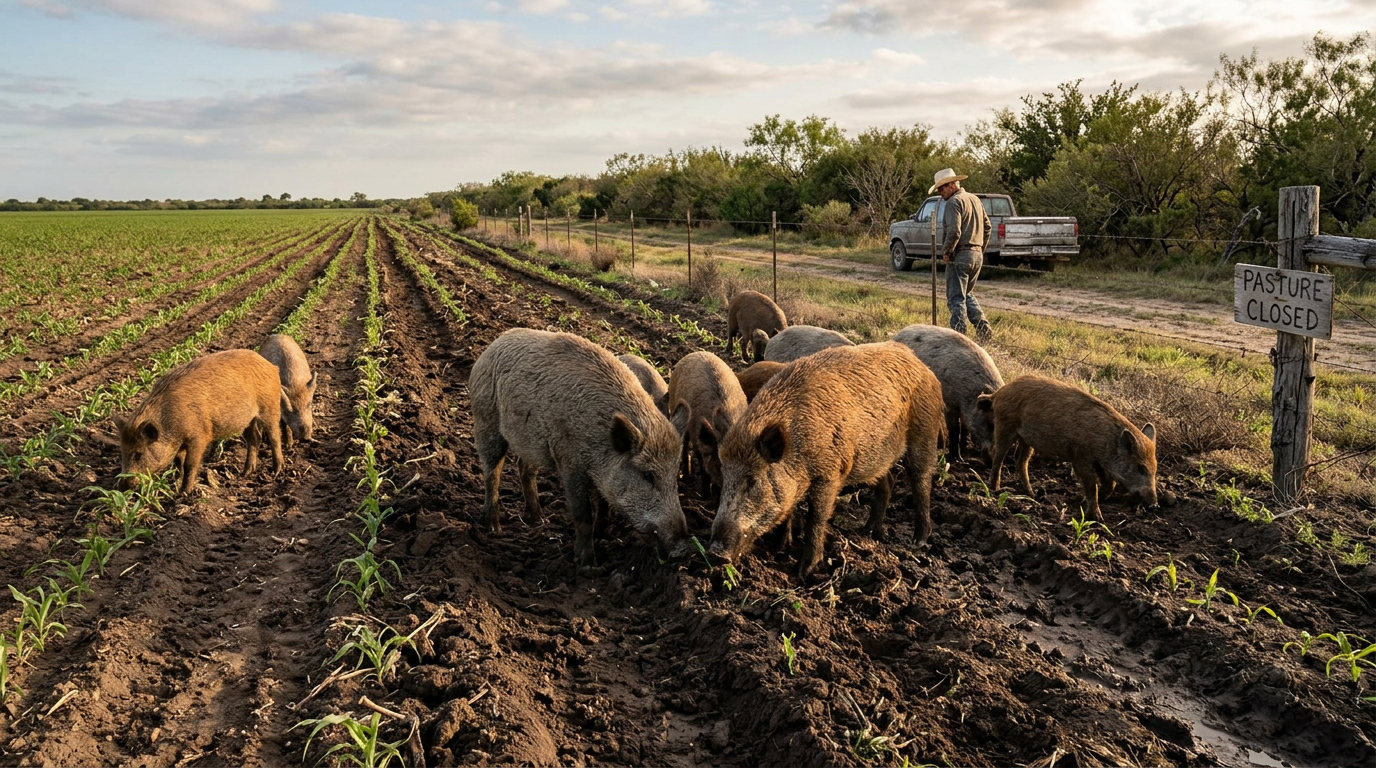
Texas is currently grappling with an escalating feral hog crisis that has reached unprecedented levels, particularly affecting rural and agricultural corridors like those near Victoria and the Gulf Coast. These invasive swine, which were first introduced to the continent centuries ago by explorers and later escaped from domestic stocks, have evolved into a resilient and prolific threat to the state's ecological stability. Historically, Texas has attempted various mitigation strategies, from aerial hunting to trapping, yet the population continues to swell at an alarming rate that far outpaces current removal efforts. Recent reports indicate that the damage to local infrastructure, crops, and residential landscaping is surfacing as a primary concern for local municipalities and state agencies alike. Today, the feral hog population in Texas is estimated to be in the millions, with some experts suggesting that at least 70% of the population must be removed annually just to keep numbers stagnant. The pigs are highly adaptable, capable of thriving in various climates ranging from the dense brush of South Texas to the piney woods of East Texas. As they move into suburban neighborhoods, the conflict between humans and wildlife has intensified, leading to a demand for more aggressive state intervention and funding for eradication programs. This biological invasion is no longer just a nuisance for farmers; it has become a significant economic drain on the entire state economy.
Texas relevance
The feral hog issue is a uniquely Texan struggle, as the state holds approximately half of the entire United States feral hog population. In regions like Victoria and surrounding counties, the impact is felt daily by ranchers who see their pastures destroyed and by city planners who must account for damage to public parks and water sources. Since 2011, Texas law has become increasingly permissive regarding the taking of feral hogs, even allowing for hunting from helicopters and hot air balloons, reflecting the desperation of state officials to protect Texas soil and biodiversity from this invasive threat.
Economic Toll on the Lone Star State
The financial burden imposed by feral hogs on Texas agriculture is staggering. Current estimates suggest that these animals cause over $500 million in damages annually across the state. This includes the direct destruction of crops such as corn, grain sorghum, and rice, as well as the indirect costs associated with repairing equipment damaged by rooted-up soil. Farmers in the Victoria area often report that a single sounder of hogs can destroy an entire field in a matter of hours, leaving behind a moonscape of holes and ridges that make harvesting nearly impossible.
Beyond crop loss, the livestock industry face unique hurdles. Hogs compete with cattle for forage and have been known to prey on young calves, lambs, and goats. Furthermore, they act as vectors for various diseases, including pseudorabies and swine brucellosis, which pose a continuous threat to domestic livestock populations. The cost of maintaining high-quality fencing to keep these intruders out has also skyrocketed, adding an additional layer of overhead for Texas producers already struggling with fluctuating market prices and drought conditions.
Infrastructure damage is the next frontier of this economic crisis. As hogs migrate toward urban fringes, they are increasingly targeting golf courses, cemeteries, and suburban lawns. In these settings, the cost of repair is significantly higher per square foot than on agricultural land. Cities are being forced to allocate taxpayer dollars toward professional trapping services and the restoration of public parks, diverting funds from other essential community services to combat a problem that seems to have no end in sight.
The Biological Advantage of Invasive Swine
One of the primary reasons feral hogs are winning the war in Texas is their incredible reproductive capacity. Unlike many native species, feral hogs can begin breeding at just six to eight months of age. A single sow can produce two litters per year, with each litter averaging between four and eight piglets. This exponential growth rate means that even aggressive localized trapping efforts can be neutralized within a single breeding season if the surrounding areas are not similarly managed.
Their physical hardiness further complicates eradication efforts. Feral hogs are opportunistic omnivores, meaning they can survive on almost anything, including roots, fruits, insects, small mammals, and carrion. This versatility allows them to survive harsh Texas winters and long periods of heat and drought that might diminish other wildlife populations. Their thick hides and aggressive nature also mean they have very few natural predators in the Texas landscape once they reach adulthood.
The intelligence of these animals shouldn't be underestimated. Feral hogs are highly social and exhibit advanced learning behaviors. Trapping programs often find that 'trap-shy' hogs will avoid any structure that has previously captured a member of their sounder. This creates a selective pressure where the smartest and most elusive animals survive and reproduce, essentially breeding a more difficult-to-catch generation of hogs with every passing year.
Environmental Degradation and Water Quality
The environmental impact of feral hogs extends far beyond the visible scars on the landscape. One of the most significant concerns for Texas environmental agencies is the degradation of water quality in creeks and rivers. Hogs prefer to congregate near water sources, where they wallow in the mud to regulate their body temperature. This behavior leads to increased sedimentation, shoreline erosion, and the introduction of harmful bacteria like E. coli into the watershed.
Native wildlife also suffers as a result of hog proliferation. The hogs are direct competitors with white-tailed deer and wild turkeys for food sources like acorns and pecans. Furthermore, their rooting behavior destroys the nests of ground-nesting birds and can wipe out populations of rare plants and amphibians. In many parts of Texas, the ecological balance is being fundamentally altered as hogs become the dominant species, squeezing out the biodiversity that makes the Texas wilderness unique.
The destruction of the soil's top layer also affects the long-term health of Texas rangelands. By stripping away vegetation and churning up the earth, hogs accelerate topsoil loss during heavy rains. This not only ruins the land for future grazing but also results in the loss of native seed banks, allowing harder, invasive weed species to take root in the disturbed soil. The damage is a cumulative process that could take decades to reverse, even if the hog population were controlled today.
State Response and Legal Framework
In response to the growing threat, the Texas Legislature has consistently worked to remove barriers for those looking to eliminate feral hogs. Texas is one of the few states that allows for the 'taking' of feral hogs year-round with no bag limits. In recent years, laws have been adjusted to allow for the use of suppressors, night vision equipment, and even remote-activated traps. The 'Pork Chopper' law, which legalized aerial hunting from helicopters for hire, transformed a nuisance into a niche tourism industry, though its impact on the total population remains debated.
State agencies like the Texas Parks and Wildlife Department (TPWD) and the Texas A&M AgriLife Extension Service provide extensive resources to landowners. These programs focus on educating the public on the most effective trapping techniques, such as the use of large corral traps that can capture an entire sounder at once. However, these agencies are often limited by budget constraints and the sheer scale of the 254 counties they must cover. There is a growing call for a more centralized, state-funded bounty program or increased subsidies for professional eradication teams.
The ethical and safety considerations of large-scale eradication are also part of the state's deliberations. While the desire to use toxic baits has been discussed, the potential for secondary poisoning of native species like vultures or predators has led to significant regulatory hurdles. Currently, mechanical removal—trapping and shooting—remains the primary and most culturally accepted method of control in Texas, despite the logistical challenges it presents on such a massive scale.
Future Outlook: Can Texas Win?
Looking ahead, the future of the Texas landscape depends on a coordinated and technological approach to hog management. Innovations like cellular-connected traps allow landowners to monitor activity from their smartphones and drop gates only when the highest number of animals are inside. This precision is necessary to combat the animals' intelligence. Furthermore, drone technology is starting to play a larger role in tracking sounders across vast, inaccessible terrains, providing hunters and trappers with real-time intelligence on hog movements.
However, technology alone is not a silver bullet. The solution likely requires a cultural shift among Texas landowners to view hog management as a collective responsibility rather than an individual burden. Cooperative management areas, where multiple neighbors coordinate their trapping and hunting schedules, have shown the most promise in reducing local populations significantly. Without this type of large-scale cooperation, individual efforts often result in simply pushing the hogs from one ranch to the next.
Ultimately, the feral hog crisis is a test of Texas's ability to protect its agricultural heritage and natural beauty. As the human population of Texas continues to boom and expand into previously rural areas, the interface between people and hogs will only grow. If the state cannot find a way to tip the scales in the next decade, the economic and environmental costs may become a permanent tax on the prosperity of the Lone Star State, fundamentally changing the character of the Texas outdoors for generations to come.
Analysis
The inability to curb the feral hog population highlights a significant challenge in modern wildlife management: the limits of private property solutions for a statewide problem. While Texas prides itself on strong private property rights, the nomadic nature of these animals means that if one landowner ignores the problem, the entire neighborhood suffers. We may be approaching a point where the state must transition from a 'voluntary removal' model to a more subsidized, industrial-scale eradication strategy. The economic cost of inaction—estimated in the hundreds of millions annually—far outweighs the potential cost of a coordinated, state-led offensive against this invasive species.
Source attribution
This story was reported using a public release from the Texas Wildlife Stories (Google News). Keep TX Red rewrote the coverage independently and links to the official statement for verification.
Frequently Asked Questions
- Do I need a hunting license to kill feral hogs in Texas?
- As of recent legislative changes in Texas, a hunting license is not required for a landowner or their agent to take feral hogs on their property if they are causing damage. However, it is always recommended to check the most current Texas Parks and Wildlife regulations, especially if you are hunting on public lands or as a guest on someone else's property.
- Why is it so hard to get rid of feral hogs?
- Feral hogs have several biological advantages including a rapid reproductive cycle, few natural predators, and a high level of intelligence. They quickly learn to avoid traps and can survive in almost any environment, making it nearly impossible to eliminate them without a coordinated, large-scale effort that spans multiple counties.
- Can you eat feral hog meat?
- Yes, feral hog meat is edible and often described as being leaner and more flavorful than domestic pork. However, hunters should take precautions as feral hogs can carry diseases like swine brucellosis. It is essential to wear gloves when field dressing the animals and to ensure the meat is cooked to an internal temperature of at least 160°F to kill any potential pathogens.
Official Sources
Take the next step
Browse the Newsroom →Read more about Keep Texas Red → Our full guide to what Keep Texas Red means and why Texans support it.
Related Articles
Get Texas updates delivered weekly.
Independent Texas reporting on politics, policy, and daily life. One email a week. Unsubscribe anytime.
Keep TX Red Newsroom
The Keep Texas Red Editorial Staff produces nonpartisan explainers, policy breakdowns, and educational resources to help Texans understand how their government works. All content is reviewed for accuracy and updated regularly.
About Keep TX Red →