Exploring Palo Duro Canyon: How the Grand Canyon of Texas Defines the High Plains
Discover the history and beauty of Palo Duro Canyon, the nation's second-largest canyon located right in the heart of the Texas Panhandle.
Editorial disclaimer: Opinions and analysis on Keep TX Red are editorial content — not statements of fact. See our editorial standards.
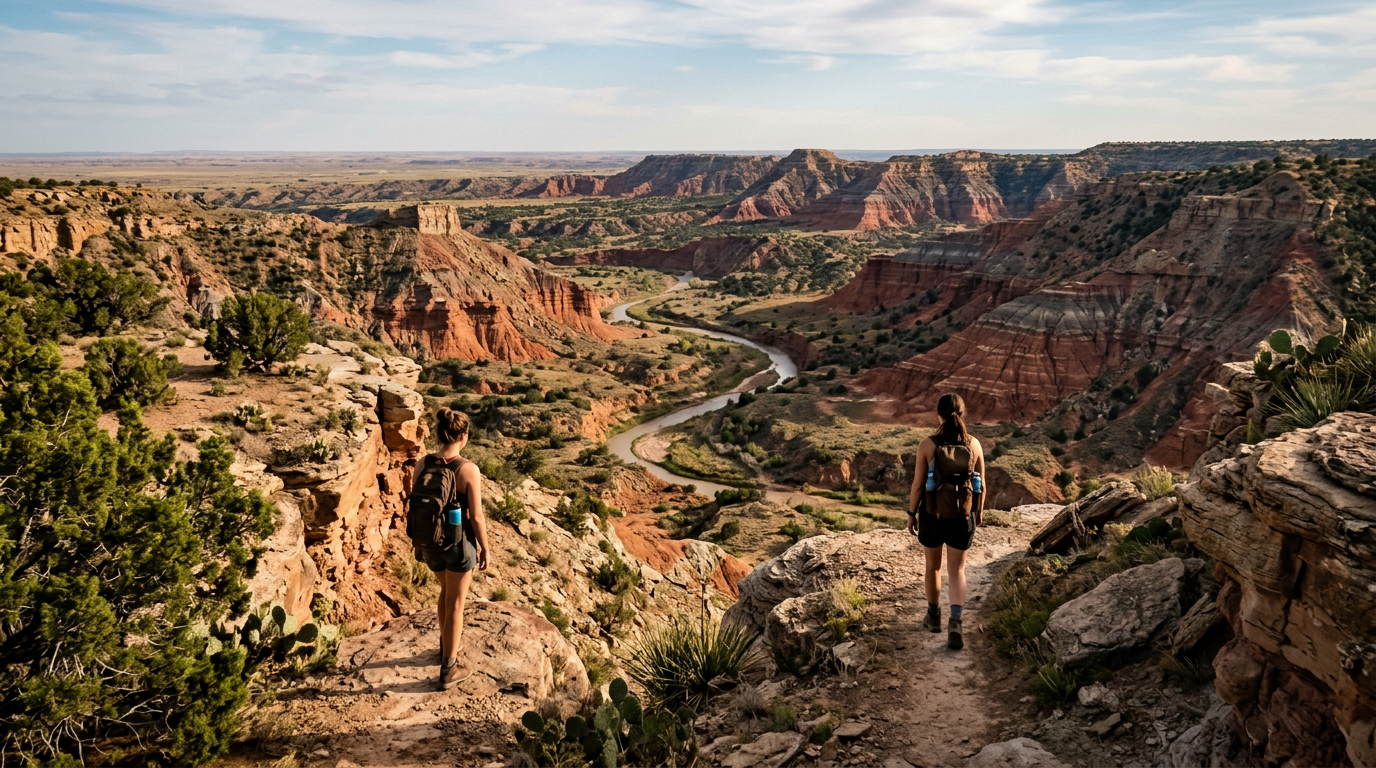
Palo Duro Canyon State Park stands as a massive geological landmark in the Texas Panhandle, often referred to as the 'Grand Canyon of Texas' due to its status as the second-largest canyon system in the United States. Spanning approximately 120 miles in length and reaching depths of up to 800 feet, the canyon offers a stark, colorful contrast to the flat plains of the surrounding Llano Estacado. This natural wonder was carved over millions of years by the Red River’s Prairie Dog Town Fork, exposing multicolored layers of shale and sandstone that date back to the Triassic and Permian periods. Historically, the canyon served as a vital sanctuary for Native American tribes, including the Comanche and Kiowa, before becoming a focal point of the Red River War in the 1870s. The park's current infrastructure and accessibility are largely the result of the Civilian Conservation Corps (CCC) efforts during the 1930s. Workers during the Great Depression built the original roads, bridges, and cabins that allow modern visitors to descend from the rim to the canyon floor safely. Today, the site remains one of the most visited locations in the Texas State Park system, drawing hundreds of thousands of guests annually for activities ranging from rugged hiking to the famous 'Texas' outdoor musical. Its preservation represents a significant victory for Texas conservationists who sought to protect the unique biodiversity of the High Plains from encroaching agricultural and industrial development during the early 20th century.
Texas relevance
As a cornerstone of the Texas Parks and Wildlife Department's portfolio, Palo Duro Canyon is a primary driver of the regional economy for Amarillo and the greater Panhandle area. The canyon’s existence highlights the geological diversity of the state, proving that Texas landscapes extend far beyond the Piney Woods of the east or the coastal plains of the south. Furthermore, the site is a critical repository of Texas history, marking the location of the Battle of Palo Duro Canyon, which was a decisive conflict in the struggle for control of the Southern Plains. For modern Texans, the park serves as a hub for land conservation education and a premier site for the state's growing eco-tourism industry, which supports thousands of local jobs and generates significant tax revenue for rural counties.
Geology of the Spanish Hardwood
The name Palo Duro translates from Spanish to 'hard wood,' a reference to the abundant rocky cedars and juniper trees that early explorers found within the chasm. Unlike the surrounding flatlands of the Llano Estacado, which can appear featureless to the untrained eye, the canyon is a vertical laboratory of earth science. The rock formations, such as the famous Lighthouse Rock, are composed of the Quartermaster Formation and the Tecovas Formation, displaying vibrant hues of red, orange, and lavender.
The erosion process that created this masterpiece began roughly one million years ago. While that timeline is brief in geological terms, the intensity of the water runoff from the High Plains allowed the Red River to slice through the caprock with surprising speed. This rapid incision created the sheer cliffs and deep arroyos that define the Panhandle landscape today, offering a dramatic break in the horizon for anyone traveling across the North Texas region.
A Legacy of Indigenous Heritage and Conflict
Long before it was a state park, Palo Duro was a sanctuary. The canyon’s floor provided shelter from the brutal Panhandle winds and offered access to fresh water and abundant game. Archeologists have discovered evidence of human habitation dating back nearly 12,000 years, including the Clovis and Folsom cultures. In more recent centuries, the canyon became the winter stronghold for the Comanche, Kiowa, and Cheyenne tribes, who relied on the hidden depths to evade encroaching settlers and military forces.
The canyon’s role as a fortress came to a violent end in September 1874 during the Battle of Palo Duro Canyon. U.S. troops led by Colonel Ranald S. Mackenzie launched a surprise dawn attack on a large confederation of tribal villages. While human casualties were relatively low, the military’s subsequent destruction of over 1,400 horses and the tribes' winter food supplies forced the indigenous populations to return to reservations, effectively ending the traditional way of life on the Texas plains.
The Rise of Ranching and the Goodnight Era
Following the transition of the land from indigenous control to state-supervised territory, the canyon became the heart of the legendary JA Ranch. Founded by Charles Goodnight and John Adair, this operation once encompassed over a million acres of Texas soil. Goodnight, one of the most famous figures in Texas history, recognized that the canyon provided natural fencing for cattle, as the steep walls prevented the animals from wandering too far afield.
During this period, the canyon was used primarily for commercial purposes, yet Goodnight himself was an early conservationist. He is credited with helping to save the Southern Buffalo herd from extinction, keeping a small group of bison within the canyon to ensure their survival. This spirit of preservation eventually paved the way for the land to be transitioned from private ranching interests to public ownership, ensuring that the 'hard wood' canyon would not be closed off to future generations of Texans.
The CCC and the Birth of a State Park
Palo Duro Canyon State Park officially opened to the public in 1934, but making the terrain accessible was a monumental engineering task. Six companies of the Civilian Conservation Corps (CCC) were dispatched to the site as part of President Roosevelt’s New Deal. These young men, many of whom had never seen the desert-like terrain of the Panhandle, were tasked with hand-carving the road that winds from the rim down into the gorge.
The CCC workers used local materials to ensure the park's structures blended seamlessly with the natural environment. They built the iconic El Coronado Lodge (now the park's visitor center), as well as several stone cabins that remain available for overnight stays today. Their craftsmanship is a hallmark of the park, representing a time when labor and conservation intersected to create a lasting public legacy. The infrastructure they built nearly a century ago still forms the backbone of the park’s operational capability.
Modern Ecosystem Management and Challenges
Managing over 30,000 acres in a volatile climate presents unique challenges for the Texas Parks and Wildlife Department. The canyon’s ecosystem is a mix of shortgrass prairie and riparian woodland, hosting a variety of wildlife including the Texas Horned Lizard, Barbary sheep, and the rare Palo Duro Mouse. Biologists work constantly to manage invasive species and maintain the delicate balance of the watershed, which is prone to flash flooding during the intense Panhandle thunderstorms.
Water conservation is particularly critical in this region. As the Ogallala Aquifer—the primary water source for the Panhandle—faces depletion, the role of state parks in protecting natural watersheds becomes even more vital. Park rangers also contend with the impacts of high volume tourism; maintaining trails and preventing erosion requires constant vigilance. These efforts ensure that while the 'Grand Canyon of Texas' remains open for play, its geological and biological integrity is not compromised by its popularity.
Tourism and Cultural Impact
Palo Duro Canyon is perhaps most famous in Texas pop culture as the setting for the outdoor musical drama 'TEXAS.' Since 1966, the show has been performed in the Pioneer Amphitheater, carved directly into a natural basin of the canyon. The performance uses the massive canyon wall as a backdrop, featuring pyrotechnics, lighting effects, and a cast of dozens to tell the story of the struggles and triumphs of early Panhandle settlers. It has become a rite of passage for many Texas families and attracts international tourists.
Beyond the arts, the park is a premier destination for mountain biking and equestrian activities. The trail system is widely regarded as one of the best in the Southwest, offering technical challenges for experienced riders and scenic loops for beginners. The annual '24 Hours in the Canyon' mountain bike race is a major event that draws competitors from across the country, further cementing the canyon's reputation as a hub for endurance sports.
The economic impact of the park on the nearby city of Amarillo cannot be overstated. Hotels, restaurants, and local outfitters rely on the steady stream of visitors who come to explore the canyon year-round. As urban centers in Texas continue to grow, the demand for expansive, wild spaces like Palo Duro is increasing. The park serves as a vital 'lung' for the region, providing a place for reflection and physical activity that is unique to the Texas High Plains experience.
Analysis
Relatively few residents of the Texas Triangle—comprising Houston, Dallas, and San Antonio—realize the sheer scale of the natural wonders located in the state's northern reaches. Palo Duro Canyon is more than just a scenic vista; it is a testament to the state's commitment to public land access. While other states have seen their natural landmarks privatized or restricted, Texas has successfully maintained Palo Duro as a public resource that balances historical preservation with active recreation. The continued investment in the park’s facilities suggests that state officials recognize the canyon not just as a local asset, but as a national destination that reinforces the Texas brand of rugged independence and natural grandeur.
Source attribution
This story was reported using a public release from the Texas Travel Stories (Google News). Keep TX Red rewrote the coverage independently and links to the official statement for verification.
Frequently Asked Questions
- Where is Palo Duro Canyon located?
- Palo Duro Canyon is located in the Texas Panhandle, approximately 25 miles south of Amarillo and about 12 miles east of the city of Canyon. It is easily accessible via State Highway 217.
- When is the best time of year to visit the canyon?
- Spring and fall are the most popular times to visit due to mild temperatures. Summer months can be extremely hot, with temperatures on the canyon floor often exceeding 100 degrees Fahrenheit, making early morning hiking essential.
- Are there camping facilities available in the park?
- Yes, the park offers a wide range of camping options including full-hookup RV sites, tent sites with water and electricity, and primitive walk-in sites. There are also historic stone cabins built by the CCC available for rent on both the rim and the floor.
- What is the difficulty level of the hiking trails?
- The park offers trails ranging from easy, flat walks along the river to strenuous climbs up the canyon walls. The Lighthouse Trail is the most popular, rated as moderate, and is approximately 5.7 miles round-trip.
Official Sources
Take the next step
Browse the Newsroom →Read more about Keep Texas Red → Our full guide to what Keep Texas Red means and why Texans support it.
Related Articles
Get Texas updates delivered weekly.
Independent Texas reporting on politics, policy, and daily life. One email a week. Unsubscribe anytime.
Keep TX Red Newsroom
The Keep Texas Red Editorial Staff produces nonpartisan explainers, policy breakdowns, and educational resources to help Texans understand how their government works. All content is reviewed for accuracy and updated regularly.
About Keep TX Red →