Massive Feral Hog Sounders Storm Katy Suburbs Triggering Urgent Local Response
Over 120 feral hogs have descended on Katy neighborhoods, causing extensive property damage and raising serious safety concerns for Texas residents.
Editorial disclaimer: Opinions and analysis on Keep TX Red are editorial content — not statements of fact. See our editorial standards.
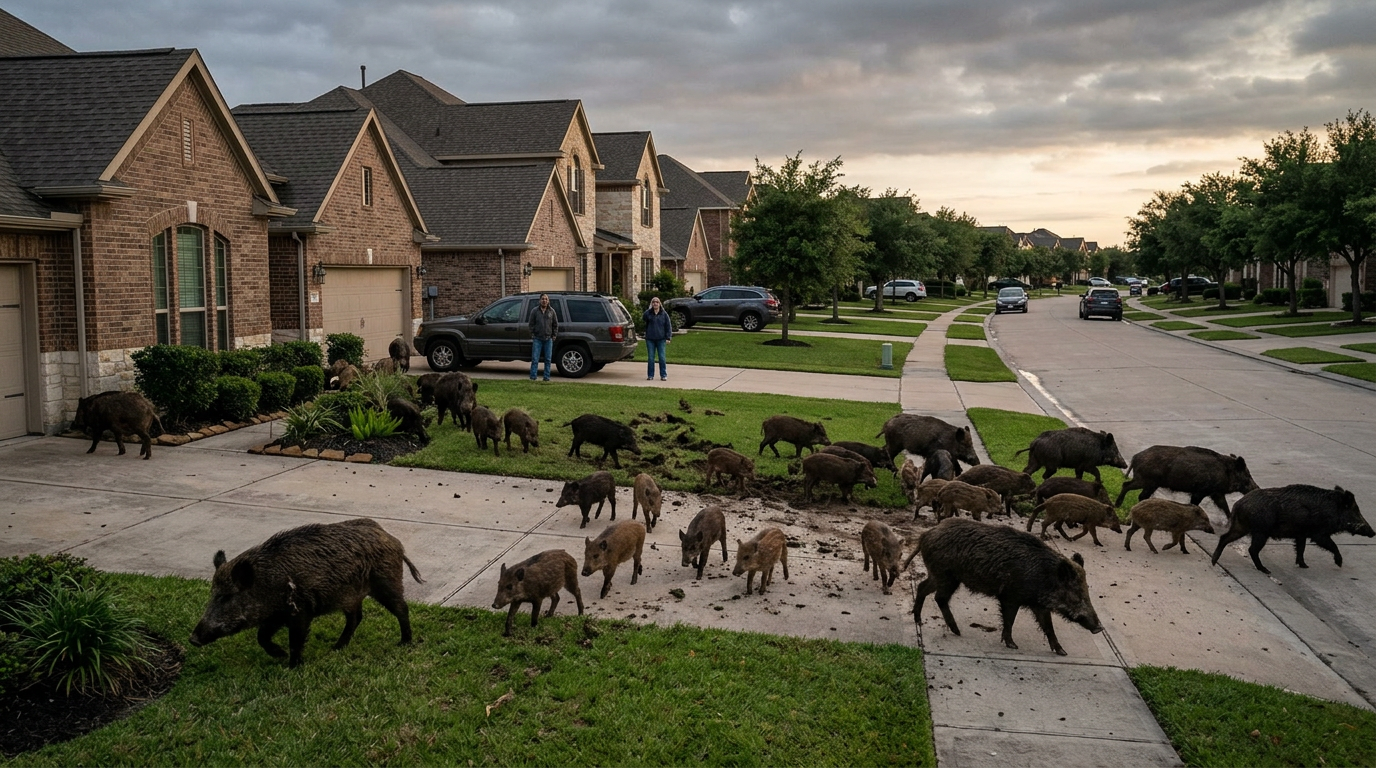
Residents in the Katy area are currently facing a significant localized crisis as a massive population of feral hogs has moved into residential developments. Reports indicate that over 120 hogs have been spotted systematically moving through suburban landscapes, leaving a trail of destruction in their wake. Historically, Texas has struggled with an invasive pig population that exceeds 2.6 million statewide, but the invasion of high-density residential areas like Katy represents a growing trend of wildlife-human conflict. These animals are not just casual visitors; they are aggressive foragers capable of overturning hundreds of square feet of manicured sod in a single night. Unlike previous years where sightings were sporadic, the current infestation involves large, organized sounders that have become increasingly bold, entering fenced backyards and navigating school-zone perimeters. Historically, the state of Texas has taken an aggressive stance against these invasive species, authorizing year-round hunting without a license and even permitting aerial eradication efforts. However, in suburban environments like those found in the Katy and Greater Houston area, traditional hunting methods are often restricted by local ordinances and safety concerns regarding firearm use in proximity to homes. This has left homeowners and local associations searching for alternative mitigation strategies, such as professional trapping and the installation of reinforced fencing. The situation in Katy serves as a stark reminder of the resilience of these animals and the ongoing challenge Texas faces in managing an invasive population that costs the state an estimated $500 million in annual damages and control costs.
Texas relevance
This situation is deeply relevant to the residents of Katy and the broader Houston metroplex, as it highlights the vulnerability of suburban infrastructure to Texas's most pervasive invasive species. As developers expand into previously wooded areas of Harris and Fort Bend counties, the natural habitats of these feral swine are squeezed, forcing them into closer proximity with humans. For Katy residents, this translates to thousands of dollars in personal landscaping losses and legitimate fears for the safety of pets and small children who utilize local parks. The state’s ability to manage this population is a top-tier concern for the Texas Department of Agriculture and the Texas Parks and Wildlife Department, as the problem is no longer confined to rural ranch lands but has firmly established a presence in the heart of Texas suburbia.
The Scale of the Destruction in Katy
The physical evidence of the hog presence in Katy is undeniable and heartbreaking for local property owners. Residents have reported waking up to lawns that appear to have been rototilled, with deep ruts and overturned soil covering entire city blocks. Feral hogs use their powerful snouts to root for grubs, roots, and tubers, a behavior that destroys the root systems of expensive Bermuda and St. Augustine grasses prevalent in the area.
Beyond simple lawn damage, the hogs have been known to compromise irrigation systems, tear through decorative fencing, and damage communal green spaces. In some instances, the scale of the damage is so extensive that neighborhood associations are facing significant budget reallocations to cover the costs of repairing public parks and medians. The sheer number of animals—estimated at over 120—means that even a single nightly excursion can result in widespread devastation across multiple adjacent properties.
Biological Characteristics of the Invasive Species
Feral hogs are a combination of escaped domestic pigs and imported European wild boars. In the Texas environment, they have become a 'super-species' of sorts, possessing no natural predators other than humans and the occasional mountain lion or alligator. They are highly intelligent, adaptable, and social, often traveling in groups known as sounders. These sounders are typically led by a matriarch and can consist of several generations of offspring.
One of the primary reasons for the population explosion in areas like Katy is the hogs' reproductive capacity. Sows can begin breeding as early as six to eight months of age and can produce two litters of six or more piglets every year. This means that even if a large portion of the sounder is removed, the remaining individuals can quickly replenish the numbers. The abundance of food sources in suburban areas—including pet food, birdseed, and lush lawns—only accelerates this growth.
Public Safety and Human Interaction
While feral hogs generally prefer to avoid direct human contact, their presence in residential areas poses a distinct safety risk. A mature hog can weigh between 150 and 400 pounds and is equipped with sharp tusks used for defense and digging. When cornered or when protecting their young, these animals can become extremely aggressive. Residents walking dogs or jogging during the dawn and dusk hours, when hogs are most active, are at the highest risk of a dangerous encounter.
There is also a significant health concern associated with the infestation. Feral hogs are known carriers of at least 30 different diseases and nearly 40 varieties of parasites. These pathogens, including swine brucellosis and pseudorabies, can be transmitted to domestic pets and, in some cases, to humans. Contamination of local water sources and playgrounds via feces is a secondary threat that has local health officials monitoring the situation closely.
The Limitation of Suburban Mitigation
Controlling feral hogs in a city like Katy is far more complex than it is on a rural ranch. In rural Texas, landowners can use a variety of methods including night-vision hunting, trapping, and even aerial gunning. In a suburban setting, the proximity of houses makes the discharge of firearms illegal and extremely dangerous. This limits residents to passive deterrents like lighting or chemical repellents, which the hogs often become accustomed to very quickly.
Trapping remains the most viable option for suburban areas, but it requires professional expertise and a large-scale approach. Small, individual traps are rarely effective for an entire sounder; instead, massive communal traps that can capture 20 or 30 hogs at once are needed to prevent the remaining animals from becoming 'trap shy.' Local homeowners' associations are currently investigating contracts with wildlife management firms to deploy these larger systems in the wooded fringes of the developments.
Economic Impact on the Katy Community
The economic toll of this hog invasion extends beyond the individual cost of replacing a lawn. For many Katy residents, the frequent damage is beginning to affect property values and the overall desirability of the neighborhoods. If a community gains a reputation for being overrun by destructive wildlife, it can lead to a cooling of the local real estate market. Furthermore, the cost of professional trapping services is not insignificant, often running thousands of dollars per month for large-scale operations.
On a broader scale, the taxpayers of Texas are already footing a massive bill for hog control and agricultural loss. When the animals move into urban centers, the burden shifts to municipal budgets. Infrastructure like drainage ditches and levies, which are critical for flood control in the Houston area, can also be undermined by the rooting and burrowing activities of massive sounders, potentially leading to more expensive structural repairs in the future.
Statewide Efforts and Future Policy
The situation in Katy has reignited discussions at the state level regarding more aggressive intervention. In recent years, Texas has debated the use of specialized toxins, such as warfarin-based baits, to manage the hog population. However, these methods have faced opposition due to concerns about secondary poisoning of non-target species like deer, eagles, and domestic pets. The Katy incident may serve as a case study for why more diverse tools are needed in the management toolkit.
Looking ahead, wildlife experts suggest that a 'no-holds-barred' approach is necessary to stabilize the population. This includes better coordination between neighboring municipalities so that hogs aren't simply pushed from one neighborhood into another. Comprehensive management plans that include data tracking, habitat modification, and consistent trapping are the only way to safeguard Texas suburbs from becoming permanent feeding grounds for these invasive sounders.
Analysis
The invasion of Katy neighborhoods by feral hogs is a clear indicator that current statewide containment strategies are struggling to keep pace with the species' rapid reproductive rate. While Texas has passed legislation to make it easier to hunt and trap these animals, suburban zones present a 'safe haven' for the hogs where they are protected from traditional hunting pressure. This creates a biological vacuum where the populations can explode without natural or human intervention. Moving forward, the state may need to consider more integrated management plans that specifically address the unique legal and safety constraints of suburban wildlife control. This is not merely an aesthetic issue for homeowners; it is an ecological and public safety challenge that requires a coordinated response between municipal leaders and state wildlife experts.
Source attribution
This story was reported using a public release from the Texas Wildlife Stories (Google News). Keep TX Red rewrote the coverage independently and links to the official statement for verification.
Frequently Asked Questions
- What should I do if I see a feral hog in my Katy neighborhood?
- You should maintain a safe distance and do not attempt to approach or feed the animal. Hogs can be unpredictable and aggressive, especially if they have young with them. Contact your local animal control or your Homeowners' Association to report the sighting so they can track movements and coordinate with professional trappers.
- Why can't we just hunt the hogs in the suburbs?
- Local ordinances generally prohibit the discharge of firearms within city limits or in residential developments due to safety risks. While Texas law is lenient on hog hunting in rural areas, suburban residents must rely on trapping or professional wildlife services that utilize non-lethal removal or suppressed firearms where permitted.
- How can I protect my personal lawn from hog damage?
- Strong physical barriers like sturdy fencing are the most effective deterrent. Some residents use motion-activated sprinklers or lights, but hogs often adapt to these. Keeping pet food indoors and ensuring trash cans are secured can also help make your property less attractive to foraging sounders.
Official Sources
Take the next step
Browse the Newsroom →Read more about Keep Texas Red → Our full guide to what Keep Texas Red means and why Texans support it.
Related Articles

Get Texas updates delivered weekly.
Independent Texas reporting on politics, policy, and daily life. One email a week. Unsubscribe anytime.
Keep TX Red Newsroom
The Keep Texas Red Editorial Staff produces nonpartisan explainers, policy breakdowns, and educational resources to help Texans understand how their government works. All content is reviewed for accuracy and updated regularly.
About Keep TX Red →