North Texas Traffic Stalemate: Managing the Growing Feral Hog Crisis in Tarrant County
A recent feral hog sighting on a major North Texas highway highlights the rising population and economic threat of invasive swine in the Lone Star State.
Editorial disclaimer: Opinions and analysis on Keep TX Red are editorial content — not statements of fact. See our editorial standards.
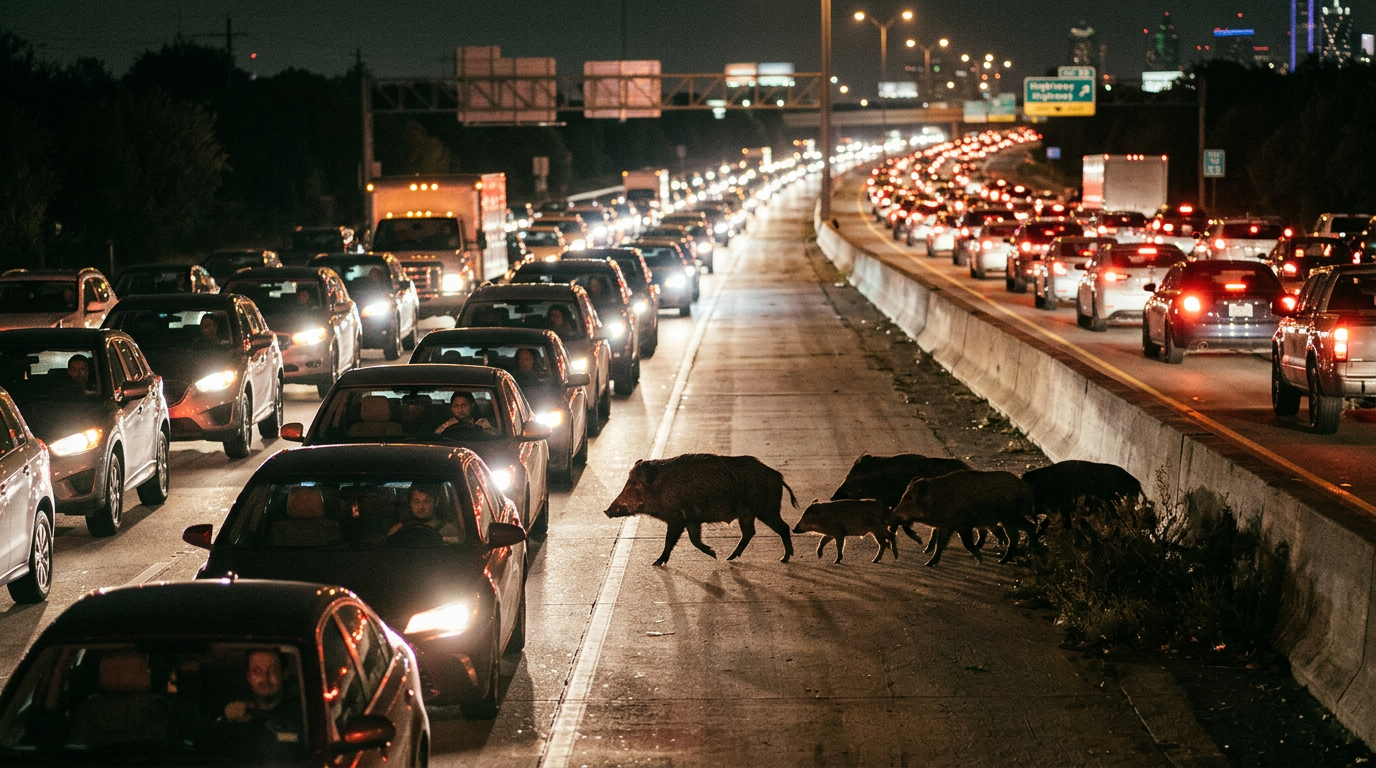
Commuters in North Texas recently faced an unusual and dangerous obstacle when a sounder of feral hogs wandered onto a major highway, bringing traffic to a standstill. This incident is the latest in a series of urban wildlife encounters that highlight the shifting range of Texas's invasive swine population. Historically, feral hogs were primarily a concern for rural farmers and ranchers in East and Central Texas, where they have caused billions of dollars in crop damage over several decades. However, as suburban developments expand into previously undeveloped brushland, these highly adaptable animals are increasingly navigating residential neighborhoods and high-traffic corridors in search of resources. The presence of these animals on roadways represents a significant public safety hazard, as high-speed collisions with large hogs can result in severe vehicle damage and human injuries. Local authorities and wildlife experts are now tasked with addressing how these animals managed to bypass traditional barriers to enter one of the busiest transit zones in the Metroplex.
Texas relevance
This issue is intensely relevant to residents of North Texas and DFW-area commuters who utilize the expanding highway network of Tarrant and Denton counties. Texas currently hosts the largest feral hog population in the United States, with an estimated 2.6 million animals roaming almost every county in the state. Historically, the state has relied on liberal hunting regulations and professional trapping to manage the population, but the encroachment into urban centers like Fort Worth and Dallas creates a new set of challenges where traditional firearms use is prohibited by municipal ordinances. This event underscores the fiscal burden on the state, as the Texas Department of Agriculture estimates that feral hogs cause upwards of $500 million in damages annually to the state’s economy. For local drivers, the 'hog crisis' is no longer just a rural anecdote; it is a daily risk on the roads.
The Biological Drivers of Urban Migration
Feral hogs are opportunistic omnivores with a biological drive that prioritizes caloric intake and safety. In North Texas, the rapid conversion of ranch land into housing developments has fragmented their natural habitats, forcing them to navigate through drainage culverts and along creek beds that often parallel major highways. These corridors serve as 'wildlife highways' that lead the animals directly into the heart of developed regions.
The drought conditions often seen in various parts of Texas also play a major role. When natural water sources and forage in the brush dry up, hogs are drawn to the irrigated landscaping of suburban office parks and residential yards. Once they find a reliable source of water and food, they are unlikely to leave, leading to a permanent presence in areas where they were never seen a decade ago.
Furthermore, feral hogs are highly intelligent and have shown an ability to adapt to human activity. They are increasingly nocturnal in urban areas to avoid detection, which significantly increases the risk of nighttime vehicular collisions. Drivers may not see a dark-coated hog until it is directly in their path, creating a high-velocity impact that can be fatal for both the animal and the occupants of the vehicle.
Economic Impact of Invasive Swine
The financial toll of the feral hog population in Texas is staggering. While the $500 million annual damage figure is a frequently cited baseline, many experts believe the true cost is much higher when factoring in vehicle repairs, the spread of livestock diseases, and the destruction of native ecosystems. In North Texas, the damage often manifests in the destruction of public parks, sports fields, and golf courses, which require expensive sod replacement and landscaping repairs.
Agricultural interests remain the hardest hit, as hogs destroy fences, consume supplemental feed intended for cattle, and root up sensitive crops. In rural counties surrounding the Metroplex, farmers report significant losses in corn and grain sorghum production. These costs are often passed down to consumers, making the hog problem a factor in the rising cost of living and food security across the region.
There is also a growing concern regarding the impact on native Texas wildlife. Feral hogs compete for resources with white-tailed deer and turkeys, and they are known to prey on the ground-nesting birds and fawns. By disrupting the local food chain, the invasive swine threaten the biodiversity that makes the North Texas ecosystem unique and vital for outdoor recreation.
Public Safety Risks on Texas Roadways
The incident on the North Texas highway is a clear reminder of the physical danger these animals pose to motorists. A mature feral hog can weigh anywhere from 150 to over 300 pounds. Striking an object of that mass at highway speeds of 65 to 75 miles per hour is comparable to hitting a small boulder or a concrete barrier. Unlike deer, which have longer legs and may fly over a vehicle upon impact, the low center of gravity of a hog often causes it to go under the wheels or be pushed directly into the engine block.
Insurance companies in Texas have noted a rise in wildlife-related claims in suburban counties that were previously considered low-risk. The unpredictability of these animals makes them a 'phantom' hazard for commuters traveling during dawn or dusk. When a sounder of twenty or more hogs crosses a multi-lane road, it can create a multi-vehicle pileup as drivers swerve to avoid the animals, leading to secondary collisions.
Law enforcement agencies and the Texas Department of Transportation (TxDOT) are increasingly being called to manage these scenes. Clearing a highway of multiple hog carcasses requires specialized equipment and creates significant lane closures, adding to the traffic congestion that already plagues the DFW area. The logistical strain on local police departments to respond to these calls takes away from other public safety priorities.
Current State Management and Removal Efforts
Texas remains one of the most proactive states in the nation regarding feral hog management. The Texas Parks and Wildlife Department (TPWD) allows for the year-round taking of feral hogs with a valid hunting license, and in most cases on private land, even the license requirement is waived for landowners protecting their property. Despite these lenient rules, the population continues to expand into the 'wildland-urban interface.'
Innovative techniques are being deployed across the state, including the use of smart-traps that can be triggered remotely via smartphone apps once an entire sounder is inside the enclosure. This 'whole sounder removal' strategy is much more effective than individual hunting, which often results in the remaining hogs becoming more wary of humans and harder to catch.
In recent years, the state has also explored the use of toxic baits, though this remains controversial due to the potential impact on non-target species like buzzards or other scavengers. As the hogs move into North Texas cities, the focus is shifting toward professional abatement strategies toward professional trapping contractors who can operate safely in populated areas where discharge of a firearm is not an option.
Future Outlook for North Texas Residents
As North Texas continues to grow, the interaction between humans and feral hogs will likely intensify. Urban planners and developers are now being encouraged to consider wildlife-resistant infrastructure, such as reinforced fencing along greenbelts and the installation of hog-proof culvert gates. However, these measures are expensive and difficult to implement across thousands of miles of existing roadways.
Education is becoming a key component of the state's strategy. Residents are urged not to feed any wildlife, as this attracts hogs and habituates them to human presence. SECuring trash bins and avoiding over-watering lawns can also make a property less attractive to rooting swine. While these individual actions help, a coordinated regional response between counties will be necessary to stem the tide of the invasion.
Ultimately, the 'Traffic Hog' phenomenon is a wake-up call for North Texas. It highlights the need for continued investment in wildlife management and a recognition that the state's invasive species problem is no longer confined to the backwoods and pastures. Without aggressive intervention, more Metroplex highways may see these dangerous disruptions in the years to come.
Analysis
The appearance of feral hogs on North Texas highways is a symptom of a broader ecological and infrastructure management failure. While Texas has famously adopted aggressive stances on hog removal—including the legalization of aerial hunting from helicopters—the rate of reproduction continues to outpace current eradication efforts. To maintain a stable population, wildlife biologists suggest that at least 66% of the hogs must be removed annually, a target that the state rarely hits. The shift toward urban centers suggests that the hogs are finding 'refuge' in suburbs where hunting is restricted and food sources like manicured lawns and golf courses are plentiful. From a policy perspective, this suggests that the Texas Legislature may need to further empower municipalities or provide centralized funding for professional urban trapping programs to prevent these animals from becoming permanent fixtures of suburban life.
Source attribution
This story was reported using a public release from the Texas Wildlife Stories (Google News). Keep TX Red rewrote the coverage independently and links to the official statement for verification.
Frequently Asked Questions
- What should I do if I see a feral hog on a North Texas road?
- Prioritize safety and do not attempt to approach or move the animal. If you are driving, avoid sudden swerving which can lead to a rollover or collision with other cars. If there is a carcass or a live animal obstructing a highway, call 911 or the local non-emergency line so that TxDOT or law enforcement can safely clear the scene.
- Why are there so many feral hogs in Texas compared to other states?
- Texas provides a perfect environment for hogs due to its vast acreage, varied climate, and the presence of numerous water sources. Furthermore, feral hogs are prolific breeders; a single sow can have two litters a year with multiple piglets per litter, allowing the population to explode rapidly in areas with few natural predators.
- Is it legal to hunt feral hogs in residential areas of North Texas?
- Generally, no. Most cities in the DFW Metroplex have ordinances against discharging firearms or bows within city limits. While state law is very permissive regarding hog removal, municipal safety laws take precedence in urban areas. Residents should contact professional trappers or city animal control for assistance with hogs on their property.
Official Sources
Take the next step
Browse the Newsroom →Read more about Keep Texas Red → Our full guide to what Keep Texas Red means and why Texans support it.
Related Articles
Get Texas updates delivered weekly.
Independent Texas reporting on politics, policy, and daily life. One email a week. Unsubscribe anytime.
Keep TX Red Newsroom
The Keep Texas Red Editorial Staff produces nonpartisan explainers, policy breakdowns, and educational resources to help Texans understand how their government works. All content is reviewed for accuracy and updated regularly.
About Keep TX Red →