Invasive Feral Hog Populations Expand into Urban Texas and New Environmental Zones
Feral hogs are spreading into previously unaffected Texas regions, causing billions in damage and prompting new state-led mitigation strategies.
Editorial disclaimer: Opinions and analysis on Keep TX Red are editorial content — not statements of fact. See our editorial standards.
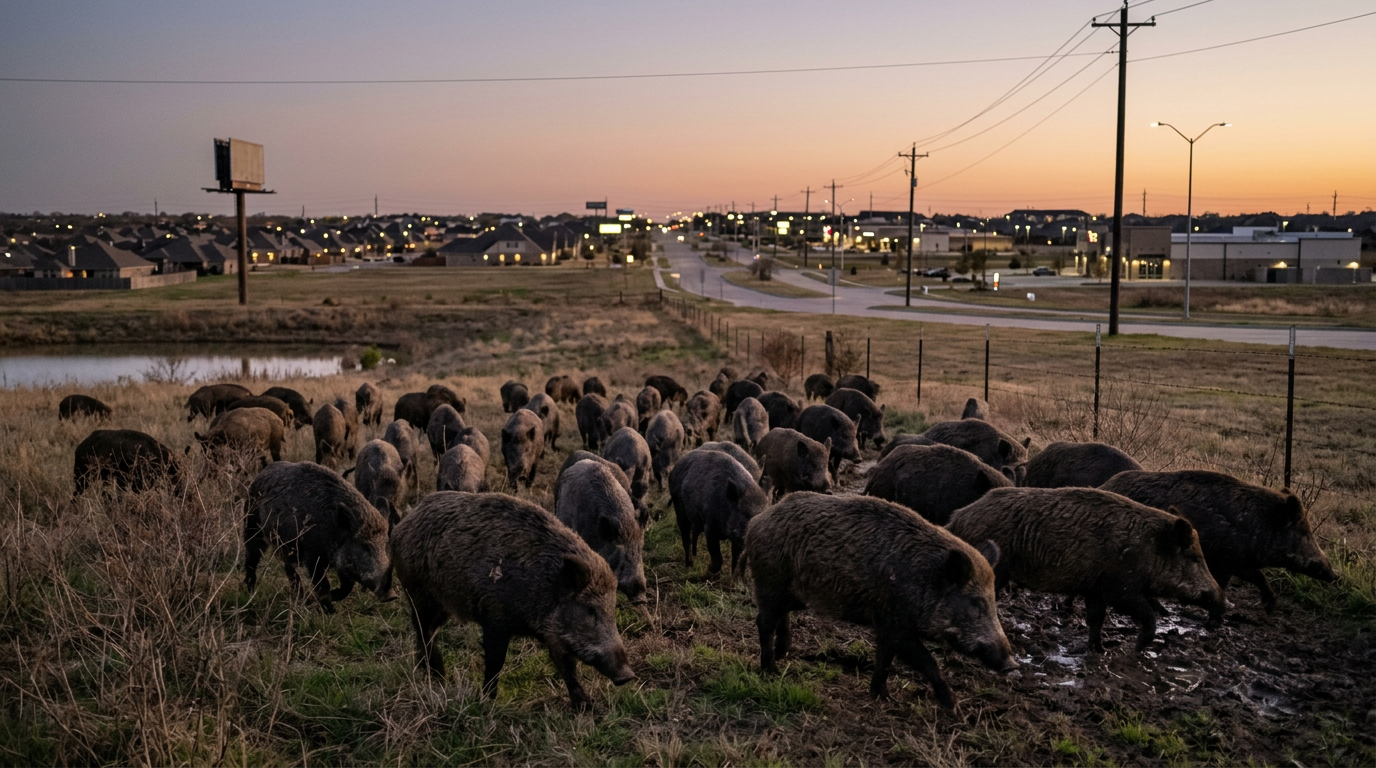
Texas is currently facing an unprecedented expansion of feral hog populations as the invasive species moves beyond its traditional rural strongholds into urban centers and previously untouched ecological zones. Historical data suggests these animals were first introduced by early explorers, but the modern explosion in their numbers is tied to their high reproductive rates and lack of natural predators in the Lone Star State. Currently, it is estimated that millions of these animals inhabit Texas, causing extensive damage to property, native ecosystems, and the agricultural industry. State officials are tracking the movement of these sounders as they adapt to more diverse climates, ranging from the arid West Texas plains to the densely populated suburbs of the Dallas-Fort Worth metroplex and the Houston area. This migration represents a significant shift in the state's biological landscape, necessitating a more aggressive approach to wildlife management and control.
Texas relevance
As a state with a massive agricultural footprint and a rapidly growing suburban population, Texas is uniquely vulnerable to the feral hog crisis. Every county in Texas, with very few exceptions, has reported sightings or damage related to these animals, making it a truly statewide emergency. For Texas landowners, the presence of hogs means destroyed crops, damaged fences, and the potential for livestock disease transmission. The Texas Department of Agriculture estimates that the financial impact of feral hogs exceeds $500 million annually in the state alone, though some researchers suggest the total economic burden, including environmental remediation and urban property repair, could reach into the billions. The state's response, including the removal of hunting license requirements for hogs on private land, highlights the urgency felt by the Texas Legislature and state agencies.
The Biological Advantage of the Feral Swine
Feral hogs possess a unique set of biological traits that make them the most successful invasive mammal in North America. A single female can produce two litters a year, with each litter consisting of six to twelve piglets. This exponential growth allows populations to recover almost instantly from traditional trapping or hunting efforts. Furthermore, their status as generalist omnivores means they can survive on almost anything, from acorns and roots to small mammals and ground-nesting bird eggs.
Their intelligence is another factor in their survival. Hogs are known to become 'trap shy,' learning to avoid specific capture devices after seeing members of their sounder caught. This adaptability has allowed them to thrive in the diverse biomes of Texas, moving from the brush country of the south to the piney woods of the east and now into the high plains. As they move, they outcompete native Texas wildlife like white-tailed deer for food sources, fundamentally altering the state's natural food chain.
Economic Destruction in the Texas Agricultural Sector
In the rural heartlands of Texas, the arrival of a hog sounder can mean the overnight destruction of entire fields. They utilize a behavior known as 'rooting,' where they use their snouts to dig deep into the soil in search of tubers and insects. This process destroys the root systems of crops like corn, cotton, and peanuts, making it impossible for farmers to harvest. Beyond crop loss, the physical damage to the land creates ruts that can break expensive farm machinery and irrigation systems.
Livestock producers also face significant risks. Feral hogs are known carriers of diseases such as swine brucellosis and pseudorabies. While these typically do not affect humans through consumption if the meat is cooked properly, they can devastate commercial hog operations and cattle herds. The cost of supplemental feeding for livestock also rises as hogs frequently break into deer feeders and cattle troughs, consuming high-cost protein and grain meant for domestic animals.
Encroachment into Suburban and Urban Landscapes
One of the most startling developments in recent years is the frequency of hog sightings in Texas suburbs. Residents in areas like The Woodlands, Katy, and Plano have reported sounders roaming through golf courses, local parks, and even private backyards. In these environments, the hogs find easy access to water from irrigation systems and food from lush landscaping or discarded trash. This proximity to humans creates a public safety risk, as hogs can be aggressive when they feel cornered or when protecting their young.
Urban infrastructure is not designed to withstand the power of a 200-pound boar. Rooting in suburban lawns can destroy thousands of dollars in landscaping in a single night. More dangerously, hogs are increasingly involved in vehicular collisions on Texas highways. Because of their low center of gravity and immense weight, hitting a hog can be as damaging to a vehicle—and as dangerous for the driver—as hitting a large deer or an elk.
State Management and Legislative Response
The Texas Legislature has taken several steps to deregulate the management of feral hogs to encourage higher take rates. Currently, no hunting license is required for a person to kill feral hogs on private land with the landowner's permission. This was a strategic move to lower the barrier for participation in population control. Additionally, the state has authorized the use of aerial gunning, allowing specialized companies to hunt hogs from helicopters, which is one of the few ways to cover the vast acreage of West Texas effectively.
New research funded by the state is focusing on the development of toxic baits. The Texas Department of Agriculture has previously explored the use of warfarin-based products and is currently looking at sodium nitrite. These substances are designed to kill hogs quickly by reducing their blood's ability to carry oxygen. However, these methods remain controversial due to concerns regarding 'non-target' species, such as vultures or raccoons, consuming the bait or the carcasses.
The Role of Technology in Eradication
As the hogs grow smarter, Texas trappers are getting more high-tech. Wireless cellular traps are now the gold standard in the state. These systems allow a user to monitor a trap via a smartphone camera and drop the gate remotely once the entire sounder is inside. This 'whole-sounder removal' strategy is critical; if even one or two hogs escape a trapping event, they learn to avoid traps in the future and continue the reproductive cycle.
Drones equipped with thermal imaging are also becoming common tools for both tracking and hunting. By flying over large ranches at night, operators can identify the heat signatures of hogs moving through thick brush that would be invisible to the naked eye. This data allows for more precise deployment of trapping resources and helps state biologists map the exact frontiers of the hog expansion in real-time.
Environmental Impact on Texas Water and Soil
The presence of feral hogs has a direct negative impact on Texas water quality. Hogs prefer to wallow in mud and shallow water to cool themselves, as they do not have sweat glands. This behavior leads to increased sedimentation and E. coli contamination in Texas creeks and rivers. Low-level streams that provide drinking water for cattle or serve as habitats for native fish are often rendered unusable or ecologically dead following a heavy hog presence.
Soil erosion is another byproduct of the hog invasion. By stripping away ground cover and churning the soil, hogs leave the land vulnerable to being washed away during Texas's intense rain events. This loss of topsoil makes it harder for native grasses to re-establish, often leading to the spread of other invasive plant species that thrive in disturbed earth. The long-term restoration of these lands is a costly endeavor that many small-scale Texas landowners cannot afford on their own.
Analysis
The expansion of feral hogs into urban Texas is more than a nuisance; it is a failure of traditional containment methods that demands a modernized policy response. For years, the state relied on recreational hunting to manage numbers, but with a population that can triple in size every five years if left unchecked, hunting alone is insufficient. We are seeing a clash between urban sprawl and invasive biology. As Texas developers push further into previously wild areas, they are coming face-to-face with a species that has no fear of humans and a voracious appetite. The move toward using sodium nitrite baits and specialized trapping technology reflects a shift toward scientific eradication over simple population control. However, balancing these lethal methods with safety in populated residential areas will be the next major hurdle for Texas policymakers.
Source attribution
This story was reported using a public release from the Texas Wildlife Stories (Google News). Keep TX Red rewrote the coverage independently and links to the official statement for verification.
Frequently Asked Questions
- Do I need a hunting license to kill feral hogs in Texas?
- No, according to current Texas law, a hunting license is not required to hunt feral hogs on private land with the landowner's consent. This applies to both residents and non-residents, reflecting the state's desire to remove obstacles to hog population control.
- Why are feral hogs considered an invasive species in Texas?
- They are not native to the Americas. They were brought over by European explorers and settlers as livestock. Those that escaped or were released established wild populations that outcompete native Texas species, destroy local habitats, and lack natural predators to keep their numbers in check.
- What should I do if I see feral hogs in my suburban neighborhood?
- You should contact your local municipal animal control or the Texas Parks and Wildlife Department. Do not attempt to approach or feed the animals, as they can be unpredictable and dangerous. Many neighborhoods now employ professional trapping services to manage urban sounders.
Official Sources
Take the next step
Browse the Newsroom →Read more about Keep Texas Red → Our full guide to what Keep Texas Red means and why Texans support it.
Related Articles
Get Texas updates delivered weekly.
Independent Texas reporting on politics, policy, and daily life. One email a week. Unsubscribe anytime.
Keep TX Red Newsroom
The Keep Texas Red Editorial Staff produces nonpartisan explainers, policy breakdowns, and educational resources to help Texans understand how their government works. All content is reviewed for accuracy and updated regularly.
About Keep TX Red →