Escalating Feral Hog Encounters Across North Texas: An In-Depth Resource for Lone Star Residents
North Texas sees a surge in feral hog activity. Learn about the environmental impact, legal trapping rules, and safety protocols for these invasive pests.
Editorial disclaimer: Opinions and analysis on Keep TX Red are editorial content — not statements of fact. See our editorial standards.
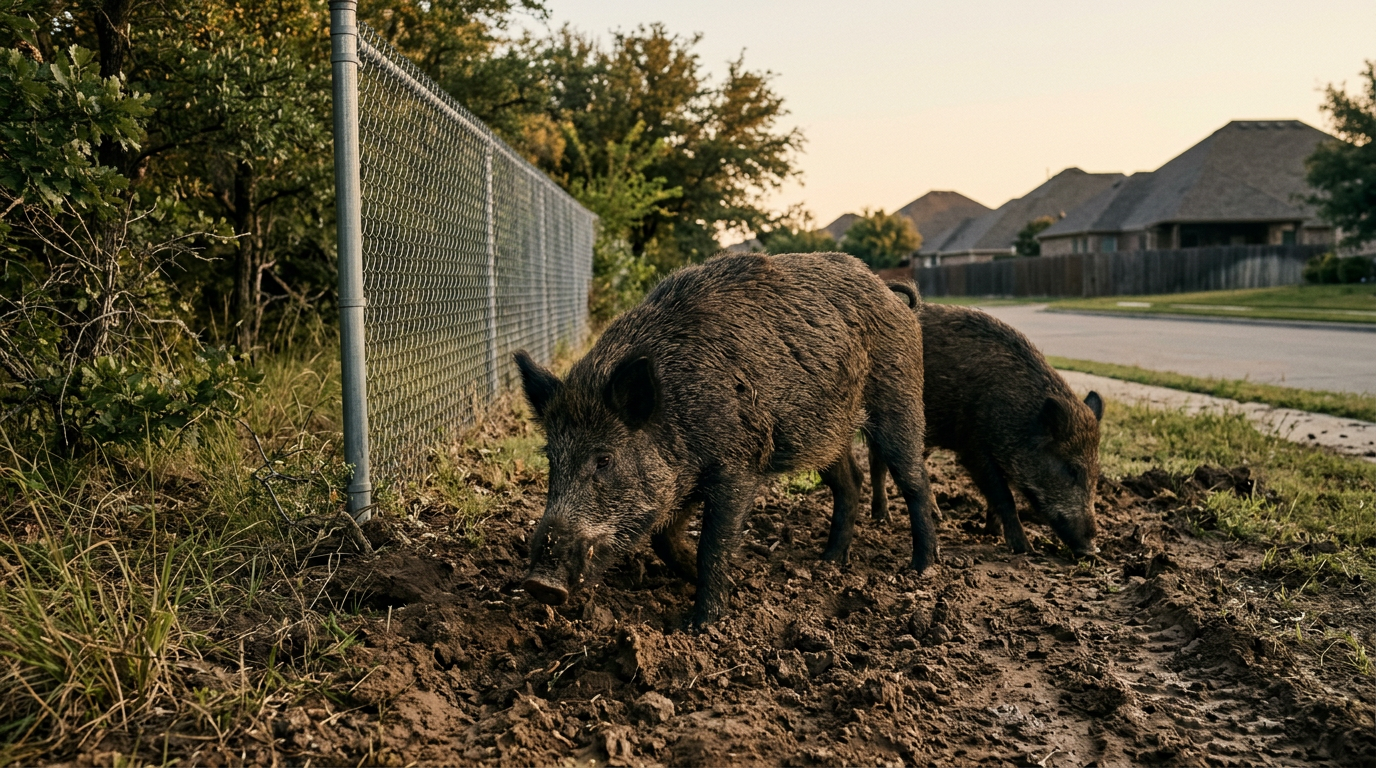
Recent data and resident reports indicate a significant uptick in feral hog sightings throughout the North Texas corridor, particularly in suburban areas surrounding Dallas and Fort Worth. These invasive animals, which were originally introduced to the continent centuries ago, have seen their populations explode due to their high reproductive rates and lack of natural predators in the urban-wildlife interface. Historical records from the Texas Parks and Wildlife Department show that these 'wild swine' have transitioned from being a purely rural nuisance to a significant threat to municipal infrastructure and residential landscaping. This trend follows a decade of rapid northward expansion as the animals adapt to human-altered environments that provide ample water and easy food sources. Experts note that as summer approaches, the search for resources often drives these sounders—or social groups of hogs—closer to populated neighborhoods, leading to increased property damage and safety concerns for local families.
Texas relevance
Texas is currently the epicenter of the feral hog crisis in the United States, with an estimated population exceeding 2.6 million animals. In North Texas specifically, the overlap of rapid suburban sprawl and existing creek beds has created a 'perfect storm' for human-animal conflict. The economic impact on Texas is staggering, with invasive hogs causing roughly $500 million in damages annually to the state's agricultural sector and private property. For residents in the DFW Metroplex, this means heightened risks for vehicle collisions, the destruction of manicured parklands, and the potential transmission of diseases to livestock and domestic pets. The state’s response, governed by the Texas Department of Agriculture and various local initiatives, serves as a vital case study for how modern municipalities handle biological threats to land stability and public safety.
Understanding the Biological Threat of Invasive Swine
Feral hogs are not a native part of the Texas wilderness. They are a hybridized mixture of escaped domestic pigs and imported Eurasian wild boars. Because they are highly intelligent and adaptable, they can inhabit almost any environment as long as there is sufficient cover and water. In North Texas, the Trinity River basin and its various tributaries provide a highway system for these animals to move undetected into the heart of suburban communities.
One of the primary biological concerns is their reproductive efficiency. A single sow can have two litters a year, with each litter consisting of six to twelve piglets. This means that even if a community manages to trap a significant portion of a sounder, the remaining individuals can repopulate the area in a matter of months. This exponential growth model makes traditional 'control' nearly impossible, requiring instead a focus on total local eradication through advanced trapping and thermal imaging technology.
Beyond their numbers, their physical behavior is inherently destructive. Hogs use their snouts to root deep into the soil to find grubs, roots, and tubers. This 'plowing' effect can destroy a residential lawn in a single night and causes significant erosion problems for the banks of North Texas creeks. When soil is disturbed on this scale, it often leads to the displacement of native Texas flora, allowing other invasive plant species to take root and further damaging the local biodiversity.
The Shifting Landscape of Management in Suburban Zones
In the past, the solution to wild pigs was simple: open season with no bag limits for anyone with a hunting license. However, as the hogs move into North Texas cities like Plano, Frisco, and Arlington, the use of high-powered rifles or even archery becomes a public safety hazard. This has forced a shift toward collaborative trapping programs. Cities are increasingly contracting with professional wildlife movers to set up large-scale 'corral traps' that can capture an entire sounder at once, which is far more effective than picking off individuals.
Texas law has also evolved to meet this challenge. The state legislature has eased many restrictions on how these animals can be dealt with, recently allowing for the removal of hogs from private property without a hunting license in specific circumstances. Furthermore, the development of specialized baits and contraceptives is being researched by scientists at Texas A&M, though widespread implementation remains years away. For now, physical removal remains the gold standard for North Texas HOAs and city managers.
Another deterrent being used in the DFW area involves 'exclusion fencing.' While expensive, building heavy-duty barriers around cemeteries, golf courses, and sports fields has become a necessary capital expense. These fences must be buried deep into the ground to prevent the animals from rooting underneath. As North Texas continues to grow, urban planning must now account for these animals as a permanent variable in infrastructure design, much like flood zones or soil stability.
Public Health Risks and Domestic Animal Safety
Feral hogs carry a variety of pathogens that pose risks to both humans and domestic animals. Swine brucellosis and pseudorabies are two of the most concerning diseases frequently detected in the Texas population. While these diseases are rarely fatal to humans if treated, they can devastate the local agricultural economy if they jump to domestic swine herds. Furthermore, the hogs act as hosts for ticks, fleas, and lice, which can migrate to pets that frequent the same wooded areas.
For residents who enjoy North Texas’s extensive trail systems, such as the Katy Trail or various park loops, the risk of a physical encounter is also rising. While feral hogs are generally shy and prefer to flee from humans, a cornered animal or a sow protecting her piglets can become extremely aggressive. They are fast, powerful, and equipped with sharp tusks that can cause severe injury. Wildlife experts advise keeping dogs on short leashes in areas with known hog activity to avoid provoking a defensive strike from a sounder.
The environmental health of North Texas watersheds is also at risk. Hogs often congregate near water, and their waste can contaminate local streams with E. coli and other bacteria. This makes the management of their population a matter of public sanitation, not just property preservation. Monitoring water quality in North Texas lakes often reveals spikes in bacterial counts that correspond directly with high-density hog activity in the surrounding drainage basins.
Economic Consequences for North Texas Property Owners
The financial burden of the feral hog invasion is often borne directly by the individual homeowner. Standard homeowners' insurance policies in Texas rarely cover damage caused by 'vermin' or 'wild animals,' leaving residents to pay out-of-pocket for costly sod replacement and irrigation repairs. A single night of rooting by a small sounder can result in thousands of dollars in landscape damage. For small-scale hobby farmers in counties like Collin or Denton, the destruction of a season's crop can be a total loss.
On a larger scale, municipalities are finding their budgets stretched by hog-related repairs. Public parks, which are essential for the quality of life in the North Texas region, require constant monitoring and repair work to remain safe for public use. The cost of hiring professional trappers is an unbudgeted expense for many smaller towns, leading to a patchwork of enforcement that the hogs easily exploit by simply moving across city lines.
Investment in 'smart' technology is being seen as a long-term cost-saving measure. Remote-monitored traps allow a single technician to manage dozens of sites from a smartphone, only traveling to the trap when it has successfully triggered. By reducing the labor costs associated with traditional trapping, North Texas cities are hoping to create a more sustainable model for keeping hog numbers low enough to minimize economic disruption.
Future Outlook: Can Texas Win the War on Hogs?
The consensus among Texas biologists is that the feral hog population cannot be fully eradicated using current technology; rather, the goal is 'abatement' and 'control.' Maintaining a population requires removing roughly 66% to 70% of the animals every year just to keep the numbers level. This is a monumental task that requires cooperation between the state, the private sector, and individual citizens. North Texas is currently the frontline for testing new strategies that might eventually be used in other urbanizing states like Florida or Georgia.
Technological advancements are the most promising avenue for future success. Drones equipped with infrared sensors are increasingly used to track sounder movements through dense Texas brush, allowing for more strategic trap placement. Additionally, the Texas Department of Agriculture continues to evaluate the safety of sodium nitrite-based baits, which would offer a more efficient way to reduce numbers in remote areas, provided they can be deployed without harming native Texas wildlife like deer or raccoons.
Resident awareness remains the final piece of the puzzle. By reporting sightings via apps and local wildlife portals, North Texas residents provide the data points necessary for officials to identify 'hot zones.' As the 'Keep Texas Red' spirit suggests a commitment to land stewardship and property rights, the fight against feral hogs is a unifying issue for Texans. Protecting the landscape from invasive species is not just an environmental goal; it is an essential part of preserving the Texas way of life for future generations.
Analysis
The shift in feral hog behavior highlights a failure in traditional containment strategies. For years, Texas relied on rural hunting to manage the population, but as these animals move into residential areas where firearm use is restricted, the legal and tactical landscape changes. We are witnessing a transition from 'sport hunting' to 'technical eradication.' The political and social challenge lies in balancing humane treatment with the absolute necessity of removing a species that threatens the Texas ecosystem. Without aggressive, coordinated intervention between state agencies and private landowners, North Texas may soon reach a tipping point where hog damage becomes an unmanageable cost for taxpayers and property owners alike.
Source attribution
This story was reported using a public release from the Texas Wildlife Stories (Google News). Keep TX Red rewrote the coverage independently and links to the official statement for verification.
Frequently Asked Questions
- What should I do if I see a feral hog in a neighborhood park?
- Maintain a safe distance and do not attempt to feed or approach the animal. Keep all pets on a leash. Once safely away, report the sighting to your local municipal animal control or the Texas Parks and Wildlife Department. This helps officials track population movements and place traps more effectively.
- Are there specific times of day when hogs are most active?
- Feral hogs are primarily crepuscular, meaning they are most active during dawn and dusk. However, in areas with high human activity or during the extreme Texas heat, they often become almost entirely nocturnal to avoid detection and stay cool.
- How can I protect my lawn from being destroyed by rooting?
- While no method is 100% foolproof, reducing lawn grubs (a primary food source) through treatments can make your yard less attractive. High-quality perimeter fencing is the most effective physical deterrent, though it must be reinforced at the base to prevent the hogs from lifting or digging under the wire.
Official Sources
Take the next step
Browse the Newsroom →Read more about Keep Texas Red → Our full guide to what Keep Texas Red means and why Texans support it.
Related Articles
Get Texas updates delivered weekly.
Independent Texas reporting on politics, policy, and daily life. One email a week. Unsubscribe anytime.
Keep TX Red Newsroom
The Keep Texas Red Editorial Staff produces nonpartisan explainers, policy breakdowns, and educational resources to help Texans understand how their government works. All content is reviewed for accuracy and updated regularly.
About Keep TX Red →