East Texas Neighbors Rally for State Assistance as Invasive Hog Population Overruns Mesquite Suburbs
Mesquite residents call for urgent intervention as feral hog sounders destroy local property and threaten suburban safety in North Texas.
Editorial disclaimer: Opinions and analysis on Keep TX Red are editorial content — not statements of fact. See our editorial standards.
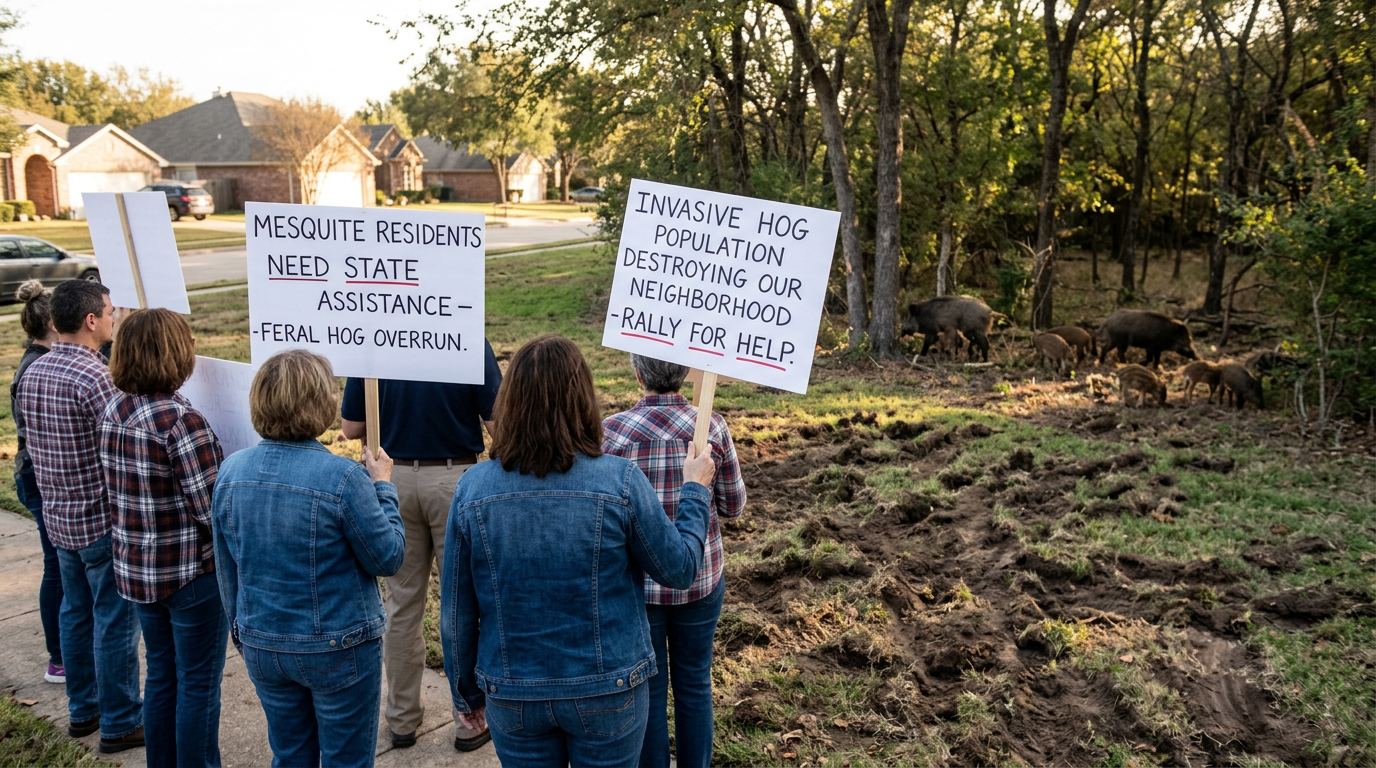
In the suburban corridors of Mesquite, Texas, a growing conflict between residential development and invasive wildlife is reaching a breaking point. For several months, local homeowners have documented a surge in destructive activity linked to feral hog sounders. These animals, which are not native to North America, have transitioned from traditional agricultural concerns into a significant urban nuisance. The problem has escalated beyond simple lawn damage; families now express genuine fear regarding the presence of these erratic and sometimes aggressive animals in areas where children play and pets roam. Historically, Texas has struggled with various feral species, but the rapid urbanization of the Dallas-Fort Worth Metroplex has increasingly pushed these resilient animals into high-density residential zones where traditional eradication methods like hunting are often restricted by city ordinances. The historical precedent for this crisis dates back centuries, as feral hogs are descendants of domestic swine brought by Spanish explorers and later by settlers. Over the decades, these escapees interbred with Eurasian wild boars introduced for sport. The resulting hybrid is a reproductive powerhouse capable of producing two litters a year. In recent years, the Texas Department of Agriculture has estimated the statewide hog population to be in the millions, causing over $50 million in annual damage to the state's agricultural sector. However, the current situation in Mesquite highlights a shifting theater of operations for the species: the suburban landscape. As native habitats are converted into housing developments, the hogs have adapted, finding consistent food sources in manicured lawns, golf courses, and drainage basins.
Texas relevance
This situation is a quintessential Texas conflict, highlighting the intersection of rapid suburban expansion and the state's ongoing battle with invasive species. In North Texas, specifically legal jurisdictions like Mesquite and surrounding Dallas County, the surge in hog sightings directly impacts public safety and local property values. Texas state law provides significant leeway for the removal of feral hogs on private property, yet the dense layout of neighborhoods creates a unique challenge where discharge of firearms is illegal and professional trapping can be cost-prohibitive for individual families. The outcome of the grievances in Mesquite will likely serve as a blueprint for how other expanding Texas cities manage wildlife encroachment as the state's population continues to boom.
Escalating Damage in Local Neighborhoods
Residents in affected Mesquite neighborhoods report that the frequency of these incursions has shifted from occasional events to a nightly occurrence. The damage left behind is often compared to a rototiller having been run through a front yard. Feral hogs use their powerful snouts to root deep into the soil searching for grubs, roots, and tubers. This process destroys expensive sod, compromises irrigation systems, and can even destabilize small retaining walls or decorative landscaping features.
Beyond the financial burden of repairing yards, there is the sociological impact on the community. Neighbors who once enjoyed walking their dogs at dusk or letting children play in the backyard after school are now hesitant. The uncertainty of encountering a several-hundred-pound animal with sharp tusks in a residential driveway has significantly altered the daily lives of Mesquite citizens, leading to the current public outcry for municipal intervention.
The Biological Resilience of the Texas Hog
Understanding why Mesquite is struggling requires looking at the biology of the hogs themselves. These animals are highly intelligent and possess an acute sense of smell. They are opportunistic omnivores, meaning they can thrive on almost any organic matter found in a suburban environment, including fallen fruit, pet food left outdoors, and even garbage. Their ability to adapt to human presence makes them exceptionally difficult to deter with simple fences or commercial repellents.
Furthermore, the lack of natural predators in North Texas means that their population growth is largely unchecked. While coyotes may occasionally take a very young piglet, an adult hog is a formidable opponent that few native animals will engage. In the absence of a vigorous trapping program, a single family of hogs can expand into a massive sounder in just twelve to eighteen months, making the window for effective intervention quite narrow for local authorities.
Local Government and Policy Limitations
In many Texas cities, animal control departments are primarily geared toward managing stray dogs and cats. Handling a feral hog infestation requires specialized equipment, such as heavy-duty steel traps and thermal imaging for night operations. Mesquite officials are currently facing pressure to reallocate funds or seek state grants to hire professional trappers who can remove the animals safely without endangering residents.
There is also a legal complexity regarding where the animals go after capture. Texas animal health regulations are strict about the transport of feral swine due to the risk of disease transmission, such as pseudorabies and swine brucellosis. Consequently, any mass removal effort in Mesquite must coordinates with state-approved processors or holding facilities, adding layers of bureaucracy to what residents see as a simple 'pest control' issue.
Economic Impact on North Texas Homeowners
For many Mesquite residents, their home is their largest financial asset. The persistent presence of feral hogs can lead to a decline in curb appeal and even property values if the problem becomes a known characteristic of a specific neighborhood. Insurance coverage for wildlife damage to landscaping is notoriously difficult to claim, leaving many families to pay thousands of dollars out of pocket for repairs that may be undone the very next night.
The economic toll extends to the city as well. Public parks, sports fields, and common areas maintained by HOAs are equally vulnerable. When city-owned parkland is torn up, taxpayers ultimately foot the bill for the restoration. This shared financial burden is one of the primary drivers behind the collective demand for a more aggressive, city-funded mitigation strategy to protect both private and public investments.
Potential Solutions and Barriers to Success
Several strategies are being discussed by the community, ranging from the installation of hog-proof fencing in public corridors to the use of communal trapping programs. Some residents have suggested that the city should relax certain ordinances to allow for more aggressive removal tactics, though safety concerns in densely populated areas make this a controversial proposition. Coordination at the county level may be necessary to ensure that hogs are not simply pushed from one city's limits into another's.
Another significant barrier is the animals' habit of using creek beds and wooded easements as 'highways' into the city. These areas are often difficult for vehicles to access and provide plenty of cover for the hogs during daylight hours. Effective management would require a multi-faceted approach involving habitat modification, consistent monitoring, and community-wide cooperation to remove attractants like accessible food and water sources.
Long-Term Outlook for Suburbia
Experts from Texas A&M AgriLife Extension have long warned that the feral hog problem would eventually migrate from the farm to the city. As Mesquite serves as a frontline in this battle, the steps taken now will likely be studied by other municipalities across the state. The reality is that total eradication is likely impossible; the goal is shifting toward 'population suppression' to keep the numbers manageable and the damage within tolerable limits.
As the state continues to grow and more natural land is developed, the frequency of human-wildlife conflicts is expected to rise. Mesquite's current struggle is a bellwether for the future of Texas suburban living. Success will require a mix of sophisticated trapping technology, state-level financial support, and a realization by the public that the Texas landscape still retains a wild, and sometimes destructive, character that requires active management.
Analysis
The tension in Mesquite reflects a broader policy failure to keep pace with the biological reality of invasive species in Texas. While the state has legalized aerial hunting and various trapping methods, these tools are largely ineffective in a suburban context where noise ordinances and safety risks prevent large-scale eradication. Local governments are often caught between a rock and a hard place; they lack the specialized animal control budgets to handle large-scale swine removal, yet leaving the burden on residents leads to inconsistent results. If state authorities do not coordinate a regional response that transcends city limits, the DFW suburbs may face a permanent, costly, and dangerous co-habitation with a species that has no natural predators in the urban ecosystem. This is no longer just a 'country problem'—it is an infrastructure and public health crisis for modern Texas.
Source attribution
This story was reported using a public release from the Texas Wildlife Stories (Google News). Keep TX Red rewrote the coverage independently and links to the official statement for verification.
Frequently Asked Questions
- Why are there so many feral hogs in Mesquite right now?
- Feral hogs are extremely prolific breeders and are highly adaptable. As more land is developed in the DFW area, their natural habitats are squeezed, pushing them into residential areas where they find easy food sources like watered lawns and pet food.
- Can Mesquite residents shoot hogs on their own property?
- While state law generally allows for the taking of feral hogs on private property, Mesquite city ordinances strictly prohibit the discharge of firearms within city limits. Residents are encouraged to use professional trapping services or contact local animal control for guidance.
- What kind of damage do these hogs cause?
- The most common damage is 'rooting,' where hogs use their snouts to dig up large patches of earth. This can destroy lawns, flower beds, irrigation lines, and the structural integrity of light landscaping or trails.
- Are feral hogs dangerous to people and pets?
- While they generally prefer to avoid human contact, they can be unpredictable and aggressive, especially if they feel cornered or are protecting their young. Large boars can weigh over 300 pounds and possess tusks that can cause severe injury.
Official Sources
Take the next step
Browse the Newsroom →Read more about Keep Texas Red → Our full guide to what Keep Texas Red means and why Texans support it.
Related Articles
Get Texas updates delivered weekly.
Independent Texas reporting on politics, policy, and daily life. One email a week. Unsubscribe anytime.
Keep TX Red Newsroom
The Keep Texas Red Editorial Staff produces nonpartisan explainers, policy breakdowns, and educational resources to help Texans understand how their government works. All content is reviewed for accuracy and updated regularly.
About Keep TX Red →