Mesquite Residential Areas Facing Destruction as Feral Hog Invasion Intensifies
Mesquite residents report significant yard damage as the city partners with state officials to manage a growing feral hog population in North Texas.
Editorial disclaimer: Opinions and analysis on Keep TX Red are editorial content — not statements of fact. See our editorial standards.
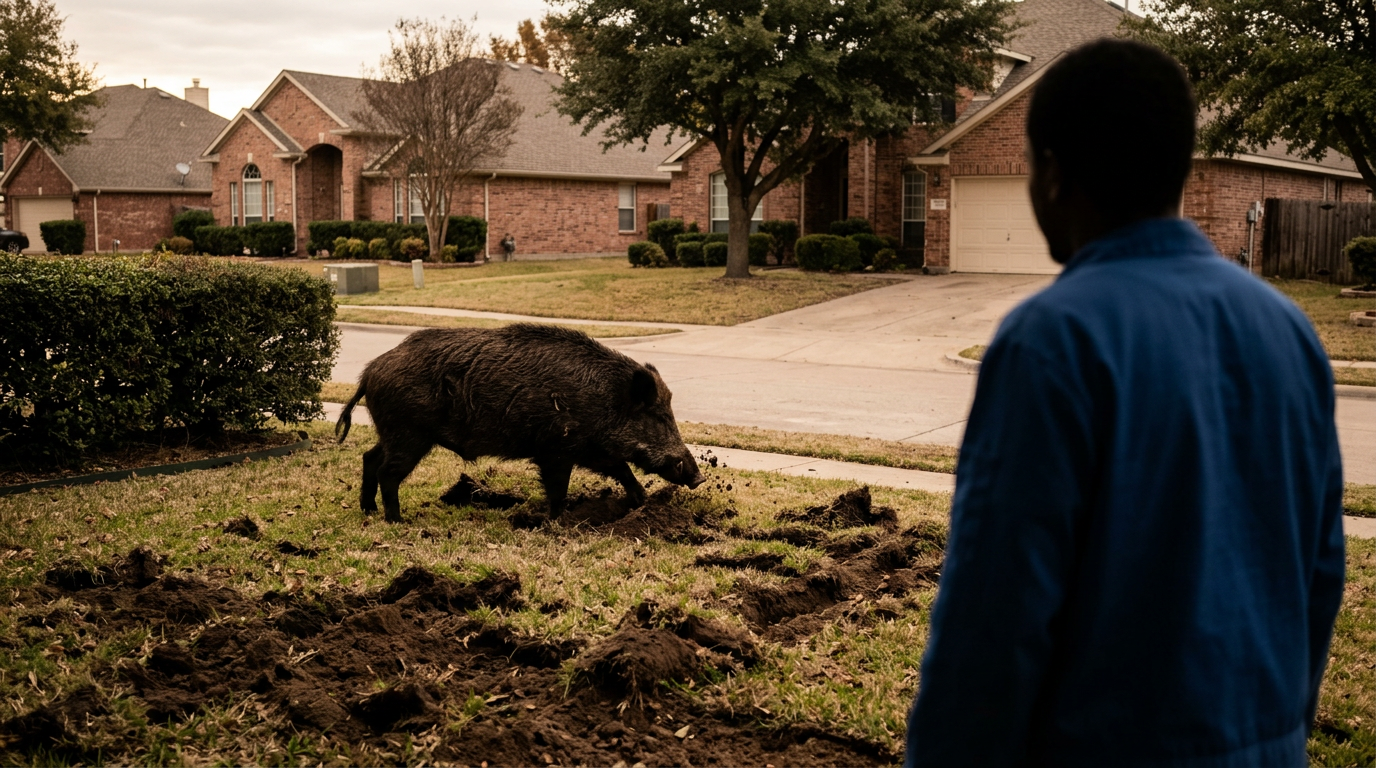
Residents in Mesquite, Texas, are currently grappling with an influx of feral hogs that have transitioned from rural outskirts into established residential neighborhoods. These invasive animals, known for their destructive rooting behavior, have caused thousands of dollars in landscape damage to private properties over recent weeks. The surge in activity has prompted local municipal leaders to escalate their response strategies, moving beyond standard animal control measures to coordinate directly with state-level wildlife experts. This situation mirrors a broader historical trend in Texas, where subterranean foraging by non-native swine has cost the state's agricultural and residential sectors an estimated $500 million annually. Historically, the feral hog problem in Texas began centuries ago with the introduction of domestic swine by explorers, which later crossbred with Eurasian boars. While they were once primarily a concern for farmers and ranchers in the Texas Hill Country or East Texas piney woods, urban sprawl has pushed these resilient creatures into suburban corridors. In Mesquite, the proximity to soft soil near creeks and undeveloped land provides an ideal habitat for sounders—groups of hogs—to thrive while remaining hidden during daylight hours. The current spike in residential sightings suggests that local populations have outgrown their natural food sources, forcing them into manicured lawns to hunt for grubs and roots. The city's response involves a multi-agency approach to mitigate the spread and prevent further property devaluation. Officials are currently identifying the specific entry points where the hogs are emerging from wooded areas into neighborhoods. By mapping these movement patterns, the city aims to deploy more effective trapping and removal techniques that adhere to state regulations regarding invasive species. This local crisis highlights the ongoing struggle between Texas urban development and the prolific reproductive rates of an animal that has no natural predators in the North Texas ecosystem.
Texas relevance
This situation is a direct consequence of the unique intersection of Texas urban expansion and the state's massive invasive species crisis. Texas is home to an estimated 2.6 million feral hogs, the largest population in the United States, making this a statewide environmental and economic priority. For residents of North Texas cities like Mesquite, the issue is no longer a distant agricultural nuisance but a direct threat to personal property and neighborhood safety. State law in Texas is particularly aggressive regarding feral hogs, allowing for year-round removal without a license on private property with owner consent, reflecting the severity of the ecological threat these animals pose to the Lone Star State.
The Extent of Residential Property Damage
Homeowners in affected Mesquite neighborhoods have reported waking up to lawns that appear to have been rototilled. Feral hogs use their powerful snouts to overturn turf in search of insects, earthworms, and roots. This rooting process does not just ruin the aesthetic of a lawn; it destroys irrigation systems and creates deep holes that can be hazardous to pedestrians and pets.
In many cases, the damage is so extensive that entire lawns must be resodded. Because feral hogs often travel in sounders that can include dozens of individuals, a single night of activity can lead to the total destruction of multiple adjacent yards. This has created a sense of urgency among neighbors who are now looking to the city for protective interventions and structural barriers to keep the animals contained within wild areas.
Beyond the soil damage, there are concerns regarding the structural integrity of fences. Hogs are surprisingly strong and can easily lift or break through standard residential fencing if they detect food on the other side. This creates a cycle of expensive repairs for homeowners who are already dealing with the rising costs of land maintenance in North Texas.
Collaborative State and Local Strategy
The City of Mesquite is not working in isolation to solve this problem. By reaching out to state authorities, the city is tapping into specialized knowledge regarding hog behavioral patterns and the most effective trapping technologies. State experts provide guidance on the use of large-scale corral traps, which are designed to capture entire sounders at once to prevent 'trap shyness'—a phenomenon where surviving hogs learn to avoid traps.
This partnership also ensures that all removal efforts comply with Texas Department of Agriculture and Texas Parks and Wildlife Department regulations. Since feral hogs are known carriers of various diseases, including pseudorabies and swine flu, the safe handling and disposal of the animals is a critical component of the state-guided strategy. Local animal control units are being trained on these specific protocols to ensure public safety remains the top priority during the removal phase.
City officials have emphasized that the goal is to create a sustainable reduction in the hog population rather than a temporary fix. By targeting the source of the hogs in nearby wooded tracts and drainage culverts, the city hopes to push the remaining populations back into more remote areas, away from the residential clusters where they are currently causing the most friction.
Environmental Factors Driving Hogs Urbanward
Several environmental factors in North Texas have conspired to bring the feral hog issue into the limelight this season. Recent weather patterns, including cycles of heavy rain followed by dry spells, affect the softness of the ground. When the soil is moist, it is much easier for hogs to root for food, making residential irrigated lawns particularly attractive compared to the hard-packed clay of the surrounding unmanaged brush.
Additionally, the loss of natural habitat due to the rapid pace of development in the Dallas-Fort Worth area has left these animals with fewer corridors to roam. As new housing developments and shopping centers are constructed, the pockets of wild land become fragmented. Hogs are highly adaptable and have learned that suburban environments offer easy access to water from pet bowls and food from unsecured trash cans or fallen fruit trees.
The high reproductive rate of these animals further complicates the ecological balance. A single sow can produce two litters of six or more piglets a year. Without active management, a small group of hogs can explode into a massive population in just a few seasons, quickly overwhelming the capacity of local ecosystems to support them without spilling over into human-occupied spaces.
Public Safety and Pet Concerns
While feral hogs generally prefer to avoid human contact, their sheer size and unpredictability make them a potential safety risk. An adult hog can weigh several hundred pounds and possesses tusks that can cause significant injury if the animal feels cornered or is protecting its young. Mesquite officials are advising residents to maintain a safe distance and not attempt to shoo the animals away personally.
Pet owners are particularly concerned, as hogs can be aggressive toward dogs. There have been instances in other Texas suburbs where hogs have charged at pets in backyards. Residents are being encouraged to keep their pets on leashes and to be extra vigilant during the early morning and late evening hours when hogs are most active.
The city is also disseminating information on how to 'hog-proof' properties. Suggestions include removing outdoor food sources, securing trash lids, and using specific types of motion-activated lighting that may discourage hogs from entering a yard. While these are not permanent solutions, they serve as a first line of defense while the broader trapping program is implemented.
Long-Term Management Challenges
Eterminating feral hogs entirely is a near-impossible task given their intelligence and adaptability. Therefore, Mesquite’s long-term plan focuses on population suppression rather than total eradication. This requires a consistent, multi-year commitment to trapping and monitoring. The city may need to consider regular budget allocations for wildlife management as this issue is likely to persist as long as North Texas continues to grow.
Community cooperation is another major hurdle. For a trapping program to be effective, it often requires the participation of multiple landowners. If one homeowner allows hogs to feed on their property while another tries to trap them, the hogs will simply relocate to the 'safe' property. City leaders are working to foster a neighborhood-wide approach to ensure that the deterrents are applied uniformly across affected zones.
The legal framework in Texas provides more flexibility for hog management than almost any other state, but urban environments present unique challenges for traditional hunting methods. Discharging firearms is generally prohibited within city limits, meaning the municipal response must rely heavily on mechanical traps and professional contractors who specialize in urban hog removal, which can be more costly than rural management.
Analysis
The situation in Mesquite serves as a microcosm of a larger policy debate regarding wildlife management in the suburban-wildland interface. While municipalities often prioritize non-lethal deterrents for native wildlife, the feral hog is classified as an invasive menace that requires decisive removal efforts to protect the local economy. The collaboration between the city and state indicates a shift toward seeing urban hog incursions as a public works issue rather than just a nuisance. Furthermore, if Mesquite’s management plan proves successful, it could serve as a blueprint for other DFW metroplex cities currently seeing similar encroachment from the Trinity River basin.
Source attribution
This story was reported using a public release from the Texas Wildlife Stories (Google News). Keep TX Red rewrote the coverage independently and links to the official statement for verification.
Frequently Asked Questions
- Are feral hogs dangerous to humans in residential areas?
- Feral hogs are generally not aggressive unless they feel cornered, threatened, or are protecting their young. However, they are large, powerful wild animals and should never be approached. The city recommends keeping a safe distance and contacting animal control if a hog is present in a yard.
- What should Mesquite residents do if their yard is damaged?
- Residents should document the damage and report the activity to the city’s animal control or non-emergency lines. This helps officials track the movement of the sounders and prioritize areas for trapping and removal efforts.
- Why can't residents just shoot the hogs in their yards?
- While state law is lenient regarding feral hog removal, municipal ordinances in Mesquite and other North Texas cities strictly prohibit the discharge of firearms within city limits. Residents should rely on professional trapping services or city-coordinated removal programs to avoid legal complications and safety hazards.
Official Sources
Take the next step
Browse the Newsroom →Read more about Keep Texas Red → Our full guide to what Keep Texas Red means and why Texans support it.
Related Articles
Get Texas updates delivered weekly.
Independent Texas reporting on politics, policy, and daily life. One email a week. Unsubscribe anytime.
Keep TX Red Newsroom
The Keep Texas Red Editorial Staff produces nonpartisan explainers, policy breakdowns, and educational resources to help Texans understand how their government works. All content is reviewed for accuracy and updated regularly.
About Keep TX Red →